TL;DR
Learn what a dental billing virtual assistant does in US practices and how to structure role boundaries that improve clean claims and cash flow.
Use a practical onboarding and governance model for eligibility, claim follow-up, denial tracking, and payment posting support.
Measure ROI with billing-specific KPIs so your office can reduce A/R friction without sacrificing compliance control.
Table of Contents
- Introduction
- What does a dental billing virtual assistant actually do in a US dental office?
- Is a dental billing virtual assistant HIPAA-compliant and legally workable for US practices?
- How much does a dental billing virtual assistant cost, and what ROI should you expect?
- Which billing workflows should a practice delegate first, and how do you onboard in 90 days?
- What KPIs should you track to manage a dental billing virtual assistant for long-term performance?
- Final Thoughts
Introduction
A dental billing virtual assistant can be one of the highest-leverage hires for a US practice when the role is designed as a revenue-cycle function, not a generic admin backup. Most dental offices do not lose margin because fees are too low. They lose margin because the billing engine runs inconsistently: eligibility checks happen late, claims go out with avoidable errors, denials get reworked too slowly, and aging A/R sits without disciplined follow-up.
If you are evaluating your support model, start with your broader dental service context at /industries/dental, then use this guide to build a role that protects cash flow, strengthens front-office execution, and gives leaders better visibility into what is blocking collections.
This article follows a PAA-first structure with five high-intent questions dental owners and office managers ask before hiring a dental billing virtual assistant. It is intentionally practical. You will see what to delegate first, what to keep in-office, how to handle HIPAA-sensitive workflows, what cost/ROI model to use, and what KPI cadence keeps performance stable after launch.
For adjacent implementation detail, pair this with Dental Virtual Assistant Guide for US Practices, Dental Virtual Assistant Playbook for US Practices, Dental Virtual Receptionist Guide for US Practices, HIPAA Virtual Assistant Compliance Guide for US Clinics, Healthcare Virtual Assistant Playbook for US Practices, and Virtual Assistant Onboarding Checklist for 2026.
Throughout, recommendations are anchored to reputable primary references, including HHS HIPAA resources, HHS Security Rule guidance, CMS Oral Health resources, CDC Oral Health, and BLS data for medical records and health information specialists.
What does a dental billing virtual assistant actually do in a US dental office?
Snippet answer: A dental billing virtual assistant runs repeatable, non-clinical revenue-cycle workflows such as eligibility preparation, claim submission support, claim-status follow-up, denial reason tracking, patient-balance workflow support, and reporting handoffs under office-defined SOPs.
Many teams ask this question too narrowly. They imagine billing as a single task: “send claim, wait, post payment.” In reality, dental billing is a chain. Cash flow improves only when each link is managed with timing discipline. A remote specialist helps by owning that chain day to day.
A practical responsibility map usually includes:
- Pre-visit insurance checks and standardized benefit snapshots.
- Missing-data checks before claim release.
- Claim batch tracking and payer status follow-up.
- Denial categorization by reason code and root cause.
- Appeals packet preparation support under office policy.
- Aging A/R queue updates and follow-up sequencing.
- Patient statement and payment-plan reminder workflows.
- Reporting support for weekly billing review meetings.
The key principle is role boundaries. A dental billing virtual assistant should own process execution, queue health, and documentation quality. The office owner, manager, or designated in-house lead should retain policy exceptions, dispute decisions, and high-risk financial judgment calls.
Why this role creates leverage faster than generic admin support
Dental practices are usually constrained by two things at once: patient-facing volume and reimbursement friction. Front desk teams absorb calls, schedule pressure, and insurance questions, while billing tasks get interrupted repeatedly. Interruptions are expensive because revenue-cycle work demands continuity.
Dedicated remote billing capacity reduces those interruptions. That matters because reimbursement lag compounds:
- A same-day delay in claims review can push payer response out by days or weeks.
- An uncategorized denial can hide a repeating front-end error.
- Weak follow-up cadence allows aging balances to drift into low-recovery buckets.
When one person owns queue movement every day, small issues are caught earlier, corrected faster, and documented for prevention.
Tasks that typically stay in-office
Even with strong remote execution, some billing-adjacent decisions are better retained locally:
- Complex patient disputes requiring relationship-sensitive handling.
- Contract interpretation where payer policy language is ambiguous.
- Escalations that combine clinical notes, legal risk, and financial exceptions.
- Final approval for non-standard write-offs and refunds.
This split keeps governance clear. Your remote teammate drives throughput and consistency; your in-house lead keeps discretionary authority.
Daily operating rhythm for a billing lane
A useful cadence for a dental billing virtual assistant looks like this:
- Morning queue scan by priority bucket: eligibility exceptions, unsubmitted claims, denial follow-up due, aged A/R due.
- Midday status update to office lead: blockers, payer-specific issues, required escalation.
- End-of-day closeout: completed actions, unresolved items, next-day priorities.
Simple rhythm beats complicated tools. Consistency gives managers confidence and makes performance measurable.
Is a dental billing virtual assistant HIPAA-compliant and legally workable for US practices?
Snippet answer: Yes, a dental billing virtual assistant model can be HIPAA-aligned when the practice enforces role-based access, minimum-necessary permissions, approved communication systems, documented SOPs, signed agreements, and routine audit oversight.
A common mistake is asking whether a remote worker is “inherently compliant.” Compliance is not a trait. It is an operating environment built by the covered entity and its business associates.
Primary references are clear that safeguards and accountability matter:
- HHS HIPAA for Professionals
- HHS Business Associate guidance
- HHS Security Rule guidance
- OCR Compliance and Enforcement
In practical terms, your office should treat remote billing like any other sensitive access function: define scope, restrict permissions, monitor execution, and document control activity.
Minimum control stack before go-live
Before a dental billing virtual assistant handles live workflow, implement these baseline controls:
- Written role charter with allowed and prohibited actions.
- Unique user credentials with MFA and no shared accounts.
- Least-privilege system access tied to task lane.
- Approved communication channels only.
- SOP repository with version control.
- Required training logs and competency checks.
- QA audit sample schedule with documented findings.
- Offboarding checklist with immediate access revocation.
This stack is not excessive. It is the minimum for repeatable, defensible operations.
Typical compliance failures in dental billing transitions
Most issues come from avoidable shortcuts, not malicious behavior:
- Granting broad access “temporarily” and never tightening it.
- Using unapproved messaging tools for convenience.
- Skipping documentation because “we trust the person.”
- Launching without escalation paths for payer edge cases.
These failures create blind spots. Blind spots become rework, and in higher-risk scenarios, they can become reportable incidents.
Practical governance boundaries
A dental billing virtual assistant can absolutely work inside HIPAA-aware operations when boundaries are explicit:
- The assistant executes predefined billing workflows.
- The office lead handles policy exceptions and legal-sensitive determinations.
- QA reviews confirm that documentation, communication, and follow-up standards are being met.
This mirrors the control logic used in Virtual Medical Assistant Services for US Clinics and Medical Virtual Assistant Guide for US Clinics: strong process design first, then scale role scope.
How much does a dental billing virtual assistant cost, and what ROI should you expect?
Snippet answer: The strongest ROI from a dental billing virtual assistant comes from revenue-cycle performance gains, not labor-rate comparison alone; practices should model impact on clean claims, denial turnaround, aging A/R, and recovered collections over 30-60-90 days.
Cost matters. But focusing only on hourly rate is a frequent leadership error. A lower-cost resource with unclear workflows often produces hidden losses through delayed claims, inconsistent follow-up, and manager rework.
A practical ROI model should include both direct cost and workflow output.
Total cost components to include
Use a full-cost lens:
- Service fee or compensation.
- Onboarding and training time.
- Manager oversight capacity.
- Tooling and communication stack.
- QA/review time for first 60 to 90 days.
Then compare that to measurable revenue-cycle outcomes.
Value drivers specific to dental billing
For most US practices, gains come from:
- Higher clean-claim submission quality.
- Faster payer follow-up on pending claims.
- Better denial categorization and correction speed.
- Reduced days in A/R, especially in 31-60 and 61-90 buckets.
- Improved patient-balance follow-up consistency.
Even modest movement in these metrics can materially change cash flow. That is why the dental billing virtual assistant decision is usually an operations decision first and a staffing decision second.
30-60-90 ROI measurement framework
Track trend deltas at baseline, day 30, day 60, and day 90:
- Clean claim rate.
- Claim aging by payer and bucket.
- Denial first-pass resolution rate.
- Rework volume per claim batch.
- Follow-up SLA adherence.
- Net collection trend.
This creates a real decision framework. If indicators improve consistently, expand scope. If they stall, inspect root causes before adding tasks.
Example directional economics (not universal benchmarks)
A mid-sized office might see:
- Fewer preventable denials due to improved pre-submission checks.
- Faster recovery of pending claims through consistent payer touches.
- Reduced manager firefighting because queues are updated daily.
The exact dollar result varies by payer mix, existing process maturity, and baseline denial profile. But the operational direction is predictable: consistent execution produces cleaner reimbursement flow.
Cost mistakes that undermine ROI
Avoid these recurring patterns:
- Hiring before defining workflow ownership.
- Expanding scope before quality is stable.
- Measuring success only by “hours saved.”
- Ignoring payer-specific patterns in denial analysis.
A dental billing virtual assistant delivers best when measured as a lane owner with explicit outcomes, not as general overflow labor.
Which billing workflows should a practice delegate first, and how do you onboard in 90 days?
Snippet answer: Delegate high-volume, rules-based workflows first, then expand to denials and A/R optimization in phases; a 30-60-90 onboarding model with SOPs, QA, and escalation paths is the fastest route to reliable performance.
Trying to delegate everything at once is the fastest way to fail. Billing quality rises when onboarding is staged.
Days 1-30: Build process control and visibility
Primary objective: establish reliability on foundational tasks.
Recommended first-wave delegation:
- Next-day eligibility and benefits-prep checks.
- Claim readiness checks using standardized checklist.
- Claim status follow-up for defined payer queues.
- Documentation cleanup in billing trackers.
What to avoid in wave one:
- Complex appeals strategy decisions.
- Multi-step patient disputes with legal or reputational risk.
- Undefined exception handling with no escalation owner.
Deliverables by day 30:
- Stable daily queue cadence.
- Accurate handoff notes.
- Clear escalation log.
- Early QA pass-rate baseline.
Days 31-60: Expand into denial and rework reduction
Primary objective: cut avoidable leakage and shorten reimbursement loops.
Add responsibilities:
- Denial reason coding and trend tagging.
- Appeals packet prep support under office guidelines.
- Root-cause feedback loop to front office for eligibility/documentation errors.
- A/R bucket prioritization by payer and amount.
Deliverables by day 60:
- Weekly denial trend summary.
- Reduced rework volume on recurring denial reasons.
- Better predictability in claim follow-up activity.
Days 61-90: Optimize and operationalize manager reporting
Primary objective: move from execution to proactive management insight.
Expand to:
- Weekly KPI packet with trend commentary.
- Payer escalation watchlist.
- Corrective-action proposals tied to denial categories.
- Monthly process-improvement recommendations.
Deliverables by day 90:
- Reliable KPI trendline data.
- Stable follow-up SLA adherence.
- Reduced reactive management time.
SOP format that keeps quality high
Most dental teams overcomplicate SOPs. Keep each workflow document short and precise:
- Trigger condition.
- Required inputs.
- Step-by-step actions.
- Stop conditions and escalation path.
- Required notes/output format.
- QA checklist.
Short SOPs are easier to train, audit, and improve.
Tooling and communication guardrails
Before expanding workload, confirm foundational process infrastructure:
- Central queue and status tracker.
- Approved communication channels.
- Escalation response-time expectations.
- Weekly billing standup cadence.
These practices mirror effective rollout discipline shown in Outsourced Bookkeeping Services Guide for US Businesses and QuickBooks Virtual Assistant Guide for US Businesses, where phased delegation prevents quality collapse.
What KPIs should you track to manage a dental billing virtual assistant for long-term performance?
Snippet answer: Start with a small KPI set that directly reflects revenue-cycle health: clean claim rate, denial resolution velocity, days in A/R by bucket, follow-up SLA adherence, and net collection trend; review weekly and tie each metric to an owner and corrective action.
Without KPI discipline, even a skilled dental billing virtual assistant gets judged by anecdote. Strong offices replace anecdote with a compact scorecard that drives action.
Core KPI set for the first 90 days
Use these as primary indicators:
- Clean claim rate.
- Denial rate and denial mix by category.
- First-pass denial resolution rate.
- Days in A/R by aging bucket.
- Follow-up SLA compliance by payer queue.
- Net collection trend.
- Eligibility completion rate before visit.
These indicators connect front-end execution to back-end cash results.
KPI ownership model
Metrics improve when ownership is explicit:
- Assistant owns queue execution metrics and documentation completeness.
- Billing lead owns exception decisions and payer escalation strategy.
- Office manager/owner owns weekly review cadence and corrective-action prioritization.
Shared accountability without clear ownership usually creates drift.
Weekly management cadence that works
A practical weekly review meeting can be 30 to 45 minutes if data is clean:
- Last-week KPI snapshot.
- Top three blockers by financial impact.
- Root causes and corrective actions.
- Priority queue changes for current week.
- Escalations needing in-office decision.
This rhythm helps your dental billing virtual assistant move from task execution to process improvement partner.
Leading indicators vs lagging indicators
Use both. Lagging metrics (like monthly net collections) confirm outcome. Leading metrics (like follow-up SLA and clean-claim checks) show whether the system is improving before month-end closes.
A strong dashboard balances:
- Leading indicators: eligibility completion, checklist compliance, follow-up cadence.
- Lagging indicators: collections, A/R aging mix, denial carryover.
When leading metrics slip, intervene immediately; waiting for lagging metrics delays correction.
Quality assurance approach
KPI tracking should be paired with simple QA sampling:
- Review a fixed sample of completed items each week.
- Score against SOP and documentation standards.
- Record error types and retraining actions.
QA makes KPI movement trustworthy. Otherwise teams can “hit numbers” while quality erodes underneath.
External context for KPI culture
As payer requirements and administrative burden continue to evolve, disciplined data management is increasingly important for healthcare operations. Reliable references such as CMS program resources, ONC interoperability resources, and BLS employment outlook data reinforce a broader point: administrative capability is now a strategic function, not just back-office support.
For additional operating context beyond billing, related guides include Legal Document Management Services: Outsourcing Guide for Law Firms and Insurance Back Office Services for US Agencies, both of which apply similar control-first scaling logic across regulated workflows.
Final Thoughts
A dental billing virtual assistant is not a shortcut. It is an operating choice. When you define workflow ownership, enforce HIPAA-aware controls, and manage by KPI trends, the role can strengthen cash flow reliability, reduce denial friction, and free local teams to focus on patient experience instead of constant billing firefighting.
The practices that win with this model stay disciplined: phased onboarding, strict role boundaries, weekly review cadence, and continuous SOP improvement. The practices that struggle usually skip process design and hope capacity alone will fix structural issues.
If your office is building a dental-specific support system this quarter, start with /industries/dental, then use this guide to launch a focused billing lane before expanding scope across broader admin functions.
Frequently Asked Questions
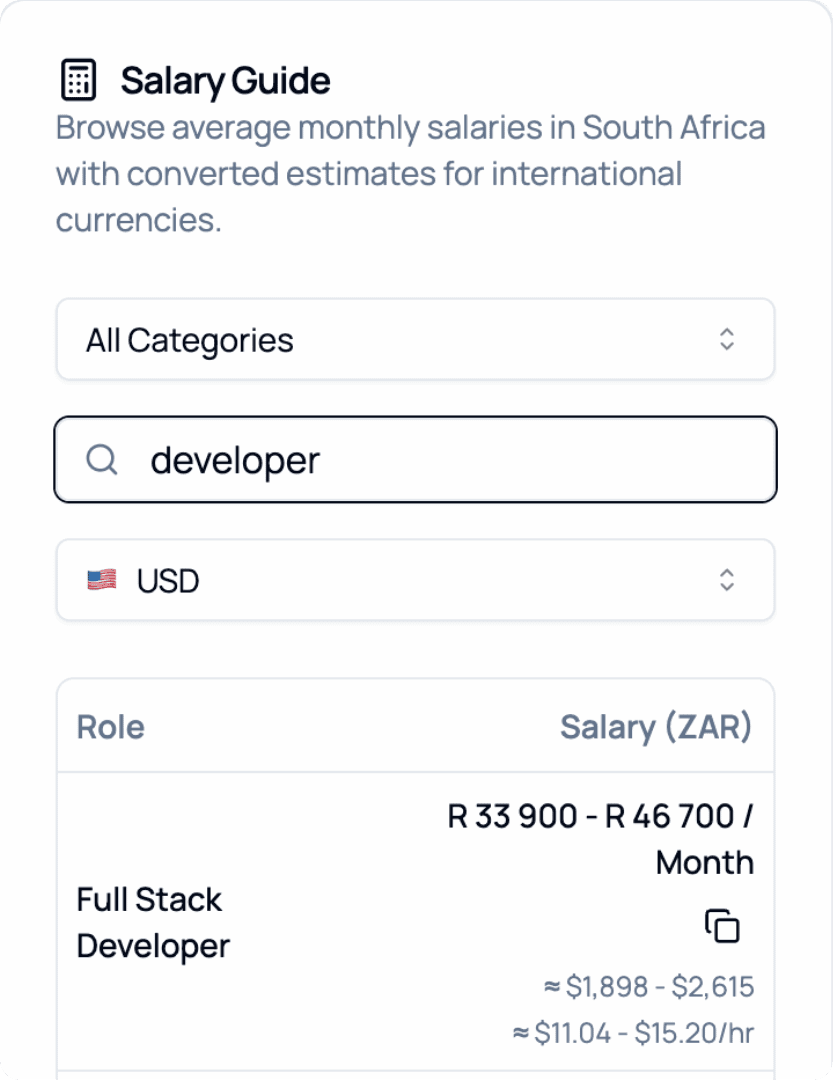
2026 Salary Guide: South Africa
Discover South African Salaries by Role. Compare costs and see how much you can save.