TL;DR
Learn what a healthcare virtual assistant can handle safely in US clinics, private practices, and specialty groups.
Use a practical HIPAA-first framework for role design, onboarding, and risk controls.
Track the right KPIs to prove ROI across scheduling, billing, and patient communication workflows.
Table of Contents
- Introduction
- What is a healthcare virtual assistant, and which tasks can US practices delegate safely?
- Is a healthcare virtual assistant HIPAA compliant, and how do you reduce compliance risk?
- How much does a healthcare virtual assistant cost compared with in-house staffing?
- How do you onboard a healthcare virtual assistant in the first 30 days?
- Which KPIs should practices track to prove healthcare virtual assistant ROI?
- Final Thoughts
Introduction
US healthcare operators are under pressure from every angle: tighter margins, staffing shortages, prior authorization friction, documentation overload, and rising patient expectations for fast communication. For most practices, the core problem is not clinical quality. It is operational bandwidth. Physicians, nurse practitioners, and office managers spend too much time on repetitive administrative work that can be systematized.
That is why many groups are adopting a healthcare virtual assistant model. A well-structured remote support role can improve scheduling, intake, referrals, eligibility checks, and billing follow-up while your in-practice team focuses on patient care. If you are evaluating options, start with HireSava's healthcare support overview, then use this guide to design your workflow and controls.
This playbook is built for US practices that want practical execution, not vague outsourcing advice. You will see what a medical virtual assistant can handle, how to structure HIPAA safeguards, what costs to expect, how to onboard in 30 days, and which KPIs prove business impact.
Along the way, we will reference reputable data and policy anchors, including the Centers for Medicare & Medicaid Services (CMS), the Office for Civil Rights HIPAA guidance, the ONC Interoperability and Information Blocking framework, AHRQ patient safety resources, and BLS healthcare support occupation outlook.
What is a healthcare virtual assistant, and which tasks can US practices delegate safely?
A healthcare virtual assistant is a trained remote operations specialist who handles non-clinical, process-driven practice tasks under documented SOPs, escalation rules, and compliance controls.
In plain terms, this role is your operational force multiplier. Instead of asking front-desk staff and clinicians to absorb everything, you assign structured tasks to a dedicated remote teammate who can execute consistently across the week.
Most successful deployments start with a strict boundary: no diagnosis, no treatment advice, no independent clinical decision-making. The assistant supports process flow, documentation readiness, communication cadence, and revenue cycle throughput.
Common safe delegation areas include:
- Patient scheduling and appointment confirmations
- Insurance eligibility verification and demographic checks
- Referral coordination and specialist follow-up tracking
- Prior authorization packet assembly and status monitoring
- EHR data entry for structured non-clinical fields
- Claim status follow-up and billing queue updates
- No-show recall and preventive care reminder outreach
- Inbox triage and callback list preparation
These functions map directly to known practice pain points. CMS and payer requirements continue to increase documentation and administrative volume, and many clinics cannot justify adding multiple local FTEs immediately. A HIPAA-compliant virtual assistant model creates capacity without forcing clinical staff into chronic overtime.
A role boundary that prevents confusion
Many practices fail because they hire a "general VA" and assign mixed responsibilities without process design. A healthcare model works when responsibilities are explicit.
A clear split looks like this:
- Clinical team owns diagnosis, treatment decisions, and direct medical judgment.
- Practice manager owns policy, escalation rules, and quality control.
- Healthcare virtual assistant owns repeatable workflow execution and escalation triggers.
This structure protects both patient safety and staff confidence. Your remote assistant is not a replacement for clinical licensing; they are the execution layer that keeps operational tasks moving.
High-impact workflows to assign first
If you want quick wins, start with tasks that are high-volume, rules-based, and measurable.
- Appointment reminders and confirmation calls
- Insurance eligibility checks completed 24-48 hours before visits
- Prior auth tracker maintenance and payer follow-up
- Outstanding claim status follow-up and denial reason tagging
- Recall list outreach for overdue follow-up visits
Those five lanes usually reduce call backlog, improve schedule fill rates, and free local staff to handle complex patient interactions.
Where this fits in the broader hiring strategy
A healthcare virtual assistant is often the fastest first move for practices that are not ready for another in-office coordinator. It also pairs well with broader staffing frameworks in related guides, such as how to hire a virtual assistant for small business, hiring remote talent without recruiting fees, and onshore vs offshore team design.
The goal is not simply "outsource admin." The goal is to design a resilient operating model where your clinical team spends more time on care and less time on manual process work.
Is a healthcare virtual assistant HIPAA compliant, and how do you reduce compliance risk?
A healthcare virtual assistant can operate in a HIPAA-aligned model when the practice enforces role-based access, signed agreements, secure tools, audit trails, and documented incident response procedures.
The right question is not "Is remote work compliant?" The right question is "Do we have a defensible compliance system?" HIPAA compliance depends on controls, not geography.
According to HHS Office for Civil Rights guidance, covered entities and business associates are responsible for safeguarding protected health information (PHI), including administrative, technical, and physical safeguards. In practical operations, this means your virtual support workflow must be intentionally engineered.
Core safeguards to put in place before go-live:
- Business Associate Agreement (BAA) where required by your legal/compliance counsel
- Minimum necessary access design by task, not by convenience
- Unique user credentials and strict no-sharing credential policy
- Multi-factor authentication for all systems touching PHI
- Device and connection security requirements (encrypted drives, secure network practices)
- Approved communication channels only (no personal messaging apps)
- Logging and periodic access review
- Immediate offboarding checklist for role changes or termination
Minimum necessary access in real practice terms
A common failure pattern is over-permissioning. Teams grant full EHR access to "make onboarding easier," which expands risk surface.
A better model is lane-based permissions:
- Scheduling lane: calendar and patient contact module only
- Eligibility lane: payer portal plus designated EHR registration fields
- Authorization lane: relevant order/referral data plus tracking sheet
- Billing support lane: claim status and non-clinical account notes
With lane-based access, an assistant can perform work quickly while you reduce unnecessary PHI exposure.
Documentation that regulators and auditors expect
Whether you are in a small specialty practice or a multi-site group, written documentation matters. At minimum, maintain:
- Role description with allowed/prohibited tasks
- Standard operating procedures by workflow
- Access matrix by system and permission level
- Training completion logs (privacy, security, workflow)
- Escalation matrix for clinical and compliance events
- Incident response protocol with notification timeline
These are not checkbox artifacts. They are operational guides that make daily decisions consistent and defensible.
Training model for a HIPAA-compliant virtual assistant
Training should happen in layers:
- Privacy and security baseline (HIPAA principles, PHI handling, breach awareness)
- Tool-specific workflow training (EHR, phone system, payer portals)
- Scripted communication standards (patient identity verification, handoff language)
- Exception handling and escalation drills
A strong medical office virtual assistant learns not only what to do, but what not to do, when to pause, and who to escalate to.
Risk reduction is a management system, not a one-time setup
Compliance is maintained through rhythm. Build monthly access audits, random QA checks, and recurring retraining. Align this with patient-safety quality thinking from AHRQ. The most reliable teams treat operational errors as system gaps to fix, not one-off mistakes to ignore.
When leaders frame compliance as an ongoing operating system, a remote model can be both efficient and controlled.
How much does a healthcare virtual assistant cost compared with in-house staffing?
For many US practices, a healthcare virtual assistant lowers total administrative cost per completed workflow by reducing payroll burden, overtime pressure, and recruitment friction while improving throughput on repetitive tasks.
Cost discussions often fail because teams compare hourly rates instead of total economics. A proper evaluation includes salary burden, turnover risk, onboarding time, supervision load, and output consistency.
Cost components practices should compare
For in-house administrative hires, total cost usually includes:
- Base pay
- Payroll taxes and statutory costs
- Benefits contribution
- Paid time off and coverage planning
- Workstation, space, and equipment
- Recruiting and backfill costs
- Ramp-up productivity lag
For a healthcare virtual assistant model, common cost components include:
- Monthly service or staffing fee
- Training and onboarding time from your team
- Secure tool licenses and account provisioning
- QA/management time for oversight
The right comparison metric is not "cheapest option." It is cost per completed, accurate, on-time workflow in priority lanes (scheduling, eligibility, prior auth tracking, claims follow-up, patient communication).
Sample ROI framework a practice manager can use
Start with one lane, such as eligibility verification.
- Measure current baseline: number of verifications completed per week, error rate, and visit-day eligibility surprises.
- Measure staff time consumed by this lane.
- Launch the virtual assistant with SOPs and checklists.
- Re-measure at week 4 and week 8.
If your verification completion rate rises and front-desk interruptions fall, you can quantify value through reduced rework, fewer delayed visits, and better patient experience.
Then expand to a second lane (prior authorizations or claim status follow-up) to compound gains.
Why throughput and reliability matter more than hourly price
A lower-cost resource that produces inconsistent output can increase hidden costs through denials, callbacks, and patient dissatisfaction. A higher-quality healthcare administrative assistant setup with strong QA may have better net economics because it prevents downstream failures.
This is similar to revenue cycle principles: faster, cleaner first-pass work improves cash flow. Practices often notice improvements in:
- Days in AR trend stability
- Fewer claims left untouched in aging buckets
- Better visibility into denial reason patterns
- Reduced end-of-day call backlog
Budgeting by phase instead of all at once
A practical way to manage risk is phased adoption:
- Phase 1 (Weeks 1-4): one workflow lane, one assistant, tight QA
- Phase 2 (Weeks 5-8): add second lane and KPI dashboard
- Phase 3 (Weeks 9-12): broaden scope after performance review
This avoids overcommitting budget before you validate operational fit.
If your team needs hiring process support, align with virtual assistant onboarding checklist best practices and role-scoping principles from industry-specific VA playbooks.
How do you onboard a healthcare virtual assistant in the first 30 days?
The first 30 days should focus on controlled scope, SOP-based training, supervised execution, and measurable quality gates before full ownership of any workflow lane.
A rushed onboarding is the fastest way to fail. In healthcare operations, unclear process design creates errors, anxiety, and compliance risk. A strong 30-day plan removes ambiguity and builds predictable execution.
Week 1: Setup and policy foundation
Primary goal: secure access and role clarity.
- Finalize role charter with allowed/prohibited tasks
- Complete HIPAA/privacy training and acknowledgement logs
- Provision required systems with least-privilege access
- Provide workflow map for each assigned lane
- Share escalation matrix and response-time SLAs
By end of Week 1, the assistant should understand the exact boundaries and where to escalate any exception.
Week 2: Shadowing and script calibration
Primary goal: convert SOPs into live practice.
- Shadow real workflows with your in-house coordinator or manager
- Practice patient communication scripts for common scenarios
- Run simulated cases for identity verification, rescheduling, and referral follow-up
- Review documentation standards for EHR notes and status tags
This week is where language quality matters. For patient trust, every call, message, and note should be clear, professional, and concise.
Week 3: Supervised execution with QA sampling
Primary goal: move from observation to production under supervision.
- Assign a limited daily queue (for example, 15 eligibility checks and 20 reminders)
- Track completion time, accuracy, and escalation appropriateness
- Perform manager QA on a fixed sample each day
- Correct script, process, and system-use gaps quickly
At this stage, the assistant should demonstrate reliable judgment on when to escalate to clinical or billing leads.
Week 4: Controlled ownership and KPI baseline
Primary goal: validate readiness for partial lane ownership.
- Increase queue volume to target level
- Shift from daily to scheduled QA cadence
- Publish first weekly dashboard for agreed KPIs
- Hold a formal performance review and scope decision
By day 30, you should have objective data on speed, quality, and handoff reliability.
Tools and SOP assets you should prepare in advance
Practices get better outcomes when they pre-build an onboarding pack:
- Workflow SOPs with screenshots and decision trees
- Script library for reminders, follow-ups, and intake clarifications
- Escalation playbook for urgent or clinical-adjacent concerns
- QA checklist for each process lane
- KPI tracker template for weekly review
This documentation also improves resilience when team members take leave or when you scale beyond one assistant.
Communication cadence that prevents drift
Use a predictable operating rhythm:
- Daily 10-15 minute huddle for queue priorities
- Weekly 30-minute quality and KPI review
- Monthly process improvement review
This is where most teams either gain leverage or lose it. Consistent communication keeps the healthcare virtual assistant aligned with changing priorities and payer requirements.
Which KPIs should practices track to prove healthcare virtual assistant ROI?
Track a focused KPI set across access, throughput, quality, and financial outcomes so you can tie virtual assistant activity to measurable operational and patient-experience gains.
Too many teams track vanity metrics like "tasks completed" without linking them to outcomes that matter. A better approach uses a small, high-signal dashboard.
Access and patient communication KPIs
These show whether patients can reach your practice and move through scheduling faster.
- Call answer rate during target hours
- Appointment confirmation rate
- No-show rate trend
- Reschedule turnaround time
- Patient message first-response time
If these improve, your front office is becoming more reliable and patients feel supported.
Throughput and workflow KPIs
These measure execution consistency in delegated lanes.
- Eligibility checks completed before visit date
- Prior authorization status update cadence
- Referral completion cycle time
- Claim follow-up touches per aging bucket
- Daily queue completion rate by lane
Throughput KPIs are your early warning system. If cycle time rises, backlog and patient dissatisfaction usually follow.
Quality and compliance KPIs
These protect safety and brand trust.
- QA pass rate on sampled tasks
- Documentation accuracy rate in EHR non-clinical fields
- Escalation appropriateness rate
- Access audit exceptions
- Policy deviation incidents
A strong HIPAA-compliant virtual assistant program improves both output and control. If productivity rises while quality declines, your operating model is unstable and needs correction.
Financial and revenue cycle KPIs
These connect admin execution to business outcomes.
- Denial rate trend for preventable admin issues
- Days in AR movement by payer category
- Clean claim ratio (if within role scope)
- Cost per completed workflow lane
- Overtime hours avoided in admin team
As a rule, track changes monthly and compare against baseline, not against assumptions.
How to operationalize the dashboard
Build one owner and one review rhythm.
- Assign a single KPI owner (practice manager or operations lead).
- Review weekly for tactical fixes and monthly for strategic scope decisions.
- Tie KPI movement to process adjustments, not just staffing opinions.
Over time, you should see compounding gains: fewer missed touches, cleaner queues, faster patient communication, and less fire-fighting by high-cost staff.
For benchmarking staffing models, labor context from BLS healthcare occupation data and care-delivery policy trends from CMS can help frame long-term planning.
Final Thoughts
A healthcare virtual assistant is most valuable when treated as a core operations role, not ad hoc extra help. The model works when practices define task boundaries, enforce compliance controls, train with SOPs, and measure outcomes that matter to patients and cash flow.
If you are starting from scratch, begin with one workflow lane, one clear owner, and one KPI dashboard. Prove reliability first. Then expand. This phased approach reduces risk and gives your clinicians room to focus on care while your administrative engine becomes faster and more predictable.
In 2026, the practices that scale sustainably are not the ones that ask already-busy teams to "work harder." They are the ones that redesign execution. A disciplined healthcare virtual assistant program gives you that redesign in a practical, measurable way.
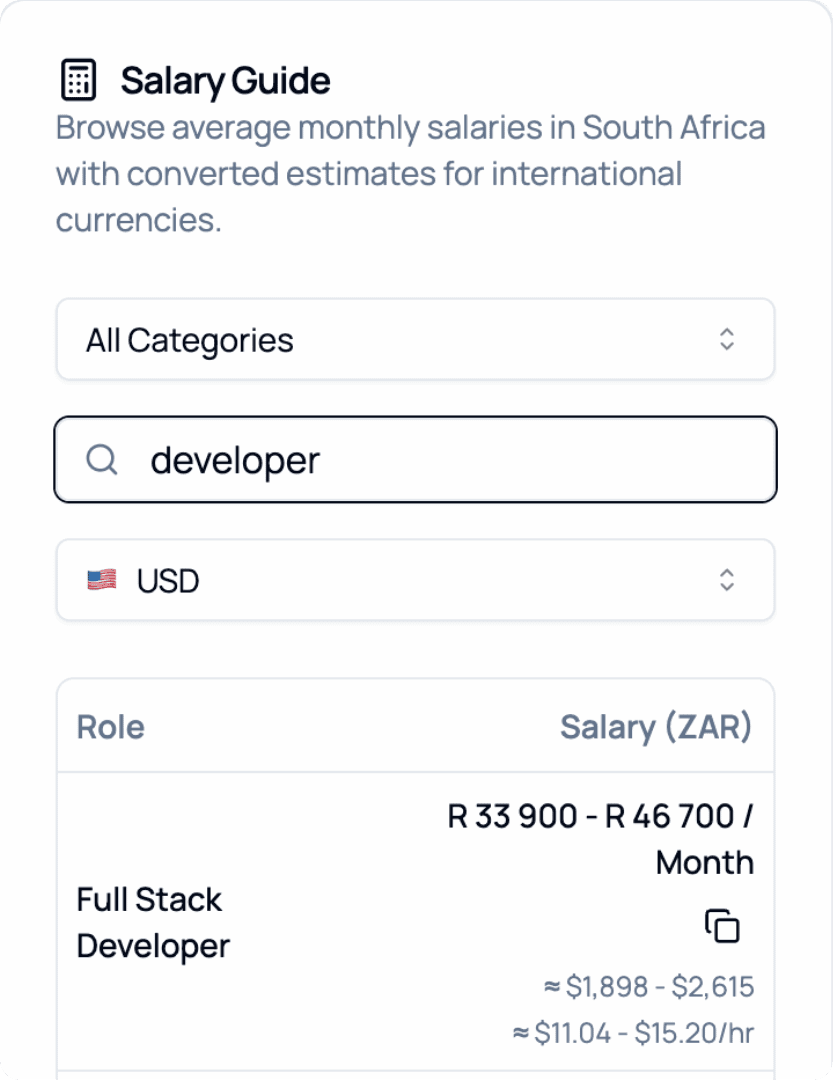
2026 Salary Guide: South Africa
Discover South African Salaries by Role. Compare costs and see how much you can save.