TL;DR
Learn a practical step by step process to hire a virtual assistant for small business without wasting time.
Use role scorecards, interview filters, and onboarding systems that improve output in the first thirty days.
Avoid common small business hiring mistakes that lead to rework, churn, and missed growth opportunities.
Table of Contents
- Why small businesses struggle with VA hiring
- Step one: define what you need this role to solve
- Step two: choose the right role type
- Step three: build a role scorecard
- Step four: write a high quality job brief
- Step five: screen for role fit, not just fluency
- Step six: run structured interviews
- Step seven: validate with a paid test sprint
- Step eight: onboard with SOP first
- Step nine: set a clean communication cadence
- Step ten: manage by outcomes, not activity
- Small business budget planning for VA hiring
- Self serve versus done for you for small businesses
- Common mistakes when hiring a virtual assistant for small business
- First thirty days playbook
- Interview questions that create better signal
- What to look for in final candidate selection
- How HireSava supports small business VA hiring
- Final answer: how to hire a virtual assistant for small business in 2026
- Deep dive: small business role design examples
- Interview rubric you can score in five minutes
- Onboarding kit that reduces first month failure risk
- Weekly review template for small business teams
- FAQ: how to hire a virtual assistant for small business
- Final action plan for this week
If you are trying to figure out how to hire a virtual assistant for small business, you are usually balancing two constraints at once. You need better execution now, and you cannot afford to waste weeks managing the wrong hire.
That is why most small businesses fail at VA hiring. They hire for generic support instead of business outcomes. Then they discover they still own every bottleneck.
This guide gives you a practical system to hire the right virtual assistant in 2026. It is built for teams that care about speed, reliability, and measurable business impact.
Why small businesses struggle with VA hiring
Small businesses often run lean, which means every hire has to perform quickly. The most common failure points are:
- Role scope is too broad
- Success metrics are unclear
- Hiring is based on vibes, not role fit
- Onboarding is improvised
- Feedback loops are inconsistent
The fix is not more interviews. The fix is a stronger hiring process.
Step one: define what you need this role to solve
Before posting anything, write a one page problem statement.
Include:
- Current bottlenecks
- Tasks causing delays
- Weekly output you expect
- What success looks like in thirty, sixty, and ninety days
Example outcomes:
- Inbox cleared to SLA every weekday
- CRM hygiene above ninety eight percent
- Social media publishing cadence met weekly
- Listing updates completed within twenty four hours
Hiring decisions are easier when outcomes are explicit.
Step two: choose the right role type
Many founders post for a generic VA and hope for a full operations solution. That usually creates mismatch.
Choose one of these role types first:
- Executive or admin support
- Operations assistant
- Marketing support assistant
- Customer support assistant
- Industry specific support assistant
If you need multiple outcomes, start with the one role that unlocks the biggest weekly time savings.
Step three: build a role scorecard
A role scorecard is your hiring compass.
Your scorecard should include:
- Top five responsibilities
- Required tools
- Communication expectations
- Quality standards
- Weekly KPI targets
Without this, interviews become personality checks. With this, interviews become fit checks.
Step four: write a high quality job brief
A strong brief filters better candidates before the interview.
Your brief should answer:
- What this role owns
- How success is measured
- What tools are used
- What timezone overlap is needed
- What communication quality is expected
Avoid vague lines like “must be proactive” without examples. Instead, define proactive behavior for the role.
Step five: screen for role fit, not just fluency
Good communication matters, but communication alone is not enough.
Use a quick screening system:
- Written response task for clarity and judgment
- Tool familiarity check
- Process thinking check
- Basic reliability signals
You can ask candidates to complete one short simulation based on your real workflow. This gives far better signal than generic interview questions.
Step six: run structured interviews
Use the same interview structure for all finalists.
Suggested structure:
- Role context and expected outcomes
- Candidate walk through of similar past work
- Process challenge question
- Communication and escalation scenario
- Availability and overlap check
Use a scoring rubric during interviews so decisions are consistent and defensible.
Step seven: validate with a paid test sprint
A short paid test sprint is usually worth it.
In a one week sprint, evaluate:
- Task completion speed
- Instruction quality response
- Communication consistency
- Error rate
- Improvement after feedback
A paid sprint helps both sides confirm fit before full commitment.
Step eight: onboard with SOP first
Most small businesses skip this and pay for it later.
Your onboarding package should include:
- Role scorecard
- Core SOPs
- Tool access checklist
- Priority queue for first two weeks
- Daily and weekly reporting format
If documentation is weak, even a great candidate will underperform.
Step nine: set a clean communication cadence
Use a predictable cadence from day one.
Example cadence:
- Daily async update
- Weekly planning and review
- Escalation rules for blockers
Keep updates simple and outcome focused. Long status messages without decisions are noise.
Step ten: manage by outcomes, not activity
Founders often track activity and ignore outcomes. That increases micromanagement and slows scale.
Track:
- SLA performance
- Accuracy
- Throughput
- Time saved for owner or team
- Revenue adjacent impact where relevant
When outcome tracking is clear, autonomy improves and management overhead drops.
Small business budget planning for VA hiring
When deciding budget, think in three layers.
Direct role cost
This is the visible rate or monthly cost.
Management overhead
This is internal time spent supervising, reviewing, and fixing.
Opportunity cost
This is what slips when role output is unstable.
Choose the model with the best total economics, not just the lowest direct rate.
Self serve versus done for you for small businesses
Self serve hiring
Best for teams that:
- Have internal hiring discipline
- Can run interviews and onboarding
- Can maintain QA routines
Done for you recruiting and vetting
Best for teams that:
- Need faster placement
- Have limited management bandwidth
- Need stronger quality control in the first month
Neither model is universally better. The better model is the one your current team can operate consistently.
Common mistakes when hiring a virtual assistant for small business
Mistake one: hiring for too many responsibilities
If one role owns unrelated functions, output quality drops.
Mistake two: skipping trial structure
No test sprint means weaker signal and higher first month risk.
Mistake three: no KPI baseline
If success is undefined, performance conversations get messy.
Mistake four: inconsistent feedback
Delayed or vague feedback creates repeated mistakes.
Mistake five: changing priorities every day
Frequent priority shifts create confusion and lower trust.
First thirty days playbook
Use this simple thirty day plan.
Week one
- Finalize access
- Assign core workflows
- Run supervised execution
- Start daily updates
Week two
- Increase owned tasks
- Tighten SOP quality
- Review early KPIs
- Resolve recurring blockers
Week three
- Expand to adjacent tasks
- Improve speed and consistency
- Reduce rework loops
Week four
- Evaluate fit against scorecard
- Confirm scale or adjust decision
- Plan next month priorities
This playbook helps you move from onboarding to measurable output quickly.
Interview questions that create better signal
Use questions that test real execution.
- Walk me through how you would handle this exact weekly workflow.
- If task instructions are unclear, what would you do first?
- How do you prioritize when three urgent requests arrive at once?
- Show how you would report progress at end of day.
- Give an example where you improved a process, not just completed tasks.
These questions reveal judgment, communication, and ownership.
What to look for in final candidate selection
Strong candidates for small business support usually show:
- Clear written communication
- Reliable execution habits
- Process orientation
- Comfortable escalation behavior
- Fast learning with feedback
Do not over index on polished interview style. Prioritize consistency and operational reliability.
How HireSava supports small business VA hiring
HireSava is designed to help small teams hire well without adding chaos.
You can choose:
- A self serve path if you want direct control
- A structured recruiting and vetting path if you want support with speed and quality
This flexibility helps small businesses start where they are, then evolve their model as operations mature.
Final answer: how to hire a virtual assistant for small business in 2026
If you want the short version:
- Define outcomes before posting
- Build a role scorecard
- Screen with structured tests
- Onboard with SOP first
- Manage by outcome KPIs
That system consistently beats ad hoc hiring.
When you treat hiring as an operating process, your VA becomes a growth multiplier instead of another management burden.
Deep dive: small business role design examples
Example one: founder with overloaded admin workload
If the founder is spending ten to fifteen hours each week on inbox, scheduling, and follow up admin, the first VA role should be tightly scoped around those outcomes.
Role scorecard sample:
- Inbox triage completed twice daily
- Calendar cleaned and confirmed daily
- Meeting prep packet delivered twenty four hours before calls
- Follow up tasks logged and assigned same day
KPI sample:
- Founder admin time reduced by at least eight hours per week by day thirty
- Missed follow ups reduced by at least seventy percent
- Meeting prep readiness above ninety percent
Example two: real estate team with listing bottlenecks
If listings are delayed and data quality is inconsistent, the first role should focus on listing logistics and CRM hygiene.
Role scorecard sample:
- Listing setup completed within target turnaround
- Data fields completed to agreed quality threshold
- Photo and copy handoff checklists completed
- Weekly pipeline cleanup completed
KPI sample:
- Listing go live time reduced week over week
- CRM completeness above ninety eight percent
- Rework tickets down month over month
Example three: agency owner with lead handling delays
If inquiry response time is slow, the role should focus on lead response operations and pipeline discipline.
Role scorecard sample:
- Lead response SLA compliance
- Lead qualification form completion
- CRM stage updates same day
- Weekly follow up sequence execution
KPI sample:
- Response time median below target
- Qualified meeting conversion improved
- Pipeline hygiene maintained above threshold
Interview rubric you can score in five minutes
Use a simple one to five scale across these dimensions:
- Written clarity
- Process thinking
- Tool familiarity
- Ownership behavior
- Reliability signals
Add notes under each score. Finalists should show balanced strength, not one high spike and multiple weak areas.
Example interpretation:
- Strong written clarity plus weak process thinking usually means good communication but weak execution structure.
- Strong process thinking plus weak reliability signals can create risk in unattended workflows.
- Strong ownership plus strong reliability usually predicts stable delivery in small teams.
Onboarding kit that reduces first month failure risk
Your onboarding kit should be built before day one.
Required items:
- Role scorecard
- SOP starter pack
- Priority queue for first fourteen days
- Escalation map
- Daily reporting template
- Weekly review template
Optional but useful:
- Example completed tasks
- Tool walkthrough videos
- Common error and correction guide
A prepared onboarding kit can save weeks of rework.
Weekly review template for small business teams
Use this format in a thirty minute weekly review.
Wins
- What shipped and what improved
Misses
- What slipped and why
Quality
- Error patterns and root causes
Priorities
- Top three outcomes for next week
Support needed
- Decisions, access, or process updates needed from owner
This review loop keeps momentum and prevents silent drift.
FAQ: how to hire a virtual assistant for small business
Should I hire full time first
Not always. Start from workload and outcome needs. If recurring workload is lower, begin with a narrower scope and expand after consistency is proven.
How long should I expect onboarding to take
For most small businesses, basic stability appears in two to four weeks when SOPs and review cadence are clear.
What if communication is good but output is weak
This is often a scope and process design issue. Tighten role boundaries, improve SOP detail, and reduce context switching before replacing the person.
How do I know if I should replace versus coach
If reliability and response discipline remain weak after clear feedback and documented expectations, replacement may be right. If reliability is strong and quality is improving, coaching is usually worth it.
What is the right first KPI
Pick one KPI tied to your biggest bottleneck, such as turnaround time or owner hours saved. Keep KPI count low in month one.
Should I prioritize industry experience
Prioritize role fit and process capability first, then industry familiarity. For many support roles, structured onboarding can close industry gaps faster than expected.
How do I avoid becoming dependent on one assistant
Document workflows, build cross train notes, and keep a backup plan for critical tasks.
How can I improve retention after hiring
Set clear expectations, give consistent feedback, and tie work to business outcomes so the role feels meaningful and stable.
What if my priorities change often
Use weekly planning and keep daily priorities stable unless urgent changes are required. Constant shifts hurt output quality.
How can I scale beyond one VA
Scale only after one role is stable. Then split work by function and preserve clear ownership boundaries.
Final action plan for this week
If you want a simple execution plan, do this in order:
- Write your role scorecard
- Build interview rubric
- Create onboarding kit
- Run structured interviews
- Start a paid test sprint
- Launch weekly review cadence
This approach gives small businesses the fastest path to useful output with lower hiring risk.
Explore related hiring options
Useful next pages based on this article's topic:
- Virtual Assistant role overview — hiring and onboarding guidance
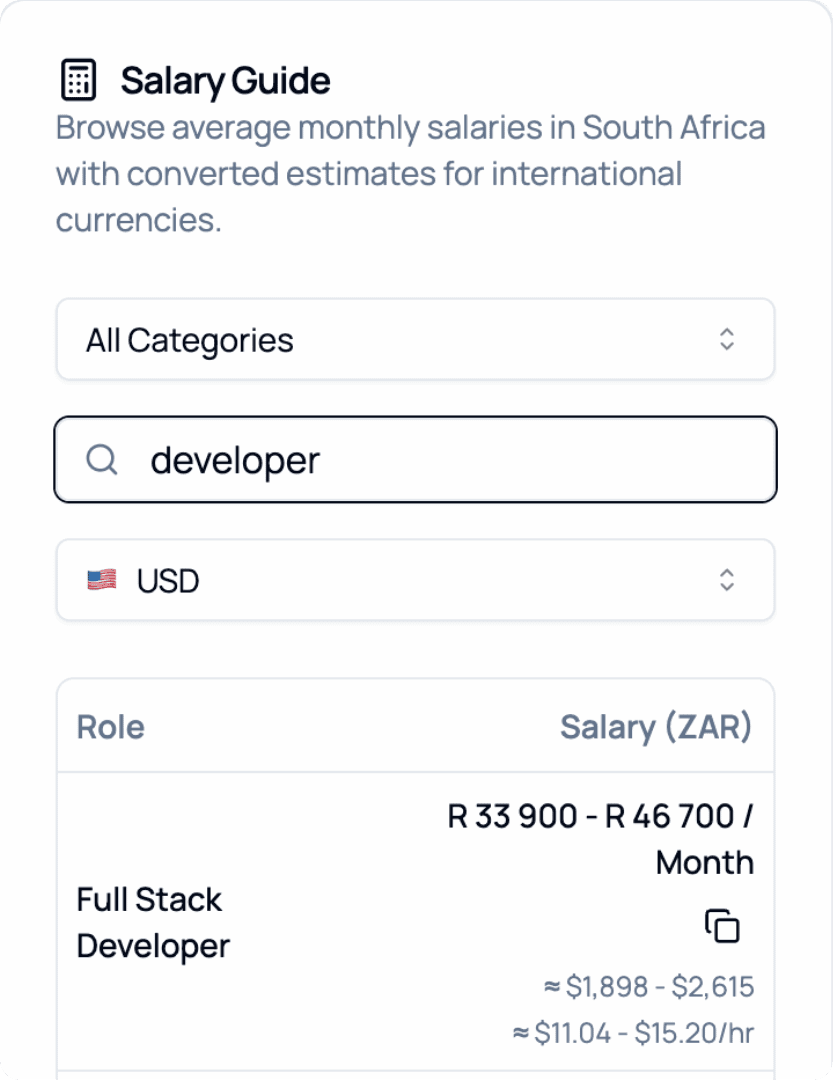
2026 Salary Guide: South Africa
Discover South African Salaries by Role. Compare costs and see how much you can save.