TL;DR
Learn how to delegate project coordination workflows in construction without losing schedule control, communication quality, or accountability.
Use a practical field-to-office operating model for updates, change-order routing, subcontractor coordination, and invoice readiness handoffs.
Apply KPI and ROI frameworks that help US contractors scale delivery operations with fewer admin bottlenecks and better execution consistency.
Table of Contents
- Introduction
- What does a construction project coordination virtual assistant do?
- Which project coordination tasks should be delegated first?
- How much does project coordination VA support cost and what ROI should you expect?
- How do you keep project communication and change orders from slipping?
- How do you scale project coordination support without creating bottlenecks?
- Final Thoughts
Introduction
If you are designing support capacity for this vertical, start with the construction industry page for broader role and staffing context.
Most construction projects do not go off track because one person failed. They go off track because coordination fails between good people who are using different systems, different assumptions, and different communication rhythms. Field updates arrive late. Schedule changes are not propagated. Change-order details sit in message threads. Billing packets are incomplete when work is already done.
That is where a construction project coordination virtual assistant model becomes high leverage. This role is not a project manager replacement and not a superintendent substitute. It is a process and communication stabilizer that keeps handoffs clean from kickoff to closeout.
This guide shows US contractors how to delegate project coordination workflows in a way that improves reliability without increasing management complexity. You will get role boundaries, delegation sequencing, communication controls, change-order discipline, cost/ROI modeling, and a scale framework that avoids new bottlenecks.
For supporting context, pair this with Construction Virtual Assistant Guide for US Contractors (2026), Construction Estimating Virtual Assistant Playbook for US Contractors (2026), How to Hire a Virtual Assistant for Small Business in 2026, Virtual Assistant Onboarding Checklist for 2026, Virtual Assistant Cost Calculator Guide for SMB Teams, and How to Hire Remote Talent Without Recruiting Fees.
For external references, anchor to practical guidance from the U.S. Small Business Administration, OSHA construction resources, Associated General Contractors, Project Management Institute, and IRS business recordkeeping guidance.
What does a construction project coordination virtual assistant do?
Snippet answer: A construction project coordination VA manages repeatable coordination workflows—schedule updates, communication cadences, document routing, change-order admin support, and handoff tracking—while project leadership keeps final technical and contractual decisions.
Project coordination work is where execution quality either compounds or breaks. When ownership is unclear, everyone is working, but no one can prove what is complete.
A construction project coordination VA typically owns process lanes like:
- Kickoff packet readiness and checklist tracking.
- Master schedule board updates after field changes.
- Client and internal status communication cadence.
- Change-order document routing and timestamp discipline.
- Subcontractor documentation and deadline reminders.
- Meeting recap synthesis with action owners.
- Invoice-readiness handoff packet assembly support.
Role boundaries that prevent confusion
This role should never be asked to replace licensed judgment or contract authority. Keep boundaries explicit:
- No independent scope or technical means-and-methods decisions.
- No contractual commitments to clients or subs.
- No unsupervised approval of change-order pricing.
- No field safety direction.
The role is accountable for process reliability and communication clarity.
Where it creates immediate value
Contractors usually see immediate gains in:
- Schedule reliability: fewer “I thought someone updated that” failures.
- Handoff quality: cleaner transitions between field, PM, and office.
- Cash cycle readiness: faster prep for billing because documentation is cleaner.
In short, this role reduces operational drag where it hurts most.
Which project coordination tasks should be delegated first?
Snippet answer: Delegate repetitive, high-friction workflows first: schedule board maintenance, action-item tracking, change-order admin routing, subcontractor follow-up reminders, and status update cadence execution.
The first wave should remove predictable admin friction from PM and owner time.
Priority delegation stack (first 30-45 days)
Lane 1: Schedule and milestone board management
- Maintain one source of truth schedule board.
- Log change events and owner assignments.
- Trigger reminders based on SLA windows.
Lane 2: Communication cadence control
- Send status update templates at fixed intervals.
- Collect missing updates from responsible parties.
- Escalate when updates are incomplete past threshold.
Lane 3: Change-order admin flow
- Route intake packets to correct approvers.
- Track pending vs approved status.
- Log timestamps and document versions.
Lane 4: Subcontractor and vendor admin follow-up
- Track COI/W-9/document due dates.
- Send reminders and capture confirmations.
- Flag expirations and missing docs.
Lane 5: Invoice-readiness handoff support
- Assemble completion evidence packet.
- Confirm supporting docs before billing handoff.
- Track handoff completion and exceptions.
Delegation filter to keep risk low
Before assigning any task, ask:
- Is this repeatable and checklist-driven?
- Is delay expensive?
- Can exceptions be escalated clearly?
- Can quality be measured in one or two KPIs?
If yes, delegate first.
What to keep with PM/owner in phase 1
- Scope-change negotiation decisions.
- Contract language interpretation.
- Final client commitment decisions.
- Dispute resolution authority.
Start with workflow control, then expand only with KPI evidence.
How much does project coordination VA support cost and what ROI should you expect?
Snippet answer: ROI comes from reduced coordination failures, faster decision cycles, and improved billing readiness, not from labor cost alone.
A project coordination role should be evaluated as a reliability investment. If it decreases dropped handoffs and shortens delay chains, margin protection usually follows.
Cost components to model
Direct costs
- Monthly support fee/compensation.
- Tool and communication licenses.
- Onboarding/training time.
- Weekly QA and manager review time.
Indirect costs
- Rework due to missed updates.
- Delay costs from unresolved action items.
- Owner/PM context switching costs.
- Billing delays from incomplete closeout documentation.
Practical ROI framework
Use:
ROI = recovered leadership/PM hours + delay-chain reduction value + billing-readiness gains - total support cost
Illustrative scenario:
- PM spends 32 hrs/month on repetitive coordination admin.
- Safe delegation = 50% (16 hrs).
- PM blended value = $160/hr.
- Recovered value = $2,560/month.
Add commercial effects:
- fewer schedule slips from untracked dependencies,
- faster issue visibility,
- cleaner invoice packet handoff.
Even conservative assumptions can justify the role when project volume is growing.
KPI baseline for first 90 days
Track weekly and trend monthly:
- Action-item closure SLA adherence.
- Schedule change propagation lag.
- Change-order admin cycle time.
- Missing-document incident rate.
- Status update completion rate.
- Invoice-ready packet turnaround time.
These metrics tie directly to reliability and financial outcomes.
How do you keep project communication and change orders from slipping?
Snippet answer: Keep communication and change orders from slipping by enforcing one status system, strict update cadence, revision logs, approval path clarity, and escalation triggers tied to deadline risk.
Most “communication problems” are actually process design problems. If there is no single status view and no escalation protocol, slip is inevitable.
Communication control system
Use one protocol across all projects:
- One source of truth for status
- One source of truth for documents
- Standard update windows (daily/weekly)
- Defined urgency tags (urgent/blocked/info)
- Escalation SLA by urgency tier
This prevents hidden work and delayed visibility.
Change-order workflow control
A robust change-order flow should include:
- intake trigger and owner assignment,
- required supporting documentation checklist,
- version-controlled change-order log,
- approval-state tracking,
- timestamped communication records,
- handoff confirmation to billing and PM.
Without these controls, change-order leakage becomes a recurring margin problem.
Escalation matrix (simple and effective)
Define clear thresholds:
- Level 1: informational delay (within buffer)
- Level 2: at-risk delay (buffer breached)
- Level 3: critical deadline risk (same-day escalation)
Each level should map to exactly who gets notified and within what time window.
Weekly quality review checklist
Run a 30-minute review each week:
- open blockers by age,
- recurring miss patterns,
- change-order bottlenecks,
- status update compliance,
- SOP updates needed.
Do not skip this review. It is where “small misses” are prevented from becoming systemic failures.
How do you scale project coordination support without creating bottlenecks?
Snippet answer: Scale by splitting ownership lanes, standardizing handoffs, and measuring queue health so growth does not rely on one coordinator carrying all context.
The first coordinator role should prove the model. Scaling requires architecture.
Scale phases
Phase 1: single-coordinator stabilization (0-60 days)
- One VA owns core coordination workflows.
- SOP baseline and KPI baseline established.
- Escalation matrix in use.
Phase 2: lane specialization (60-120 days)
- Split schedule/communication lane from change-order/billing-handoff lane.
- Add backup coverage for critical workflows.
- Refine exception taxonomy.
Phase 3: system-level governance (120+ days)
- Add coordinator lead or operations manager layer.
- Monitor queue-level metrics by lane.
- Formalize monthly process redesign decisions.
Signals you are ready to scale
- Repeated SLA misses despite overtime effort.
- Rising blocker age across projects.
- PM/owner pulled into avoidable coordination tasks weekly.
- Increased billing lag due to packet incompleteness.
These signals indicate process capacity limits, not effort deficits.
30-60-90 rollout for coordination support
Days 1-30
- finalize role boundaries,
- publish three core SOPs (schedule updates, status cadence, change-order routing),
- define one board + one file system policy,
- run first KPI baseline.
Days 31-60
- implement escalation SLA by urgency,
- add document completeness controls,
- start exception tags,
- run weekly trend review.
Days 61-90
- identify bottleneck lane,
- add backup ownership,
- optimize communication cadence by project type,
- decide headcount vs process redesign next step.
Internal links for implementation path
- Construction Virtual Assistant Guide for US Contractors (2026)
- Construction Estimating Virtual Assistant Playbook for US Contractors (2026)
- Virtual Assistant Cost Calculator Guide for SMB Teams
- Virtual Assistant Onboarding Checklist for 2026
- How to Hire Remote Talent Without Recruiting Fees
- What Is an Onshore and Offshore Team?
Common scaling mistakes to avoid
- Expanding headcount without clarifying lane ownership.
- Tracking output volume but ignoring exception age.
- Letting change-order records live in ad hoc channels.
- Accepting “verbal complete” as handoff proof.
Fix these early and scale becomes far easier.
Practical monthly scorecard template
Use weighted dimensions:
- Timeliness (25%)
- action-item SLA compliance
- schedule update lag trend
- Quality (25%)
- document completeness rate
- rework incidents
- Control (25%)
- escalation adherence
- change-order log integrity
- Commercial impact (25%)
- invoice-ready turnaround
- avoidable delay reduction trend
The scorecard should guide decisions, not just reporting.
Coordination SOP blueprint you can reuse
For each workflow, define:
- Trigger event
- Owner and backup owner
- Required inputs
- Required output
- SLA target
- Escalation condition
- QA checkpoint
- Audit artifact location
This template reduces onboarding time and prevents “tribal process” drift.
Field-to-office handoff protocol
A reliable protocol includes:
- daily field summary capture,
- next-action owner assignment,
- change-impact notes,
- supporting evidence links,
- same-day acknowledgement in office board.
When this protocol is active, schedule and billing stability improve quickly.
Team meeting cadence that supports scale
- Daily (10 min): blockers, due-today risks, ownership clarity.
- Weekly (30 min): KPI trend, repeated exceptions, SOP patch list.
- Monthly (45 min): lane capacity planning and redesign decisions.
Skipping cadence is one of the fastest ways to lose control as project count increases.
Risk controls for contractual and financial protection
- no change-order status marked complete without required documentation.
- no billing handoff marked ready without closeout packet check.
- no milestone update accepted without owner attribution.
- no unresolved blocker older than escalation threshold.
These controls protect margin and reduce client-friction moments.
Hiring scorecard for project coordination VA role
Evaluate candidates on:
- process discipline
- communication clarity
- escalation judgment
- documentation consistency
- tool adoption speed
The best coordinator profiles are operationally predictable, not just “busy.”
Communication architecture by project phase
Most coordination breakdowns happen when teams use one communication style for every project phase. Instead, define explicit communication architecture for each phase.
Pre-construction phase
- Focus: intake completeness, scope alignment, bid-to-kickoff handoff.
- Cadence: structured recap after every client milestone call.
- Critical outputs: kickoff packet, owner map, dependency list.
Active execution phase
- Focus: schedule movement, blockers, change-order status.
- Cadence: daily field summary + weekly client-facing status digest.
- Critical outputs: active risk list, updated timeline, handoff-ready task list.
Closeout phase
- Focus: completion evidence, billing readiness, unresolved item closure.
- Cadence: tighter follow-up intervals until all docs are complete.
- Critical outputs: invoice-ready packet, final action closure report, archive handoff.
This phase-aware approach reduces confusion and avoids over-communication in low-risk moments while tightening control where risk is highest.
Change-order quality framework (practical version)
If you want fewer disputed or delayed change orders, run a simple quality framework:
- Intake completeness: trigger, description, responsible owner, timing context.
- Commercial clarity: pricing impact, schedule impact, approval requirement.
- Documentation evidence: supporting notes/photos/files attached.
- Approval traceability: who approved, when, and in what channel.
- Downstream propagation: PM schedule, field scope, and billing status updated.
Most disputes come from missing one of these five layers.
Queue health dashboard design
A coordinator without queue visibility will always be reactive. Build a small dashboard with:
- total open items by lane,
- items due in next 24/48/72 hours,
- blocker age distribution,
- overdue count by owner,
- unresolved exception count by category.
Reviewing this daily lets teams catch risk before it becomes client-facing friction.
Owner involvement model that scales
Owner time is limited. The support system should protect owner attention, not consume it.
Use this model:
- Owner reviews: high-impact exceptions, weekly trend summary, monthly redesign decisions.
- PM/lead reviews: daily blockers, lane quality, SLA adherence.
- Coordinator execution: status integrity, follow-up cadence, handoff completeness.
When owner involvement is structured, leadership quality improves and response fatigue drops.
Subcontractor coordination control points
Subcontractor misalignment often causes hidden schedule loss. Add these controls:
- explicit start/finish confirmation checkpoints,
- prerequisite checklist before mobilization,
- update cadence standard for schedule-impacting tasks,
- documented variance report if timeline deviates.
This is low-effort and high-impact for schedule reliability.
Client update quality checklist
Every external update should answer:
- What changed?
- What is next?
- What needs client action?
- What timeline impact exists?
- Who owns follow-up and by when?
This keeps client communication concise, useful, and defensible.
Exception taxonomy that improves process design
Tag recurring issues using a stable taxonomy:
- missing input,
- delayed approval,
- scope ambiguity,
- documentation gap,
- schedule dependency conflict,
- communication no-response.
Over time, this taxonomy shows where to patch SOPs instead of repeatedly firefighting symptoms.
14-day stabilization checklist for new coordination lane
- finalize role boundary document,
- publish three lane SOPs,
- launch single status board,
- enforce communication tag protocol,
- run day-7 KPI review,
- patch top three process gaps by day 14,
- confirm backup owner coverage for critical items.
If this checklist is completed with discipline, the lane becomes stable quickly.
Leadership review template (monthly)
Use a one-page monthly review:
- KPI trend summary,
- top recurring exceptions,
- lanes at risk,
- process changes implemented,
- next-month priority fixes,
- decision needed (add capacity vs redesign process).
A simple review template creates compounding operational clarity.
Governance principle to keep long-term quality
As volume grows, your biggest risk is silent process drift. Prevent it by assigning explicit governance ownership for SOP updates and scorecard integrity.
If nobody owns governance, the system reverts to ad hoc communication within one quarter.
Final Thoughts
Project coordination is where execution quality is either protected or silently degraded. A construction project coordination virtual assistant gives contractors a repeatable way to maintain schedule, communication, and handoff control as project complexity grows.
Use the construction industry page to align this role with your broader operating model, then scale with strict SOPs, lane ownership, and KPI cadence instead of reactive firefighting.
When coordination is reliable, everything downstream improves: fewer missed updates, cleaner change-order flow, faster billing readiness, and stronger delivery confidence.
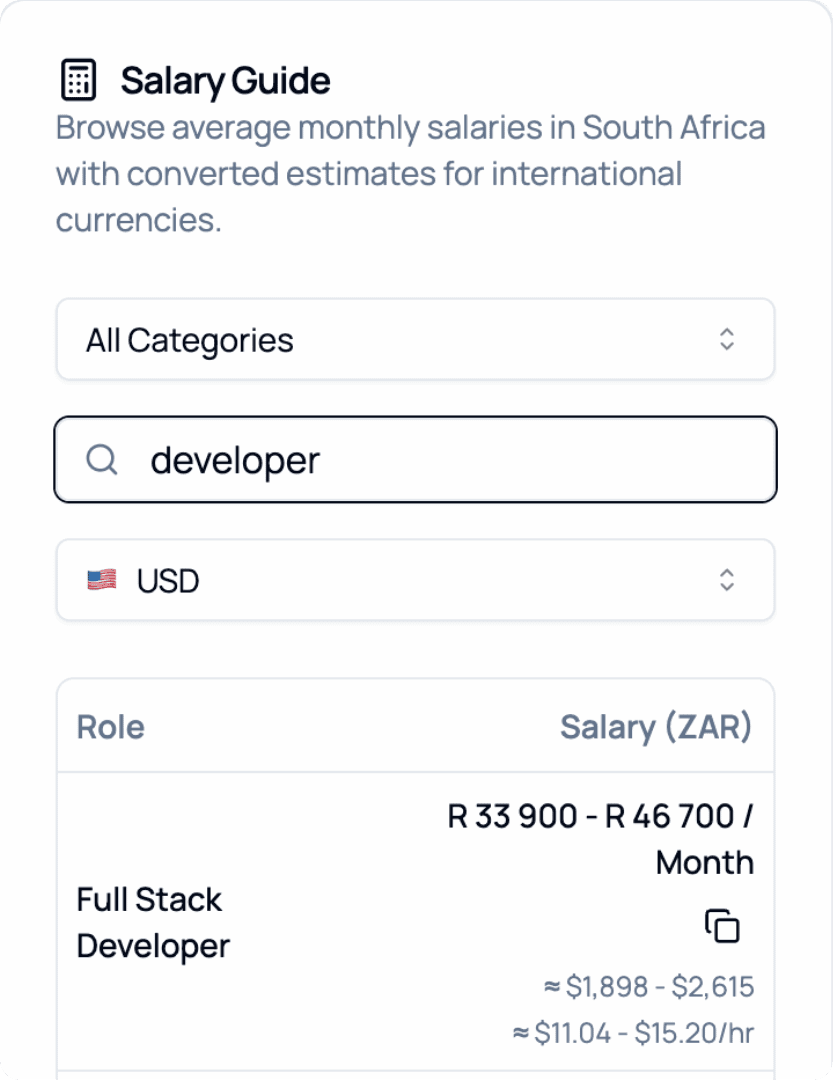
2026 Salary Guide: South Africa
Discover South African Salaries by Role. Compare costs and see how much you can save.