TL;DR
Learn what a business coach virtual assistant should own first, what to keep in-house, and how to delegate without sacrificing client experience.
Use a practical ROI model based on reclaimed coaching hours, faster lead response, cleaner onboarding, and stronger retention operations.
Follow a structured onboarding and KPI cadence to scale your coaching practice with consistency instead of operational drift.
Table of Contents
- Introduction
- What does a business coach virtual assistant actually do day to day?
- Which tasks should business coaches delegate first?
- How do you onboard a business coach virtual assistant for consistent quality?
- How do you measure performance and ROI for a business coach virtual assistant?
- What mistakes should you avoid when hiring a business coach virtual assistant?
- Final Thoughts
Introduction
Most business coaches do not stall because they lack expertise. They stall because the founder becomes the operational bottleneck. If you are evaluating the role, begin with the broader service context at /industries/business-coaches, then use this guide to design a measurable operating model for a business coach virtual assistant.
As pipeline volume increases, the same pattern appears in almost every coaching business: discovery call follow-up slows down, onboarding gets inconsistent, CRM records lose integrity, and delivery quality starts depending on memory instead of systems. Owners try to solve this by "working harder," but the real issue is workflow capacity and process ownership.
That is where a business coach virtual assistant creates leverage. The right hire does not "help with random admin." The right hire runs specific, repeatable workflow lanes under clear SOPs, escalation boundaries, and KPI targets. Done well, this lets coaches spend more time on paid delivery, offer refinement, and strategic growth while the client journey stays consistent from inquiry to renewal.
This article is structured around five People Also Ask questions that high-intent buyers use before hiring. You will get practical answers on role scope, delegation sequence, onboarding systems, KPI management, and cost-to-ROI expectations.
For related implementation playbooks, pair this guide with Virtual Assistant for Coaches Guide: Systems, Costs, and Scale, Virtual Assistant for Life Coaches Guide: Systems, Scope, and ROI, Online Business Manager for Coaches Guide: Scope, Systems, and ROI, How to Hire a Virtual Assistant for Small Business in 2026, Virtual Assistant Onboarding Checklist for 2026, and Virtual Assistant Cost Calculator Guide for SMB Teams.
External references in this guide are anchored to reputable sources such as the International Coaching Federation, U.S. Small Business Administration, U.S. Bureau of Labor Statistics, IRS recordkeeping guidance for small businesses, and FTC cybersecurity guidance for small business.
What does a business coach virtual assistant actually do day to day?
Snippet answer: A business coach virtual assistant owns recurring, process-based workflows such as lead follow-up logistics, onboarding coordination, calendar operations, CRM hygiene, content scheduling, and KPI reporting support under documented SOPs.
The biggest hiring failure is role vagueness. "Please help with admin" sounds practical, but it usually creates context-switching, missed handoffs, and quality drift. High-performing coaching teams define this role by workflow lanes, not by generic task lists.
A proven lane model for a business coach virtual assistant:
- Lead-to-discovery-call operations.
- New-client onboarding administration.
- Ongoing client communication logistics.
- Content and event execution support.
- Weekly operations reporting and hygiene checks.
When each lane has a clear definition of done, coaching leaders can track output and quality without constant supervision.
Typical day-to-day responsibilities include:
- Managing discovery call scheduling, reminders, and reschedules.
- Sending intake forms, agreements, and onboarding packets.
- Tracking onboarding completion before first paid session.
- Keeping CRM stages, tags, and notes current.
- Drafting or routing inbox replies according to SLA rules.
- Publishing approved content across channel calendars.
- Coordinating webinar registration and reminder workflows.
- Updating action-item trackers from coaching sessions.
- Preparing weekly KPI snapshots for leadership review.
Most coaches should keep these tasks in-house:
- Offer design and pricing decisions.
- Sensitive conflict resolution with active clients.
- Complex sales objection handling on premium offers.
- Contract exception approvals.
- Final strategic decisions on positioning and messaging.
A practical filter is simple: if the task is high-frequency and rule-driven, it is often delegable. If it carries legal, reputational, or strategic downside, it should stay with leadership.
Operating rhythm that prevents chaos
A business coach virtual assistant works best with a fixed rhythm instead of reactive task switching:
- Morning: inbox triage, lead response queue, and schedule check.
- Midday: onboarding and client-ops completion work.
- Afternoon: content/event logistics and backlog cleanup.
- End-of-day handoff: unresolved items, risk flags, next-day priorities.
That rhythm reduces missed details and keeps communication clean. It also helps leaders review execution quickly because work is grouped by lane and time block.
Why this role impacts client experience directly
Many owners frame this hire as "internal admin support," but clients experience operations as part of service quality. Slow responses, missing reminders, and inconsistent onboarding make even strong coaching feel disorganized. A structured business coach virtual assistant role protects trust by turning delivery logistics into a reliable system.
Which tasks should business coaches delegate first?
Snippet answer: Business coaches should delegate repeatable, low-ambiguity workflows first, validate quality with KPI baselines, and only then expand scope to higher-judgment operational tasks.
Delegation order is one of the biggest success variables. Teams that delegate complex edge cases too early usually conclude that the hire "is not working," when the real problem is sequencing.
Best first-wave delegation for most coaching businesses:
- Calendar scheduling, confirmations, and reminder cadence.
- Discovery call prep and no-show recovery follow-up.
- Onboarding packet delivery and checklist tracking.
- CRM updates, stage hygiene, and next-step tagging.
- Inbox triage with escalation labels and SLA windows.
- Content publishing from approved drafts and assets.
Why first-wave delegation works:
- High frequency creates immediate time recovery.
- SOPs are easy to define and audit.
- Errors are easy to catch before they scale.
- Performance can be measured weekly.
- The coach gets quick confidence in the role.
Second-wave delegation once baseline quality is stable:
- Webinar and workshop operations.
- Testimonial and referral workflow management.
- Community moderation under clear policy boundaries.
- Renewal reminder process ownership.
- Weekly operations dashboard preparation.
Third-wave delegation for mature systems:
- SOP maintenance and process version control.
- Cross-platform handoff coordination.
- Proactive bottleneck reporting.
- Process-improvement recommendations backed by data.
Tasks to keep with owner or leadership:
- Offer architecture changes.
- High-stakes sales calls.
- Refund and policy exception decisions.
- Legal-sensitive communication.
- Major brand narrative decisions.
Use a three-column delegation matrix
Create one decision matrix for every recurring workflow:
Delegate by defaultDelegate with reviewDo not delegate
Example for coaching operations:
- Session reminder messages: delegate by default.
- Discount request triage: delegate with review.
- Contract term exceptions: do not delegate.
This one-page matrix removes ambiguity and reduces the number of interruptions the coach receives each week.
Stage-based delegation keeps quality intact
Stage 1: Solo coach, limited delivery complexity
- Delegate scheduling, onboarding logistics, and inbox triage.
- Keep strategy, sales, and offer design fully in-house.
Stage 2: Consistent lead flow, recurring programs
- Add client check-in logistics, community workflows, and KPI packs.
- Keep sensitive client conversations with leadership.
Stage 3: Multi-offer business with contractors
- Add cross-functional coordination and SOP governance.
- Introduce weekly process-improvement reviews.
If you want a broader hiring framework for remote roles, see How to Hire Remote Talent Without Recruiting Fees and What Is an Onshore and Offshore Team?.
How do you onboard a business coach virtual assistant for consistent quality?
Snippet answer: Onboard a business coach virtual assistant with a 30-60-90 framework that combines SOPs, shadowing, clear escalation rules, and weekly scorecards so consistency is built before scope expansion.
Even skilled hires underperform when onboarding is improvised. If knowledge lives in voice notes and scattered chats, execution quality will depend on guesswork.
A reliable onboarding plan starts before day one:
- Define workflow lanes and ownership boundaries.
- Document SOPs with step order and quality standards.
- Prepare tools, access permissions, and security policy.
- Set KPI baselines from the last 30 days.
- Define escalation pathways and response-time rules.
Days 1-30: foundation and guided execution
Primary goals:
- Learn tools and communication protocols.
- Execute first-wave workflows with close QA.
- Build confidence with repeatable tasks.
Execution model:
- Shadow week: assistant observes real workflow execution.
- Reverse shadow week: assistant executes while leader reviews.
- Supervised production week: assistant owns lanes with daily check-ins.
Expected outputs by day 30:
- SOP adherence across first-wave workflows.
- Daily end-of-day summaries with blockers and escalations.
- Basic KPI reporting cadence started.
Days 31-60: stabilization and quality control
Primary goals:
- Increase throughput without quality loss.
- Reduce avoidable escalations.
- Improve handoffs and documentation discipline.
Execution model:
- Shift from daily to 2-3 formal QA reviews per week.
- Introduce second-wave workflows gradually.
- Track error patterns and update SOPs weekly.
Expected outputs by day 60:
- Consistent SLA performance on lead and client communications.
- Reduced rework for onboarding and CRM updates.
- Clear escalation decisions aligned with policy.
Days 61-90: scale readiness
Primary goals:
- Transition from task execution to lane ownership.
- Build proactive reporting and process insight.
- Prepare for capacity expansion.
Execution model:
- Weekly operations review with KPI trend analysis.
- Monthly SOP refresh cycle with version tracking.
- Pilot one process-improvement initiative.
Expected outputs by day 90:
- Stable quality across first- and second-wave lanes.
- Proactive identification of bottlenecks.
- A documented handoff system that can scale.
Onboarding documents you should not skip
At minimum, maintain:
- Role charter (scope, exclusions, escalation rules).
- SOP library for each workflow lane.
- SLA table by channel and urgency.
- Voice-and-tone response standards.
- QA checklist for weekly review.
- Incident protocol for security or compliance concerns.
Use Virtual Assistant Onboarding Checklist for 2026 as a companion document to build this stack without missing foundational elements.
Security and compliance hygiene
Even small coaching firms handle sensitive business and client data. Align onboarding with baseline controls from the FTC cybersecurity guide for small businesses, maintain disciplined records in line with IRS recordkeeping guidance, and apply role-based access rules so assistants only access tools needed for owned workflows.
How do you measure performance and ROI for a business coach virtual assistant?
Snippet answer: Measure a business coach virtual assistant using a blended scorecard of speed, quality, and business impact, then calculate ROI from recovered owner hours, conversion protection, retention support, and rework reduction.
Many teams only ask, "Did we save time?" Time recovery matters, but a complete model should also include revenue protection and process reliability.
Start with three KPI buckets:
- Speed metrics.
- Quality metrics.
- Business impact metrics.
Speed metrics:
- Median first response time for inbound leads.
- Calendar reminder completion rate.
- Onboarding activation time from signed client to first session readiness.
Quality metrics:
- CRM accuracy rate (stage, notes, next action).
- Onboarding checklist completion without rework.
- Percentage of communications meeting SLA and tone standards.
Business impact metrics:
- Owner hours reclaimed per week.
- Discovery-to-close conversion trend.
- Retention touchpoint completion rate.
- Renewal and referral workflow completion.
Practical ROI formula
Use a monthly model:
(Recovered owner hours x blended hourly value) + conversion lift + retention lift + rework avoided - total support cost = net monthly ROI
Illustrative example:
- Recovered owner hours: 30 per month.
- Blended owner value: $180/hour.
- Conversion lift impact: $1,500.
- Retention/renewal impact: $1,200.
- Rework avoided: $600.
- Total support cost (comp + tools + management): $3,900.
Net monthly ROI:
(30 x 180) + 1,500 + 1,200 + 600 - 3,900 = $4,800
This is directional, not universal, but it shows why hourly cost alone is a weak hiring decision metric.
Benchmark responsibly
Use external benchmarks for context, not as a replacement for your internal data:
- Staffing and role context from the U.S. Bureau of Labor Statistics.
- Finance discipline guidance from the U.S. Small Business Administration.
- Coaching profession context from the International Coaching Federation.
Then compare those inputs to your own baseline before and after onboarding.
Common measurement mistakes
- Measuring only activity volume, not outcomes.
- Expanding scope before baseline quality stabilizes.
- Changing five variables at once and attributing results to one role.
- Ignoring management overhead in cost calculations.
- Reviewing KPIs irregularly so issues surface too late.
A weekly scorecard plus monthly ROI review is usually enough to keep execution and economics aligned.
For deeper budgeting structure, reference Virtual Assistant Cost Calculator Guide for SMB Teams.
What mistakes should you avoid when hiring a business coach virtual assistant?
Snippet answer: Avoid vague scope, weak onboarding, over-delegating high-judgment decisions, and unmanaged communication channels; these mistakes create rework, client friction, and poor ROI even with strong talent.
Most failed hires are system failures, not people failures. The assistant is often capable, but the operating model sets them up to fail.
The most common mistakes:
- Hiring before defining workflow ownership.
- Delegating too many lanes in week one.
- Skipping SOP documentation and QA cadence.
- Using multiple channels with no communication protocol.
- Failing to set escalation boundaries.
- Treating KPI reviews as optional.
- Choosing purely on hourly rate instead of operating fit.
Mistake 1: vague scope
If scope is unclear, priorities change hourly and nothing reaches consistent quality. Fix this with a role charter that includes lane ownership, exclusions, and escalation rules.
Mistake 2: no baseline before handoff
Without baseline metrics, you cannot prove whether performance improved. Capture 30 days of lead speed, onboarding time, CRM hygiene, and admin-hour usage before the role starts.
Mistake 3: onboarding by chat thread
When knowledge transfer happens only through messages, process quality is fragile. Build SOPs, a response standard, and a QA checklist before delegation expands.
Mistake 4: unlimited channels and interruptions
If tasks arrive via email, chat, text, and voice notes without hierarchy, the assistant is forced into reactive mode. Define one primary task channel, one escalation path, and daily handoff timing.
Mistake 5: no escalation map
Assistants need clarity on when to decide and when to escalate. A missing escalation map causes either risky independent decisions or constant bottlenecks.
Mistake 6: role mismatch
Some teams need a process executor. Others need a coordinator with stronger judgment. Misalignment here creates frustration for both parties. If your operation needs more strategic coordination, compare the role to Online Business Manager for Coaches Guide: Scope, Systems, and ROI.
Mistake 7: treating management as optional
Delegation is not abdication. Weekly reviews, KPI checks, and SOP updates are management tasks that preserve quality and unlock long-term scale.
How to reduce risk in the first 90 days
A simple risk-control playbook:
- Start with first-wave workflows only.
- Review KPI and QA results every week.
- Expand scope only after two stable review cycles.
- Keep sensitive decisions with leadership.
- Document every recurring exception and convert it into SOP updates.
If you need broader guardrails, use Hiring VA Mistakes to Avoid and How to Hire a Virtual Assistant for Small Business in 2026 alongside this guide.
Final Thoughts
A business coach virtual assistant is not a shortcut. It is an operating system decision. The role produces strong outcomes when scope is precise, delegation is phased, onboarding is structured, and performance is measured with consistent scorecards.
If your coaching business is hitting growth friction, treat this hire as a workflow architecture project, not a task dump. Start with first-wave lanes, establish quality baselines, and scale only when execution is stable. That approach protects client experience and improves owner leverage at the same time.
For broader service context and next-step support options, revisit /industries/business-coaches and align your hiring plan to the specific operating constraints of your current growth stage.
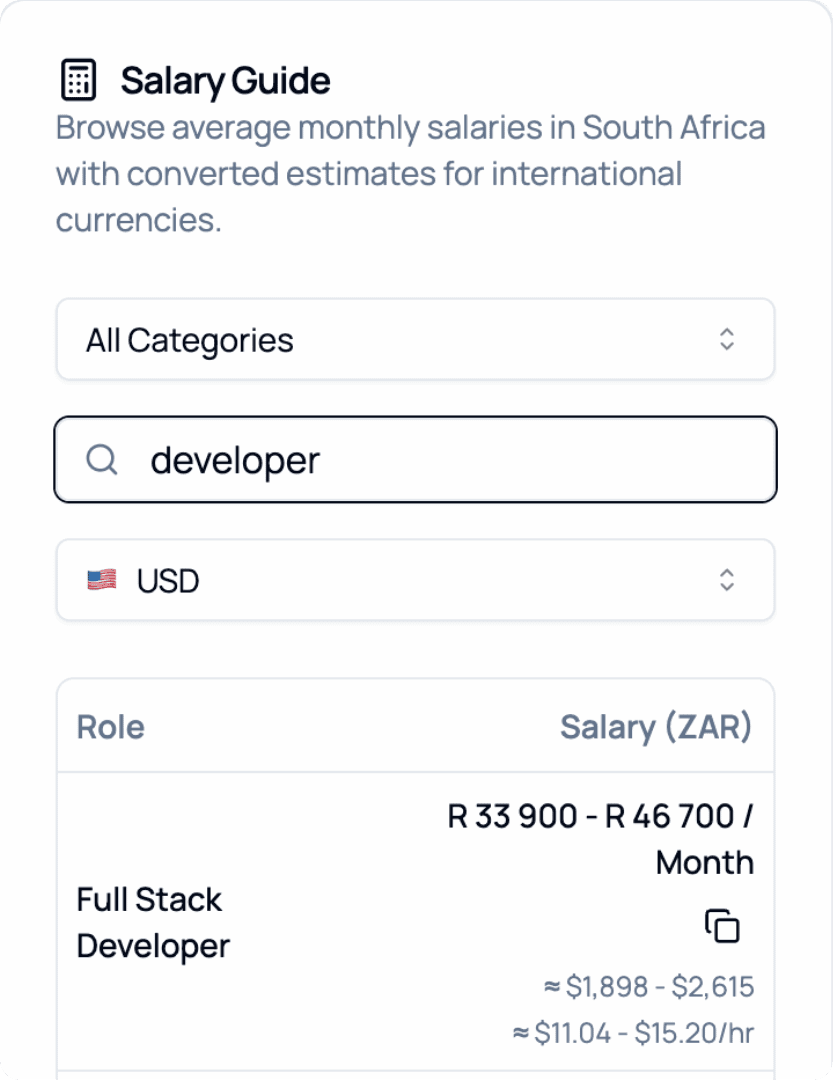
2026 Salary Guide: South Africa
Discover South African Salaries by Role. Compare costs and see how much you can save.