TL;DR
Learn what a virtual assistant for life coaches should own first, what should stay with the coach, and how to prevent quality drift as client volume grows.
Use a practical cost and ROI model based on reclaimed coaching hours, faster lead follow-up, and stronger client-retention operations.
Follow a 30-60-90 onboarding framework with SOPs, QA checkpoints, and KPI cadence to scale support with consistency.
Table of Contents
- Introduction
- What does a virtual assistant for life coaches actually do?
- Which tasks should life coaches delegate first?
- How much does a virtual assistant for life coaches cost, and what ROI is realistic?
- How do you hire and onboard a virtual assistant for life coaches successfully?
- What are the most common mistakes when using a virtual assistant for life coaches?
- Final Thoughts
Introduction
Most life coaches do not hit a growth ceiling because they stop getting results for clients. They hit a ceiling because they become the bottleneck for every operational task in the business. If you are evaluating support options, start with the broader context at /industries/business-coaches, then use this guide to design a role that is measurable, manageable, and aligned to client experience.
A life coaching business usually grows in uneven phases. One month, you are filling discovery calls. Next month, delivery workload spikes. Then content, follow-up, and community operations fall behind. The pattern is predictable: scheduling slips, inboxes pile up, onboarding becomes inconsistent, and the coach spends peak-energy hours doing admin work instead of paid coaching.
That is why demand for a virtual assistant for life coaches keeps increasing. But many hires still underperform, not because the person is weak, but because role boundaries are vague. “Help me with admin” is not a role design. It is a guarantee of rework.
This guide is structured around five People Also Ask questions buyers use before they hire. You will get clear, practical answers on role scope, delegation order, cost and ROI, onboarding systems, and the mistakes that cause breakdowns.
For adjacent implementation guidance, pair this with Virtual Assistant for Coaches Guide: Systems, Costs, and Scale, Virtual Assistant for Entrepreneurs Guide: Systems, Delegation, and ROI, How to Hire a Virtual Assistant for Small Business in 2026, Virtual Assistant Onboarding Checklist for 2026, Virtual Assistant Cost Calculator Guide for SMB Teams, and How to Hire Remote Talent Without Recruiting Fees.
External references in this article are anchored to reputable organizations including the International Coaching Federation, U.S. Small Business Administration, IRS recordkeeping guidance, Federal Trade Commission cybersecurity guidance for small business, and U.S. Bureau of Labor Statistics occupational data.
What does a virtual assistant for life coaches actually do?
Snippet answer: A virtual assistant for life coaches owns repeatable, process-based workflows such as calendar operations, onboarding coordination, CRM hygiene, follow-up execution, and content logistics under clear SOPs and escalation rules.
The fastest way to fail this hire is to define the role as “general support.” High-performing life coaching teams define role ownership by workflow lane. That creates clarity for both execution and quality checks.
A practical lane model for life coaches:
- Lead-to-discovery-call operations.
- New client onboarding and admin setup.
- Ongoing client communication logistics.
- Content and audience operations.
- Back-office reporting and coordination.
When each lane has clear ownership, you can track performance without micromanaging.
Typical responsibilities for a virtual assistant for life coaches include:
- Managing discovery call calendars and reminder sequences.
- Sending intake forms, agreements, and onboarding packets.
- Tracking completion status before first paid session.
- Maintaining CRM stage accuracy and follow-up tags.
- Organizing inboxes by urgency and routing escalation items.
- Publishing pre-approved content and newsletters.
- Coordinating webinar logistics and attendee communications.
- Tracking testimonial and referral request cadence.
- Preparing weekly KPI snapshots for review.
What the role should not own:
- Offer positioning and pricing decisions.
- High-stakes sales conversations with major objections.
- Legal or contract exception approvals.
- Sensitive conflict resolution with at-risk clients.
- Core messaging strategy and brand decisions.
A useful filter is simple: if the task is high-frequency and rule-based, it is usually delegable. If it requires business judgment with legal, reputational, or strategic downside, keep it with leadership.
Daily operating rhythm that works
Most life coaching assistants perform better with a predictable daily cadence:
- Morning triage: inbox, calendar, and lead follow-up queue.
- Midday execution: onboarding checklist progress and content tasks.
- End-of-day handoff: unresolved issues, priority flags, and next-day plan.
This rhythm reduces missed handoffs and keeps the coach informed without constant interruptions.
Weekly scorecard to avoid “management by feeling”
If you do not define scorecards, feedback becomes subjective. A simple weekly scorecard for a virtual assistant for life coaches can include:
- Discovery call reminder completion rate.
- Lead first-response median time.
- Onboarding completion within 7 days.
- CRM stage accuracy percentage.
- Client follow-up task completion by SLA.
The goal is not policing. The goal is visibility, early issue detection, and systematic improvement.
Which tasks should life coaches delegate first?
Snippet answer: Life coaches should delegate repetitive, low-ambiguity workflows first, then expand scope in phases only after quality and KPI baselines stabilize.
Delegation order matters more than most coaches expect. If you delegate complex edge cases too early, the role looks unstable even when the model is sound. Sequence first, then scale.
Best first-wave delegation for most life coaching businesses:
- Calendar scheduling, confirmations, and reminders.
- Discovery call prep and no-show recovery follow-up.
- Onboarding document delivery and checklist tracking.
- CRM updates and lead-stage hygiene.
- Inbox triage and response drafting.
- Content publishing from approved drafts.
Why this first wave works:
- High volume.
- Repeatable logic.
- Clear done criteria.
- Fast QA loops.
- Immediate time recovery for the coach.
Second-wave delegation once first-wave metrics are stable:
- Webinar and workshop operations.
- Community moderation under defined rules.
- Client check-in scheduling and reminder operations.
- Referral/testimonial process management.
- Basic KPI reporting packs.
Third-wave delegation for mature systems:
- SOP version control and updates.
- Cross-platform handoff management.
- Proactive process improvement recommendations.
- Weekly bottleneck reporting and escalation.
Tasks that should generally remain in-house:
- High-value sales calls.
- Refund exception decisions.
- Contract and pricing exceptions.
- Sensitive client relationship repairs.
- Offer architecture and strategic pivots.
Delegation by business stage
Stage 1: Solo coach with one core offer
- Delegate scheduling, inbox triage, and onboarding admin.
- Keep sales and offer strategy fully in-house.
Stage 2: Consistent lead flow and recurring programs
- Add community operations and content scheduling.
- Add KPI reporting and quality audit cadence.
Stage 3: Multi-program business with contractors
- Add cross-functional coordination ownership.
- Add workflow documentation governance.
This stage-based model lowers risk and prevents the “delegate everything at once” failure pattern.
Use a delegation matrix to remove ambiguity
Create a three-column matrix for every recurring workflow:
Delegate by defaultDelegate with reviewDo not delegate
Examples:
- Session reminder sequence: delegate by default.
- Discount request handling: delegate with review.
- Contract exception approval: do not delegate.
This single document prevents most role confusion and creates cleaner escalation behavior.
How much does a virtual assistant for life coaches cost, and what ROI is realistic?
Snippet answer: Cost varies by scope and operator level, but ROI from a virtual assistant for life coaches is typically driven by reclaimed coaching hours, faster lead response, cleaner onboarding, and lower rework rather than hourly rate alone.
Many buyers over-focus on hourly rate. That is a weak decision model because a low fee with poor execution can be more expensive than a higher fee with consistent process performance.
Use an all-in cost model:
- Direct support fee or compensation.
- Tooling and software seat costs.
- Onboarding and SOP build time.
- Management and quality review time.
- Rework cost from preventable errors.
Then map value creation:
- Recovered coaching hours that can be redirected to paid sessions.
- Faster lead-response cadence, which protects conversion.
- Better onboarding consistency, reducing client friction.
- More reliable retention touchpoints and renewal follow-up.
- Less leadership rework from operational misses.
A practical monthly formula:
(Recovered high-value hours x blended hourly value) + conversion/retention lift + rework avoided - all-in support cost = net monthly impact
Illustrative scenario:
- Recovered coaching/owner time: 26 hours per month.
- Blended hourly value of that time: $175.
- Conversion and retention lift: $1,700.
- Rework avoided: $500.
- All-in support cost: $3,100.
Net monthly impact:
(26 x 175) + 1,700 + 500 - 3,100 = $3,650
This is directional, not universal. Your numbers depend on pricing model, lead quality, close rate, and lifecycle length.
Build a baseline before launch
Capture 30 days of baseline metrics before onboarding starts:
- Median lead first-response time.
- Discovery call no-show rate.
- Onboarding completion within 7 days.
- Weekly coach admin hours.
- Client check-in and follow-up completion rate.
Without baseline data, it is hard to separate actual gains from normal demand variation.
Where ROI usually breaks down
Most underperformance comes from five avoidable issues:
- Scope is vague and changes weekly.
- No pre-hire KPI baseline exists.
- Too many lanes are assigned in week one.
- SOPs are implied, not documented.
- Review cadence is inconsistent.
If you fix these, day 60 to day 90 outcomes usually improve materially.
Use reputable references for planning assumptions
For small-business finance discipline, use the SBA finance guide. For documentation and records controls, use IRS recordkeeping guidance. For labor and role context, use BLS occupational resources. For governance around digital operations, use FTC small-business cybersecurity guidance.
For additional cost modeling depth, also review Virtual Assistant Cost Calculator Guide for SMB Teams and What Is an Onshore and Offshore Team?.
How do you hire and onboard a virtual assistant for life coaches successfully?
Snippet answer: Hire for process reliability and communication clarity, then onboard by workflow lane using a 30-60-90 plan with SOP certification, QA checkpoints, and KPI review.
Most hiring mistakes happen before the first interview ends. Teams select for personality and “helpfulness,” but skip process discipline testing. For a virtual assistant for life coaches, execution reliability matters more than generic enthusiasm.
Hiring criteria that predict performance
Prioritize these capabilities:
- Written communication clarity.
- Calendar and workflow management discipline.
- CRM attention to detail.
- Ability to follow SOPs and document changes.
- Comfort escalating with context, not panic.
Screen using scenario-based prompts:
- “A lead books a discovery call but submits no intake form. What do you do?”
- “A client requests rescheduling after cutoff. How do you respond and escalate?”
- “You see duplicate records and stale stages in CRM. How do you clean it?”
Good candidates answer with sequence, ownership, and escalation logic.
30-60-90 onboarding model
Days 1-30: foundations and first lane
- Tool access, SOP walkthrough, and communication standards.
- Shadow existing workflows and document clarifying questions.
- Own one lane (usually scheduling + reminders).
- Daily check-ins with quick QA reviews.
Days 31-60: expand controlled ownership
- Add onboarding checklist management.
- Add CRM hygiene and follow-up queue operations.
- Transition to twice-weekly performance reviews.
- Track weekly KPI trendlines and error categories.
Days 61-90: stabilize and optimize
- Add second-wave lane ownership (content/community ops).
- Improve SOPs based on recurring blockers.
- Start proactive bottleneck reporting.
- Move to weekly reviews with monthly deep-dive audits.
The objective is predictable transfer of ownership, not “instant full handoff.”
SOP standards that prevent drift
Each SOP should define:
- Trigger: what starts the workflow.
- Inputs: required information.
- Steps: explicit sequence.
- Output: what done looks like.
- SLA: timing expectation.
- Escalation rule: when and how to flag issues.
Most quality problems are actually SOP problems in disguise.
Management cadence that scales
Use this operating rhythm:
- Daily async updates in the first 2-4 weeks.
- Weekly KPI and queue review.
- Monthly QA audit with SOP revisions.
This creates accountability without overmanagement.
For broader onboarding systems, see Virtual Assistant Onboarding Checklist for 2026, 7 Mistakes to Avoid When Hiring Your First VA, and Why Hire a Virtual Assistant: The Ultimate Guide.
What are the most common mistakes when using a virtual assistant for life coaches?
Snippet answer: The biggest failure points are vague role scope, weak SOP discipline, no KPI baseline, over-delegation too early, and inconsistent management cadence.
A virtual assistant for life coaches can be a growth multiplier, but only when the operating model is disciplined. Most breakdowns come from system design errors, not effort.
Mistake 1: Hiring before defining lane ownership
If ownership is unclear, the assistant is forced to guess priorities. That creates rework and avoidable escalation noise.
Fix:
- Define lane ownership before the hire starts.
- Publish a delegation matrix.
- Set “done” criteria for each recurring workflow.
Mistake 2: Delegating strategy instead of operations
Coaches sometimes outsource core strategic tasks too early, especially around offer positioning, sales narrative, and sensitive client communication.
Fix:
- Delegate execution workflows first.
- Keep judgment-heavy decisions in-house.
- Add review gates for any borderline task.
Mistake 3: No baseline metrics
Without baseline data, performance conversations become opinion-driven.
Fix:
- Capture 30 days of baseline before onboarding.
- Track leading and lagging indicators weekly.
- Compare trendlines, not isolated snapshots.
Mistake 4: Too many tools, no process map
Tool sprawl creates confusion. Teams add platforms hoping software will solve clarity issues.
Fix:
- Start with a lean stack.
- Build SOPs before adding tools.
- Add tooling only when a specific bottleneck is proven.
Mistake 5: Irregular review cadence
If reviews are skipped, small errors compound. If reviews are constant and reactive, both sides burn time.
Fix:
- Set a fixed review cadence by stage.
- Use scorecards and issue logs.
- Revise SOPs monthly from evidence.
Mistake 6: No escalation policy for sensitive cases
Life coaching can involve emotional and personal context. Without escalation boundaries, assistants either over-escalate or under-escalate.
Fix:
- Define red-flag categories in writing.
- Provide response templates for common scenarios.
- Route sensitive cases directly to the coach.
Mistake 7: Treating this as a “one-time hire” instead of an operating system
Sustainable outcomes come from system design, not individual heroics.
Fix:
- Build documentation from week one.
- Track process changes and versions.
- Design backup coverage for critical workflows.
When these seven issues are addressed, a virtual assistant for life coaches shifts from “extra admin help” to a durable operational layer that supports consistent growth.
Final Thoughts
A virtual assistant for life coaches creates real leverage when role design is precise: clear lane ownership, measurable KPIs, stage-based delegation, and disciplined onboarding. The point is not to offload random tasks. The point is to build an operating system that protects client experience while freeing the coach to focus on high-value work.
If you are designing this role now, keep the sequence practical: define lanes, establish baseline metrics, delegate first-wave workflows, and review outcomes weekly before expanding scope. That approach usually produces cleaner execution and stronger ROI than trying to delegate everything in the first month.
For broader staffing context and role fit across this vertical, review /industries/business-coaches. Then align this guide with your implementation stack using Virtual Assistant for Coaches Guide: Systems, Costs, and Scale, Virtual Assistant for Entrepreneurs Guide: Systems, Delegation, and ROI, and How to Hire a Virtual Assistant for Small Business in 2026.
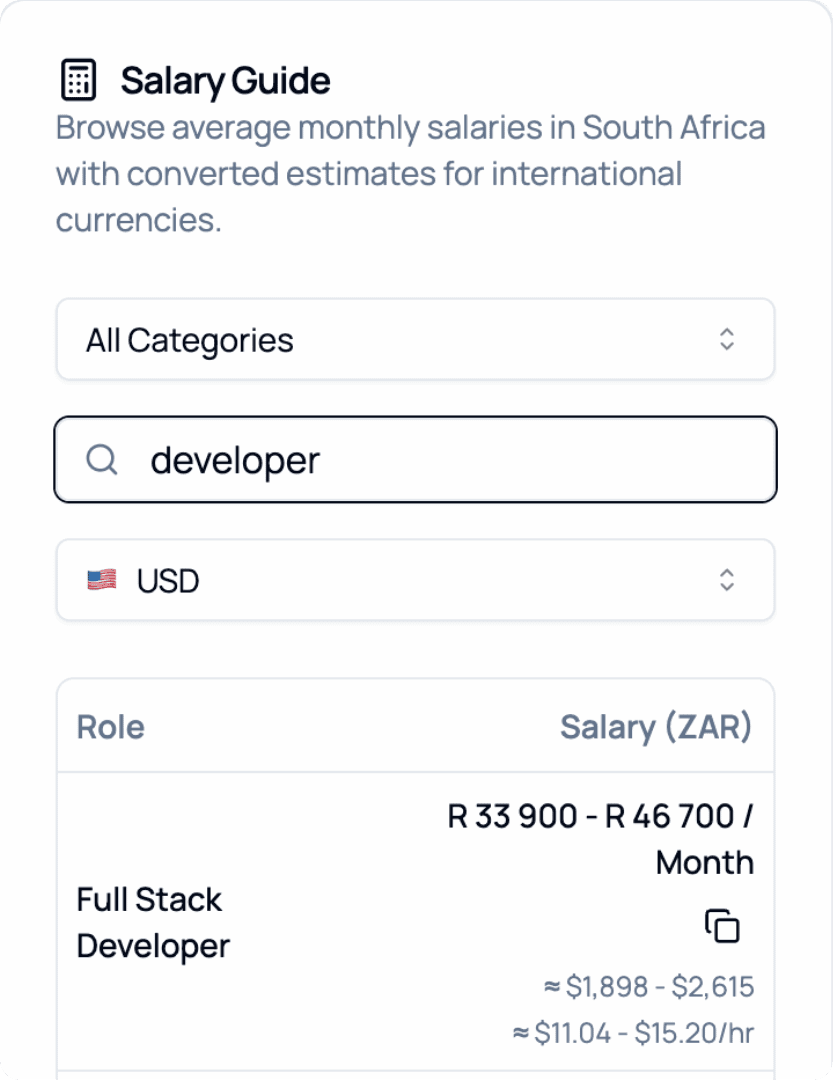
2026 Salary Guide: South Africa
Discover South African Salaries by Role. Compare costs and see how much you can save.