TL;DR
Learn exactly what a mortgage processing virtual assistant should own, what must stay with licensed staff, and how to build a clean escalation workflow.
Use this practical US playbook to improve file velocity, reduce condition-cycle delays, and keep borrower communication consistent.
Model cost and ROI with clear operational KPIs so you can scale volume without adding avoidable overhead.
Table of Contents
Introduction
If you are evaluating scalable back-office support in financial services, start with the broader insurance industry page for context on operating models and staffing leverage.
Mortgage teams do not usually lose deals because they lack demand. They lose momentum because the file pipeline slows down in the middle: missing documents, delayed follow-up, unclear ownership, and condition loops that keep reopening. That drag kills turn times, frustrates borrowers, and burns expensive loan-officer capacity on admin work.
A mortgage processing virtual assistant can fix that when the role is designed correctly. The goal is not to replace licensed judgment. The goal is to create operational consistency across document collection, status updates, file setup, condition tracking, and closing coordination so licensed processors and loan officers spend time where they create real value.
This guide is a practical execution playbook for US lenders, broker shops, and mortgage operations leaders. You will get role boundaries, delegation framework, compliance controls, onboarding process, KPI scorecards, and ROI math you can actually run.
For adjacent operating frameworks, see How to Hire a Virtual Assistant for Small Business in 2026, Virtual Assistant Onboarding Checklist for 2026, Virtual Assistant Cost Calculator Guide for SMB Teams, and How to Hire Remote Talent Without Recruiting Fees.
For factual references, this guide aligns with public source material including CFPB mortgage resources, HUD homeownership guidance, Fannie Mae Selling Guide, Freddie Mac Single-Family Seller/Servicer Guide, and NMLS consumer access background.
What does a mortgage processing virtual assistant do?
Snippet answer: A mortgage processing virtual assistant executes structured, repeatable loan-file workflows—document intake, checklist tracking, borrower follow-up, LOS updates, and condition management support—under clear supervision from licensed and accountable in-house leaders.
The role works best when your team defines workflow lanes before hiring. If the job description is vague, output quality becomes random. High-performing teams map tasks by decision risk, then assign ownership with explicit escalation points.
At a practical level, this role usually supports:
- Loan file setup and data entry support in your LOS.
- Initial document checklist distribution and collection tracking.
- Borrower follow-up for missing items using approved templates.
- File hygiene: naming conventions, indexing, and timeline logs.
- Condition queue monitoring and reminder cadence.
- Internal handoff prep between LO, processor, and closing coordinator.
- Status-update support for internal dashboards and pipeline meetings.
The three-level responsibility model
Use this model to avoid compliance and quality mistakes:
- Execution layer: rule-based admin work with SOP-backed instructions.
- Exception layer: non-standard issues routed through documented escalation.
- Judgment layer: licensed interpretation, credit decisions, policy calls.
A mortgage processing virtual assistant should own layer 1, support layer 2, and never independently own layer 3.
Where teams get immediate gains
Most teams feel impact in four places within 30 to 60 days:
- Faster document-cycle completion.
- Fewer file-stall surprises in weekly pipeline reviews.
- Better borrower communication consistency.
- More productive time for licensed processors and loan officers.
If your operation relies on ad-hoc reminders and personal memory, this role can materially improve execution discipline.
Which mortgage tasks can be delegated safely?
Snippet answer: Delegate repeatable process work with clear rules and auditability; keep all licensed advice, policy interpretation, and final credit/underwriting judgment with authorized US team members.
The safest way to delegate is to split the workflow into low-risk, medium-risk, and high-risk activities.
Low-risk tasks (delegate first)
These are process-heavy, repeatable, and ideal for virtual support:
- Document request checklists based on approved templates.
- Borrower reminder cadence and deadline nudges.
- File completeness checks against defined checklists.
- LOS data updates where values come from provided documents.
- Condition-log maintenance and status flag updates.
- Appointment scheduling for internal/external touchpoints.
- Closing package prep coordination support.
Medium-risk tasks (delegate with controls)
These can be delegated with QA checkpoints:
- Preliminary discrepancy logging (not decisioning).
- Cross-document consistency flagging for processor review.
- Pipeline stage movement recommendations for supervisor approval.
- Escalation packet preparation for underwriting exceptions.
High-risk tasks (keep in-house/licensed)
Do not delegate these as independent responsibility:
- Advice that could be interpreted as legal/financial guidance.
- Credit judgment, underwriting approval/denial logic.
- Any representation requiring NMLS-licensed authority.
- Final disclosure interpretation or compliance signoff.
- Policy exceptions and compensating-factor decisions.
A practical delegation matrix
Create a one-page matrix with five columns:
- Task name.
- Owner role.
- SLA target.
- QA reviewer.
- Escalation trigger.
This matrix prevents role drift and lets you scale faster without confusion.
How much does mortgage processing virtual support cost?
Snippet answer: Cost varies by complexity and coverage window, but ROI is mainly driven by improved file velocity, reduced rework, and recovered licensed-team capacity—not by hourly price alone.
Teams that chase the lowest rate often pay for it later through condition-loop delays and file-quality issues. You want cost per clean file progression, not just cost per labor hour.
Direct cost components
- Staffing/service fee for the virtual assistant.
- Tooling seats (LOS access where applicable, communication, QA docs).
- Onboarding and SOP training time.
- QA oversight time from processors/ops leaders.
Indirect cost components
- Delay costs from missed lock timelines or stalled files.
- Borrower churn risk due to poor communication cadence.
- Rework effort when documents are miscategorized or incomplete.
- Opportunity cost when licensed staff do repetitive admin work.
ROI model you can use this week
Use a simple model:
- Measure current processor/LO admin hours per month.
- Estimate safe delegation percentage.
- Multiply recovered hours by blended internal value/hour.
- Add value from cycle-time improvement (fewer delayed closings).
- Subtract full program cost.
Illustrative example:
- 80 monthly admin hours currently handled by licensed staff.
- 55% safely delegable = 44 recovered hours.
- Blended value/hour = $120.
- Recovered capacity value = $5,280/month.
- Net program cost = $2,200/month.
- Net operational gain = $3,080/month (before secondary upside from better pull-through).
The hidden upside is consistency: cleaner files reduce stress and reduce pipeline volatility.
How do you keep compliance and quality controlled?
Snippet answer: You maintain control through role boundaries, permission design, SOP versioning, documented QA checkpoints, and strict escalation triggers—never by hoping people “just know” what to do.
Compliance discipline is operational discipline. The teams with the best performance treat process control like product engineering.
Permission and access design
Start with least-privilege access:
- Give only the minimum systems/data needed for assigned tasks.
- Segment credentials with password management and activity logs.
- Restrict ability to alter sensitive profile fields without review.
- Review access quarterly and after role changes.
SOP governance
Every core workflow should have:
- Purpose and owner.
- Step-by-step process.
- Required artifacts.
- SLA target.
- QA checklist.
- Escalation triggers.
- Last-reviewed date.
No SOP, no delegation. That rule saves teams from expensive ambiguity.
QA operating rhythm
Adopt a two-layer QA model:
- Daily spot checks: quick review of randomly sampled active files.
- Weekly audit: deeper review on condition-cycle quality, timeline adherence, and borrower communication records.
Track these QA KPIs:
- First-pass completeness rate.
- Condition re-open rate.
- Average days in processing stage.
- Borrower response-time median.
- File error rate by task category.
Escalation rules that actually work
Define hard triggers such as:
- Missing documents > X days after first request.
- Data mismatch across key docs.
- Potential compliance-sensitive borrower communication.
- Repeated condition re-open on same file.
Escalations must be timestamped, assigned, and resolved visibly in your operations board.
How do you onboard and manage performance?
Snippet answer: Effective onboarding combines workflow shadowing, controlled task ramp-up, clear QA feedback loops, and scorecard-based performance management from day one.
Do not drop a new mortgage processing VA into live files without a structured ramp. A short, disciplined onboarding plan beats a long, vague one.
30-day onboarding blueprint
Week 1: Systems and workflow orientation
- Introduce your mortgage pipeline stages end to end.
- Review SOPs for intake, checklisting, and status updates.
- Train communication templates and tone standards.
- Set expectations on escalation boundaries.
Week 2: Supervised execution
- Assign low-risk tasks with close QA.
- Run daily review sessions for feedback and corrections.
- Track turnaround times and checklist accuracy.
Week 3: Expanded ownership
- Add medium-complexity file-support tasks.
- Start independent cadence management for document reminders.
- Introduce exception packet preparation workflow.
Week 4: Stabilization and KPI handoff
- Transition to standard operating load.
- Establish weekly scorecard review with ops lead.
- Lock improvement goals for the next 60 days.
Performance scorecard framework
Use a compact scorecard with both quality and speed measures:
- Task completion SLA adherence.
- File completeness pass rate.
- Rework rate.
- Escalation quality (accuracy and timeliness).
- Communication consistency (template compliance + response standards).
Tie feedback to real files, not generic comments.
Common failure modes (and fixes)
-
Failure: Too many undocumented edge cases.
Fix: Add exception playbooks and escalation tags. -
Failure: QA only happens when there is a problem.
Fix: Set mandatory weekly audits regardless of issue volume. -
Failure: Role creep into decision-sensitive territory.
Fix: Reinforce task matrix and permission boundaries monthly. -
Failure: No clear owner for final process outcomes.
Fix: Assign one accountable operations lead for scorecard governance.
Recommended operating stack for mortgage processing support
You do not need an expensive tool explosion. You need a clean stack with clear ownership and auditability. A practical setup usually includes:
- System of record: your LOS for loan milestones and file-state truth.
- Task layer: a board tool for assignment, SLA timers, and escalation labels.
- Documentation hub: SOP library with version history and role-specific playbooks.
- Communication channels: borrower and internal templates with approved language.
- QA log: weekly file-audit tracker with trend notes.
The key is integration discipline. If staff members update one system but not the others, your dashboards lie. Define one source of truth for each data point and train against that rule.
90-day implementation roadmap
If you want this role to stick, run a phased rollout:
Days 1–15: Baseline and design
- Document the current pipeline from lead-to-close handoff.
- Measure baseline metrics: days in processing, condition re-open rate, and handoff latency.
- Build delegation matrix for low/medium/high-risk tasks.
- Finalize SOP versions and QA checklists.
- Define escalation SLA by issue type.
Deliverable: signed-off operations blueprint and scorecard template.
Days 16–45: Controlled launch
- Start with one team pod (for example, 1–2 loan officers and a supervising processor).
- Assign only low-risk workflows initially.
- Run daily huddles for issue triage and process corrections.
- Audit 100% of delegated files in first two weeks.
- Track borrower communication consistency.
Deliverable: validated process lane with stable accuracy.
Days 46–90: Scale and optimize
- Expand scope to medium-risk support tasks with defined guardrails.
- Shift from 100% QA to sampling-based QA once accuracy threshold is stable.
- Introduce weekly trend review with action items.
- Refine SOPs based on repeated escalation patterns.
- Add backup staffing plan for continuity during leave/surge periods.
Deliverable: repeatable, measurable support function ready for higher volume.
SLA design for pipeline velocity
Most teams miss this: you cannot improve turn times without explicit SLA targets per micro-step. Suggested starting points:
- New file setup completed within 4 business hours of handoff.
- Initial document checklist sent within 2 business hours.
- Borrower follow-up cadence every 24 hours until complete.
- Condition-response packet prepared within 1 business day.
- Internal status update posted before daily pipeline standup.
Set your own targets based on operating reality, but write them down. Otherwise, "urgent" becomes subjective and consistency disappears.
Borrower experience standards that reduce fallout
A mortgage pipeline is also a communication system. Inconsistent updates increase anxiety and can reduce pull-through. Your virtual support role should follow borrower communication standards:
- Use plain language, no jargon-heavy request emails.
- Explain why each document is needed.
- Confirm receipt quickly to reduce duplicate uploads.
- Share next-step expectations after every major milestone.
- Escalate sentiment risk immediately if frustration signals appear.
Good communication is not just customer service. It protects cycle time by reducing confusion loops.
KPI targets to monitor monthly
A strong first-month scorecard can include:
- Checklist completion within SLA: target 90%+.
- Condition re-open rate: target downward trend month over month.
- Document deficiency repeat rate: target below 10% after onboarding stabilization.
- Average processing-stage days: target clear reduction versus baseline.
- Borrower touchpoint timeliness: target 95%+ on-time communication actions.
Add quality comments next to each KPI so numbers have context. Raw percentages without file notes are rarely actionable.
Governance cadence for leadership
Use a simple governance rhythm:
- Daily (15 min): queue health, blockers, immediate escalations.
- Weekly (45 min): KPI trends, QA findings, SOP edits, ownership actions.
- Monthly (60 min): capacity plan, staffing decisions, risk review, and process investments.
This rhythm keeps execution tight without over-managing.
What to standardize before hiring the second assistant
Do not scale headcount until you standardize these elements:
- Task matrix and role boundaries are documented and current.
- SOP library has version control and named owners.
- QA protocol has sampling logic and escalation thresholds.
- KPI dashboard is trusted by operations leadership.
- Coverage plan exists for peak volume and absences.
If those five are not stable, adding more people usually amplifies inconsistency.
Implementation checklist (copy/paste)
Use this checklist as your launch control:
- [ ] Delegation matrix approved by operations lead.
- [ ] All low-risk tasks mapped to SOPs.
- [ ] Compliance-sensitive tasks explicitly excluded.
- [ ] System permissions reviewed and least-privilege applied.
- [ ] Communication templates approved.
- [ ] QA reviewer assigned.
- [ ] Escalation SLAs configured.
- [ ] Baseline KPIs captured.
- [ ] Weekly governance meeting on calendar.
- [ ] First 30-day performance goals documented.
When this checklist is complete, the role is set up to generate reliable value instead of ad-hoc admin relief.
Final Thoughts
A mortgage processing virtual assistant is not a shortcut. It is an operating-system upgrade for teams that want cleaner files, faster cycle times, and better borrower experience without stuffing licensed staff into low-leverage admin loops.
If you build this function with clear boundaries, SOP discipline, and measurable KPIs, the role can improve throughput and reduce operational chaos quickly. If you skip those controls, you will just move your bottleneck to a different part of the pipeline.
Start lean: delegate low-risk tasks first, enforce escalation rigor, then scale scope as quality stabilizes. Keep your process tied to the broader financial-services staffing context on the insurance industry page, and connect execution to your larger hiring system through How to Hire Remote Talent Without Recruiting Fees and Virtual Assistant Onboarding Checklist for 2026.
The teams that win this market are not the loudest. They are the most operationally consistent, week after week.
Explore related hiring options
Useful next pages based on this article's topic:
- Remote Policy Admin Specialist role — policy workflows, endorsements, and renewals
- Claims Processing service — faster claims handling and reduced admin drag
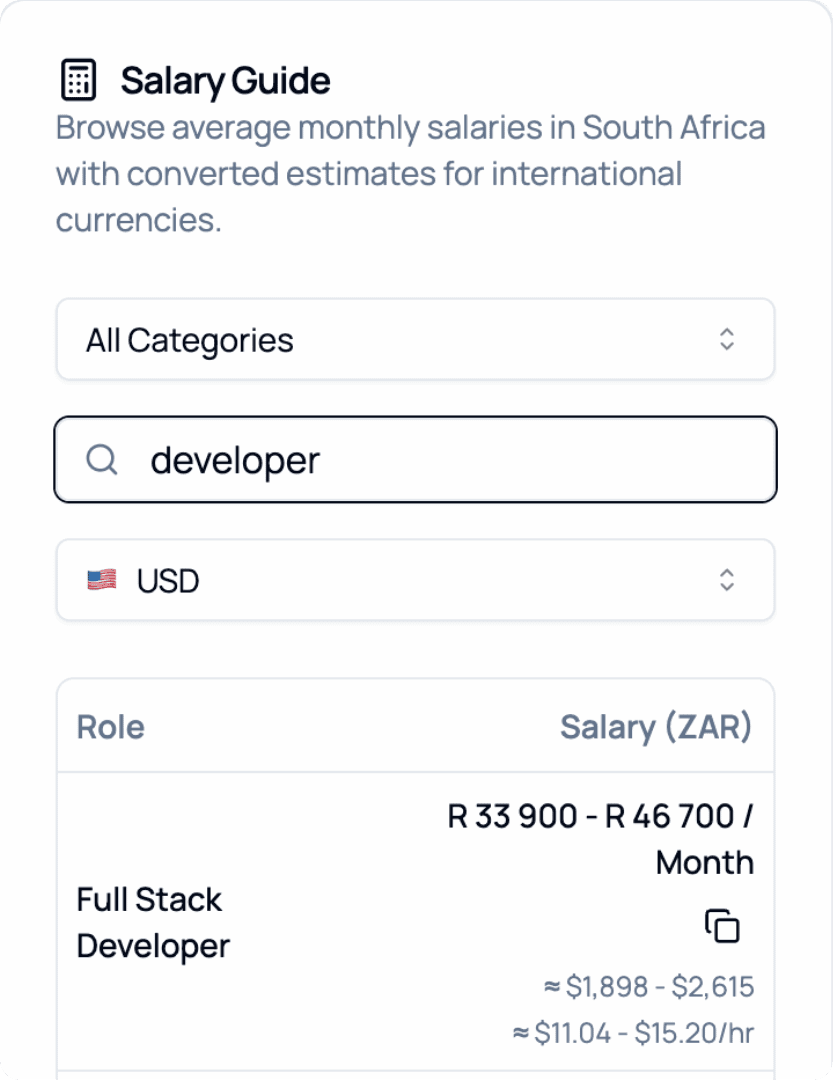
2026 Salary Guide: South Africa
Discover South African Salaries by Role. Compare costs and see how much you can save.