TL;DR
Find the best platforms to source remote talent directly without paying agency commissions.
Avoid costly legal mistakes like worker misclassification when hiring internationally.
Vet remote candidates yourself using async screening, behavioral questions, and test projects.
Table of Contents
- Introduction
- What Are the Most Effective Platforms for Sourcing Remote Talent Directly?
- How Do You Stay Legally Compliant When Hiring International Remote Talent Without an Agency?
- What Is the True Cost of Internal Recruitment vs Paying an Agency Fee?
- What Are the Best Methods for Vetting Remote Candidates Without an Agency?
- What's the Ideal Remote Onboarding Checklist Without an HR Department?
- Final Thoughts
Introduction
Recruitment agencies charge 20% to 30% of a candidate's first-year salary. For a $200,000 role, that's $40,000 to $60,000 gone before your new hire even starts. (source)
Most companies pay this because they think it's the only way. It's not.
You can hire remote professionals directly — without handing over a cut of your budget to a middleman. Platforms like HireSava connect you with qualified South African talent at no placement fee. But going the direct route still takes work. You need to know where to source, how to stay legally compliant across borders, how to vet candidates yourself, and how to onboard them properly.
This guide walks you through all of it. We'll cover the best platforms for finding remote workers in 2026, the legal risks most companies ignore, the real cost of doing recruitment in-house, how to interview for remote-specific skills, and a simple onboarding checklist you can use even without an HR department.
What Are the Most Effective Platforms for Sourcing Remote Talent Directly?
The best platforms combine high candidate quality with built-in filters for remote-readiness. Your strategy should mix generalist boards for reach, niche platforms for specialized roles, and regional hubs for time-zone alignment.
Generalist Platforms That Actually Work
We Work Remotely (WWR) pulls over 250,000 unique visitors a month and fills 90% of its listed positions. It has industry tags and regional filters that help you find candidates with the right time-zone overlap.
FlexJobs takes a different approach. Their team spends 200+ hours a day vetting employers and listings. Because candidates pay for a subscription, you get applicants who are serious — not mass-applying to everything they see.
Here's a quick comparison of the main platform types:
| Platform Type | Example | Key Advantage | Pricing |
|---|---|---|---|
| High-Trust Generalist | FlexJobs | Human-vetted listings; pre-screened, serious candidates | Employer subscription |
| Global Reach | We Work Remotely | Largest reach; 90% fill rate; time-zone tagging | $299 per 30-day listing |
| Tech/Startup Niche | Wellfound | Access to equity-minded developers; high technical signal | Free and paid options |
| Creative Niche | Dribbble | Portfolio-based sourcing for designers and UI/UX | Subscription/Pay-per-post |
| High-Volume Search | Indeed/LinkedIn | Massive scale; "remote" filters; resume databases | PPC or flat-fee |
Niche Boards for Technical and Creative Roles
Generalist boards tend to flood you with unqualified CVs for specialized positions. For tech and startup roles, Wellfound (formerly AngelList Talent) focuses on developers and ops people who are used to fast-paced, distributed teams. For designers and creatives, skip the resume and go straight to portfolio platforms like Dribbble and Behance where you can judge actual work.
Regional Talent Hubs and Time-Zone Strategy
A growing trend in 2026 is hiring from specific regions rather than casting a global net. US companies are targeting Latin America through platforms like Get on Board and Torre — getting 30-40% salary savings with near-perfect time-zone alignment. For European coverage, EU Remote Jobs offers curated listings optimized for those time zones.
South Africa is another strong option. English proficiency is high, the time zone overlaps with both US East Coast mornings and European afternoons, and salary expectations are competitive. That's why platforms like HireSava exist — to connect businesses directly with SA-based professionals.
Don't Ignore "Informal" Channels
Some of the best hires happen in communities, not on job boards. Reddit threads like r/RemoteJobs, niche Slack groups, and Discord servers are where founders and team leads find people through referrals and conversation. It's less structured, but the culture-fit signal is strong.
How Do You Stay Legally Compliant When Hiring International Remote Talent Without an Agency?
When you skip the agency, you take on full responsibility for international labor compliance. The three biggest risks are worker misclassification, permanent establishment exposure, and data privacy violations. Get any of these wrong and the penalties can cost more than the agency fee you saved.
Worker Misclassification Is the Biggest Trap
Many companies classify all remote hires as "independent contractors" to avoid payroll taxes and benefits. But regulators don't care what your contract says — they look at how the relationship actually works. If you set fixed hours, provide tools, and supervise the work directly, that person is legally an employee. (source)
In Australia, a landmark ruling found that offshore workers performing core business functions under regular supervision are employees — entitled to superannuation and leave, regardless of location. Fines for getting this wrong can hit $93,900 per violation.
The "Permanent Establishment" Risk Most Companies Miss
Here's one that catches people off guard. If your remote worker in a foreign country can close deals or sign contracts on your behalf, your company may be considered to have a taxable presence in that country. That means you could owe corporate taxes there — on top of what you already pay at home.
The fix: limit the decision-making authority of employees in foreign jurisdictions. Keep contract-signing and revenue-generating activities centralized.
What Documents Do You Actually Need?
For US-based hires, you'll need the I-9 form (remote video verification is now accepted in many cases) and W-4 or W-9 forms. For international hires, put together a Remote Work Agreement that covers:
- Governing law — which country's laws apply
- IP ownership — explicitly assign it, or the worker may retain rights to what they build
- Termination procedures — notice periods and severance rules vary by country
- Equipment responsibilities — who provides and maintains the tools
- Data privacy — encrypted storage and processing agreements, especially for GDPR regions
Skip any one of these and you're exposed.
Quick Reference: Risk Matrix
| Risk | What It Means | What Happens | How to Avoid It |
|---|---|---|---|
| Misclassification | Treating an employee-like worker as a contractor | Back taxes, fines (up to $93,900 in AU), lawsuits | Use "Control Tests"; results-oriented management |
| Permanent Establishment | Creating a taxable presence through local activity | Corporate tax liability on profits; double taxation | Limit employee decision-making power in foreign jurisdictions |
| Wage Theft | Deliberate underpayment or non-payment of benefits | Imprisonment (up to 10 years), massive fines | Ensure local minimum wage and benefit compliance |
| Data Privacy | Improper handling of cross-border employee data | GDPR/local privacy fines; reputational damage | Encrypted storage; data processing agreements |
What Is the True Cost of Internal Recruitment vs Paying an Agency Fee?
Skipping the agency fee saves you 20-30% of a hire's annual salary. But internal recruitment isn't free. The average cost to bring on a new employee exceeds $4,000 — and that's before you factor in productivity loss during the vacancy.
The Direct Costs You'll Pick Up
An in-house recruiter in North America averages $85,000 per year. Add benefits (20-30% on top) and you're looking at $100,000+ in total compensation. Then there's the tech stack — an ATS like Greenhouse or Workable, LinkedIn Recruiter seats, sourcing tools like ZoomInfo. That's another $15,000 to $25,000 annually. (source)
An agency rolls all of this into their fee. So the math only works in your favor if you're hiring consistently enough to justify the overhead.
The Cost Nobody Talks About: Vacancy Time
Internal hiring is slower. It takes about 68 days on average to fill an executive role internally, compared to 45 days through an agency. That 23-day gap matters.
For a revenue-generating role that costs $5,000 per day in lost productivity, that delay adds up to $115,000 in missed output. Sometimes the "free" route ends up being the expensive one.
Side-by-Side Cost Breakdown
| Cost Component | Internal DIY Hiring | Recruitment Agency |
|---|---|---|
| Direct Fee | $0 (no agency commission) | 20-30% of first-year salary ($40k-$60k for $200k role) |
| Infrastructure | $15k-$25k/year for tech stack | Included in fee |
| Staffing | $85k-$110k per senior recruiter | $0 (for the company) |
| Time-to-Hire | ~68 days (slower) | ~45 days (faster) |
| Vacancy Cost | High ($4k-$10k per month for revenue roles) | Lowered by speed of placement |
| ROI Potential | High for high-volume, steady hiring | High for occasional, specialized, or urgent roles |
When Does DIY Hiring Actually Make Sense?
Internal recruitment pays off when you're:
- Hiring at volume — multiple roles per quarter across similar functions
- Building a repeatable pipeline — same role types with predictable sourcing channels
- Investing in employer brand — your company attracts inbound candidates organically
It doesn't make sense when you're filling one-off specialized roles or urgent executive positions. For those, the agency speed premium is worth it.
A Simpler Option: No-Fee Marketplaces
There's a middle ground most people overlook. No-fee hiring platforms give you access to pre-vetted talent pools without the agency commission or the overhead of building an internal team. You get direct access to candidates, handle the interviews yourself, and pay nothing for the placement.
What Are the Best Methods for Vetting Remote Candidates Without an Agency?
Use a three-step process: async video screening to filter fast, behavioral interviews focused on remote-specific skills, and paid test projects to see real work before committing. This replaces the "gut feel" approach that fails in remote hiring.
Start With Async Video Screening
Scheduling live interviews across time zones is a nightmare. Tools like Willo and Spark Hire let candidates record answers to your questions on their own time. You review them when it's convenient.
This also doubles as a test. If someone can't navigate a simple browser-based video tool or give a clear, structured answer on camera, they're probably not going to thrive in a distributed team.
Ask Questions That Reveal the "Remote Mindset"
Standard interview questions don't work for remote roles. You need to test for autonomy, async communication, and self-management. Here are four that actually surface useful signals:
- On autonomy: "Tell me about a time you thrived working remotely. What made it work?" — Look for proactive scheduling and self-discipline, not just "I liked working from home."
- On problem-solving: "How do you get answers to urgent questions when your manager is 12 time zones away?" — You want resourcefulness. People who check docs first, then ask, beat people who wait.
- On boundaries: "How do you switch off when your home is your office?" — Burnout awareness matters. Good remote workers have routines.
- On tech skills: "What tools do you use to stay organized, and how would you rate your ability to troubleshoot your own tech issues?" — Self-sufficiency with Slack, Zoom, VPNs, and basic troubleshooting is non-negotiable.
Here's a cheat sheet you can hand to your hiring managers:
| Competency | Question | What to Look For |
|---|---|---|
| Autonomy | "Tell me about a time you thrived while working remotely. What worked well?" | Proactive scheduling and self-discipline |
| Problem Solving | "How do you get answers to urgent questions when your supervisor is 12 time zones away?" | Resourcefulness; documentation use; active pursuit |
| Boundary Setting | "How do you switch off when your home is your office?" | Burnout awareness; structured routines |
| Tech Skills | "What tools have you used to stay organized, and can you troubleshoot your own tech issues?" | Proficiency with Slack, Zoom, VPNs; self-sufficiency |
Use Paid Test Projects Before You Commit
Resumes are poor predictors of remote performance. A better approach: hire 2-3 candidates for a small, paid, one-week project. You'll see their communication speed, work quality, and ability to meet deadlines — all the things that actually matter for remote work. (source)
For technical roles, platforms like HackerEarth run real-world coding simulations that test practical ability, not whiteboard trivia.
What's the Ideal Remote Onboarding Checklist Without an HR Department?
Ship hardware early, provision all software before Day 1, assign a welcome buddy, and set clear 30-60-90 day goals. A structured first week prevents the disengagement that causes most remote hires to quit within 90 days.
Before Day 1: Get the Logistics Right
The worst thing you can do is give someone a "dead" first day where they're sitting around waiting for access. Before they start:
- Ship hardware early — laptop, monitor, headset. Send tracking numbers so they know it's coming. (source)
- Provision software access — VPN, Slack, email, project management tools, ATS. Everything should be ready to go on login.
- Complete digital paperwork — contracts, tax forms (I-9, W-9 for US), NDAs. Get this done before Day 1 so the first morning isn't spent on admin.
Week 1: Social Integration Matters More Than You Think
Remote isolation is real. Without the hallway chats and lunch invites of an office, new hires can feel invisible. Two things that help:
- Assign a Welcome Buddy — not their manager, but a peer who can answer the "dumb" questions. Things like "how do people actually use the #general channel?" or "is it okay to message the CEO directly?" (source)
- Schedule virtual coffee chats — 15-minute calls with different team members during the first week. No agenda. Just putting faces to names.
The 30-60-90 Day Plan
Clear expectations prevent the slow drift into disengagement. Give your new hire a simple progression:
- 30 days: Learn the ropes. Meet stakeholders. Get comfortable with the tools and communication norms.
- 60 days: Start owning workflows. Deliver first small wins. (source)
- 90 days: Full integration. Evaluated against the core metrics of the role. Start discussing growth and development.
You don't need an HR department to do this. You just need a written plan and a manager who follows through.
The Full Checklist at a Glance
| Step | Action Item | Owner | Purpose |
|---|---|---|---|
| 1 | Ship hardware/swag | IT/Operations | Practical readiness; feeling valued |
| 2 | Digital paperwork (I-9, W-9, contract) | Founder/Admin | Legal compliance before Day 1 |
| 3 | Assign "Welcome Buddy" | Manager | Reducing isolation; social support |
| 4 | 30-minute virtual tour of workspace | IT/Manager | Understanding the "digital office" |
| 5 | Define 90-day success metrics | Manager | Goal clarity; performance alignment |
| 6 | 30-day formal check-in | HR/Manager | Identifying early pain points or misfits |
Final Thoughts
Hiring remote talent without fees comes down to doing the work agencies normally do — but smarter. Source from the right platforms. Stay compliant across borders. Vet for remote-specific skills, not just technical ability. And onboard with enough structure that your new hire doesn't feel like they're figuring it out alone.
It's more effort than writing a check to a recruiter. But the payoff is a direct relationship with your talent, no middleman markup, and a hiring process you actually control.
If you want to skip the overhead entirely, HireSava connects you with qualified South African remote professionals — no placement fees, no commissions.
Explore related hiring options
Useful next pages based on this article's topic:
- Virtual Assistant role overview — hiring and onboarding guidance
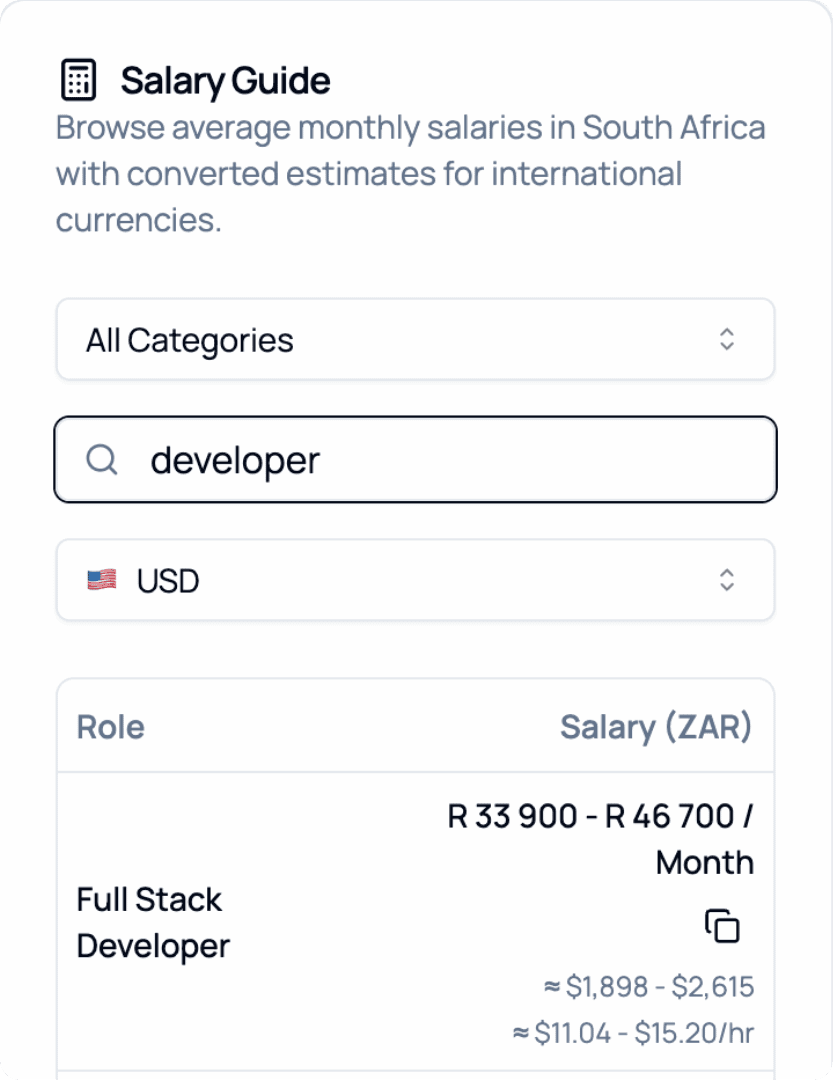
2026 Salary Guide: South Africa
Discover South African Salaries by Role. Compare costs and see how much you can save.