TL;DR
Learn how broker teams can use a mortgage closing coordination virtual assistant to improve clear-to-close execution and reduce last-minute delays.
Apply a practical workflow for title/escrow coordination, closing package QA, borrower communication, and escalation control.
Track closing-stage ROI using 30/60/90-day KPI targets tied to cycle reliability, error reduction, and team capacity.
Table of Contents
- Introduction
- What does a closing coordination VA handle?
- Which closing tasks should broker teams delegate first?
- How do you prevent clear-to-close delays?
- What compliance boundaries apply at closing stage?
- Which KPIs prove closing coordination ROI?
- 30/60/90 closing coordination rollout plan
- Advanced operating playbook for broker leaders
- Deep-dive implementation framework: from clear-to-close chaos to controlled execution
- 12-week rollout by milestone
- Final Thoughts
Introduction
If your team gets files to underwriting but still loses time near the finish line, use this guide with the broader insurance industry page to build a tighter closing-stage operating model.
Broker teams often underestimate how fragile the final stage can be. By the time a file is near clear-to-close, everyone assumes the hard part is done. In reality, this is where timeline stress, communication gaps, and coordination misses can still kill borrower trust and create avoidable reschedules.
A mortgage closing coordination virtual assistant can stabilize this stage when scope and escalation rules are explicit. The role is not about making legal or underwriting decisions. It is about keeping every close-related workflow moving with discipline: title and escrow coordination, final checklist execution, borrower prep communication, milestone tracking, and exception routing.
This guide gives US broker teams a practical system for delegation, quality control, compliance-safe operations, and measurable ROI at the closing stage.
For connected workflows, review Mortgage Processing Virtual Assistant Guide for US Lenders, Loan Processing Virtual Assistant Guide for US Mortgage Brokers, Mortgage Underwriting Support Virtual Assistant Guide for US Broker Teams, Virtual Assistant Onboarding Checklist for 2026, and How to Hire Remote Talent Without Recruiting Fees.
For factual guardrails, this article aligns with public resources from CFPB mortgages, HUD homeownership, Fannie Mae Selling Guide, Freddie Mac Guide, and NMLS Consumer Access.
What does a closing coordination VA handle?
Snippet answer: A mortgage closing coordination VA handles repeatable, deadline-sensitive execution such as final checklist tracking, title/escrow communication support, appointment coordination, milestone updates, and escalation-ready issue logs under broker supervision.
The key is to assign work by risk tier, not by convenience.
Typical responsibilities include:
- Clear-to-close checklist monitoring and deadline tracking.
- Closing calendar management and appointment coordination.
- Borrower communication support for required final steps.
- Title/escrow follow-up for status visibility and document flow.
- LOS milestone hygiene and status-update consistency.
- Final document collection tracking and packet readiness support.
- Exception log preparation for processor/broker escalation.
The risk-tier model for closing-stage delegation
- Execution lane: scheduling, checklist tracking, status confirmations, reminders.
- Exception-prep lane: discrepancy documentation, timestamped escalation packets.
- Decision lane: legal/policy interpretation, underwriting judgment, final approvals.
A closing coordination VA should own lane 1, assist lane 2, and never own lane 3.
Why this role creates disproportionate value
Closing-stage work is high-pressure and time-sensitive. Even small misses can trigger expensive reschedules and reputational damage. A disciplined coordinator reduces avoidable friction by making deadlines visible and ownership explicit.
Which closing tasks should broker teams delegate first?
Snippet answer: Delegate high-frequency, low-judgment tasks first—checklist execution, milestone updates, scheduling, and communication cadence—then expand scope after quality thresholds are stable.
Teams that try to delegate complex exception handling too early usually create rework. Build trust through clean execution first.
Phase 1 (delegate immediately)
- Closing checklist status tracking.
- Borrower reminder cadence for outstanding items.
- Calendar and appointment coordination.
- Milestone updates in LOS/task board.
- Title/escrow status follow-up support.
- Internal pipeline update prep for daily standup.
Phase 2 (delegate after QA stability)
- Final package organization support.
- Closing-day readiness verification check.
- Structured escalation packet prep for timeline risks.
- Cross-party coordination support for scheduling conflicts.
Non-delegable tasks (keep with licensed/internal owners)
- Legal or policy interpretation.
- Advice that may affect borrower decisioning.
- Underwriting or compliance judgment calls.
- Final signoff on exception approvals.
Practical delegation rule
Delegate repeatability. Escalate ambiguity. Keep judgment with accountable owners.
How do you prevent clear-to-close delays?
Snippet answer: Prevent delays with a clear-to-close control system: micro-SLAs, checklist enforcement, proactive borrower communication, and immediate escalation of risk signals.
Most clear-to-close delays are not random. They are process failures repeated quietly.
Build a clear-to-close control board
Track every active file with these minimum fields:
- File ID and borrower identifier.
- Current close milestone and due date.
- Outstanding requirement list.
- Owner by task.
- Next action timestamp.
- Risk flag level.
- Escalation owner and deadline.
No visible board, no reliable close velocity.
Micro-SLAs that keep momentum
Suggested baseline SLAs:
- Update milestone status within 60 minutes of change.
- Confirm borrower-submitted item receipt within 2 business hours.
- Escalate timeline-blocking issue within 1 business hour.
- Send end-of-day close-risk summary for next 72 hours.
Micro-SLAs turn “urgent” into measurable operations behavior.
Communication cadence that reduces borrower anxiety
A strong closing coordinator uses a predictable communication rhythm:
- Milestone confirmation message at each major step.
- Plain-language reminder for remaining items.
- Confirmation once an item is accepted.
- Clear explanation of next step and expected timing.
Confused borrowers create avoidable back-and-forth that delays closing.
High-frequency delay patterns to eliminate
- Incomplete final checklist handoffs.
- Last-minute document naming/indexing confusion.
- Unowned scheduling conflicts.
- Escalations sent without context.
- Milestones updated in one system but not another.
These are fixable with process discipline, not heroics.
What compliance boundaries apply at closing stage?
Snippet answer: Closing-stage support must follow strict boundaries: least-privilege access, approved communication templates, auditable SOP workflows, and immediate handoff of any decision-sensitive issue to licensed staff.
Speed and compliance can coexist when guardrails are explicit.
Access and system controls
- Grant only task-required system permissions.
- Restrict edits on sensitive fields.
- Use secure credential workflows and activity logs.
- Review access periodically and after role changes.
Template governance
Closing communication should use approved templates with version control:
- Required final-item requests.
- Appointment confirmation scripts.
- Escalation handoff format.
- Delay-notification format.
Free-form high-pressure messaging is where risk and confusion rise.
Escalation triggers (non-negotiable)
Escalate immediately if:
- A required item is overdue beyond SLA.
- Borrower asks policy/legal interpretation questions.
- Cross-party timeline conflict threatens closing date.
- Document mismatch could affect approval conditions.
- Complaint tone indicates fallout risk.
Early escalation prevents downstream compression and preventable mistakes.
QA governance at closing stage
Use two QA layers:
- Daily quick QA: status accuracy + communication compliance checks.
- Weekly deep QA: trend analysis on delays, rework causes, and missed SLAs.
QA must produce SOP updates, not just scorecards.
Which KPIs prove closing coordination ROI?
Snippet answer: Closing-stage ROI is proven through fewer reschedules, improved milestone reliability, faster issue resolution, and recovered broker/processor capacity.
30-day KPIs (stability)
- Closing checklist completion rate.
- On-time milestone update rate.
- Borrower communication SLA adherence.
- Escalation timeliness.
60-day KPIs (throughput reliability)
- Clear-to-close delay rate trend.
- Closing reschedule frequency.
- Average issue-resolution time.
- Rework events per closing file.
90-day KPIs (business impact)
- Licensed staff admin hours recovered.
- Percentage of closings executed on planned date.
- Borrower communication complaint trend.
- Capacity gain per processor/loan officer.
Practical ROI model
- Estimate monthly licensed-team hours spent on closing admin coordination.
- Calculate safely delegable share.
- Multiply by blended internal value/hour.
- Add value from avoided reschedules/rework.
- Subtract full support cost (staff + tools + QA oversight).
When measured properly, the biggest gain is consistency, not hourly arbitrage.
30/60/90 closing coordination rollout plan
Days 1–30: stabilize execution
- Map close-stage workflow and bottleneck points.
- Build checklist templates by product/lender lane.
- Define escalation triggers and owner map.
- Launch on low-risk files and audit every case.
Deliverable: baseline quality and predictable communication rhythm.
Days 31–60: improve velocity
- Expand scope after KPI thresholds hold.
- Add risk-level queue segmentation.
- Standardize escalation packet format.
- Run weekly root-cause loop for delay categories.
Deliverable: measurable reduction in avoidable close-stage delays.
Days 61–90: scale with controls
- Shift to risk-based QA sampling on stable lanes.
- Add backup coverage and surge planning.
- Deploy monthly leadership dashboard.
- Lock scale-readiness criteria for additional support lanes.
Deliverable: repeatable close-stage operating lane with durable KPI control.
Advanced operating playbook for broker leaders
Build a close-stage handoff contract
Before file enters final coordination, require:
- Clear owner map.
- Final item list with due dates.
- Known risks and contingencies.
- Communication owner by party (borrower/title/escrow/internal).
If handoff is incomplete, do not accept it as “active close-ready.”
Use a three-bucket risk queue
- Green: on-track files.
- Yellow: potential schedule friction.
- Red: active threat to close date.
This keeps leadership focused on real risk, not noise.
Standardize end-of-day risk digest
Every day, publish:
- Closings in next 72 hours.
- Top blockers by severity.
- Required decisions by owner.
- Time-sensitive next actions.
Predictability beats firefighting consistently.
Scale guardrails before adding another coordinator
Add headcount only when:
- Existing coordinator lane sustains KPI thresholds.
- SOP coverage is complete for recurring tasks.
- Escalation quality remains high under volume.
- QA review capacity can absorb increased throughput.
If these conditions are missing, adding people usually multiplies inconsistency.
Weekly checklist for management
- [ ] Are close-risk files visible 72 hours ahead?
- [ ] Are escalation packets complete and actionable?
- [ ] Are borrower communications within SLA?
- [ ] Are recurring delay causes documented?
- [ ] Were SOP updates pushed from QA findings?
If any answer is no for multiple weeks, fix system design before scaling volume.
Deep-dive implementation framework: from clear-to-close chaos to controlled execution
If your team wants durable gains, not one-month improvements, run this framework rigorously.
1) Design a closing-stage SOP stack by scenario
Avoid one generic close-stage SOP. Build a stack with variants for common scenarios:
- Purchase vs refinance lanes.
- Standard file vs complexity-heavy file lanes.
- Product/lender-specific close requirements.
- Different title/escrow coordination patterns.
Each SOP should include owner, SLA, escalation trigger, and completion proof. Without completion proof, you cannot audit quality reliably.
2) Add a close-readiness score before appointment confirmation
Before confirming final close logistics, score each file on five factors:
- Remaining item completeness.
- Timeline confidence.
- Cross-party confirmation status.
- Communication clarity status.
- Escalation risk level.
If score is below threshold, the file moves to yellow or red risk queue automatically. This prevents false confidence and last-minute collapse.
3) Define an escalation packet that decision-makers can act on immediately
A weak escalation note wastes time. Standardize one format:
- What is blocked right now?
- What evidence confirms the block?
- What is the close-date impact?
- What decision is needed and by when?
- What are the fallback options?
This turns escalation into a decision product, not a vague alert.
4) Build borrower communication clarity standards
At closing stage, borrowers are sensitive to uncertainty. Message quality matters more than message volume.
Use these standards:
- One request per paragraph.
- Explicit due date and local time reference.
- Exact document/type naming examples.
- Confirmation of receipt within same business day.
- Next-step summary in one short block.
Clear messages lower confusion-driven delays and complaint risk.
5) Run a “72-hour close-risk view” every day
Publish a daily panel showing all files closing in next 72 hours with:
- Risk bucket (green/yellow/red).
- Blockers and owners.
- Time to deadline.
- Required decisions pending.
- Recovery plan status.
This gives leadership a proactive view and removes surprise escalations.
6) Use recurring-delay taxonomy to drive improvements
Track delay causes with fixed taxonomy tags:
- Borrower document delay.
- Internal handoff delay.
- Title/escrow coordination delay.
- Checklist quality miss.
- Communication ambiguity.
- Unclear ownership.
When you track delays by category, your SOP updates become precise and faster.
7) KPI thresholds for scale readiness
Set non-negotiable thresholds before increasing lane capacity:
- 95%+ on-time close-stage milestone updates.
- 90%+ borrower communication SLA adherence.
- Downward trend in reschedules for 4 consecutive weeks.
- Escalation packet completeness >95%.
- QA pass rate stable above internal target.
If these are not true, keep optimizing process before adding more files or staff.
8) Monthly leadership review template
A good monthly review should answer five questions:
- Did on-time closing reliability improve or degrade?
- What are the top three delay causes and owners?
- Which SOP updates were shipped and validated?
- Is current staffing aligned with risk volume?
- What change next month will have highest ROI?
No decision loop, no sustained performance gains.
9) Common execution failures and direct fixes
-
Failure: Team updates LOS late.
Fix: Enforce milestone update SLA + daily audit spot-check. -
Failure: Borrower messages are inconsistent by team member.
Fix: Template lock with version control and review cadence. -
Failure: Escalations arrive too late.
Fix: Hard trigger thresholds with auto-notification rules. -
Failure: Closing calendar conflicts appear day-of.
Fix: 72-hour risk digest + owner confirmation checkpoints. -
Failure: QA finds same error repeatedly.
Fix: Root-cause entry required with SOP update owner and due date.
10) Operating principle that keeps close-stage quality stable
Treat every close like a production release:
- Checklist complete.
- Dependencies verified.
- Risks logged.
- Owners assigned.
- Rollback/contingency known.
That mindset shifts your team from reactive chasing to controlled execution.
12-week rollout by milestone
Weeks 1–2
- Audit recent close-stage failures.
- Build baseline SOP stack and templates.
- Define risk buckets and escalation map.
- Capture baseline KPI dashboard.
Weeks 3–4
- Launch with selected file segment.
- Audit all close-stage actions daily.
- Calibrate communication templates.
- Start recurring-delay taxonomy tracking.
Weeks 5–6
- Expand volume only if QA threshold holds.
- Add close-readiness score requirement.
- Enforce 72-hour risk panel ritual.
- Improve escalation packet quality.
Weeks 7–8
- Shift to mixed QA model (full + risk-based sampling).
- Tighten cross-party coordination scripts.
- Push SOP revisions from trend findings.
- Validate milestone-update SLA adherence.
Weeks 9–10
- Evaluate throughput vs stability tradeoffs.
- Optimize queue routing by risk segment.
- Finalize backup coverage for absences/spikes.
- Review staffing need for second coordinator lane.
Weeks 11–12
- Confirm stable KPI trend across a full cycle.
- Lock leadership review cadence for next quarter.
- Define next automation opportunities.
- Approve scale plan only if quality remains stable.
Final Thoughts
A mortgage closing coordination virtual assistant can become one of the highest-leverage roles in a broker operation because it protects the most fragile stage: the finish line where timelines, expectations, and execution quality all converge.
Treat closing coordination like a controlled system, not a set of ad-hoc reminders. Define task boundaries, enforce micro-SLAs, escalate fast, and run weekly root-cause improvements. Do that consistently and your team will close more files on plan with less stress, less rework, stronger accountability, and cleaner stakeholder communication.
For broader financial-services staffing context, keep execution anchored to the insurance industry page and connect role rollout to your existing onboarding, QA, and capacity planning playbooks. When these mechanics are respected every week, close-stage reliability becomes a compounding advantage that improves referral trust, team confidence, and operational predictability across seasons, markets, and changing lender conditions.
Explore related hiring options
Useful next pages based on this article's topic:
- Remote Policy Admin Specialist role — policy workflows, endorsements, and renewals
- Claims Processing service — faster claims handling and reduced admin drag
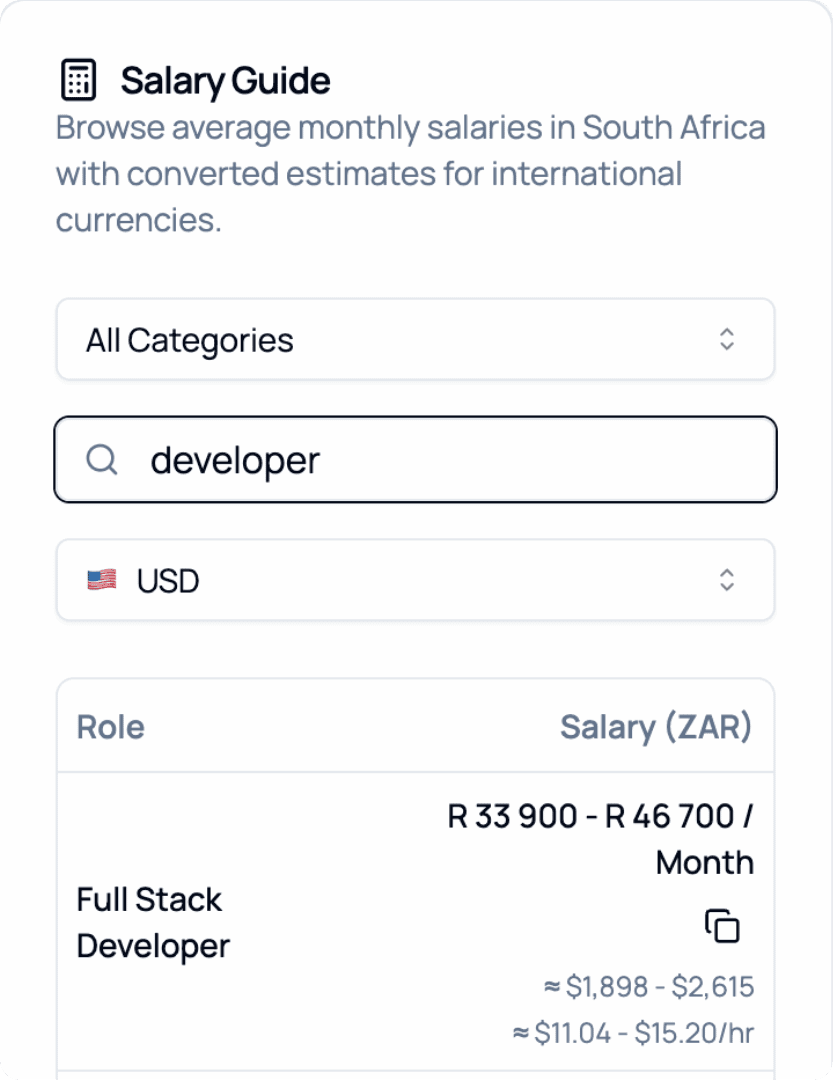
2026 Salary Guide: South Africa
Discover South African Salaries by Role. Compare costs and see how much you can save.