TL;DR
Avoid the 7 deadly mistakes of hiring VAs, such as hiring without defined SOPs or prioritizing the "cheapest" rates over value.
Learn why timezone alignment is critical: South Africa offers a "Golden Window" of overlap for US and UK/EU founders.
A successful hire requires a structured paid trial project, not just a "vibes-based" interview.
Table of Contents
- Introduction: The Day You Hit "The Wall"
- 1. Hiring Without a Defined Workflow
- 2. Prioritizing Cost Over Value
- 3. Neglecting the "Communication Stack"
- 4. Skipping the Paid Trial Project
- 5. Underestimating Timezone Overlap
- 6. Over-Managing vs. Under-Managing
- 7. Ignoring the Onboarding Experience
- People Also Ask
- Conclusion: Building for the Long Term
Introduction: The Day You Hit "The Wall"
In the lifecycle of every high-growth business, there is a predictable, painful inflection point. It’s the moment where your sheer force of will—the same grit that got you to your first $10k or $100k—stops being the engine of growth and becomes its primary constraint.
We call this "The Wall." You hit it when your biological capacity to execute is maxed out. You’re the bottleneck for every Slack message, every customer support ticket, and every social media post. At this stage, you aren't scaling your company; you’re just stretching yourself thinner.
To breach the wall, you have to transition from a Solo Operator to an Organizational Architect. This transition usually starts with your first remote hire—typically a Virtual Assistant (VA). But because this person is "Employee #1," the stakes are astronomical. They aren't just a helper; they are the co-author of your company's operating system.
Here is the no-nonsense guide to the mistakes that cost founders thousands of dollars and months of wasted time—and how to do it right the first time.
1. Hiring Without a Defined Workflow
The most common mistake founders make is trying to delegate chaos. You think, "I'm drowning in emails; I'll hire a VA to handle them." But if you haven't defined how you handle emails, you’ve just invited someone else to drown with you.
In organizational theory, there is a difference between Tacit Knowledge (the stuff in your head) and Explicit Knowledge (the stuff on paper). If your business relies on tacit knowledge, it cannot scale.
The Founder’s Fix: Don't hire to create the system; hire to execute the system. Use the Loom-to-Notion Pipeline:
- Record: Next time you do a repetitive task (scheduling, invoicing, lead gen), record your screen using Loom. Speak your thought process out loud.
- Transcribe: Give that video to your new hire.
- Standardize: Their first task is to turn that video into a written Standard Operating Procedure (SOP) in Notion or ClickUp.
Now, you don't just have a hire; you have a documented asset.
2. Prioritizing Cost Over Value
It is tempting to go to a global marketplace and filter by "Lowest Price." But in remote hiring, you get exactly what you pay for. A $5/hour hire who requires three hours of your management time per day is infinitely more expensive than an $18/hour professional who requires twenty minutes.
The Hidden Cost of High-Turnover Talent:
When you hire strictly on price, you are often hiring someone who is using your role as a "stop-gap" while they look for something better. If they leave after three months, you lose the time you spent training them, the momentum of your projects, and the mental energy of starting the search over.
The South African "Sweet Spot":
This is why many US and UK founders are pivoting toward South African talent.
- English Proficiency: South Africa is consistently ranked as one of the top English-speaking countries in the world (often #1 in Africa on the EF English Proficiency Index).
- Cultural Affinity: There is a shared "corporate DNA." South African pros tend to be assertive, direct, and familiar with Western business nuances.
- Education: You are often hiring university-educated professionals who are looking for long-term career growth, not just a gig.
3. Neglecting the "Communication Stack"
Distance requires a deliberate structure. In a physical office, you can lean over a desk to clarify a goal. In a remote setup, if your communication is fragmented across WhatsApp, Gmail, and Slack DMs, information will die.
The Reality: Your software is your office.
The "Single Source of Truth" (SSOT) Framework:
To avoid the "Where is that file?" syndrome, you must establish three tiers of communication:
- Tier 1: Project Management (Notion/ClickUp/Asana). This is where the work lives. If a task isn't in the PM tool, it doesn't exist.
- Tier 2: Asynchronous Communication (Slack/Teams). For quick updates and "watercooler" talk.
- Tier 3: Face-to-Face (Zoom/Google Meet). For high-level strategy and building rapport.
Pro Tip: Discourage "Private DMs" for project-related questions. Encourage your VA to ask questions in public project channels so the whole team benefits from the answer.
4. Skipping the Paid Trial Project
An interview is a test of how well someone can talk. A trial project is a test of how well someone can work. Too many founders hire based on a "good vibe" during a 30-minute Zoom call, only to realize two weeks later that the hire can’t follow a three-step instruction.
How to Design a "Micro-Project":
Don't ask them to work for free—that’s a red flag for top-tier talent. Instead, assign a 2-4 hour paid task that mimics their actual daily work.
What to look for during the trial:
- The "Clarifying Question" Metric: Do they ask smart questions before starting, or do they guess and get it wrong?
- The Formatting Test: Did they follow the specific naming conventions you requested?
- The Deadline Test: Even if the work is perfect, if it’s late without a heads-up, it’s a red flag for a remote setup.
5. Underestimating Timezone Overlap
The "Follow the Sun" model (where you work while they sleep) sounds great in a brochure. In reality, for your first hire, it’s usually a disaster. If you have a 12-hour gap, every question results in a 24-hour delay.
The "Golden Hours" Rule:
You need at least 3 to 4 hours of overlap every day. This is the "Golden Window" where you can sync, unblock tasks, and build a relationship.
| Region | Overlap with US East Coast | Overlap with UK/Europe | | :---- | :---- | :---- | | Philippines | 0-1 Hours (Difficult) | 2-3 Hours | | Eastern Europe | 2-3 Hours | 7-8 Hours | | South Africa | 6-7 Hours (Excellent) | 8-9 Hours (Perfect) |
South Africa sits in GMT+2, making it the most geographically strategic hub for founders who want to avoid the "lag loop."
6. Over-Managing vs. Under-Managing
Founders usually fall into one of two traps:
- The Micromanager: Tracking every keystroke and asking "Are you there?" every 10 minutes. This kills morale and drives away high-performers.
- The Ghost: Hiring someone, giving them a login, and disappearing for a week. This leads to the VA feeling lost and eventually disengaging.
The Solution: Autonomy + Accountability.
You achieve this through the Definition of Done (DoD). Never say: "Can you look into some leads for me?"
Instead say: "This task is 'Done' when I have a Google Sheet with 20 leads, their verified LinkedIn URLs, and their company's annual revenue, sorted by highest to lowest."
The 15-Minute Weekly Sync:
Don't do soul-crushing hour-long meetings. Do one 15-minute video call a week.
- What did you finish?
- Where are you stuck (the "Blockers")?
- What is the #1 priority for next week?
7. Ignoring the Onboarding Experience
The first 7 days determine the next 7 months. If a hire feels like an afterthought on Day 1, they will never fully "lean in" to your business.
The "Welcome Packet" Strategy:
Create a simple document that covers:
- Culture: "We value direct honesty over polite delays."
- Tooling: How we use Slack (e.g., "Use threads, don't spam the main channel").
- The 30/60/90 Day Roadmap:
- Day 30: Mastery of the basic recurring tasks.
- Day 60: Identifying inefficiencies in the current process.
- Day 90: Full ownership of a specific department (e.g., Customer Support).
People Also Ask
Q: Is it better to hire a generalist VA or a specialist?
A: For your first hire, go for a "High-Level Generalist." You need someone who can pivot between admin, basic marketing, and operations. As you grow, you can hire specialists (like SEO experts or Bookkeepers).
Q: Why choose South African VAs over other regions?
A: Cultural alignment and English proficiency. South African talent often understands the "nuance" of Western business communication, which reduces the management overhead for the founder.
Q: What is the average cost of a high-quality remote VA?
A: While you can find VAs for $5, a high-performing, career-oriented remote professional usually ranges from $12 to $22 USD per hour, depending on their skill set.
Q: How do I know when I'm ready to hire?
A: Use the "80% Rule." When 80% of your day is spent on tasks that don't require your unique expertise (like scheduling or data entry), you are already late to the hire.
Conclusion: Building for the Long Term
The Shift: Move from "Hiring a Helper" to "Building a System"
Your first remote hire isn’t just an extra pair of hands; they are the architect of your freedom. The goal isn't just to get through today's to-do list—it's to build a repeatable system that allows your business to function (and grow) while you sleep.
The Final Thought
You don’t need to be an HR expert or a corporate veteran to build a world-class team. You just need a proven process and access to a top-tier talent pool that understands your vision. Avoid the "cheap" traps, respect the timezone "Golden Hours," and treat your onboarding like the foundation of a skyscraper.
Ready to find your next A-Player?
Don't let the "Wall" stop your growth. At HireSava, we move past the guesswork of global hiring. We focus on connecting you with top-tier South African professionals who bring high-level English proficiency, cultural alignment, and a "get-it-done" attitude to your business.
Whether you're in the US, UK, or Australia, we bridge the gap so you can stop being the bottleneck and start being the CEO.
Explore Top-Tier South African Talent at HireSava Today
Explore related hiring options
Useful next pages based on this article's topic:
- Virtual Assistant role overview — hiring and onboarding guidance
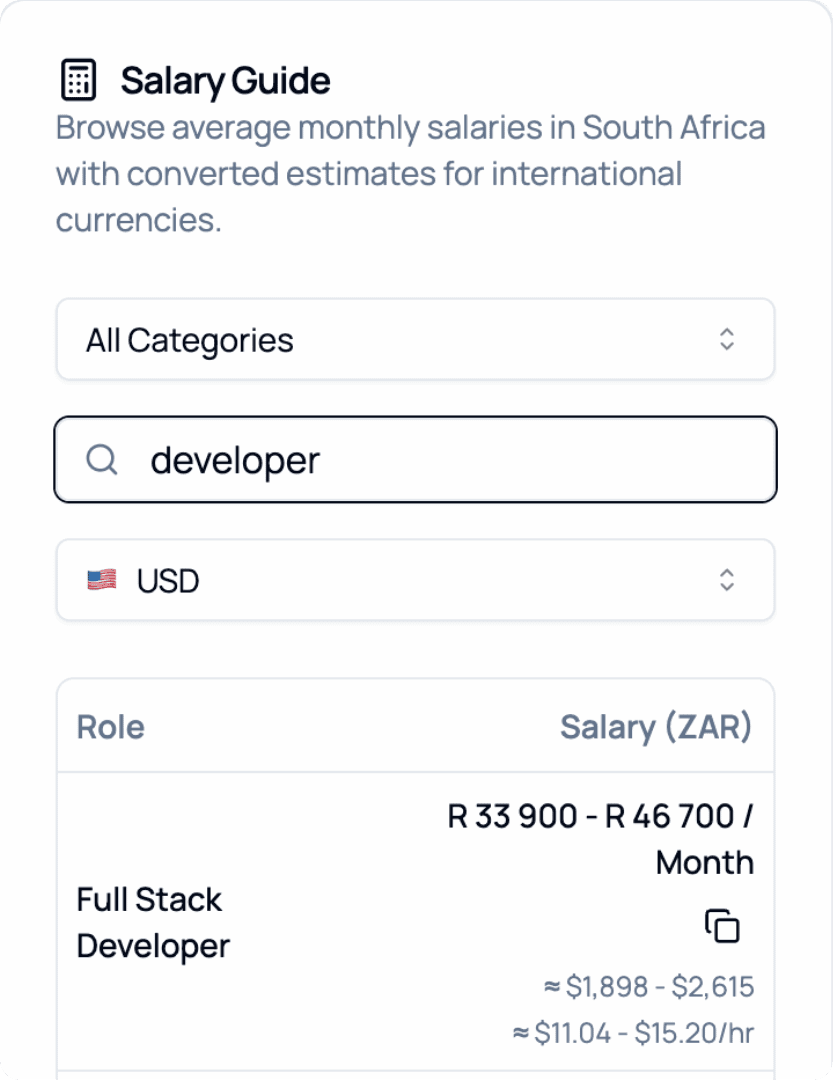
2026 Salary Guide: South Africa
Discover South African Salaries by Role. Compare costs and see how much you can save.