TL;DR
Learn what a virtual assistant for entrepreneurs should own first, which tasks to keep in-house, and how to build clear delegation boundaries.
Use a practical ROI model based on reclaimed founder hours, faster lead follow-up, cleaner operations, and improved client retention workflows.
Follow a 30-60-90 hiring and onboarding framework to scale with process discipline instead of founder bottlenecks.
Table of Contents
- Introduction
- What does a virtual assistant for entrepreneurs actually do?
- Which tasks should entrepreneurs delegate first?
- How much does a virtual assistant for entrepreneurs cost, and what ROI is realistic?
- How do entrepreneurs hire and onboard a virtual assistant successfully?
- What mistakes do entrepreneurs make with virtual assistants, and how can you avoid them?
- Final Thoughts
Introduction
If you are evaluating operational support for a growing coaching or service business, start with the Entrepreneurs industry page at /industries/entrepreneurs. Most founders do not hit a growth ceiling because demand disappears. They hit it because the founder remains the single point of execution for scheduling, inbox triage, follow-up, CRM updates, delivery logistics, billing handoffs, and team coordination.
That is where a virtual assistant for entrepreneurs changes the model. The role is not just "extra help." It is structured execution capacity that protects founder time and improves consistency across core workflows.
For early-stage and mid-stage entrepreneurs, the core challenge is not whether to delegate. The real challenge is how to delegate without creating quality drift. If handoff happens without clear lanes, documented SOPs, and measurable ownership, the founder still becomes the bottleneck through rework and constant clarification.
This guide is built around five People Also Ask questions buyers use before they hire. You will get practical answers on role scope, delegation order, cost and ROI, hiring and onboarding, and the most common failure points.
Use this guide alongside implementation resources already on the blog: Virtual Assistant for Coaches Guide: Systems, Costs, and Scale, How to Hire a Virtual Assistant for Small Business in 2026, Virtual Assistant Onboarding Checklist for 2026, Virtual Assistant Cost Calculator Guide for SMB Teams, How to Hire Remote Talent Without Recruiting Fees, 7 Mistakes to Avoid When Hiring Your First VA, and Why Hire a Virtual Assistant.
External references in this article are anchored to reputable organizations including the U.S. Small Business Administration, U.S. Bureau of Labor Statistics, IRS small business recordkeeping guidance, Federal Trade Commission cybersecurity guidance for small business, and professional context from the International Coaching Federation.
What does a virtual assistant for entrepreneurs actually do?
Snippet answer: A virtual assistant for entrepreneurs owns repeatable, process-based workflows such as scheduling, inbox triage, client onboarding coordination, CRM maintenance, follow-up execution, and reporting prep under clear SOPs and escalation rules.
The biggest hiring mistake is defining the role as "general admin support." That sounds flexible, but it usually leads to role confusion. In practice, high-performing entrepreneurs define this role by workflow lanes.
A practical lane model:
- Lead and pipeline operations.
- Client onboarding and fulfillment logistics.
- Calendar, communications, and meeting support.
- Content and distribution operations.
- Back-office reporting and coordination.
Each lane needs a clear owner, a turnaround expectation, and quality standards.
Common responsibilities for a virtual assistant for entrepreneurs:
- Managing founder calendar blocks and meeting sequencing.
- Running confirmation and reminder workflows for discovery calls.
- Maintaining CRM stage hygiene and follow-up tags.
- Sending onboarding materials and tracking completion.
- Organizing inboxes by urgency and routing decisions.
- Publishing approved content and newsletter drafts.
- Coordinating deadlines across contractors and vendors.
- Preparing weekly KPI snapshots for leadership review.
- Maintaining documented SOP updates when workflows change.
Where the role should not own final decisions:
- Pricing and offer architecture.
- High-stakes client conflict resolution.
- Contract terms and legal exception decisions.
- Core brand and messaging strategy.
- Financial policy and risk approvals.
A simple filter works well: if the task is high-frequency and rule-based, delegate. If the task requires judgment with legal, reputational, or strategic downside, keep it with leadership.
Why entrepreneurs benefit earlier than they expect
Entrepreneurs often delay hiring support because they assume the business is "too small" for operations specialization. In reality, early delegation can have outsized impact because founder attention is usually concentrated in too many low-leverage tasks.
When recurring work is assigned to a dedicated operator, the founder can shift toward high-value activities:
- Revenue conversations and strategic sales calls.
- Offer refinement and positioning.
- Partnerships and channel development.
- Hiring higher-leverage team members.
- Product and delivery quality improvement.
This reallocation is where most of the real return appears. The outcome is not only fewer tasks on the founder's plate. The outcome is improved business cadence.
Role scorecard you can run weekly
To avoid subjective management, track the role with a weekly scorecard:
- Discovery follow-ups completed within SLA.
- Calendar conflicts resolved before business day end.
- CRM stage accuracy by active lead count.
- Onboarding task completion rate in 7 days.
- Missed handoffs or rework incidents by category.
When this scorecard is reviewed weekly, operational drift is easy to catch and fix.
Which tasks should entrepreneurs delegate first?
Snippet answer: Entrepreneurs should delegate high-volume, low-ambiguity tasks first, then move into coordination workflows, and only later expand into more nuanced responsibilities after performance stabilizes.
Delegation order matters. Teams that hand off complex edge-case work too early often decide that virtual support "does not work," when the issue is sequencing.
Start with tasks that are:
- Repetitive.
- Rules-driven.
- Time-sensitive.
- Easy to QA.
- Directly tied to founder context switching.
First-wave delegation (first 30 days):
- Calendar management and meeting logistics.
- Reminder and no-show recovery workflows.
- Inbox triage and response drafting.
- CRM updates and lead-stage hygiene.
- Onboarding packet delivery and checklist tracking.
- Basic report assembly for weekly review.
Second-wave delegation (days 31 to 60):
- Client success check-in sequencing.
- Content repurposing and publishing operations.
- Vendor and contractor coordination.
- Community moderation based on policy.
- Referral and testimonial workflow management.
Third-wave delegation (days 61 to 90):
- Cross-functional handoff management.
- KPI dashboard maintenance.
- SOP version control and quality audits.
- Process improvement recommendations with evidence.
Tasks that should usually stay in-house:
- Final pricing and packaging decisions.
- Sales strategy and objection framework design.
- Legal review and contract exception approvals.
- Sensitive client escalation decisions.
- Core strategic planning.
A practical method is to use a three-column delegation matrix:
Delegate by defaultDelegate with reviewDo not delegate
Examples:
- Discovery call reminders: delegate by default.
- Refund request triage: delegate with review.
- Contract exception approval: do not delegate.
Delegation by business stage
Stage 1: Founder-led business with limited service lines
- Prioritize scheduling, CRM hygiene, and onboarding setup.
- Keep strategic sales and offer design fully in-house.
Stage 2: Consistent lead flow and repeatable fulfillment
- Add client success cadence and content operations.
- Add reporting support and recurring QA reviews.
Stage 3: Multi-offer business with team contributors
- Add cross-functional coordination and SOP governance.
- Add metric ownership for operational planning.
This staged approach reduces risk and builds confidence through measurable wins.
Common delegation trap: task dumping without system design
Many entrepreneurs claim they delegated but still feel overloaded. The usual reason is task dumping. Tasks were handed off, but inputs were vague, deadlines were unclear, and no review loop existed.
Use this handoff standard for each delegated workflow:
- Trigger: what starts the task.
- Input: what information must exist first.
- Output: what done looks like.
- SLA: expected turnaround.
- Escalation: what to do when blocked.
This turns delegation from informal help into operating system design.
How much does a virtual assistant for entrepreneurs cost, and what ROI is realistic?
Snippet answer: The cost of a virtual assistant for entrepreneurs varies by scope and experience, but ROI is typically driven by recovered founder hours, faster sales-response cadence, lower rework, and better retention operations rather than hourly rate alone.
Cost conversations usually fail because entrepreneurs compare only hourly rates. A lower hourly price with weak quality controls can be more expensive than a higher price with strong execution.
Use an all-in cost model:
- Direct compensation or service fee.
- Software and tool seat costs.
- Onboarding and SOP development time.
- Management and QA oversight time.
- Rework and error-correction cost.
Then model value creation in four buckets:
- Founder time recovered for high-leverage work.
- Pipeline performance improvements from faster follow-up.
- Client retention improvements from consistent touchpoints.
- Operating risk reduction through documented processes.
A practical monthly ROI formula:
(Recovered founder hours x founder blended hourly value) + conversion/retention lift + rework avoided - total support cost = net monthly impact
Illustrative example:
- Recovered founder time: 28 hours per month.
- Blended founder hour value: $200.
- Improved conversion/retention impact: $1,800.
- Rework avoided: $600.
- Total support cost: $3,500.
Net monthly impact:
(28 x 200) + 1,800 + 600 - 3,500 = $4,500
This is directional. Your outcome depends on business model, average contract value, close rate, and current operational maturity.
Build baseline data before launch
Before onboarding begins, capture 30 days of baseline metrics:
- Median first-response time for inbound leads.
- Discovery-call no-show rate.
- Onboarding completion within 7 days.
- Number of founder admin hours per week.
- Number of preventable process errors requiring rework.
Without baseline data, teams misread results and cannot attribute gains reliably.
Financial discipline for decision quality
For practical small-business finance controls, the SBA finance guidance and IRS recordkeeping requirements are useful anchors. For labor context, BLS occupational data can help calibrate internal hiring alternatives.
The most reliable mindset is to buy outcomes, not labor hours.
Where ROI underperforms
ROI often underperforms for one of five reasons:
- Scope is vague and changes every week.
- No KPI baseline exists before launch.
- The founder bypasses SOPs with ad hoc requests.
- Too many workflow lanes are assigned too early.
- Weekly review cadence is inconsistent.
If you prevent these five failures, performance usually improves significantly by day 60 to day 90.
For more budgeting depth, use Virtual Assistant Cost Calculator Guide for SMB Teams together with What Is an Onshore and Offshore Team? and 5 Best Countries to Find Remote Talent in 2026.
How do entrepreneurs hire and onboard a virtual assistant successfully?
Snippet answer: Entrepreneurs should hire for process reliability and communication clarity, onboard by workflow lane, and run a 30-60-90 plan with SOP certification, QA checkpoints, and weekly KPI review.
Good hiring starts with role definition. Before you source candidates, define:
- Primary lanes the role will own first.
- Tools used in each lane.
- SLA targets and weekly deliverables.
- Escalation boundaries.
- Success metrics for first 90 days.
If this is not documented first, selection quality drops because candidates are evaluated against moving expectations.
Hiring profile that predicts performance
Strong candidates typically demonstrate:
- Excellent written communication.
- Process discipline and checklist behavior.
- Tool fluency across calendar, CRM, docs, and messaging.
- Calm escalation judgment under uncertainty.
- Consistency in repetitive workflows.
Interview design should test behavior, not only resume claims:
- Ask for a concrete example of building or improving an SOP.
- Give a timed inbox triage scenario.
- Test response drafting for tone and clarity.
- Ask how they manage blocked tasks and dependency delays.
30-60-90 onboarding model
Days 1 to 30: foundation and shadowing
- SOP library review and tool access setup.
- Shadow founder or operations lead on core lanes.
- Complete first wave tasks with daily QA.
- Document recurring exceptions and edge cases.
Days 31 to 60: controlled ownership
- Own first-wave workflows with weekly QA.
- Add second-wave workflows one at a time.
- Start weekly KPI reporting and trend notes.
- Submit SOP updates based on observed friction.
Days 61 to 90: performance stabilization
- Maintain SLA and quality targets consistently.
- Expand to additional lanes with approval.
- Participate in monthly process improvement planning.
- Reduce founder intervention frequency in routine operations.
Management cadence that keeps quality high
Use a simple weekly rhythm:
- 30-minute planning review.
- KPI snapshot and exception analysis.
- Top three bottlenecks and corrective actions.
- SOP updates and ownership assignments.
Use a monthly rhythm:
- Lane-level performance audit.
- Scope expansion or consolidation decision.
- Tool/process improvements tied to measurable bottlenecks.
Teams that maintain this cadence scale cleaner than teams relying on ad hoc communication.
Compliance and security basics entrepreneurs should enforce
Even non-regulated businesses should operate with security discipline. Use guidance from the FTC cybersecurity resources for small business:
- Least-privilege tool access.
- Unique credentials and MFA.
- Clear offboarding checklist for credential removal.
- Documented data handling rules.
If customer financial or personal data is involved, tighten controls from day one.
For tactical execution steps, pair this with Virtual Assistant Onboarding Checklist for 2026 and How to Hire Remote Talent Without Recruiting Fees.
What mistakes do entrepreneurs make with virtual assistants, and how can you avoid them?
Snippet answer: The most common mistakes are vague scope, poor onboarding, no KPI baseline, inconsistent communication cadence, and assigning strategy-level decisions too early; avoid them by enforcing role boundaries, SOPs, and measurable review loops.
Most failures are management design failures, not talent failures.
Mistake 1: Hiring before defining the operating system
When entrepreneurs hire first and define process later, role confusion is guaranteed. The assistant receives conflicting requests, priorities shift daily, and trust declines.
Fix:
- Define first-wave lanes before recruiting.
- Document done criteria for each lane.
- Set SLA targets and escalation triggers.
Mistake 2: Treating onboarding as one meeting
Many teams run a single orientation call and expect immediate performance. Without phased onboarding and QA, small errors compound quickly.
Fix:
- Use a 30-60-90 onboarding framework.
- Add daily QA in the first two weeks.
- Maintain an evolving SOP library.
Mistake 3: Measuring activity instead of outcomes
Tracking only "tasks completed" can hide poor results. Fifty completed actions may still produce slow response times, missed follow-up, or client frustration.
Fix:
- Track lane outcomes: response time, completion rates, rework incidents, no-show recovery, and SLA compliance.
- Tie metrics directly to business priorities.
Mistake 4: Overloading scope too early
Assigning ten lanes in week one usually causes delivery inconsistency.
Fix:
- Start with one or two lanes.
- Add lanes only after quality is stable for at least two review cycles.
Mistake 5: No clear communication protocol
Ad hoc instructions across email, chat, and voice notes create ambiguity and lost context.
Fix:
- Choose a single source of truth for tasks.
- Standardize request format: goal, deadline, context, done criteria.
- Run weekly operating review at a fixed time.
Mistake 6: Delegating authority without boundaries
Entrepreneurs sometimes delegate tasks correctly but forget decision boundaries. This creates risk around contracts, refunds, brand statements, and client conflict handling.
Fix:
- Define red-line decisions that require founder approval.
- Include escalation examples in SOPs.
- Review edge-case handling monthly.
Mistake 7: Ignoring founder behavior as a variable
Even with strong hires, performance drops if the founder frequently changes priorities, bypasses the process, or gives contradictory direction.
Fix:
- Commit to the operating cadence.
- Route most requests through documented workflows.
- Keep strategic pivots in weekly planning, not random interruptions.
For a deeper anti-pattern list, read 7 Mistakes to Avoid When Hiring Your First VA and Why Hire a Virtual Assistant.
A simple prevention framework
Use this five-part control loop:
- Clear lane ownership.
- Documented SOPs with version control.
- KPI baseline and weekly review.
- Escalation rules for exceptions.
- Monthly scope reset based on evidence.
This framework keeps growth operationally stable and prevents founder relapse into daily firefighting.
Final Thoughts
A virtual assistant for entrepreneurs is most effective when implemented as a lane-based operating role, not as undefined administrative overflow. Entrepreneurs who define scope clearly, sequence delegation correctly, and manage by measurable outcomes usually reclaim meaningful strategic time within the first 90 days.
If your business is in the coaching space, keep your implementation aligned with the Entrepreneurs service context at /industries/entrepreneurs. Use that page with this guide to design role boundaries, SOP ownership, and KPI cadence before you hire.
The practical path is simple: start with high-frequency workflows, validate quality quickly, then expand scope in controlled phases. Done well, a virtual assistant for entrepreneurs does more than remove tasks. The role creates operational reliability that supports durable growth.
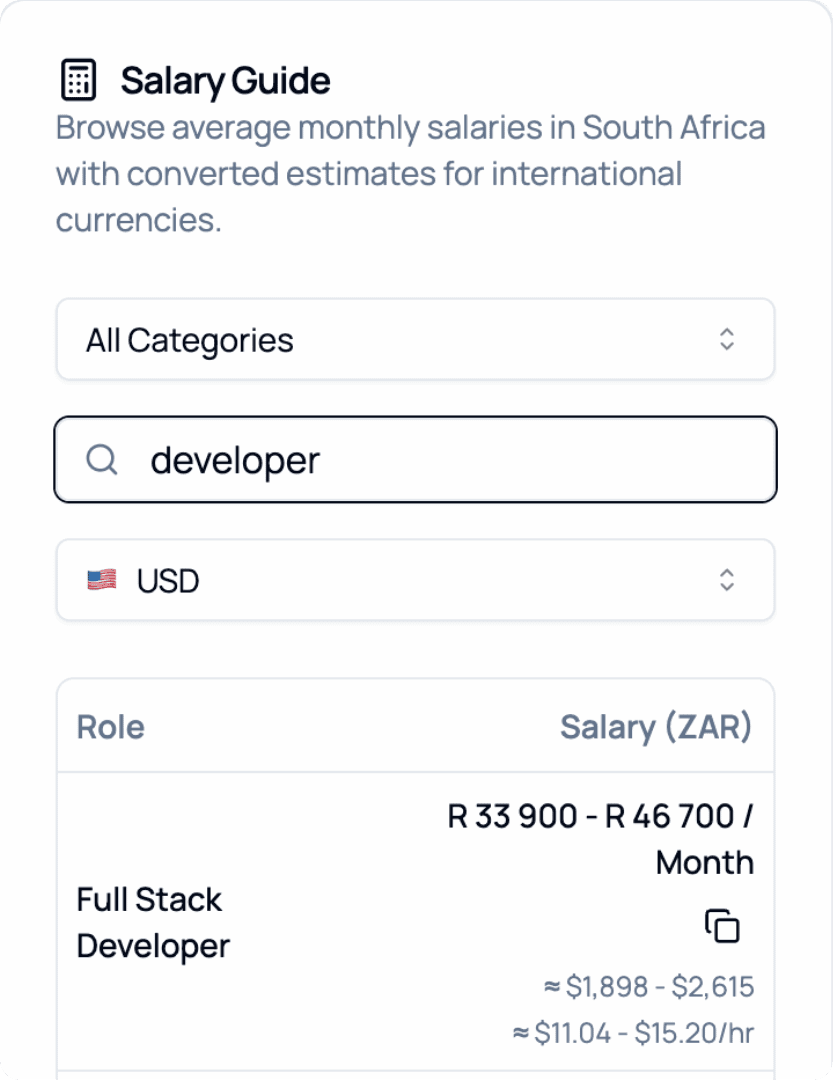
2026 Salary Guide: South Africa
Discover South African Salaries by Role. Compare costs and see how much you can save.