TL;DR
Learn how to build a delegation scorecard that tracks execution quality, speed, and founder leverage.
Use practical KPI thresholds and review rituals to improve workflow reliability week by week.
Implement a simple system that turns delegation data into clear operating decisions.
Table of Contents
- Introduction
- What is a delegation scorecard and why do entrepreneurs need one?
- Which KPI belong in an entrepreneur delegation scorecard?
- How do you set KPI thresholds that drive action?
- How should entrepreneurs run weekly scorecard reviews?
- When should entrepreneurs evolve scorecards into a full operating governance system?
- Delegation Scorecard Implementation Toolkit
- Advanced Scorecard Governance for Growing Entrepreneur Teams
- Final Thoughts
Introduction
Most delegation problems are measurement problems. Founders assume support is “not working,” but they cannot point to which workflow is failing, where quality drops, or how often avoidable interruptions happen. If you want a cleaner way to run this, start with the Entrepreneurs industry page and treat delegation as an operating system with measurable behavior.
Entrepreneurs often delegate based on urgency, then evaluate based on emotion. That combination creates churn: new process every week, no stable baseline, and repeat mistakes under different labels. A delegation scorecard solves this by giving teams a shared reality. You see what improved, what regressed, and what requires intervention now.
This post shows how to build that scorecard from scratch: what to measure, how to set thresholds, how to run weekly reviews, and how to scale without losing control. You do not need enterprise reporting. You need disciplined, actionable signal.
Pair this with related resources: Virtual Assistant for Entrepreneurs Guide: Systems, Delegation, and ROI, The Entrepreneur Delegation Operating System: What to Delegate, What to Keep, What to Automate, From Founder Bottleneck to Operator Rhythm: A Weekly System for Entrepreneur Teams, Why Entrepreneur Ops Break After the Sale (And How to Fix the Handoff), and Virtual Assistant Onboarding Checklist for 2026.
External references in this article are grounded in practical standards from the U.S. Small Business Administration, IRS small business recordkeeping guidance, Federal Trade Commission small business cybersecurity guidance, and NIST small business resources.
What is a delegation scorecard and why do entrepreneurs need one?
Snippet answer: A delegation scorecard is a weekly operating dashboard that tracks speed, quality, reliability, and founder leverage so entrepreneurs can manage support with evidence instead of guesswork.
A scorecard is not just a spreadsheet. It is a decision system. Done correctly, it answers:
- Are workflows running on time?
- Is quality getting better or worse?
- Are escalations valid or avoidable?
- Is delegation actually reducing founder load?
Without this system, founders often overreact to isolated incidents and underreact to recurring process failures.
The cost of operating without scorecards
When scorecards are missing:
- tasks are marked complete but outcomes stay weak,
- issues repeat because root causes are not tracked,
- team members optimize for activity, not impact,
- founders remain the default escalation endpoint,
- scaling decisions are made from intuition alone.
This creates a hidden tax on growth.
What a scorecard should not be
Avoid turning scorecards into:
- vanity report packs,
- static monthly summaries no one uses,
- “busy-work analytics” disconnected from workflow decisions,
- surveillance tool that erodes team trust.
The point is operational clarity, not dashboard theater.
Minimum characteristics of a useful scorecard
A useful delegation scorecard is:
- small enough to review in under 10 minutes,
- stable enough to compare week over week,
- tied to explicit action thresholds,
- owned by named operators,
- reviewed on a fixed cadence.
If one of these is missing, scorecard value drops quickly.
Which KPI belong in an entrepreneur delegation scorecard?
Snippet answer: Start with four KPI groups: speed, flow health, quality, and founder leverage. Keep 8–12 total metrics max.
Too many KPI create confusion and slow decisions. A lean scorecard is usually better for founder-led teams.
KPI Group 1: speed and responsiveness
Track:
- median first response time,
- SLA adherence percentage,
- overdue item count by workflow lane.
Speed metrics reveal where workflows lose momentum before clients notice.
KPI Group 2: flow health
Track:
- items with no next-action date,
- stage aging by lane,
- stale-record count.
Flow metrics show pipeline hygiene and handoff discipline.
KPI Group 3: quality and rework
Track:
- checklist pass rate,
- rework incidents per 20 tasks,
- handoff rejection count.
Quality metrics prevent “fast but sloppy” delegation.
KPI Group 4: founder leverage
Track:
- founder interruptions per week,
- interruptions classified avoidable vs required,
- estimated founder hours reclaimed.
Leverage metrics prove whether delegation is creating strategic capacity.
Practical 10-metric starter set
- first-response median time,
- SLA adherence rate,
- overdue queue size,
- stale items > threshold,
- records missing next action,
- checklist pass rate,
- rework incident rate,
- unresolved escalation age,
- founder interruptions count,
- founder hours reclaimed.
This set is enough to manage most entrepreneur support systems.
How do you set KPI thresholds that drive action?
Snippet answer: Define expected, warning, and critical ranges per metric. Every threshold break must trigger an owner-assigned action.
Thresholds are where scorecards become operational.
Threshold model
For each KPI define:
- Expected range: healthy baseline,
- Warning range: monitor and patch soon,
- Critical range: immediate intervention required.
Example for SLA adherence:
- expected: >= 92%,
- warning: 88–91%,
- critical: < 88%.
Action mapping table
For each metric, add:
- trigger condition,
- default action,
- action owner,
- verification date,
- rollback action if patch fails.
This removes ambiguity during weekly reviews.
Common threshold mistakes
- setting thresholds without historical baseline,
- changing thresholds too frequently,
- using “soft” thresholds without consequences,
- failing to assign action owners.
Threshold discipline is more important than metric complexity.
How to calibrate thresholds safely
Use a three-step method:
- collect baseline for 2–3 weeks,
- set conservative thresholds,
- tighten incrementally as reliability improves.
Do not set aggressive thresholds on week one and declare failure too early.
How should entrepreneurs run weekly scorecard reviews?
Snippet answer: Use a fixed 30-minute review: metric snapshot, exceptions, root causes, actions, and next-week risk plan.
Consistency beats creativity in operating reviews.
30-minute review framework
0–5 min: KPI scan
- what improved,
- what regressed,
- which thresholds broke.
5–15 min: exception analysis
- top 3 failures,
- escalation cases,
- blocked lanes.
15–25 min: patch decisions
- one corrective action per major issue,
- owner + due date,
- success signal.
25–30 min: forward risk check
- expected pressure points,
- capacity bottlenecks,
- leadership decisions needed.
Never leave this meeting without explicit owners and dates.
Required review artifacts
Keep:
- decision log,
- exception register,
- action tracker,
- unresolved risks list.
These records prevent repeat mistakes and speed onboarding for new operators.
Role of VA in scorecard operations
A VA can own:
- dashboard preparation,
- threshold-break highlights,
- decision capture,
- follow-up reminders,
- weekly memo draft.
This improves discipline while reducing founder admin burden.
Meeting quality KPI
Track review quality itself:
- % of actions closed on time,
- recurrence of same issue,
- time from issue detection to fix,
- reduction in avoidable founder interrupts.
If review quality is weak, the scorecard won’t matter.
When should entrepreneurs evolve scorecards into a full operating governance system?
Snippet answer: Expand beyond basic scorecards when volume, cross-lane complexity, and escalations increase faster than your current review rhythm can handle.
Scorecards are a strong first layer. Growth may require deeper governance.
Scale triggers
Expand governance when:
- threshold breaks persist for 4+ weeks,
- handoff failures spread across multiple lanes,
- escalation volume rises with unclear accountability,
- founder interruptions remain high despite SOP patches,
- new hires struggle due to inconsistent process documentation.
What to add next
When triggered, add:
- lane-level ownership charters,
- SOP version control,
- risk register with mitigation owners,
- monthly operating memo,
- quarterly KPI architecture audit.
This gives resilience without unnecessary bureaucracy.
30-60-90 scorecard maturity roadmap
Days 1–30:
- deploy starter KPI set,
- baseline measurements,
- assign owners.
Days 31–60:
- tighten thresholds,
- patch top recurring failures,
- improve escalation quality.
Days 61–90:
- split overloaded lanes,
- formalize monthly governance,
- launch quarterly metric audit.
This phased approach keeps adoption high.
Anti-fragile operations principle
Aim for systems that improve under pressure:
- issues surfaced earlier,
- fixes shipped faster,
- repeat failures reduced,
- founder decisions focused on strategic leverage.
That is what healthy delegation looks like in scaling entrepreneur teams.
Delegation Scorecard Implementation Toolkit
Use these practical tools to operationalize quickly.
Tool 1: metric dictionary template
For each metric, include:
- name,
- formula,
- source,
- owner,
- update frequency,
- threshold bands,
- default action.
This avoids definition drift.
Tool 2: exception register schema
Fields:
- issue date,
- lane,
- impact score,
- root cause category,
- owner,
- action,
- due date,
- verification status.
A good exception register turns incidents into process intelligence.
Tool 3: founder interruption audit
Weekly, classify interruptions:
- required strategic,
- valid escalation,
- avoidable SOP gap,
- avoidable ownership confusion.
Then patch top avoidable categories first.
Tool 4: monthly scorecard memo
One page:
- top KPI trend,
- biggest regression,
- most effective fix shipped,
- next-month risk,
- decisions required from leadership.
This keeps operations linked to strategy.
Tool 5: onboarding quality bridge
Connect scorecard to onboarding quality:
- verify handoff checklist completion,
- monitor early delivery incidents,
- track communication clarity feedback,
- tie rework trends to onboarding stage quality.
This integrates delegation measurement with client experience outcomes.
Advanced Scorecard Governance for Growing Entrepreneur Teams
As entrepreneur teams scale, scorecards need stronger governance to remain trustworthy. Without governance, data quality degrades and weekly decisions become less useful.
Governance layer 1: data integrity audits
Run a weekly integrity check:
- required fields complete,
- no duplicate active records,
- owner assignments valid,
- next-action dates populated,
- stage values from approved list only.
Assign one operator to sign off this check before weekly review. If data is not trusted, decisions should be deferred until corrections are made.
Governance layer 2: threshold calibration reviews
Every month, review whether thresholds still match current volume and workflow complexity.
Questions to ask:
- are thresholds too loose and hiding risk?
- are thresholds too tight and causing alert fatigue?
- did process changes invalidate prior baselines?
- are teams gaming metrics instead of improving outcomes?
Threshold tuning should be deliberate and documented in a change log.
Governance layer 3: lane maturity scoring
Score each workflow lane from 1 to 5 on:
- ownership clarity,
- SOP quality,
- SLA stability,
- escalation quality,
- rework trend.
Use these scores to prioritize investments. A lane at 2.5 often deserves process repair before adding headcount.
Governance layer 4: accountability contracts
For each lane owner, define an accountability contract:
- KPI they own,
- thresholds they must protect,
- required response to threshold breaks,
- communication expectations,
- monthly improvement target.
This keeps scorecards tied to human ownership.
Governance layer 5: founder decision hygiene
Founders should make decisions only where leverage is highest. Use this filter before stepping in:
- Is this a strategic decision or a process failure?
- Is there an SOP that should have handled this?
- Is this a recurring issue requiring system redesign?
- Will founder intervention solve root cause or just unblock today?
This filter protects founder time and strengthens system discipline.
Scorecard-driven coaching model
Use data for coaching, not blame.
Coach on:
- recurring error patterns,
- missed handoff behavior,
- weak escalation judgment,
- communication clarity issues.
Then track whether coaching changed metrics over 2–4 weeks. This creates measurable coaching impact.
Expansion model: from one VA to multi-operator system
When adding support capacity, keep one shared scorecard architecture and lane-level ownership.
Recommended split:
- operator A: pipeline and scheduling,
- operator B: onboarding and handoff,
- operator C (later): reporting and quality assurance.
Do not create separate, incompatible dashboards per operator. One shared operating truth is critical.
Quarterly scorecard reset checklist
At least quarterly:
- retire low-value metrics,
- add one forward-looking metric,
- review escalation taxonomy,
- validate SOP versions,
- test backup-owner readiness,
- audit dashboard-to-action conversion quality.
This keeps the scorecard relevant as business context changes.
Failure signals that demand immediate redesign
Trigger redesign if you see:
- rising backlog despite stable demand,
- repeated threshold breaks without durable fixes,
- dashboard updates lagging behind reality,
- founders becoming more interrupted despite better reporting,
- escalating disagreement over metric definitions.
These are signs of governance breakdown, not just workload pressure.
Practical final governance principle
Scorecards are not dashboards you “set and forget.” They are management systems that need maintenance, calibration, and leadership discipline. Teams that maintain scorecard governance steadily improve execution quality while reducing founder operational noise.
Delegation scorecard action library (quick-reference)
Use this quick library when thresholds break:
- SLA adherence drops
- action: simplify queue definitions, reassign owner coverage, tighten reminder logic.
- Overdue queue rises
- action: run daily aging sweep, freeze low-priority intake for 48 hours, clear blockers first.
- Rework trend increases
- action: patch checklist clarity, add one QA gate, coach top failure pattern.
- Escalation age increases
- action: enforce escalation packet completeness, set hard response windows, assign backup decision owner.
- Founder interruptions rise
- action: audit avoidable interruptions, update decision-rights map, patch SOP for recurring triggers.
A small action library accelerates response speed and prevents teams from improvising under pressure.
10-minute daily control habit
For busy founders, a daily mini-review is enough to prevent operational drift:
- check top 3 threshold risks,
- review unresolved escalations,
- confirm today’s highest-impact action owner,
- verify one founder-leverage metric.
This habit keeps the operating system alive between weekly reviews.
Final Thoughts
Entrepreneur delegation improves when measurement becomes operational, not ornamental. A scorecard should reduce confusion, speed up intervention, and protect founder attention for high-leverage decisions. Keep metrics small, thresholds explicit, ownership clear, and review rhythm strict.
As your team evolves, keep your scorecard model aligned with the Entrepreneurs industry page so delegation quality grows with business complexity instead of collapsing under it. The teams that win are not the ones with the fanciest dashboards; they are the ones that consistently convert signal into action.
If you apply this system with discipline for 30 days, you should see three shifts: fewer avoidable escalations, clearer ownership during weekly reviews, and measurable founder time recovered for strategic work. Those outcomes are the real proof that delegation is maturing into a scalable operating advantage. Keep reviewing, keep refining, and keep linking scorecard insights to weekly operating decisions so momentum compounds instead of resetting every month. Consistency in this loop is what separates scaling operators from permanently overwhelmed founders today.
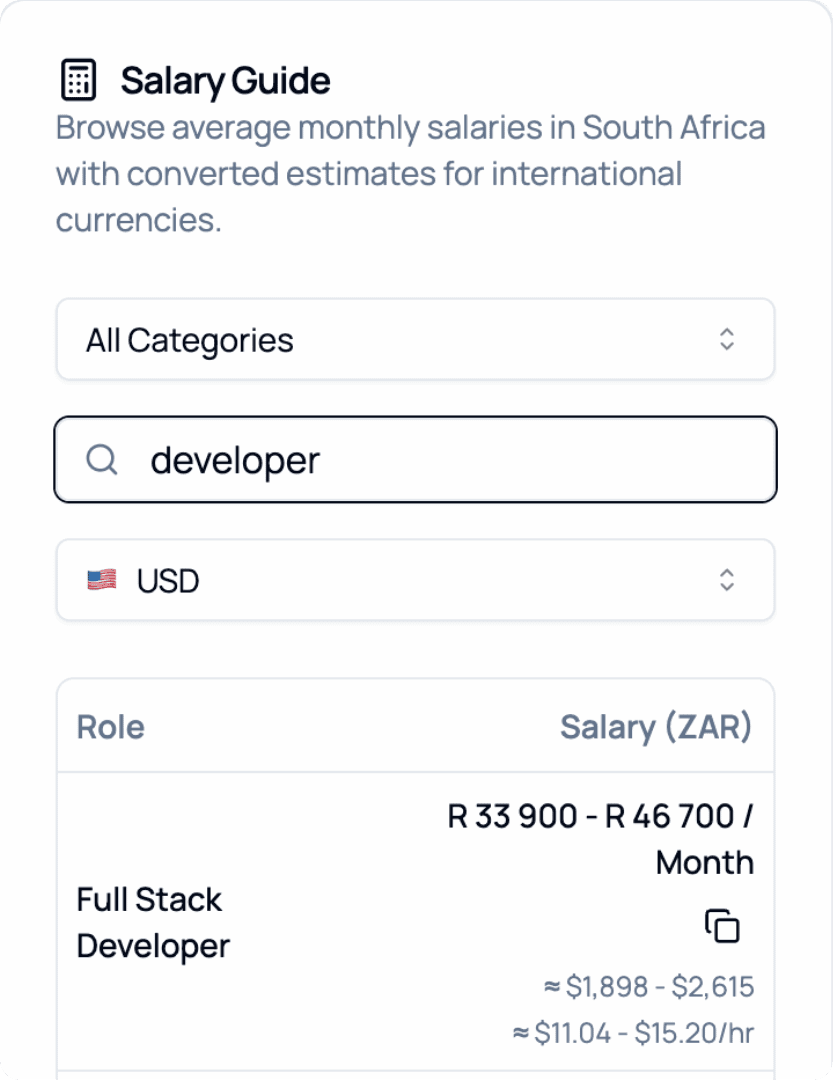
2026 Salary Guide: South Africa
Discover South African Salaries by Role. Compare costs and see how much you can save.