TL;DR
Learn how entrepreneurs can build an operations dashboard that drives decisions instead of vanity reporting.
Use practical KPI design, meeting cadence, and accountability rules to improve execution quality week by week.
Implement a founder-friendly control rhythm with clear ownership, escalation logic, and workflow visibility.
Table of Contents
- Introduction
- What should an entrepreneur operations dashboard include first?
- Which KPI matter most for entrepreneurs managing virtual assistant workflows?
- How should founders run weekly operations meetings using the dashboard?
- How do you escalate issues without bottlenecking the founder?
- When should entrepreneurs upgrade from dashboard management to a formal operations system?
- Dashboard-to-Action Toolkit for Entrepreneurs
- 21-Day Implementation Blueprint: From Reporting Habit to Operating Discipline
Introduction
Most entrepreneur-led businesses do not fail because people are lazy. They fail because execution visibility is weak. Teams stay busy, but leaders cannot quickly answer simple questions: Which workflows are breaking? What is stuck? What needs intervention today? If you are building operator support, align first with the Entrepreneurs industry page so dashboard design matches your stage and workload.
A virtual assistant can dramatically improve this, but only when data, meetings, and ownership are linked in one operating system. A dashboard alone is not enough. A meeting alone is not enough. A task manager alone is not enough. Entrepreneurs need a control loop that connects all three.
This playbook shows how to design that loop: which metrics to track, how to run weekly reviews, how to avoid vanity KPI traps, and how to escalate correctly without dragging the founder into every issue. The goal is straightforward: fewer surprises, faster interventions, and better use of founder attention.
Use this with related implementation resources: Virtual Assistant for Entrepreneurs Guide: Systems, Delegation, and ROI, Entrepreneur Delegation System Playbook: SOP, KPI, and Weekly Control Loops, Virtual Assistant Onboarding Checklist for 2026, How to Hire a Virtual Assistant for Small Business in 2026, and Virtual Assistant Cost Calculator Guide for SMB Teams.
External references are grounded in practical standards from the U.S. Small Business Administration, IRS recordkeeping guidance, Federal Trade Commission small business cybersecurity guidance, and NIST small business cybersecurity resources.
What should an entrepreneur operations dashboard include first?
Snippet answer: Start with a minimum viable dashboard covering response speed, pipeline health, execution quality, and founder leverage. Keep it small enough to drive weekly decisions.
The first dashboard should answer four questions in under five minutes:
- Are we responding on time?
- Are opportunities or projects getting stuck?
- Is execution quality improving or degrading?
- Is the founder reclaiming high-value time?
If the dashboard cannot answer those, it is decoration, not control.
Minimum viable dashboard categories
Use these buckets first:
- Speed metrics
- first-response median time
- SLA adherence rate
- Flow metrics
- records/items with no next action
- stage aging by workflow lane
- Quality metrics
- rework incidents by category
- checklist pass rate
- Leverage metrics
- founder interruptions per week
- founder hours recovered from repetitive operations
This is enough to run a meaningful weekly operations meeting.
Why founders overbuild dashboards
Common failure patterns:
- too many charts and no decision thresholds,
- metrics with no assigned owner,
- blended definitions across systems,
- “interesting” data that never changes behavior.
Keep dashboards intentionally boring. Boring dashboards that trigger action outperform beautiful dashboards that trigger nothing.
Dashboard design rule
Every metric needs four attributes:
- definition,
- source,
- owner,
- action threshold.
If one is missing, metric quality will decay quickly.
Setup checklist
Before launch, confirm:
- one source of truth for each metric,
- update cadence is fixed (daily/weekly),
- metric owners understand what to do when thresholds break,
- meeting agenda references the dashboard directly.
This creates operational glue between reporting and execution.
Which KPI matter most for entrepreneurs managing virtual assistant workflows?
Snippet answer: Track KPI that reveal operational risk early: response reliability, backlog age, rework rate, and escalation health. Avoid vanity numbers disconnected from action.
Entrepreneurs are often told to track everything. That is a mistake. Track only what helps you decide faster.
Core KPI stack (weekly)
- Response reliability
- median first-response time
- percent of items meeting SLA
- Backlog health
- items overdue by lane
- average age of overdue items
- Execution quality
- rework incidents per 20 tasks
- completion checklist pass rate
- Escalation health
- number of escalations by tier
- unresolved escalation age
- Founder leverage
- interruptions requiring founder action
- hours shifted from admin to strategic work
This KPI stack balances speed, quality, and leadership leverage.
Decision thresholds you can use immediately
Examples:
- if SLA adherence < 90% for 2 weeks, reduce lane complexity,
- if overdue backlog rises > 20% week-over-week, rebalance queue ownership,
- if rework > 10%, patch SOP before adding volume,
- if unresolved escalations exceed 48 hours, tighten escalation triggers,
- if founder interruptions rise despite stable volume, clarify decision rights.
Thresholds reduce emotional management and improve consistency.
KPI anti-patterns
Avoid these:
- tracking output volume without quality,
- celebrating completion counts while backlog ages,
- ignoring founder interruption load,
- changing metric definitions monthly.
The KPI system should be stable enough to show trends, not noise.
Data integrity controls
Run weekly data checks:
- required fields complete,
- stage status matches reality,
- no duplicate records driving false totals,
- owner field and next-action date always present.
Bad data creates false confidence and late interventions.
How should founders run weekly operations meetings using the dashboard?
Snippet answer: Use a fixed 30-minute decision meeting: KPI snapshot, exceptions, root causes, corrective actions, and next-week risk plan with named owners.
A strong dashboard without a disciplined meeting rhythm is wasted effort. The weekly review is where data becomes action.
30-minute weekly operating review format
0–5 min: KPI snapshot
- what improved,
- what regressed,
- where threshold breaks exist.
5–15 min: exceptions
- top 3 operational failures,
- escalation cases and status,
- queue bottlenecks by lane.
15–25 min: action decisions
- SOP patch decisions,
- owner assignments,
- due dates and success criteria.
25–30 min: forward risk view
- risks for next week,
- capacity constraints,
- founder decisions required.
Never end without explicit owners and dates.
Meeting artifacts to keep
Capture:
- decision log,
- issue log with root cause,
- action tracker,
- unresolved risk list.
These artifacts become your operations memory and training asset.
Role of the VA in weekly reviews
A VA can own:
- dashboard prep,
- exception list drafting,
- action tracker updates,
- follow-up reminders on decisions.
This increases meeting quality while reducing founder prep overhead.
Meeting quality score
Rate each review on:
- decision clarity,
- owner clarity,
- follow-through completion,
- recurrence of same issue.
If the same issues repeat for 3+ weeks, the system is discussing problems, not solving them.
How do you escalate issues without bottlenecking the founder?
Snippet answer: Use tiered escalation rules, clear decision rights, and pre-defined response windows. Escalate by risk level, not by anxiety level.
Most founder bottlenecks come from escalation confusion. Teams escalate too much low-risk noise and too little high-risk reality.
Three-tier escalation model
- Tier 1: routine delay, recoverable same day.
- Tier 2: at-risk issue affecting timeline or client confidence.
- Tier 3: critical issue affecting revenue, compliance, or reputation.
Each tier needs a default owner and response-time target.
Escalation packet standard
Before escalating, require:
- issue summary,
- current state,
- attempted actions,
- recommended options,
- deadline for decision.
This prevents vague escalations and speeds decisions.
Decision rights map
Document founder-only decisions:
- pricing or contract exceptions,
- legal/compliance exceptions,
- high-risk client policy decisions,
- strategic resource tradeoffs.
Everything else should resolve at lane-owner level.
Escalation KPI
Track:
- escalations per tier,
- avoidable escalation rate,
- time-to-resolution,
- repeat escalations from same root cause.
If avoidable escalations remain high, SOP clarity and decision rights need tightening.
De-escalation practices
Use post-incident reviews:
- what made this escalate,
- what rule was missing,
- what SOP or template should change,
- who owns the patch.
Escalation is useful only when it improves future resilience.
When should entrepreneurs upgrade from dashboard management to a formal operations system?
Snippet answer: Upgrade when volume and complexity exceed single-lane control: persistent backlog growth, unstable SLA, rising cross-lane dependencies, and frequent founder intervention.
Dashboards help early. As the business scales, you need deeper operations architecture.
Upgrade triggers
Consider formalizing operations when:
- overdue backlog rises for 4+ weeks,
- cross-lane handoff failures become frequent,
- KPI fluctuate heavily despite stable demand,
- founder interruptions remain high after SOP improvements,
- onboarding new team members takes too long due to documentation gaps.
These indicate system maturity limits, not effort issues.
What “formal operations system” means
Not bureaucracy. It means:
- lane-based ownership model,
- documented SOP library with versioning,
- scheduled governance cadence (daily/weekly/monthly),
- risk register and mitigation owners,
- standard monthly operations memo.
This gives entrepreneurs durable control with minimal overhead.
30-60-90 upgrade roadmap
Days 1–30:
- stabilize dashboard definitions,
- enforce ownership fields and next-action dates,
- clean queue hygiene.
Days 31–60:
- patch top 3 SOP failure points,
- formalize escalation map,
- launch risk register.
Days 61–90:
- split overloaded lanes,
- establish monthly operations review memo,
- train backup owners for critical workflows.
This roadmap scales control without overcomplicating execution.
Capacity design tip
Do not add people to broken systems. Improve workflow design first, then expand capacity with clear lanes.
Operating principle for founders
Run operations like a product:
- define target outcomes,
- measure behavior,
- ship process improvements,
- review impact,
- iterate.
This mindset protects quality and speed simultaneously.
Dashboard-to-Action Toolkit for Entrepreneurs
A dashboard is only useful if it drives concrete operational behavior. Use these tools to keep your system decision-oriented.
Tool 1: metric-to-action mapping sheet
For each KPI, define:
- expected range,
- warning range,
- critical range,
- immediate action,
- owner,
- follow-up verification date.
This sheet prevents “we’ll keep an eye on it” management.
Tool 2: weekly exception board
Use a simple board with columns:
- newly identified,
- root cause defined,
- fix in progress,
- verified resolved,
- monitoring.
Move every issue across states with owner accountability. This makes progress visible and reduces repeat failures.
Tool 3: founder focus-protection checklist
Every Friday, ask:
- how many admin interruptions required founder action?
- which interruptions were avoidable?
- what SOP patch would eliminate them next week?
- what one lane can be strengthened to reduce reactive work?
The objective is compounding founder leverage, not just cleaner reporting.
Tool 4: monthly operating memo format
Use one page:
- what improved materially,
- what regressed materially,
- top risk for next month,
- decisions required from leadership,
- process changes to ship next cycle.
This memo helps entrepreneurs stay strategic while operations scale.
Final operator note
Entrepreneurs do not need enterprise complexity. They need clear execution truth and fast correction loops. Keep the dashboard small, meetings disciplined, and ownership explicit. If you keep this model tied to the Entrepreneurs industry page, your team can scale execution quality without pulling the founder back into day-to-day noise.
21-Day Implementation Blueprint: From Reporting Habit to Operating Discipline
If your team has never run a disciplined dashboard rhythm, start with a short implementation sprint. The point is not perfection. The point is creating a consistent loop where metrics lead to decisions, and decisions lead to measurable improvements.
Week 1: build visibility and ownership
In week 1, focus only on visibility fundamentals:
- finalize KPI definitions,
- assign metric owners,
- verify data sources,
- set weekly review time,
- launch a simple action log.
Do not expand scope yet. Teams often try to include every workflow immediately and fail to maintain data quality. A narrow first scope makes adoption stick.
Recommended week-1 outputs:
- dashboard v1 (speed, flow, quality, leverage only),
- one-page KPI dictionary,
- owner map for every metric,
- first baseline snapshot,
- initial threshold settings.
Week 2: strengthen reliability and corrective action
Week 2 should focus on turning insight into action.
Run the weekly review using the fixed meeting structure and capture every decision in a follow-up tracker. Then verify whether actions were completed and whether they changed the underlying KPI.
Common week-2 priorities:
- clean records missing next-action dates,
- reduce stale queue size,
- patch top recurring rework cause,
- tighten escalation packet quality,
- reduce avoidable founder interruptions.
By the end of week 2, you should already see one meaningful trend improvement if the system is working.
Week 3: scale control without adding complexity
Week 3 is where most founders either gain confidence or drift back to reactive mode. Keep discipline.
Add only one of these upgrades:
- split one overloaded lane,
- automate one repetitive status report,
- formalize one escalation pathway,
- add one quality gate to a high-risk workflow.
Do not add all four. One deliberate upgrade is better than four partially adopted changes.
Practical dashboard field standards
To keep data clean, enforce these standards:
- dates in one format,
- stage values from controlled list,
- owner names from controlled list,
- status updates with timestamp,
- no blank next-action fields,
- required risk tag for escalated items.
This sounds basic, but most dashboard failures are caused by inconsistent inputs, not poor intentions.
Example lane scorecard for entrepreneur teams
Use lane-level scoring each week (0 to 5):
- SLA reliability,
- backlog hygiene,
- quality pass rate,
- escalation handling,
- founder interrupt reduction.
Then compute overall lane score. Any lane under 3.5 needs intervention. This creates objective prioritization when multiple issues compete for attention.
Decision hygiene checklist for founders
Before approving any process change, ask:
- what KPI will this improve,
- how will we verify impact,
- who owns implementation,
- what is rollback plan if it fails,
- when will we review results.
This checklist prevents random process churn and keeps improvements tied to outcomes.
Typical warning signs your dashboard is drifting
Watch for these signals:
- review meetings become status-only,
- no actions are closed week over week,
- owners dispute metric definitions,
- same root causes reappear repeatedly,
- founder feels less informed despite more charts.
If two or more signs appear, simplify dashboard scope and re-anchor governance.
Sustainable governance rhythm
Use this rhythm for entrepreneur-led teams:
- Daily: 10-minute queue and risk check,
- Weekly: 30-minute decision review,
- Monthly: one-page operations memo and priority reset,
- Quarterly: KPI and workflow architecture audit.
This cadence is lightweight enough for lean teams but strong enough to protect execution quality during growth.
Closing implementation perspective
A good dashboard does not replace leadership judgment. It sharpens it. The best entrepreneur operators build a system where visibility is fast, ownership is clear, and corrections happen before issues become expensive. Keep implementation tight, keep thresholds honest, and keep your control model connected to the Entrepreneurs industry page so operations evolve with business stage, not just with temporary urgency.
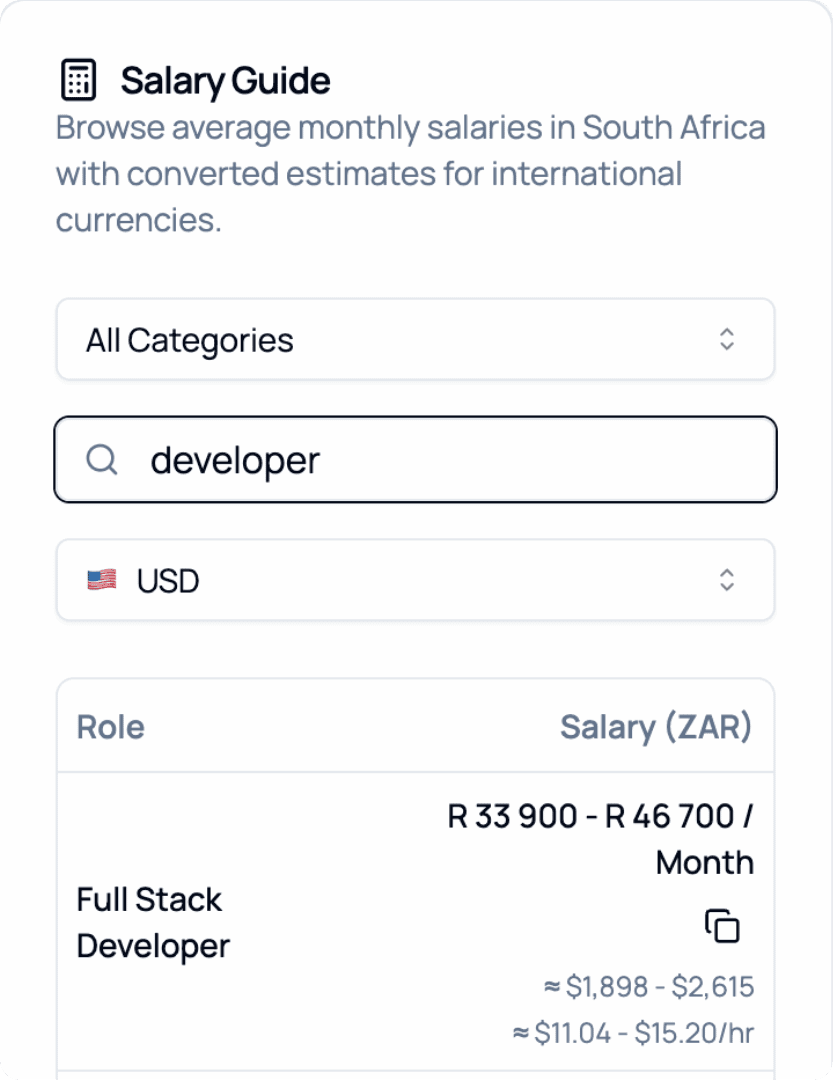
2026 Salary Guide: South Africa
Discover South African Salaries by Role. Compare costs and see how much you can save.