TL;DR
Build a delegation operating system that protects quality while reducing founder bottlenecks.
Use SOP, KPI, and escalation rules to manage a virtual assistant without micromanaging.
Apply a weekly control loop to improve execution speed, accountability, and scaling readiness.
Table of Contents
- Introduction
- What should entrepreneurs delegate first to create leverage fast?
- How do you build SOPs that preserve quality instead of creating rework?
- What KPI should founders track to manage a VA without micromanaging?
- How do you enforce accountability without turning into a micromanager?
- When should an entrepreneur add a second VA or specialist role?
- Final Thoughts
- Delegation Control Room: Practical Templates for Founder Operators
Introduction
If growth feels messy, the problem is often not effort, it is operating design. Most founders do not lack talent or intent. They lack a reliable execution system that survives week-to-week volatility. If you are building support for this stage, start with the Entrepreneurs industry page and use it as the anchor for role design, workflow ownership, and hiring boundaries.
Entrepreneurs usually stall at the same inflection point: too many recurring tasks still require founder attention. Calendar management, inbox triage, lead follow-up, CRM updates, onboarding reminders, vendor coordination, and reporting prep all compete with strategic work. The founder becomes the default fallback for every unclear handoff.
A virtual assistant can fix this, but only if delegation is treated as system architecture, not random task transfer. The right model combines three components:
- SOP structure for repeatable execution,
- KPI visibility for operating truth,
- weekly control loops for continuous correction.
This guide is built around the most practical questions founders ask before scaling support. You will get a clear delegation matrix, SOP format, KPI stack, accountability model, and scale triggers so delegation actually increases leverage.
Use this with related implementation guides: Virtual Assistant for Entrepreneurs Guide: Systems, Delegation, and ROI, How to Hire a Virtual Assistant for Small Business in 2026, Virtual Assistant Onboarding Checklist for 2026, Virtual Assistant Cost Calculator Guide for SMB Teams, How to Hire Remote Talent Without Recruiting Fees, and 7 Mistakes to Avoid When Hiring Your First VA.
External references are grounded in practical business resources from the U.S. Small Business Administration, IRS recordkeeping guidance, FTC small business cybersecurity guidance, NIST small business resources, and PMI project management standards context.
What should entrepreneurs delegate first to create leverage fast?
Snippet answer: Delegate high-frequency, rules-driven tasks first: scheduling, inbox triage, follow-up workflows, CRM hygiene, onboarding checklists, and reporting prep. Keep strategic, legal, and pricing decisions in-house.
The fastest delegation wins come from recurring workflows that already consume founder time and can be quality-checked quickly. Most entrepreneurs over-delegate ambiguous work too early and under-delegate repetitive work that creates constant context switching.
Use a Keep / Delegate / Automate matrix
Before assigning any task, classify it:
- Keep (founder-owned): pricing decisions, strategic partnerships, high-stakes hiring, legal exceptions, brand positioning.
- Delegate (VA-owned execution): reminders, follow-up sequences, CRM updates, calendar coordination, onboarding task tracking, invoice support prep.
- Automate (tool-owned where possible): recurring reminders, status notifications, form routing, reporting snapshots.
This matrix avoids emotional delegation. It makes handoff decisions operational.
First-wave delegation list (first 2–4 weeks)
Start with one lane from each category:
- Calendar and meeting logistics
- scheduling windows
- confirmations and reminders
- pre-meeting prep notes
- Inbox and communication routing
- label/priority sorting
- draft responses for approval
- escalation flagging
- Pipeline maintenance
- stage updates
- no-response follow-up
- stale lead reporting
- Client onboarding support
- checklist execution
- document chase workflow
- kickoff logistics
- Weekly reporting prep
- KPI extraction
- summary table drafting
- action item log updates
The objective is not to “offload tasks.” The objective is to remove predictable operational noise from founder attention.
Delegation readiness test
A task is ready to delegate if:
- trigger is clear,
- output is clear,
- quality can be checked,
- escalation condition exists,
- business risk of mistakes is manageable.
If these are missing, write the SOP first and delegate second.
Common early mistakes
- Delegating based on urgency instead of repeatability.
- Assigning outcomes without process context.
- Mixing multiple priorities into one queue without SLA.
- Skipping escalation definitions.
- Changing process every week without version control.
These mistakes create micromanagement loops and false conclusions that support “is not working.”
How do you build SOPs that preserve quality instead of creating rework?
Snippet answer: Good SOPs define trigger, owner, steps, quality checks, escalation, and output artifacts. Short and specific SOPs outperform long vague documentation.
Entrepreneurs often create SOPs that read like essays. Teams need operational scripts, not theory. Keep SOPs compact, practical, and versioned.
SOP template that actually works
For each delegated workflow, include:
- Purpose: what business outcome this process protects.
- Trigger: event that starts the workflow.
- Owner + backup: primary and fallback operator.
- Inputs required: data, files, approvals needed.
- Step sequence: exact execution order.
- SLA target: expected timing.
- Quality gate: what must be true before completion.
- Escalation trigger: when to hand to founder/lead.
- Output artifact: where proof of completion is stored.
- Version and change log: when/why updates happened.
This structure is enough for reliability without creating documentation drag.
Keep SOPs operationally thin
Use the 80/20 rule:
- Write the minimal version first.
- Run for one week.
- Patch based on failures.
- Re-run and re-measure.
SOP maturity should come from usage data, not assumptions.
Quality control pattern
For each SOP, define one quality score:
- pass/fail checklist completion,
- error count per 20 tasks,
- rework rate,
- missed SLA count.
If quality signals deteriorate, inspect SOP clarity before blaming execution skill.
Example: lead follow-up SOP quality gate
A lead follow-up sequence is complete only when:
- touchpoint log is updated,
- next action date is set,
- contact status is current,
- stage reflects reality,
- escalation tag is applied when stalled.
Without this gate, CRM metrics become fiction.
Documentation governance
Assign one SOP owner per workflow domain. If multiple people edit SOPs ad hoc, process drift accelerates. Use monthly review windows and explicit change summaries.
What KPI should founders track to manage a VA without micromanaging?
Snippet answer: Track a small KPI stack tied to response speed, pipeline health, workflow accuracy, and founder time recovery. Avoid vanity metrics that do not trigger decisions.
A founder needs signal, not noise. Most teams collect too many metrics and use none. Build a lean scorecard that informs weekly decisions.
Core KPI stack (weekly)
- Response performance
- median first response time
- SLA adherence rate
- Pipeline hygiene
- records missing next action
- stale leads by stage age
- Execution quality
- rework incidents by workflow
- checklist pass rate
- Coordination reliability
- missed handoff count
- unresolved escalation age
- Founder leverage
- hours reclaimed from repetitive ops
- number of founder interrupts avoided
This mix captures both output and operational health.
Decision thresholds (examples)
Define explicit thresholds:
- if SLA adherence < 90% for 2 weeks, simplify queue scope,
- if stale leads increase > 20% week-over-week, tighten follow-up cadence,
- if rework rate > 10%, patch SOP before adding volume,
- if founder interrupts rise, clarify ownership boundaries.
Thresholds remove emotional management. They turn performance into system adjustments.
KPI dashboard hygiene
A dashboard is useful only if:
- definitions are consistent,
- data source is trusted,
- owner is assigned,
- review cadence is fixed,
- actions are documented.
Treat reporting as an operational product, not a side artifact.
Monthly performance memo
Use one page:
- what improved,
- what regressed,
- top recurring failure mode,
- fixes shipped,
- next constraint to solve.
This keeps delegation management strategic instead of reactive.
How do you enforce accountability without turning into a micromanager?
Snippet answer: Use clear ownership, SLA, escalation rules, and weekly review rituals. Accountability is a system property, not a personality trait.
Micromanagement usually happens when ownership is unclear. Founders step in because the system cannot reliably tell them what is happening.
Accountability architecture
For each workflow lane:
- one primary owner,
- one backup owner,
- one SLA,
- one escalation rule,
- one quality metric.
If any of these are missing, accountability degrades into constant checking.
Daily and weekly rhythm
Daily (10–15 min):
- priority queue review,
- blocker flags,
- today’s SLA risks.
Weekly (30 min):
- KPI review,
- missed SLA analysis,
- rework root cause,
- SOP patch decisions,
- next week focus.
Keep meetings short and decision-oriented.
Escalation tiers
Use three levels:
- Tier 1: small delay, recoverable same day.
- Tier 2: at-risk task affecting timeline, needs owner decision.
- Tier 3: critical risk affecting client/revenue/compliance, immediate founder or lead escalation.
This model prevents low-risk noise from flooding leadership attention.
Communication protocol
Require status updates in a consistent format:
- current state,
- next action,
- owner,
- due time,
- risk tag.
Consistency in updates reduces confusion more than longer messages.
Accountability anti-patterns
- founder answers every question live,
- no written escalation standards,
- “just keep me posted” as management system,
- changing priorities daily without queue re-rank,
- measuring activity instead of outcomes.
Fixing these often improves performance more than hiring more people.
When should an entrepreneur add a second VA or specialist role?
Snippet answer: Add capacity only after the first lane is stable. If KPI are unstable, redesign process first. Scale from proof, not pressure.
Growth pressure can push founders to hire early, but adding people to a weak operating system multiplies confusion.
Scale readiness signals
You are ready to add capacity when:
- SLA is stable for 4+ weeks,
- rework trend is low and declining,
- SOP coverage exists for core workflows,
- escalation handling is predictable,
- founder interrupt load remains controlled despite volume growth.
If these conditions are not met, fix system quality first.
Role-splitting sequence
Common split pattern:
- VA #1: core ops and communication workflows.
- VA #2 or specialist: pipeline operations or fulfillment coordination.
- Later: channel-specific support (content ops, customer success ops, finance admin support).
Avoid splitting by random tasks. Split by coherent workflow lanes.
Capacity planning model
Estimate by queue load:
- task volume per lane,
- average handling time,
- SLA constraints,
- peak-day variability.
Then compare against available weekly hours. If lane utilization stays above 80% with rising SLA misses, capacity expansion is justified.
30-60-90 scale path
Days 1–30: stabilize baseline lanes and scorecard.
Days 31–60: patch highest-failure SOPs, reduce founder interrupts.
Days 61–90: split one overloaded lane with explicit owner transfer and QA checkpoint.
This creates durable scale without quality collapse.
Risk controls while scaling
- no new role without SOP packet,
- no role split without clear handoff artifacts,
- no queue expansion without updated SLA,
- no major workflow changes during peak periods unless critical.
These controls keep expansion from breaking service quality.
Final Thoughts
Delegation success for entrepreneurs is not about finding “the perfect assistant.” It is about building an operating system that makes good execution repeatable. When SOPs are clear, KPI are visible, and weekly control loops are disciplined, support roles become leverage instead of overhead.
Use this playbook with the Entrepreneurs industry page as your reference point for scope, workflow design, and scale pacing. Keep decisions data-led, keep ownership explicit, and keep process updates continuous. That is how founders reclaim strategic time while improving execution reliability.
Delegation Control Room: Practical Templates for Founder Operators
The biggest difference between “delegation that sounds good” and “delegation that works” is control design. Founders need a small, repeatable control room that shows what is happening, what is at risk, and what must be fixed next.
Template 1: weekly operator review agenda (30 minutes)
Use this exact sequence every week:
- Scorecard snapshot (5 min)
- SLA adherence
- stale records by lane
- rework incidents
- founder interrupt count
- Exceptions review (10 min)
- top 3 failure patterns
- blocked tasks beyond threshold
- escalation cases and resolution status
- Patch decisions (10 min)
- one SOP change per high-impact issue
- one owner per change
- completion deadline
- Forward plan (5 min)
- next-week risk list
- queue reprioritization
- support capacity forecast
Most teams fail because they run updates, not decisions. This agenda forces decisions.
Template 2: exception log fields
Maintain one exception log with:
- date/time
- workflow lane
- issue type
- business impact
- root cause hypothesis
- fix owner
- due date
- verification status
Over time this becomes your operations memory. Without it, teams repeat the same mistakes under different labels.
Template 3: founder interruption audit
Track interruptions for two weeks:
- what was asked,
- why it was escalated,
- whether SOP already covered it,
- whether escalation was valid.
Then classify:
- valid escalation (keep),
- SOP gap (patch),
- ownership confusion (clarify),
- avoidable interruption (prevent via checklist/template).
This single audit usually recovers meaningful founder hours quickly.
Delegation risk register for entrepreneurs
Create a lightweight risk register with these categories:
- communication delay risk,
- data quality risk,
- compliance or privacy handling risk,
- client experience risk,
- capacity overload risk.
For each risk, assign:
- trigger condition,
- impact score,
- owner,
- mitigation action,
- review cadence.
A risk register is not corporate overhead. For founders, it is how you avoid expensive surprises while scaling lean.
Role design for mixed workload businesses
Many entrepreneur-led businesses combine sales, service delivery, and content. That creates competing operational rhythms.
Use lane-based role design:
- Lane A: pipeline operations
- lead routing, follow-up cadence, CRM stage integrity
- Lane B: delivery operations
- onboarding, milestone tracking, fulfillment coordination
- Lane C: communication operations
- inbox triage, client updates, scheduling flow
- Lane D: reporting operations
- KPI prep, weekly memo draft, exception tracking
As volume grows, split lanes by load, not by random task preference.
Founder decision rights map
Document what only the founder (or leadership) can decide:
- pricing exceptions,
- contract exceptions,
- scope or policy deviations,
- high-risk reputation issues,
- strategic resource allocation.
Everything else should have delegated execution logic. This reduces decision fatigue and avoids accidental authority gaps.
21-day delegation stabilization sprint
Week 1: visibility
- deploy queue views by lane,
- enforce next-action dates,
- launch daily risk flags,
- baseline KPI.
Week 2: reliability
- patch top two SOP failure points,
- tighten escalation rules,
- standardize templates by scenario,
- reduce rework via quality gate checks.
Week 3: leverage
- remove one recurring founder bottleneck,
- automate one repetitive update/report,
- improve one conversion-critical workflow,
- lock monthly governance cadence.
This sprint gives entrepreneurs quick operational traction without bloating process.
What to do when delegation performance dips
If metrics degrade, avoid emotional reactions. Run this order:
- verify data quality,
- inspect SOP clarity,
- inspect workload balance,
- inspect escalation correctness,
- coach execution behavior.
Most dips are system flaws before they are talent flaws.
Final operator principle
Entrepreneurs win with delegation when they design for clarity first, speed second, scale third. If you reverse that order, quality breaks and founder workload rebounds. If you keep that order, the business gets more predictable, team confidence rises, and growth decisions become less reactive and more intentional over time. For implementation alignment, keep this operating model tied to the Entrepreneurs industry page.
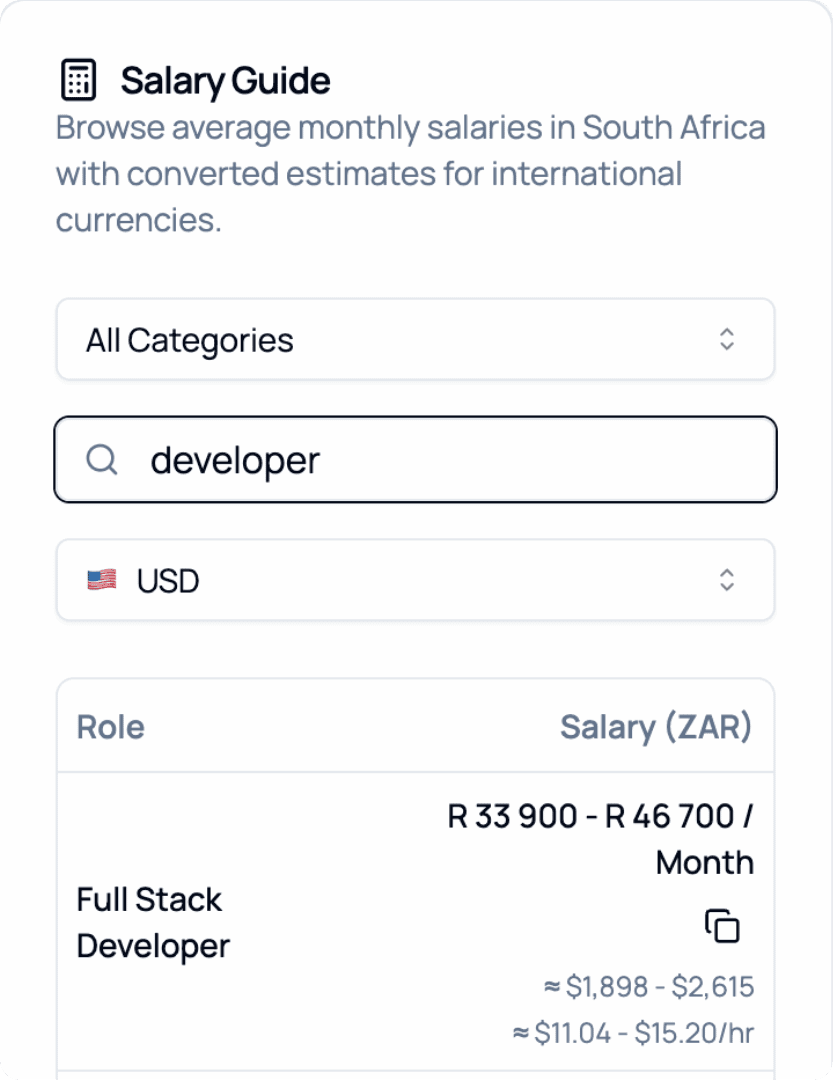
2026 Salary Guide: South Africa
Discover South African Salaries by Role. Compare costs and see how much you can save.