TL;DR
Understand the critical differences between onshore (local) and offshore (global) teams in terms of cost, legal compliance, and cultural alignment.
Learn how offshore hiring can reduce labor costs by 40-70% while providing "follow-the-sun" productivity advantages.
Discover why South Africa is the "Goldilocks" solution for US/UK/AU firms, offering Western alignment with offshore economic benefits.
Table of Contents
- What Is an Onshore Team?
- What Is an Offshore Team?
- Offshore vs. Onshore: What’s the Difference?
- How Much Does Offshore Hiring Save?
- Hidden Costs of Onshore Hiring (2026)
- Is South African Talent GDPR Compliant?
- Managing Time Zone Differences
- Balancing Cost and Quality
- Best Country for Cultural Alignment?
- Why "High-Value" Offshoring Is Trending
- Is Offshore Hiring Safe for Data?
- FAQ: Common Questions About Outsourcing
- Ready to Build Your Offshore Team?
In today's global economy, the way businesses build their teams has fundamentally changed. The question is no longer if you should consider remote talent, but how to find the right balance between local expertise and global efficiency. Understanding the distinction between onshore and offshore teams is the first step toward making smarter hiring decisions that drive growth without draining your budget.
Whether you're a growing startup looking to scale quickly or an established enterprise seeking operational efficiency, this guide will walk you through everything you need to know about onshore versus offshore hiring—with a special focus on why South African talent is becoming the go-to choice for discerning businesses worldwide.
What Is an Onshore Team?
An onshore team refers to employees or contractors who are based in the same country as your business headquarters. For a company in New York, an onshore team would consist of workers located anywhere within the United States. For a London-based firm, onshore means hiring across the UK.
Characteristics of Onshore Teams:
- Same legal jurisdiction: Employment laws, tax regulations, and compliance requirements are familiar and straightforward.
- Cultural alignment: Shared national holidays, business customs, and communication styles.
- Real-time collaboration: Working within the same or similar time zones enables synchronous meetings and faster decision-making.
- Higher labor costs: Onshore hiring typically comes with premium salaries, office overhead, benefits packages, and payroll taxes.
Onshore teams are often preferred for roles that require deep institutional knowledge, face-to-face client interaction, or handling of highly sensitive materials that demand physical presence.
What Is an Offshore Team?
An offshore team consists of employees or contractors who work from a different country than your business headquarters. Offshore hiring allows companies to tap into global talent pools, often at a fraction of the cost of local hires.
Characteristics of Offshore Teams:
- Cost efficiency: Significant savings on salaries, benefits, and operational overhead.
- Access to specialized skills: The global talent market offers expertise that may be scarce or expensive domestically.
- Extended operations: With team members in different time zones, your business can effectively operate around the clock.
- Cultural diversity: Different perspectives can drive innovation and creative problem-solving.
Offshore teams are ideal for roles in software development, customer support, digital marketing, administrative tasks, and many specialized professional services.
Offshore vs. Onshore: What’s the Difference?
The primary difference between offshore and onshore teams comes down to three key factors: location, cost, and time zone alignment.
| Factor | Onshore Team | Offshore Team |
|---|---|---|
| Location | Same country as HQ | Different country |
| Cost | Higher (local market rates) | Lower (global market rates) |
| Time Zone | Same or similar | Different (can be advantageous) |
| Communication | Real-time, synchronous | Asynchronous or overlapping hours |
| Legal Complexity | Familiar employment laws | Requires understanding of foreign regulations |
| Cultural Fit | Native cultural understanding | May require onboarding for cultural alignment |
The best hiring strategy often involves a hybrid approach—keeping strategic and client-facing roles onshore while leveraging offshore talent for execution, support, and specialized tasks.
How Much Does Offshore Hiring Save?
The cost savings from offshore hiring can be dramatic—often ranging from 40% to 70% compared to equivalent onshore positions. Here's a breakdown:
Sample Cost Comparison (Annual Salary, USD):
| Role | US/UK Onshore | South African Offshore | Savings |
|---|---|---|---|
| Executive Assistant | $55,000 - $75,000 | $18,000 - $28,000 | ~60% |
| Digital Marketing Specialist | $65,000 - $85,000 | $22,000 - $35,000 | ~58% |
| Software Developer | $90,000 - $140,000 | $35,000 - $55,000 | ~55% |
| Customer Support Rep | $40,000 - $55,000 | $12,000 - $18,000 | ~68% |
These savings don't include the additional overhead of onshore hiring: office space, equipment, health insurance, retirement contributions, and payroll taxes—which can add 25-40% to base salary costs.
The Bottom Line: A mid-sized company replacing just 5 onshore roles with qualified South African offshore professionals could save $150,000 to $250,000 annually while maintaining—or even improving—work quality.
Hidden Costs of Onshore Hiring (2026)
When evaluating onshore versus offshore hiring, many businesses underestimate the true cost of local employment. Beyond base salary, here are the hidden costs that inflate your onshore hiring budget:
1. Benefits and Insurance
Health insurance, dental, vision, and life insurance can add $8,000 to $25,000 per employee annually in the US.
2. Payroll Taxes
Employers pay Social Security, Medicare, state unemployment, and workers' compensation—typically adding 7.65% to 15% of salary costs.
3. Paid Time Off
Vacation, sick days, and holidays cost the equivalent of 2-4 weeks of salary without productive output.
4. Office Overhead
Real estate, utilities, equipment, and supplies can run $5,000 to $15,000 per employee annually in major metros.
5. Recruitment and Onboarding
The average cost-per-hire in the US is over $4,700, plus 30-90 days of reduced productivity during ramp-up.
6. Turnover Costs
Replacing an employee costs 50% to 200% of their annual salary when accounting for lost productivity, recruiting, and training.
The 2026 Reality: With inflation, rising healthcare costs, and increased competition for skilled workers, the fully-burdened cost of an onshore employee is often 1.5x to 2x their base salary.
Is South African Talent GDPR Compliant?
Yes—South African offshore talent can absolutely be GDPR compliant, and in many cases, South Africa offers stronger data protection frameworks than other popular offshore destinations.
South Africa's Data Protection Landscape:
- POPIA (Protection of Personal Information Act): South Africa's POPIA is closely aligned with GDPR principles, covering data processing, consent, security, and cross-border transfers.
- Constitutional Right to Privacy: Privacy is enshrined in Section 14 of the South African Constitution, providing a strong legal foundation.
- International Standards: South African professionals working with international clients are well-versed in GDPR, HIPAA, and other global compliance frameworks.
How to Ensure Compliance:
- Data Processing Agreements (DPAs): Establish clear DPAs with your South African contractors or virtual assistants.
- Secure Infrastructure: Use enterprise-grade tools (VPNs, encrypted storage, secure communication platforms).
- Training: Work with talent that has documented compliance training and certifications.
- Contractual Obligations: Include GDPR-specific clauses in your service agreements.
Why South Africa Stands Out: Unlike some offshore destinations with limited data protection laws, South Africa's regulatory environment is specifically designed to meet EU adequacy requirements, making it a safer choice for compliance-conscious businesses.
Managing Time Zone Differences
Managing time zones effectively is one of the most common concerns businesses have about offshore hiring. The good news? With the right strategies and the right offshore location, time zones become an advantage rather than an obstacle.
Strategies for Time Zone Success:
- Overlap Hours: Schedule 2-4 hours of overlap for real-time collaboration, meetings, and urgent issues.
- Async-First Communication: Use tools like Loom, Slack, and Notion to document decisions and reduce meeting dependency.
- Clear Handoff Protocols: Create SOPs for end-of-day handoffs so work continues seamlessly across time zones.
- Follow-the-Sun Model: Leverage time differences to provide extended customer support or continuous development cycles.
The South African Time Zone Advantage:
South Africa operates on SAST (South African Standard Time, GMT+2), which offers:
- Full UK/Europe alignment: 1-2 hours difference enables near-synchronous collaboration.
- US East Coast overlap: 6-7 hours ahead, allowing morning overlap (9 AM Cape Town = 3 AM New York, but 2 PM Cape Town = 8 AM New York).
- Australian compatibility: Only 6-8 hours behind Sydney, making afternoon handoffs practical.
The Result: South African professionals can work during your core business hours or extend your operational capacity into additional time zones—you choose the model that fits your business.
Balancing Cost and Quality
Finding the sweet spot between cost savings and quality is the central challenge of offshore hiring. The cheapest option is rarely the best value—and premium onshore hiring isn't always the highest quality either.
The Quality-Cost Spectrum:
| Offshore Destination | Relative Cost | English Proficiency | Technical Skills | Cultural Fit (US/UK/AU) |
|---|---|---|---|---|
| Philippines | Very Low | Good | Moderate | Moderate |
| India | Low | Variable | High (Tech) | Low-Moderate |
| Eastern Europe | Moderate | Good-Excellent | High | Moderate-High |
| Latin America | Moderate | Variable | Moderate-High | High (US) |
| South Africa | Moderate | Excellent | High | Excellent |
Why South Africa Wins on Value:
- Native-level English: No translation barriers or communication friction.
- Strong educational system: Particularly in business, law, finance, and technology.
- Western-aligned work culture: Professional norms, work ethic, and communication styles match US, UK, and Australian expectations.
- Competitive pricing: 40-60% lower than onshore rates, but without the quality compromises of ultra-low-cost destinations.
The Smart Strategy: Invest in "premium offshore" destinations like South Africa where cost savings are substantial but quality, compliance, and communication remain at Western business standards.
Best Country for Cultural Alignment?
Cultural alignment is often overlooked in offshore hiring discussions—until communication breakdowns, missed deadlines, or misaligned expectations become costly problems. The country with the best cultural fit for US, UK, and Australian businesses is South Africa.
What Makes South African Professionals Culturally Aligned:
-
English as a Primary Business Language: Unlike countries where English is a second language, South African professionals communicate with native fluency, idioms, and nuance.
-
Western Legal and Business Heritage: South Africa's legal, financial, and corporate systems are built on UK common law traditions, making professional norms instantly familiar.
-
Shared Media and Cultural References: From Netflix to global news, South Africans consume the same media and understand the same cultural context as their US, UK, and Australian counterparts.
-
Professional Work Ethic: Direct communication, deadline orientation, and proactive problem-solving are hallmarks of South African professionals.
-
Minimal Accent Barriers: South African accents are neutral and easily understood by American, British, and Australian clients.
Client Feedback Insight: US and UK businesses consistently report that South African team members "feel like an extension of the local team" rather than a distant offshore resource.
Why "High-Value" Offshoring Is Trending
The offshore hiring landscape is evolving. In 2026, smart businesses are moving away from race-to-the-bottom pricing and toward "High-Value Offshoring"—a strategy that prioritizes quality, reliability, and long-term partnership over short-term cost savings.
What Is High-Value Offshoring?
High-Value Offshoring means choosing offshore destinations that deliver:
- Top-tier talent with strong education and professional experience
- Cultural and linguistic compatibility with your core markets
- Robust infrastructure including reliable internet, power, and modern workspaces
- Legal and compliance frameworks aligned with international standards
- Sustainable cost savings without sacrificing quality or creating management headaches
Why South Africa Is the Hub of High-Value Offshoring:
1. Education and Skill Depth:
South Africa produces world-class graduates in business, technology, law, healthcare, and finance—many from internationally ranked universities.
2. Infrastructure for Remote Work:
Major cities like Cape Town, Johannesburg, and Durban have excellent digital infrastructure, co-working spaces, and reliable connectivity.
3. Growing Remote Work Culture:
The South African workforce has rapidly adapted to remote work, with professionals who understand the tools, communication styles, and accountability expectations of international clients.
4. Favorable Exchange Rates:
The South African Rand provides natural cost advantages for USD, GBP, EUR, and AUD-based businesses while ensuring competitive local wages that attract top talent.
5. Time Zone Versatility:
As noted earlier, South Africa's GMT+2 position enables practical overlap with Europe, East Coast US, and even Asia-Pacific markets.
The 2026 Trend: Forward-thinking companies are consolidating their offshore operations in South Africa—not because it's the cheapest option, but because it delivers the best return on investment when factoring in quality, communication, and retention.
Explore South African virtual assistant and remote specialist roles on HireSava to build your high-value offshore team.
Is Offshore Hiring Safe for Data?
Yes—with the right safeguards, hiring offshore staff for data-sensitive roles can be as secure as onshore hiring. In fact, many offshore professionals working with international clients maintain higher security standards because they're specifically trained for remote, compliant work.
Security Best Practices for Offshore Data Roles:
-
Background Checks: Conduct criminal and professional background verification through reputable local services.
-
NDAs and Service Agreements: Ensure legally binding non-disclosure agreements are in place before sharing any sensitive data.
-
GDPR/POPIA Compliance: Work with professionals who understand and can certify compliance with data protection regulations.
-
Access Controls: Use role-based access permissions, VPNs, and secure authentication (2FA/MFA).
-
Secure Equipment: Provide company-issued devices or require documented security standards for personal equipment.
-
Monitoring and Audits: Implement reasonable activity monitoring and periodic security audits for high-sensitivity roles.
Why South Africa Is a Safe Choice for Sensitive Roles:
- POPIA alignment with GDPR provides a strong regulatory baseline.
- Professional services culture: Many South African VAs have experience working with UK and US law firms, financial services, and healthcare organizations—industries with the strictest compliance requirements.
- Stable legal system: South Africa has a mature, independent judiciary and enforceable contracts.
Real-World Example: HireSava clients routinely hire South African professionals for legal research, healthcare administration, financial reporting, and client communication—all roles involving sensitive data handled securely and compliantly.
FAQ: Common Questions About Outsourcing
What's the difference between outsourcing and offshoring?
Outsourcing means contracting work to an external party rather than handling it in-house—this can be to a domestic (onshore) or international (offshore) provider. Offshoring specifically refers to moving work to another country, whether to an in-house subsidiary or external contractor.
How do I communicate effectively with an offshore team?
Use a combination of synchronous (video calls, chat) and asynchronous (email, recorded video, project management tools) communication. Establish clear expectations, document processes, and schedule regular check-ins during overlapping hours.
Will language barriers be a problem?
Not if you hire from the right location. South African professionals speak English natively and communicate with the same clarity and nuance as US or UK team members.
How do I pay offshore workers?
International payment platforms like Wise, PayPal, Payoneer, and Deel make cross-border payments simple, fast, and cost-effective. HireSava facilitates direct payments between employers and workers, keeping the relationship transparent.
What roles are best suited for offshore hiring?
Almost any role that can be performed remotely is suitable for offshoring, including:
- Virtual assistants and executive support
- Customer service and sales support
- Digital marketing and content creation
- Software development and IT support
- Bookkeeping and financial analysis
- Legal research and paralegal work
- Healthcare administration and medical billing
How do I ensure quality when hiring offshore?
Screen candidates carefully, check references and portfolios, start with a trial project or probation period, and work with reputable platforms like HireSava that vet professionals before listing them.
Is offshore hiring only for large corporations?
Absolutely not. Small businesses, startups, and solo entrepreneurs often benefit most from offshore hiring because it allows them to access talent they couldn't otherwise afford, leveling the playing field with larger competitors.
Ready to Build Your Offshore Team?
The world's top companies are embracing high-value offshoring to stay competitive—and South Africa is leading the way as the destination of choice for quality-conscious businesses.
Whether you need a virtual assistant to manage your calendar, a marketing specialist to grow your brand, or a developer to build your next product, South African professionals offer the perfect blend of skill, communication, and value.
Explore top South African remote talent on HireSava →
Explore related hiring options
Useful next pages based on this article's topic:
- Virtual Assistant role overview — hiring and onboarding guidance
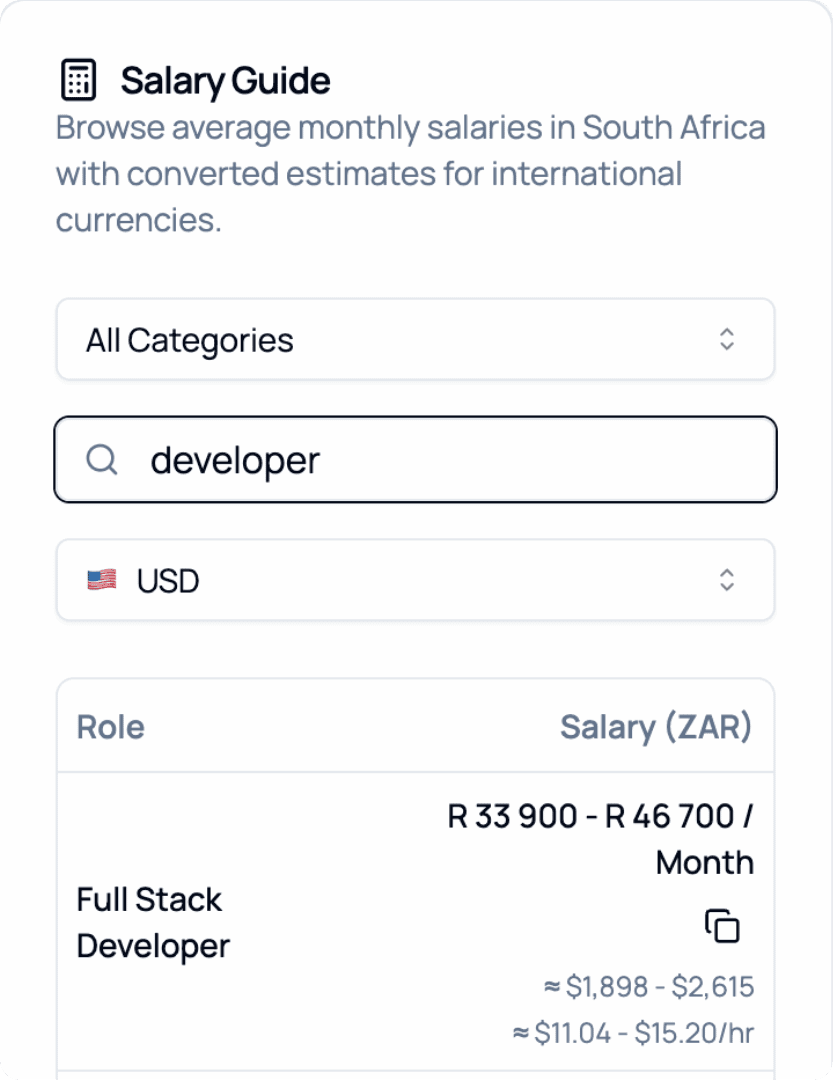
2026 Salary Guide: South Africa
Discover South African Salaries by Role. Compare costs and see how much you can save.