TL;DR
Use this practical playbook to delegate construction estimating workflows without sacrificing bid quality, speed, or margin discipline.
Learn which estimating tasks to delegate first, how to control versioning and assumptions, and how to run handoff QA between field, estimator, and office support.
Model cost and ROI with a clear estimating-support framework that improves response time, bid consistency, and close-rate visibility.
Table of Contents
- Introduction
- What does a virtual assistant estimator do in construction?
- Which estimating tasks should contractors delegate first?
- How much does estimating VA support cost and what ROI should you expect?
- How do you prevent estimating errors when work is delegated?
- How do you scale estimating support from one VA to a reliable system?
- Final Thoughts
Introduction
If you are building support capacity in this vertical, start with the construction industry page for broader role context and staffing options, then review the dedicated Construction Estimating Virtual Assistant page if you want a role-specific hiring path.
Most construction teams think estimating problems are pricing problems. Often they are execution problems. The scope is incomplete at intake. Assumptions are not documented. Follow-ups are delayed. Revisions are mixed across files. By the time the owner reviews the bid, the team is already behind and confidence is lower than it should be.
That is where a construction estimating virtual assistant model helps. This is not a replacement for estimator judgment. It is an operations layer that keeps estimate-related workflows moving on time, with better documentation, tighter handoffs, and fewer avoidable misses.
This playbook shows US contractors how to delegate estimating support in a way that protects quality while improving speed. You will get role boundaries, delegation priorities, QA controls, cost/ROI modeling, and a practical scale path from one support role to a repeatable estimating system.
For adjacent operating context, this guide ties into Construction Virtual Assistant Guide for US Contractors (2026), How to Hire a Virtual Assistant for Small Business in 2026, Virtual Assistant Onboarding Checklist for 2026, Virtual Assistant Cost Calculator Guide for SMB Teams, How to Hire Remote Talent Without Recruiting Fees, and What Is an Onshore and Offshore Team?.
For external references, use practical sources such as the U.S. Small Business Administration, OSHA construction safety resources, Associated General Contractors, Project Management Institute, and IRS business recordkeeping guidance.
What does a virtual assistant estimator do in construction?
Snippet answer: A virtual assistant estimator supports the estimating lane by managing repeatable process work—RFQ intake organization, scope document preparation, revision tracking, follow-up workflows, and bid-package hygiene—while licensed or senior estimators keep final pricing and technical judgment authority.
The fastest way to fail this role is to treat it as “general admin.” Estimating support has to be designed around exact workflow stages, with clear authority boundaries.
A construction estimating VA typically owns these repeatable lanes:
- Intake packet organization (plans, specs, addenda, client notes, deadlines).
- Bid calendar control and milestone reminders.
- Document naming/version control before and after revisions.
- Scope checklist preparation per project type.
- Assumption log formatting and update tracking.
- Estimate follow-up cadence with internal and external stakeholders.
- Revision request routing and status updates.
- Final bid package assembly support before estimator signoff.
Role boundaries that protect margin
A high-performing estimating support role speeds execution without expanding decision risk.
Keep these boundaries explicit:
- No independent scope interpretation where code/licensing judgment is required.
- No final pricing decisions or margin overrides.
- No unsupervised inclusion/exclusion changes in bid assumptions.
- No direct commitment to clients on scope/cost/timeline.
The role owns process discipline, not technical liability.
Where the role creates leverage immediately
Estimating teams usually get the first gains in:
- Cycle-time control: fewer deadline scrambles and late submissions.
- Revision clarity: cleaner assumptions and version visibility.
- Handoff reliability: better data transfer to PM/billing once work is awarded.
The point is not to add more activity. The point is to reduce avoidable friction around high-value estimator time.
Which estimating tasks should contractors delegate first?
Snippet answer: Delegate high-frequency, process-heavy tasks first: intake packet setup, deadline board management, revision/version tracking, assumption-log formatting, and follow-up cadence execution.
Delegation should start with work that is repeated, measurable, and expensive to delay.
First-wave delegation stack
Lane 1: Intake and packet readiness
- Build standardized intake folder structures.
- Confirm required input checklist completion (plans/specs/addenda).
- Flag missing components early.
Lane 2: Bid timeline management
- Maintain bid calendar and stage owners.
- Send reminder cadence by project priority.
- Escalate at pre-defined SLA thresholds.
Lane 3: Version and revision control
- Track revision numbers and timestamps.
- Maintain approved file naming standards.
- Preserve single source of truth for active estimate package.
Lane 4: Assumption and exclusion documentation
- Format assumption logs consistently.
- Ensure revision deltas are captured.
- Prepare pre-submission checklists.
Lane 5: Follow-up and close-loop communication
- Run post-send follow-up cadence.
- Track response/no-response outcomes.
- Prepare status summaries for estimator and owner review.
Delegation filters to use
Before assigning a task, ask:
- Does this require technical pricing judgment?
- Can this be governed by checklist and SOP?
- Is delay cost high if the task is missed?
- Can escalation be defined in one sentence?
If it is checklist-governed and delay-sensitive, delegate first.
What to keep in-house initially
Do not delegate early:
- Final scope interpretation where ambiguity is material.
- Trade-off decisions that impact risk profile and margin.
- Final proposal signoff language that creates legal commitments.
- Exception cases with unresolved specification conflicts.
Start narrow, then expand as accuracy history improves.
How much does estimating VA support cost and what ROI should you expect?
Snippet answer: The best ROI comes from recovered estimator/owner focus, faster bid turnaround, and reduced rework—not from hourly rate reduction alone.
Teams often under-model the economics because they ignore timeline effects. In construction estimating, every delay has compounding impact: lower close confidence, rushed reviews, and weaker client experience.
Cost model components
Direct costs
- Monthly support fee/compensation.
- Tool seats (docs, comms, board, CRM/project software).
- Onboarding/training time.
- Weekly QA/review overhead.
Indirect costs
- Rework from poor version control.
- Opportunity cost from late bids.
- Estimator context switching.
- Lost close probability from delayed follow-up.
Simple ROI equation for estimating support
Use:
ROI = (Recovered estimator hours + cycle-time gains + reduced rework value) - total support cost
Illustrative example:
- Estimator currently spends 30 hrs/month on process-heavy support tasks.
- Safe delegation = 55% (16.5 hrs).
- Estimator blended value = $175/hr.
- Recovered value = $2,887.50/month.
Add cycle-time impact:
- 2-3 faster bid turnarounds/month.
- More consistent follow-up on pending quotes.
- Fewer revision mistakes from version confusion.
Even conservative assumptions often justify a dedicated support lane when estimate volume is rising.
KPI baseline for first 90 days
Track weekly and trend monthly:
- Intake completeness rate at day 1.
- Median estimate cycle time.
- On-time bid submission rate.
- Revision error/rework incidents.
- Follow-up completion rate.
- Close rate on submitted estimates.
The goal is process reliability first, then higher conversion efficiency.
How do you prevent estimating errors when work is delegated?
Snippet answer: Prevent errors by enforcing strict version governance, assumption logging, milestone checklists, and escalation rules before any estimate moves to final review.
Delegation does not create errors. Weak controls do. Most costly estimating mistakes are process mistakes long before they become pricing mistakes.
Error prevention framework
Use a 4-layer control model:
- Input control
- no estimate moves forward without minimum intake completeness.
- Version control
- one active package, clear archive, strict naming/version schema.
- Assumption control
- every major assumption documented and review-ready.
- Submission control
- pre-send checklist + signoff path enforced.
Standard checklist structure
Each estimate should have:
- Project ID and deadline owner.
- Current revision identifier.
- Required doc completeness status.
- Assumptions/exclusions log.
- Outstanding questions status.
- Submission channel and timestamp record.
If one field is unclear, escalation is required before submission.
Escalation triggers that reduce expensive misses
Define these triggers in SOPs:
- Missing critical drawing/spec package.
- Conflicting revision versions.
- Scope ambiguity unresolved within SLA.
- Deadline risk crossing threshold (for example, less than 24h remaining with unresolved blockers).
A support role should never be forced to “guess through” these triggers.
QA cadence that works in real teams
- Daily 10-minute operations huddle: blockers, due-today risks, handoff issues.
- Weekly 30-minute quality review: trend metrics, root causes, SOP updates.
This keeps controls active without adding heavy admin overhead.
Technology controls for cleaner execution
You do not need enterprise complexity. You need deterministic behavior.
- Standard folder templates by project type.
- Locked naming conventions.
- Shared timeline board with explicit status definitions.
- Change log for revisions and assumption edits.
- Permission rules by role.
Low-friction controls beat high-complexity tools every time.
How do you scale estimating support from one VA to a reliable system?
Snippet answer: Scale by separating lanes (intake/versioning/follow-up), documenting inter-lane handoffs, and measuring quality throughput so output is system-driven, not person-dependent.
The first support hire validates the model. Scaling requires process architecture that survives turnover, spikes, and deadline compression.
Scale phases
Phase 1: Single-lane stabilization (0-60 days)
- One support role manages core estimating admin lane.
- SOP baseline and checklist set.
- KPI baseline established.
Phase 2: Lane split (60-120 days)
- Separate intake/versioning from follow-up/status reporting.
- Add backup ownership map.
- Formalize escalation matrix by priority.
Phase 3: System reliability (120+ days)
- Add coordinator oversight or OBM-style lane governance.
- Introduce trend dashboards by lane.
- Tie estimating workflow quality to close-rate and project-start readiness.
Indicators you should scale now
- Frequent bid deadline crunch despite team effort.
- Rising revision confusion incidents.
- Estimator spend on process admin remains high despite SOPs.
- Owner intervention required weekly for avoidable coordination failures.
When these signals appear consistently, you are capacity-constrained by system design—not effort.
30-60-90 rollout playbook
Days 1-30:
- Define role scope and hard boundaries.
- Stand up intake and deadline board.
- Implement version naming protocol.
- Train follow-up templates.
Days 31-60:
- Add assumption log discipline.
- Add submission checklist and signoff path.
- Introduce exception tagging.
- Run weekly trend review.
Days 61-90:
- Identify bottleneck lane by KPI data.
- Add backup coverage and failover instructions.
- Refine SLA thresholds.
- Decide whether to add second support role or coordinator layer.
Internal link set for implementation support
To align hiring and execution model decisions, use:
- Construction Virtual Assistant Guide for US Contractors (2026)
- Virtual Assistant Cost Calculator Guide for SMB Teams
- Virtual Assistant Onboarding Checklist for 2026
- How to Hire Remote Talent Without Recruiting Fees
- 5 Best Countries to Find Remote Talent in 2026
- How to Hire a Virtual Assistant for Small Business in 2026
Common scaling mistakes
- Expanding headcount before fixing version governance.
- Measuring output count but not error/rework cost.
- Letting estimate assumptions live in ad hoc messages.
- Treating follow-up cadence as optional admin.
Fix these first, then scale.
Practical monthly scorecard template
Use four weighted dimensions:
- Timeliness (25%)
- on-time submission rate
- cycle-time trend
- Quality (25%)
- revision error rate
- checklist completeness
- Control (25%)
- assumption log consistency
- escalation compliance
- Commercial impact (25%)
- follow-up completion rate
- estimate-to-close trend movement
Review trend direction monthly, not just point-in-time snapshots.
Estimating SOP blueprint (copy-ready)
A lot of teams know they need SOPs but get stuck at the template level. Use this practical structure for each estimating workflow:
- Workflow name (example: RFQ intake packet readiness)
- Trigger (what event starts the workflow)
- Owner (default role and backup role)
- Inputs required (required documents/data fields)
- Output required (what complete work looks like)
- Deadline/SLA (response and completion standards)
- Escalation rule (what condition triggers escalation)
- Quality check (how completion is verified)
- Reference artifacts (templates, links, naming conventions)
If every estimating lane has this format, onboarding time drops and role ambiguity disappears.
Example: RFQ intake SOP skeleton
Trigger: New RFQ received by email, form, or referral source.
Owner: Estimating VA (primary), estimator (backup review).
Inputs: Plans/specs/addenda, project address, due date, bid instructions, contact details.
Output: Intake board entry + project folder + completeness score + missing-item request sent (if needed).
SLA: Initial log within 2 hours of receipt during business day.
Escalation: Missing critical scope docs within 4 business hours.
Quality check: No estimate starts without minimum intake threshold.
This one workflow alone can remove a surprising amount of deadline stress.
Example: Revision tracking SOP skeleton
Trigger: New addendum/revision/version update received.
Owner: Estimating VA.
Inputs: Prior version ID, new revision docs, affected bid list.
Output: Revision log updated + renamed package + impacted assumptions flagged.
SLA: Revision posted and acknowledged same business day.
Escalation: Conflicting file versions or unresolved scope differences.
Without this SOP, most teams eventually pay for rework, confusion, or incorrect assumptions carried into final bids.
Example: Submission handoff SOP skeleton
Trigger: Estimator marks package ready for pre-submit QA.
Owner: Estimating VA for checklist control, estimator for final approval.
Inputs: Final package files, assumption/exclusion sheet, client submission instructions.
Output: Submission-ready package with timestamp and proof of send.
SLA: QA pass completed before submission deadline buffer.
Escalation: Missing assumptions or unresolved checklist failure.
This protects close-rate quality while preserving speed.
Team communication protocol that actually works
If your communication stack is fragmented, SOP quality will collapse under deadline pressure. Use one protocol:
- Primary system for status: one board/tool only
- Primary system for files: one folder structure only
- Message category tags: urgent/blocked/info
- Escalation window: explicit response-time standard by urgency
- Daily digest: one consolidated update to estimator/owner
The objective is to reduce “hidden work” and eliminate status confusion.
Capacity planning for estimate volume spikes
Construction estimate demand is rarely flat. You need a simple volume playbook:
Tier A (normal volume): standard SLA and workflow ownership.
Tier B (moderate spike):
- shorten follow-up loops
- defer non-critical administrative cleanups
- activate backup reviewer role
Tier C (high spike):
- strict triage by fit and margin potential
- hard escalation to owner/estimator on priority conflicts
- temporary freeze on low-priority process changes
This prevents quality collapse when demand accelerates.
Governance cadence for continuous improvement
Use this rhythm to keep the system improving:
- Weekly: operational KPI review + top 3 blockers + immediate SOP patches.
- Monthly: trend review, role load analysis, exception taxonomy cleanup.
- Quarterly: workflow redesign decision (add capacity vs redesign process).
Most teams skip the monthly layer and then wonder why recurring issues never disappear.
Risk controls for commercial protection
Estimating support should improve win quality, not just speed. Add these controls:
- mandatory exclusion language checklist before final submission
- revision impact notes for every material change
- bid deadline buffer policy (no “just-in-time” single point of failure)
- audit trail retention for estimate artifacts and assumptions
These controls are especially important when deal size or legal exposure increases.
Hiring scorecard for an estimating VA candidate
When evaluating candidates, score on:
- process discipline (checklist behavior)
- documentation quality (clarity and consistency)
- communication reliability (response and handoff quality)
- escalation judgment (knows when to raise risk)
- tool fluency (can follow your stack quickly)
A candidate with strong process behavior often outperforms a “construction-heavy” profile with weak execution habits.
14-day launch checklist
Use this to start quickly without chaos:
- finalize role boundaries
- publish three core SOPs (intake, revision, submission)
- define one source of truth for status and files
- set KPI dashboard template
- run first weekly review on day 7
- patch SOP gaps by day 14
Execution speed matters, but control clarity matters more.
Final Thoughts
Estimating support is one of the highest-leverage places to improve contractor operations. Not because it replaces technical expertise, but because it protects that expertise from process drag.
If you are building this lane now, use the construction industry page to align role design with your broader operations model, then execute with strict SOPs, explicit controls, and measurable KPI cadence.
When your estimating workflow is reliable, growth planning becomes less reactive and more strategic: better response speed, cleaner submissions, tighter handoffs, and stronger margin confidence.
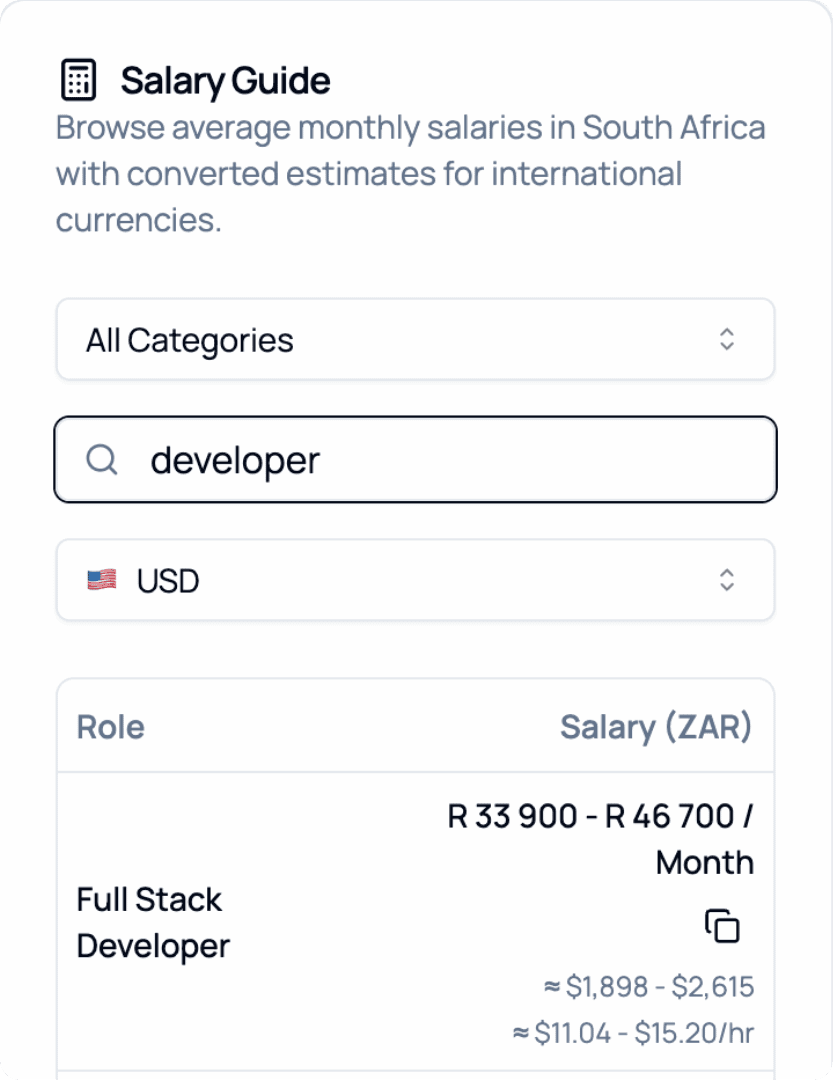
2026 Salary Guide: South Africa
Discover South African Salaries by Role. Compare costs and see how much you can save.