TL;DR
Learn what a construction virtual assistant should own, what to keep in-house, and how to structure field-to-office handoffs without missed details.
Use a practical operating model for estimate follow-up, scheduling, permits, vendor coordination, invoicing support, and client communications.
See a clear cost and ROI framework so you can scale contractor operations with better response times, cleaner admin workflows, and stronger margin control.
Table of Contents
- Introduction
- What does a construction virtual assistant do for a US contractor?
- Which construction tasks should you delegate first?
- How much does a construction virtual assistant cost, and what ROI should you expect?
- How do you structure SOPs and accountability for a construction VA?
- How do you scale from one construction VA to a repeatable support system?
- Final Thoughts
Introduction
If you are planning support capacity for this vertical, start with the construction industry page for broader staffing context and role options. If estimating speed is the bottleneck, the new Construction Estimating Virtual Assistant page gives you a tighter fit for bid-support workflows.
Many contractors do not lose margin because they cannot win work. They lose margin because office operations cannot keep up with field velocity. Calls are missed. Follow-ups happen too late. Change-order paperwork sits in inboxes. Permits and scheduling updates are spread across text messages, notebooks, and disconnected tools. The field keeps moving, but the admin layer lags.
That is exactly where a construction virtual assistant becomes valuable. The role is not about replacing project leadership or site supervision. It is about creating a reliable operations spine so estimates, appointments, permits, vendors, documentation, and client communication move on time with fewer drop-offs.
This guide is for US contractors, remodelers, specialty trades, and small-to-mid construction firms that want cleaner execution without overhiring in-office staff too early. You will get a practical delegation model, SOP and accountability framework, cost and ROI view, and a scale path from one assistant to a repeatable support system.
To build the full operating picture, this guide also connects to adjacent planning resources: How to Hire a Virtual Assistant for Small Business in 2026, Virtual Assistant Onboarding Checklist for 2026, Virtual Assistant Cost Calculator Guide for SMB Teams, How to Hire Remote Talent Without Recruiting Fees, What Is an Onshore and Offshore Team?, and 5 Best Countries to Find Remote Talent in 2026.
For external operating references, anchor to practical standards from the U.S. Small Business Administration, OSHA construction safety requirements, IRS business recordkeeping guidance, Associated General Contractors resources, and the Project Management Institute.
What does a construction virtual assistant do for a US contractor?
Snippet answer: A construction virtual assistant owns repeatable office workflows—lead-response coordination, estimate follow-up, scheduling support, permit/admin tracking, vendor paperwork, and invoice prep—under clear SOPs and escalation rules.
A construction virtual assistant is most effective when the role is designed around workflow ownership, not generic “admin help.” If responsibilities are vague, tasks pile up in the wrong places and handoffs break between office and field.
At a high level, this role supports the “middle layer” between inbound demand and project delivery:
- Intake and initial qualification logging for new inquiries.
- Estimate pipeline tracking and follow-up reminders.
- Calendar coordination for site visits and calls.
- Permit/admin checklist tracking and status updates.
- Vendor COI/W-9 and documentation collection support.
- Change-order and field-note documentation routing.
- Invoice packet preparation and collection follow-up support.
- Client communication cadence for updates and confirmations.
Where this role creates immediate leverage
Most contractors feel the pain in three places first:
- Response-time leakage: leads arrive faster than the team can respond.
- Coordination drag: schedule changes are not propagated quickly.
- Documentation debt: decisions are made in the field but not logged cleanly.
A well-scoped assistant reduces all three by creating a consistent operations rhythm.
Role boundaries that protect quality
A construction virtual assistant should handle process execution, checklist management, and communication support—not technical judgment or licensed decisions.
Keep these boundaries explicit:
- No permitting legal interpretation beyond checklist procedure.
- No scope/pricing authority without owner or PM approval.
- No independent field instruction to crews.
- No final accounting decisions on revenue recognition or tax-sensitive treatment.
When boundaries are clear, speed improves without creating compliance or liability risk.
Which construction tasks should you delegate first?
Snippet answer: Delegate high-frequency, low-ambiguity tasks first: lead intake logging, estimate follow-up, appointment confirmations, permit packet tracking, vendor document collection, and invoice-status updates.
The fastest wins come from tasks that are repeated often, easy to standardize, and expensive when delayed. Do not start with edge cases. Start with recurring process lanes.
Priority delegation stack (first 30 days)
Lane 1: Demand response and estimate pipeline
- New inquiry capture into CRM or job board.
- First-response templates and follow-up cadence.
- Estimate status board updates (sent/viewed/follow-up/closed).
Lane 2: Scheduling and confirmations
- Site visit scheduling support.
- Multi-party confirmation workflows (client, estimator, PM).
- Reschedule queue management and communication updates.
Lane 3: Permit/admin checklist control
- Packet readiness checklist tracking.
- Required document reminders.
- Status updates to PM and owner dashboards.
Lane 4: Vendor and subcontractor paperwork support
- COI/W-9 request and collection tracking.
- Expiry reminders.
- Documentation handoff for accounting/compliance folders.
Lane 5: Invoice ops support
- Job-complete triggers for invoice prep.
- Supporting doc collection before invoicing.
- Receivable follow-up workflow (friendly cadence, status notes).
Task triage framework
Use this simple filter before delegating:
- Is the task repeated weekly?
- Can success be described as a checklist?
- Can exceptions be escalated clearly?
- Does delay hurt cash flow or client experience?
If all four are true, delegate it first.
What not to delegate in phase 1
Avoid delegating high-judgment lanes too early:
- Scope-change pricing decisions.
- Contract/legal interpretation.
- Safety-critical field instructions.
- Final signoff on billing disputes.
Phase-1 delegation should stabilize operations, not increase decision ambiguity.
How much does a construction virtual assistant cost, and what ROI should you expect?
Snippet answer: ROI is usually driven by faster lead response, better schedule reliability, and cleaner billing throughput—not hourly rate alone.
Teams often compare only labor rates and miss the real economics. In construction operations, the highest-value outcomes are response speed, reduced admin rework, and faster invoice conversion.
Cost components to model
Direct costs
- Monthly assistant cost/service fee.
- Tool seats (CRM, scheduling, comms, docs).
- Onboarding and training hours.
- Manager QA/review time.
Indirect costs
- Rework from poor documentation quality.
- Schedule disruption from communication lag.
- Lead loss from late response.
- Billing delay from missing paperwork.
Practical ROI model
Use this formula:
ROI value = (Recovered high-value hours + leakage reduction + billing acceleration gains) - total program cost
Example baseline for a growing contractor:
- Owner/PM currently spends 35 hrs/month on repetitive admin.
- Delegation-safe portion: 60% (21 hrs/month).
- Blended leadership value: $150/hr.
- Recovered leadership value: $3,150/month.
Additional gains:
- 2 rescued opportunities/month due to faster follow-up.
- 5-day faster average invoice issue cycle on completed jobs.
Even before attributing all revenue effects, recovered decision-time + cycle-time improvements can justify the role quickly when SOP discipline is strong.
KPI set for the first 90 days
Track these metrics weekly:
- Lead response median time.
- Estimate follow-up completion rate.
- No-show or unconfirmed appointment rate.
- Permit checklist on-time completion.
- Invoice-ready packet turnaround time.
- AR follow-up completion rate.
If these trend in the right direction, ROI usually follows.
How do you structure SOPs and accountability for a construction VA?
Snippet answer: Build SOPs around event triggers, required inputs, deadline standards, and escalation paths—then enforce them through daily check-ins and weekly KPI reviews.
A construction VA program succeeds on process design, not motivation alone. Good people still fail in bad systems. Your SOP stack should remove ambiguity before volume increases.
SOP architecture that works
For each workflow, include:
- Trigger (what starts the workflow)
- Owner (who executes each step)
- Inputs required (docs/data needed)
- Deadline standard (SLA)
- Output (what “done” looks like)
- Escalation rule (when and to whom)
Core SOPs to build first
- Lead intake and qualification routing.
- Estimate follow-up cadence by status age.
- Site-visit scheduling and reminder workflow.
- Permit packet readiness tracking.
- Vendor documentation collection and archive naming.
- Invoice packet completion and AR follow-up protocol.
QA cadence
Use a two-layer review rhythm:
- Daily 10-minute huddle: blockers, priority changes, same-day risks.
- Weekly 30-minute KPI review: metric trend, exception root causes, SOP updates.
This cadence keeps execution tight without management overhead exploding.
Permissions and controls
Set access by workflow need:
- Principle of least privilege for tools/accounts.
- Role-based templates and macros.
- Change log discipline for key records.
- Simple audit trail for estimates, schedule edits, and billing handoffs.
Good controls are not bureaucracy. They are what lets remote operations scale safely.
How do you scale from one construction VA to a repeatable support system?
Snippet answer: Scale by splitting ownership lanes (demand, coordination, billing/admin), documenting handoffs, and standardizing KPI dashboards so performance does not depend on one person.
The first assistant proves feasibility. The real value comes when the system works even if workload doubles or one person is out.
Phase model for scaling
Phase 1 (single-VA foundation)
- One assistant manages priority workflow lanes.
- SOP library version 1.0.
- Weekly KPI baseline established.
Phase 2 (lane specialization)
- Split responsibilities into two lanes:
- Demand + scheduling
- Documentation + billing support
- Add backup coverage map.
Phase 3 (ops system maturity)
- Introduce quality owner or coordinator role.
- Build dashboard-level visibility by lane.
- Tighten escalation matrix and exception tagging.
Operating metrics that indicate readiness to scale
Move from one-person to lane-based structure when you see:
- persistent same-day backlog in any core queue,
- recurring missed SLA thresholds,
- rising exception volume without root-cause closure,
- leadership spending increasing time on escalation rather than planning.
Internal link strategy to support scaling decisions
As you design your model, cross-reference adjacent operating guides:
- Virtual Assistant Cost Calculator Guide for SMB Teams
- How to Hire Remote Talent Without Recruiting Fees
- Your Step-by-Step Guide to Hiring Your First South African Virtual Assistant
- What Is an Onshore and Offshore Team?
- Virtual Assistant Onboarding Checklist for 2026
These help align hiring model, onboarding, and economics as complexity increases.
Common scaling mistakes to avoid
- Adding people before tightening SOP quality.
- Measuring output volume without error/rework rates.
- Letting field-critical updates rely on one communication channel.
- Ignoring handoff ownership between estimating, PM, and billing.
When these issues are controlled early, scaling is straightforward.
30-60-90 implementation blueprint for contractors
A lot of teams ask, "What should this look like in calendar terms?" A practical rollout timeline helps avoid both under-planning and overengineering.
Days 1-30 (stabilize inputs and communication):
- Finalize role scope with a hard "in-scope / out-of-scope" table.
- Stand up lead and estimate tracking in one source of truth.
- Document core templates for first response, estimate follow-up, appointment confirmation, and rescheduling.
- Define one daily operations check-in and one weekly KPI review.
- Confirm escalation owners (owner, PM, estimator, accounting).
Days 31-60 (standardize workflow quality):
- Add permit/admin packet checklist standards.
- Add vendor documentation naming and storage standards.
- Introduce exception tagging (missing info, delayed approval, client no-response, vendor document gap).
- Start response-time and cycle-time baseline reporting.
- Tighten QA rules for each workflow lane.
Days 61-90 (improve economics and reliability):
- Review workload and identify bottleneck lane.
- Reduce handoff friction with clearer trigger-to-owner mapping.
- Add backup coverage for top two critical workflows.
- Refine KPI dashboard and set target thresholds.
- Build decision memo on whether to add second assistant or keep single-VA model.
This timeline makes the program measurable and prevents "busy but unclear" execution.
Tooling recommendations by workflow lane
You do not need a perfect software stack on day one. You need clear ownership and consistent usage. Still, using the right tool by lane dramatically reduces rework.
Lead and estimate lane
- CRM or pipeline board (HubSpot, Pipedrive, JobNimbus-style workflow boards).
- Mandatory fields for lead source, job type, timeline, budget signal, and next action date.
- Follow-up SLA tags by stage (new lead, estimate sent, no response, decision pending).
Scheduling lane
- Shared calendar standards with role-based views.
- Appointment type templates (site visit, discovery call, install check-in).
- Confirmation and reminder cadence with fallback if unconfirmed.
Documentation lane
- Centralized cloud folders with strict naming conventions.
- Standardized job packet checklist (scope, estimate version, approvals, permit status, COI/W-9, change-order log).
- Version-control rules for estimate revisions and signed docs.
Billing support lane
- Completion trigger checklist before invoice prep.
- Invoice packet quality check (PO reference, approved scope, signed change orders, supporting notes).
- AR follow-up cadence with outcome notes to avoid duplicate outreach.
The more deterministic your tooling behavior is, the less training burden you carry as volume grows.
Field-to-office handoff protocol that prevents margin leakage
In construction operations, many failures are not talent failures. They are handoff failures. A simple protocol can prevent costly misses:
- End-of-day field summary template (completed tasks, blockers, approved changes, pending client decisions).
- Next-action ownership line (who owns next step and by when).
- Documentation capture requirement (photos, signed forms, updated notes attached same day).
- Escalation trigger threshold (what must be flagged immediately vs in daily batch).
When a VA sits in the office operations lane, this protocol ensures field reality is reflected in admin systems fast enough for billing, scheduling, and client communication to stay accurate.
Quality scorecard example for monthly review
A lightweight monthly scorecard keeps the role strategic instead of reactive. Suggested scoring dimensions:
- Response discipline (25%)
- Median first-response time
- Follow-up completion rate
- Coordination quality (25%)
- Confirmation accuracy
- Reschedule recovery speed
- Documentation integrity (25%)
- Checklist completion quality
- Missing-document incident rate
- Billing readiness (25%)
- Invoice packet completeness rate
- AR follow-up cadence adherence
Use trend movement, not single-week spikes, for management decisions. The goal is stable, compounding improvement.
When to hire a second VA vs an OBM-style coordinator
After the first 90 days, teams usually face one of two expansion paths:
- Second VA path: best when volume is high in repetitive lanes and SOP quality is already strong.
- Coordinator/OBM path: best when work quality is acceptable but cross-functional orchestration is still inconsistent.
Decision rule:
- If queues are long but predictable, add execution capacity.
- If queues are short but chaotic, add coordination quality.
This distinction saves teams from scaling the wrong bottleneck.
Implementation checklist you can use this week
- Finalize role scorecard.
- Lock first-response and estimate follow-up SLA.
- Document permit/admin minimum packet definition.
- Document invoice-ready packet definition.
- Run one weekly KPI review with trend notes.
- Capture top five recurring exceptions and patch SOPs.
If you execute these six items consistently for four weeks, the operational impact is usually obvious: fewer missed opportunities, cleaner communication, and better billing flow. Most teams also see better owner focus, less schedule confusion, and a sharper close-rate-to-capacity relationship that makes growth planning less guesswork and more disciplined execution over time consistently.
Final Thoughts
A construction virtual assistant is not a shortcut. It is a systems decision. Teams that win with this model treat it like operations architecture: clear workflow ownership, strict handoff standards, measurable KPIs, and disciplined escalation.
If your company is preparing to scale office support without losing project velocity, use the construction industry page to align role selection, workflow scope, and implementation sequence.
Start small, instrument the process, and scale only what is measurable. In construction, administrative consistency is often the difference between stable margin and operational chaos.
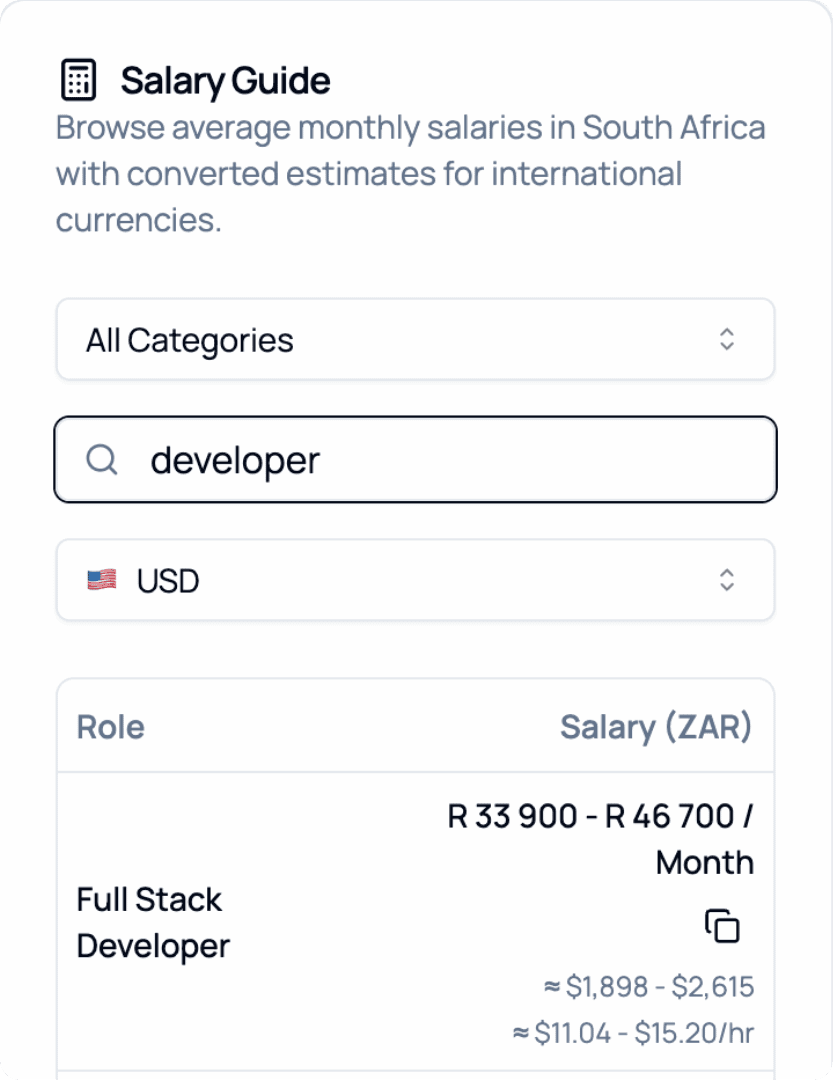
2026 Salary Guide: South Africa
Discover South African Salaries by Role. Compare costs and see how much you can save.