TL;DR
Follow a clear step-by-step process to hire your first South African virtual assistant without wasting time on the wrong role.
Learn how to scope the work, screen candidates, run paid tests, and onboard for reliable output in the first 30 days.
Use practical hiring criteria for communication, timezone overlap, process ownership, and long-term team fit.
Table of Contents
- Why South African virtual assistants are attractive for growing teams
- Step 1: Define the business problem before you define the role
- Step 2: Choose a narrow starting role
- Step 3: Build a role scorecard before interviewing anyone
- Step 4: Write a job brief that filters for clarity and judgment
- Step 5: Screen for signal, not charm
- Step 6: Run structured interviews with the same rubric for every finalist
- Step 7: Use a paid test project before you commit
- Step 8: Onboard with SOPs, not vibes
- Step 9: Set expectations for communication and ownership early
- Step 10: Manage performance by outcomes, not online presence
- Common mistakes when hiring your first South African virtual assistant
- What success looks like in the first 30 days
- Final takeaway
If you are trying to hire your first South African virtual assistant, the goal is not to “get help.” The goal is to remove a real bottleneck from your business without creating a new management problem.
That is where most first-time hires go sideways. Founders hire too broadly, interview too casually, and onboard too loosely. Then they blame remote work when the real issue was a weak system.
This guide gives you a practical step-by-step process to hire a South African VA who can actually make your business faster, calmer, and more scalable.
If you are still deciding whether a VA is the right model, start with why businesses hire virtual assistants or compare options in our guide to virtual assistant vs remote worker.
Why South African virtual assistants are attractive for growing teams
South Africa has become a strong hiring market for remote support roles for a few simple reasons:
- Strong written and spoken English
- Good alignment with UK, EU, and workable overlap for US teams
- Professional customer-facing communication
- Cost efficiency versus local hiring in many Western markets
- A growing talent pool across admin, customer support, marketing, sales support, and operations
That does not mean you should hire based on geography alone. Geography helps with supply. Systems determine whether the hire works.
For many companies, the better framing is not “Can I find a cheaper assistant?” It is “Can I hire a reliable operator who removes recurring low-leverage work from my week?”
Step 1: Define the business problem before you define the role
Do not start by writing “Virtual Assistant” in a job post.
Start by identifying the bottleneck.
Ask:
- What work keeps slipping every week?
- What tasks am I doing that someone else could own?
- What tasks create revenue protection or time savings if done consistently?
- Where do errors, delays, or follow-up failures happen?
Good first-hire examples include:
- Inbox and calendar management
- CRM hygiene and lead routing
- Customer support triage
- Research and reporting
- Proposal or document preparation
- Social media scheduling
- Listing, admin, or operations coordination
Bad first-hire setup: one person handling executive support, design, sales ops, bookkeeping, and project management because you are “testing versatility.” That is not versatility. That is chaos with a headset.
Step 2: Choose a narrow starting role
The safest first hire is a role with a clear scope and repeatable outputs.
Common first South African VA roles include:
- Admin VA for inbox, scheduling, travel, and documentation
- Operations VA for process tracking, data cleanup, and follow-up
- Customer support VA for inbox triage, ticket updates, and knowledge-base use
- Sales support VA for CRM updates, lead qualification support, and meeting coordination
- Marketing VA for scheduling, research, light content operations, and reporting
If you serve a specialized industry, you may also want an industry-fit role such as a real estate virtual assistant, legal support assistant, or insurance support VA.
Keep the first role narrow enough that you can measure success quickly.
Step 3: Build a role scorecard before interviewing anyone
A scorecard will save you from hiring based on vibes.
Your scorecard should include:
- Top 5 responsibilities
- Tools they need to use
- What “good” looks like weekly
- Response time expectations
- Accuracy and quality standards
- Escalation rules
Example scorecard metrics for a first admin or ops VA:
- Inbox triaged to target SLA every business day
- Calendar conflicts caught before meetings break
- CRM updated within 24 hours of new activity
- Weekly report delivered by Friday noon
- Less than 2 percent avoidable data errors
This step matters because a candidate cannot succeed in a role you have not defined.
Step 4: Write a job brief that filters for clarity and judgment
A strong job brief is not long. It is specific.
Include:
- The outcomes this role owns
- The tasks they will handle most often
- The tools they will use
- Required timezone overlap
- Communication standard you expect
- A short paid test-project requirement for finalists
Avoid empty filler like “must be a self-starter” unless you define what that means in the role.
Better version:
- Flags blockers early instead of waiting
- Documents repeatable steps while learning
- Asks clarifying questions before executing ambiguous tasks
- Can summarize progress in a short async update
That kind of specificity improves applicant quality fast.
Step 5: Screen for signal, not charm
A polished interview does not prove execution ability.
Use a simple screening stack:
Written screening
Ask 3 to 5 short questions that reveal:
- Writing clarity
- Attention to detail
- Decision-making
- Process thinking
Tool familiarity check
You are not looking for perfection. You are looking for comfort with the kinds of tools the role requires, such as:
- Google Workspace
- Slack
- HubSpot or another CRM
- Notion, ClickUp, or Asana
- Help desk systems
- Spreadsheet workflows
Mini scenario task
Give a short real-world prompt, such as:
- Triage a messy inbox
- Draft a follow-up sequence
- Clean a small CRM sample
- Turn a voice-note style brief into a checklist
That will tell you more than 30 minutes of polished interview answers.
Step 6: Run structured interviews with the same rubric for every finalist
Keep the interview consistent.
Use the same themes for every candidate:
- Relevant past work
- Communication style
- Handling unclear instructions
- Managing mistakes or missed deadlines
- Prioritization under workload pressure
- Availability and timezone overlap
Listen for specifics. Strong candidates describe how they work, how they escalate issues, how they organize tasks, and how they improve after feedback.
Weak candidates stay generic and over-index on being “hardworking.” Hardworking is nice. Systematic is better.
Step 7: Use a paid test project before you commit
For a first South African virtual assistant hire, a paid test project is one of the best risk reducers you have.
A good test project should be:
- Short enough to complete in a few hours or over a few days
- Close to real work
- Easy to review objectively
- Clear on instructions and deadline
Evaluate:
- Accuracy
- Speed
- Communication
- Judgment
- Response to feedback
This step reveals whether the candidate can operate in your environment, not just interview well inside it.
Step 8: Onboard with SOPs, not vibes
If you want your first VA to succeed, do not make them reverse-engineer your brain.
At minimum, provide:
- Role scorecard
- Access checklist
- SOPs for core recurring tasks
- Tool logins through your secure process
- Escalation rules
- Daily and weekly reporting cadence
- First 14-day priority list
Good onboarding reduces anxiety on both sides. It also turns “I thought you meant…” into “Here is the process we agreed on.”
If you need a structured follow-up after hiring, pair this with our virtual assistant onboarding checklist for 2026.
Step 9: Set expectations for communication and ownership early
A lot of remote hiring frustration is really communication drift.
Decide upfront:
- What needs same-day response
- What can wait until the next async update
- What deserves escalation immediately
- What format updates should follow
- Which KPIs matter most
A simple cadence works well for most first hires:
- Daily update: what was done, what is blocked, what is next
- Weekly review: wins, misses, process fixes, next priorities
- Immediate escalation: urgent client or revenue-adjacent issues
Clear communication rules create trust faster than constant checking.
Step 10: Manage performance by outcomes, not online presence
Do not confuse being available with being effective.
Your first South African VA should be measured on outcomes such as:
- Tasks completed on time
- Accuracy rate
- SLA adherence
- Fewer follow-up misses
- Time saved for founder or team lead
- Process improvements documented
If performance is weak, diagnose the actual cause:
- Was the role poorly scoped?
- Were instructions unclear?
- Is the candidate missing a critical skill?
- Are SOPs weak?
- Is the QA loop too loose?
Usually it is one of those. “Remote” is rarely the real diagnosis.
Common mistakes when hiring your first South African virtual assistant
Hiring a generic VA for a specialized problem
If you need CRM cleanup, sales support, or customer success process ownership, hire for that function directly.
Skipping the paid test
This is how teams discover execution gaps after access is already granted and momentum is already lost.
Overloading the first role
Start narrow. Expand after trust and systems are in place.
Making onboarding entirely verbal
If it only exists in your head, it does not exist.
Managing by gut feel
Use scorecards, KPIs, and regular reviews. Otherwise every week becomes a subjective debate.
What success looks like in the first 30 days
By day 30, a strong first VA hire should usually be doing some mix of the following:
- Owning a repeatable task set without daily rescue
- Sending clear updates without rambling
- Catching obvious mistakes before they reach you
- Improving speed while maintaining quality
- Reducing your administrative drag meaningfully
The first hire does not need to be perfect. They need to be reliable, coachable, and steadily more autonomous.
That is the real win.
Final takeaway
Hiring your first South African virtual assistant works best when you treat it like an operating decision, not a hope-based delegation experiment.
Define the bottleneck. Narrow the role. Use a scorecard. Test before you commit. Onboard with SOPs. Manage by outcomes.
Do that, and your first VA can become one of the highest-leverage hires in your business.
If you want a faster path to vetted talent, explore how HireSava helps businesses hire remote talent from South Africa or review our employer resources on why South Africa and how to hire a virtual assistant for small business.
Frequently Asked Questions
Explore related hiring options
Useful next pages based on this article's topic:
- Hire South African virtual assistants — core service page for evaluating HireSava's hiring model and next-step CTA
- Fluent English remote workers in South Africa — proof of communication quality for customer-facing and judgment-heavy roles
- South Africa virtual assistant cost guide — budget planning and quality-adjusted cost expectations
- South Africa VA rates benchmark — role-by-role compensation ranges and seniority bands
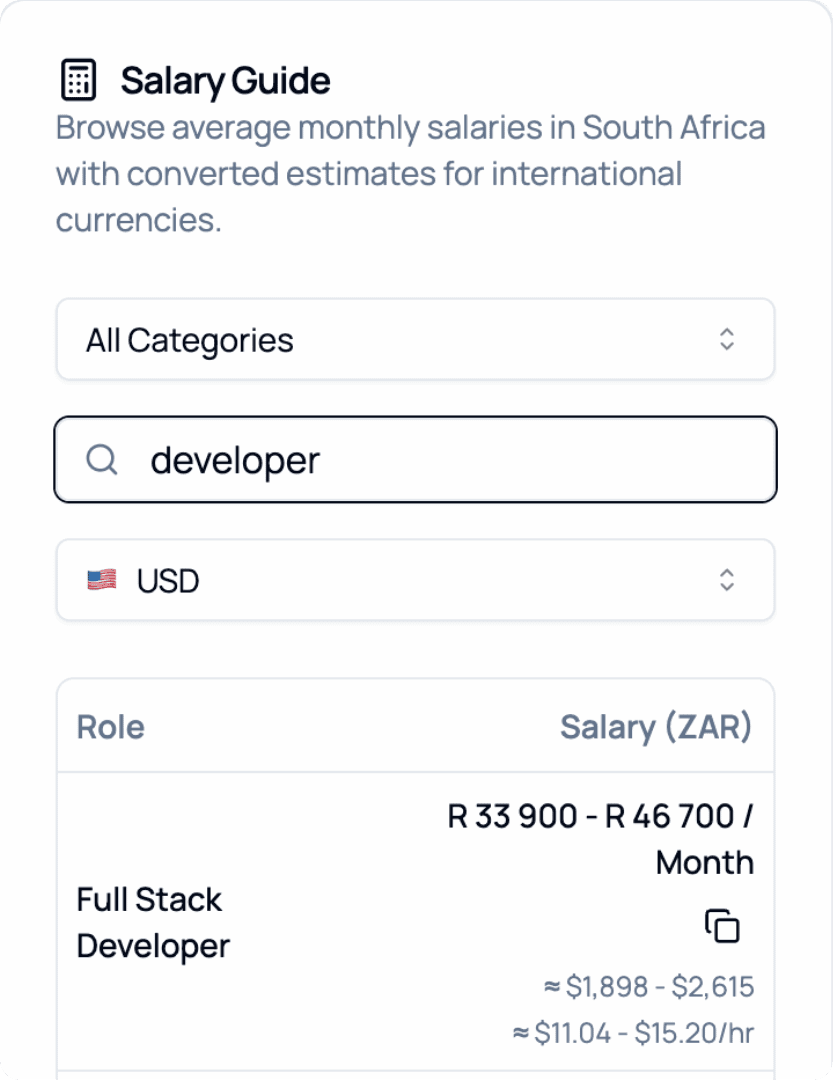
2026 Salary Guide: South Africa
Discover South African Salaries by Role. Compare costs and see how much you can save.