TL;DR
A practical employer guide to what a virtual assistant costs in South Africa in 2026 and what actually drives the number.
Compare hourly, monthly, contractor, and managed-support cost structures without falling for cheap-rate traps.
Use a quality-adjusted budgeting model to hire South African remote talent with better margin control.
Table of Contents
- How much does a virtual assistant cost in South Africa?
- What changes the cost of a virtual assistant in South Africa?
- Is South Africa actually a cost-effective place to hire virtual assistants?
- Should employers compare hourly cost or monthly cost?
- What is the true cost of a virtual assistant in South Africa?
- How should employers budget for South African VA hiring in 2026?
- What hiring model usually gives the best cost outcome?
- Cost mistakes employers make when hiring South African virtual assistants
- When is a higher-cost South African VA actually worth it?
- Employer FAQ: virtual assistant cost in South Africa
- Final thoughts
If you’re asking how much a virtual assistant costs in South Africa, you’re probably trying to make a hiring decision, not win a trivia contest.
That is exactly where most cost content goes wrong. It gives you a number, skips the operating reality, and leaves you to discover the expensive part later: manager time, rework, weak communication, and unstable delivery.
This guide is for employers who want a realistic 2026 answer. We’ll break down what changes the price, when low rates become expensive, and how to budget for reliable output instead of fantasy savings.
If you want role-by-role benchmarks, start with Virtual Assistant Rates in South Africa (2026): Employer Benchmarks by Role and Seniority. If you need to compare hourly and monthly pricing, use Virtual Assistant Hourly Rate in South Africa (2026): What Employers Should Actually Pay. For full budget modeling, pair this guide with Virtual Assistant Cost Calculator Guide for SMB Teams.
How much does a virtual assistant cost in South Africa?
Snippet answer: Virtual assistant cost in South Africa depends on role complexity, ownership expectations, communication quality, and hiring model. Basic task support generally costs less than process-owning or specialist support, but the cheapest option is often not the lowest total cost once oversight and rework are included.
There is no single magic number because “virtual assistant” covers very different jobs. A calendar-and-inbox admin role is not priced the same as a revenue-support coordinator, executive assistant, or compliance-adjacent operations role.
A better employer question is this:
What does this role cost to reach stable, reliable output?
That question leads to better hiring decisions and fewer ugly surprises.
What changes the cost of a virtual assistant in South Africa?
Snippet answer: Cost is mainly shaped by role difficulty, expected autonomy, turnaround requirements, and the business impact of mistakes. The more judgment, accountability, and responsiveness a role requires, the higher the cost band should be.
The four biggest cost drivers
-
Role complexity
Repetitive admin tasks sit in a different cost band from multi-tool operations support. -
Ownership level
“Complete these tasks” is cheaper than “run this workflow, catch issues early, and escalate intelligently.” -
Communication burden
Client-facing, cross-functional, or executive-facing roles require stronger writing and judgment. -
Error cost
If mistakes affect revenue, customer trust, or compliance posture, paying more for reliability is usually cheaper than paying less for noise.
Why employers get fooled by low rates
A low direct rate can look great until it creates:
- higher oversight hours,
- slower execution,
- repeated corrections,
- churn inside the first 90 days.
That is not savings. That is delayed pain wearing a discount sticker.
Is South Africa actually a cost-effective place to hire virtual assistants?
Snippet answer: Yes, South Africa is often cost-effective for employers because it combines strong English communication, broad role coverage, and attractive cost-to-quality economics. But cost-effectiveness depends on selecting the right role design and quality bar—not just finding the lowest quote.
South Africa tends to stand out for employer teams that care about:
- clear spoken and written English,
- customer-facing professionalism,
- timezone overlap with UK and workable coverage for US teams,
- strong support across admin, operations, sales support, finance support, and recruiting workflows.
That is why many employers are not simply asking, “Can we hire cheaper?” They are asking, “Can we hire well without paying onshore rates?”
That’s a much smarter question.
For a broader employer-side view, see Why US Companies Hire from South Africa.
Should employers compare hourly cost or monthly cost?
Snippet answer: Employers should compare both, but monthly cost tied to outcomes is usually more useful for decision-making. Hourly pricing helps with quotes; monthly cost helps you understand real budget impact and whether the role will stay efficient over time.
Hourly cost is useful when
- workload is variable,
- scope is still being tested,
- the role is narrow and project-like.
Monthly cost is more useful when
- workflows are recurring,
- role ownership is stable,
- you need predictable planning,
- delivery consistency matters more than pure flexibility.
The trap to avoid
Many teams compare a cheap hourly rate against a higher monthly managed option and think they are comparing the same thing. They aren’t.
One model may include more screening, better continuity, and faster ramp. The other may demand far more internal management.
If you skip management overhead, you are not comparing cost. You are comparing invoices.
What is the true cost of a virtual assistant in South Africa?
Snippet answer: True cost includes direct compensation plus manager time, onboarding drag, tooling, and rework. Employers should use a quality-adjusted cost model instead of evaluating candidates or providers on price alone.
Use this practical formula:
True Monthly Cost = Direct Cost + Oversight Cost + Ramp Cost + QA/Rework Cost + Tooling Cost
That formula is boring. It is also how adults avoid dumb hiring math.
What each line means
- Direct cost: pay rate, fee, or monthly service charge.
- Oversight cost: internal manager time spent correcting, checking, and re-explaining.
- Ramp cost: slower output during the first few weeks.
- QA/rework cost: fixes caused by avoidable mistakes or unclear execution.
- Tooling cost: role-specific software, seats, or workflow systems.
Why this matters
Candidate A may look cheaper on paper. But if Candidate B reaches stable output faster and needs less supervision, Candidate B often wins on true cost.
That is the difference between buying labor and buying leverage.
How should employers budget for South African VA hiring in 2026?
Snippet answer: Budget by role outcomes, not title alone. Start with the work to be done, estimate the management load, choose the hiring model, and then build a 30/60/90-day cost view. This gives a much more reliable forecast than quoting a single monthly number.
Step 1: define the role by output
Document:
- recurring weekly tasks,
- ownership boundaries,
- expected turnaround times,
- success metrics for the first 90 days.
Step 2: choose the model
Budget differently for:
- direct contractor support,
- employee or EOR path,
- managed support or recruiting-assisted model.
Step 3: price the first 90 days, not only month one
Use three views:
- Launch month: onboarding and setup heavy.
- Stabilization month: process quality improves.
- Steady-state month: role economics become clearer.
Step 4: stress-test the budget
Before approving the hire, ask:
- If output is slower than planned, what happens?
- If manager time doubles for 30 days, is the role still worth it?
- If the role succeeds, can we scale this model?
If your budget collapses under mild stress, it was fiction.
What hiring model usually gives the best cost outcome?
Snippet answer: The best model depends on management bandwidth and role risk. Self-managed hiring can be cost-efficient when your internal processes are strong. Managed support often wins when speed, reliability, and lower oversight matter more than minimum direct cost.
Self-managed hiring fits when
- you already have clear SOPs,
- one manager owns the workflow,
- QA is simple,
- you can absorb more screening and ramp work.
Managed support fits when
- speed matters,
- reliability matters,
- internal management capacity is limited,
- role continuity is important.
A practical rule
If your team is short on management bandwidth, the “cheaper” model often stops being cheaper very quickly.
Cost mistakes employers make when hiring South African virtual assistants
Snippet answer: The biggest mistakes are pricing the role before defining it, ignoring oversight cost, and using low rate as a proxy for value. These errors create unstable delivery and usually lead to rehiring or compensation redesign.
Mistake 1: pricing before scope
If scope is vague, cost comparisons are garbage.
Mistake 2: ignoring manager time
Founder or operator time is expensive. Pretending it is free wrecks cost analysis.
Mistake 3: using one title for different jobs
“Virtual assistant” can mean admin support, executive support, operations coordination, sales assistance, or industry-specific workflow support. Those are different roles and should be budgeted differently.
Mistake 4: overbuying flexibility
Keeping a stable recurring role on a vague hourly arrangement often produces noisy spending and weak accountability.
Mistake 5: underestimating replacement cost
A bad hire does not just waste one month of pay. It also burns recruiting time, manager attention, and operating momentum.
When is a higher-cost South African VA actually worth it?
A higher-cost hire is usually worth it when the role:
- protects revenue,
- reduces executive bottlenecks,
- touches client experience,
- requires independent judgment,
- lowers manager oversight materially.
A useful decision test:
Will paying more here reduce friction enough to improve output per managed hour?
If yes, the premium may be economically correct.
Employer FAQ: virtual assistant cost in South Africa
Is South Africa cheaper than hiring in the US or UK?
Often yes, especially for remote support, admin, and operations roles. But lower cost is only valuable if quality and reliability remain strong.
Can I estimate cost by hourly rate alone?
You can estimate a quote that way. You cannot estimate the full business cost that way.
Should I use contractor or employee pricing assumptions?
Use the assumption that matches the real operating model. If the role behaves like a long-term manager-led role, treat that seriously during planning rather than hiding behind convenience.
What is the best way to compare candidates or providers?
Compare them on quality-adjusted cost: direct rate, communication quality, ramp speed, oversight burden, and consistency.
What should I review after the hire starts?
Track first-pass quality, manager oversight hours, rework volume, and whether the role is approaching stable output by day 30, 60, and 90.
Final thoughts
The real answer to “how much does a virtual assistant cost in South Africa?” is not one number. It is a budgeting framework.
South Africa can be a strong hiring lane for employers who want capable remote talent with solid cost-to-quality economics. But the win comes from hiring discipline, not bargain hunting.
If you want the best result, price the role based on output, management load, and business risk—not just the cheapest rate someone was willing to quote.
For next-step planning, read How to Hire Remote Staff in South Africa: Employer Playbook (2026), Virtual Assistant Rates in South Africa (2026): Employer Benchmarks by Role and Seniority, and Virtual Assistant Cost Calculator Guide for SMB Teams.
Explore related hiring options
Useful next pages based on this article's topic:
- Hire South African virtual assistants — core service page for evaluating HireSava's hiring model and next-step CTA
- Fluent English remote workers in South Africa — proof of communication quality for customer-facing and judgment-heavy roles
- South Africa VA rates benchmark — role-by-role compensation ranges and seniority bands
- South Africa hourly rate guide — hourly pricing expectations and hiring math
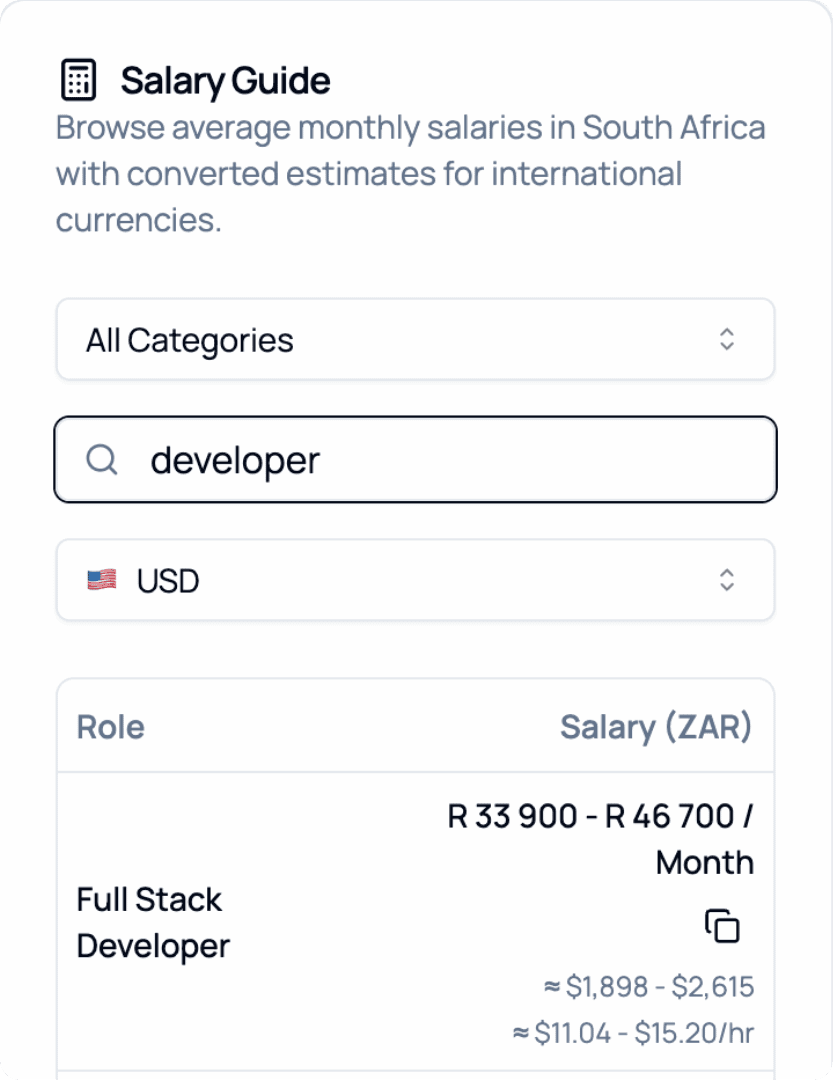
2026 Salary Guide: South Africa
Discover South African Salaries by Role. Compare costs and see how much you can save.