TL;DR
A practical employer comparison of South Africa vs Pakistan virtual assistants for 2026 hiring decisions.
Compare communication quality, cost realism, management overhead, timezone fit, and role suitability instead of chasing the cheapest rate on paper.
Use this guide to choose the better hiring lane for executive support, operations, customer support, recruiting, and process-heavy admin work.
Table of Contents
- South Africa vs Pakistan virtual assistants: which is better for employers?
- Cost comparison: South Africa vs Pakistan VA hiring
- Communication quality and employer trust
- Timezone overlap and workflow fit
- Which market fits different role types?
- Management overhead: where ROI really gets decided
- Employer decision framework: South Africa vs Pakistan VAs
- Common employer mistakes in South Africa vs Pakistan comparisons
- Should you hire virtual assistants from South Africa or Pakistan?
- Final thoughts
If you’re comparing South Africa vs Pakistan virtual assistants, you are not choosing between two interchangeable “offshore” markets.
You are choosing between two very different operating profiles.
Pakistan often gets shortlisted because employers want lower labor costs, broad freelancer supply, and access to admin or back-office support at aggressive price points. South Africa usually gets chosen when the role depends on polished English, cleaner client-facing communication, and steadier execution in workflows where judgment matters.
So the real question is not, which market is cheaper at first glance?
It is which market gets this role stable faster without turning your managers into full-time quality-control staff.
If you want South Africa-specific pricing context first, start with How Much Does a Virtual Assistant Cost in South Africa? Employer Guide for 2026, Virtual Assistant Hourly Rate in South Africa (2026): What Employers Should Actually Pay, and Virtual Assistant Rates in South Africa (2026): Employer Benchmarks by Role and Seniority.
South Africa vs Pakistan virtual assistants: which is better for employers?
Snippet answer: Pakistan can be attractive when cost pressure is the main constraint and the role is structured enough to manage tightly. South Africa is often the better fit for communication-heavy, customer-facing, and quality-sensitive roles where polished English and lower management friction matter more than headline savings.
There is no universal winner.
Pakistan can work well for businesses that have clear SOPs, strong QA, and managers who are comfortable monitoring detailed execution.
South Africa often wins when the business needs a virtual assistant who can communicate with confidence, handle nuance, and produce cleaner work with fewer correction loops.
That difference gets expensive fast.
Cost comparison: South Africa vs Pakistan VA hiring
Snippet answer: Pakistan may look cheaper on raw hourly rates, but South Africa often looks stronger on quality-adjusted cost for roles where communication, autonomy, and customer trust affect outcomes. Employers should compare total operating cost, not just vendor pricing.
Cheap labor is not the same thing as cheap output.
Use this instead:
True Cost = Direct Cost + Oversight Time + Rework Cost + Delay Cost
That formula matters because a lower-rate hire can become more expensive if the manager has to rewrite messages, catch mistakes, clarify instructions, or absorb customer friction.
Where Pakistan can win on price
Pakistan may be attractive when:
- budget is the main limiting factor,
- the work is process-heavy and clearly documented,
- the team already has strong QA systems,
- the role is less exposed to customers or executives,
- leadership is comfortable trading lower rates for tighter supervision.
That can absolutely work. Just call it what it is.
Where South Africa often wins on value
South Africa usually looks stronger when the role includes:
- executive assistance,
- recruiting coordination,
- client support,
- operations support,
- customer communication,
- work that requires polished written English and contextual judgment.
For those roles, fewer mistakes often beat cheaper rates.
Communication quality and employer trust
Snippet answer: South Africa often stands out in spoken and written English quality for customer-facing, executive-support, and commercially sensitive roles. Pakistan can still be a fit in structured support environments, but the right choice depends on how communication-critical the role really is.
This part gets hand-waved too often.
If the role touches customers, candidates, executives, or sales conversations, communication quality is not a soft benefit. It is the job.
That is why many employers working through HireSava’s hiring model are trying to reduce management drag, not simply buy the lowest hourly number they can find.
For broader context, see Why US Companies Hire from South Africa and Hire Remote Staff in South Africa: Employer Playbook.
Timezone overlap and workflow fit
Snippet answer: Neither South Africa nor Pakistan is a true nearshore option for US employers, so the comparison usually comes down to workflow design rather than live overlap. South Africa often fits better for teams that value cleaner async execution, while Pakistan can work in more tightly managed production systems.
This is not a Mexico-style nearshore comparison.
Both markets usually require employers to operate with an async-first mindset for US teams.
That means the hiring decision should focus less on overlap fantasy and more on questions like:
- How clearly can this person run from context?
- How much live supervision will they need?
- How expensive are avoidable communication mistakes?
- Does the team actually have the management muscle to support a lower-cost, higher-QA workflow?
If your team is structured and comfortable reviewing detailed output, Pakistan can be viable.
If your team wants smoother independent execution with fewer clarification loops, South Africa often looks stronger.
Which market fits different role types?
Snippet answer: South Africa is often stronger for communication-heavy, judgment-heavy, and customer-facing support roles. Pakistan is often stronger when price sensitivity is high and the work is process-driven enough to manage through SOPs and QA.
South Africa often fits best for
- executive assistants,
- recruiting coordinators,
- customer support roles,
- sales support,
- operations coordinators,
- client-facing admin roles.
Pakistan often fits best for
- process-led admin support,
- back-office execution with strong SOPs,
- cost-sensitive task coverage,
- teams with active QA and management capacity,
- roles where communication polish matters less than throughput discipline.
The right comparison is not cultural. It is operational.
Management overhead: where ROI really gets decided
Snippet answer: Management overhead is usually the hidden separator between South Africa and Pakistan. The better market is often the one that reaches dependable output with fewer rewrites, fewer check-ins, and less manager intervention.
Ask this before hiring:
How many managed hours per week will this role consume before it becomes reliable?
That question is brutal, but useful.
If your team is already stretched, the lower-rate option can become the more expensive one if every handoff needs cleanup.
South Africa often performs well in these cases because stronger communication reduces avoidable friction.
Pakistan can still produce strong ROI when the team has:
- clean SOPs,
- patient managers,
- clear QA checkpoints,
- tolerance for closer supervision during ramp.
If you do not model management cost, your comparison is basically fan fiction.
Employer decision framework: South Africa vs Pakistan VAs
Use this five-question filter before choosing a hiring lane.
1. Is the role communication-sensitive?
If the role touches customers, candidates, or executives, South Africa often deserves the edge.
2. How price-constrained is the business?
If budget pressure is severe and the workflow is well documented, Pakistan may deserve stronger consideration.
3. How much independent judgment does the role require?
The more nuance the work requires, the more communication quality and contextual thinking matter.
4. How mature is your management system?
A business with weak SOPs and limited QA capacity should be careful about choosing the lowest-rate lane.
5. What is the real cost of manager cleanup?
If delays, rewriting, or customer friction are expensive, higher-quality execution usually wins the math.
That is the adult version of offshore comparison.
Common employer mistakes in South Africa vs Pakistan comparisons
Snippet answer: The biggest mistakes are overvaluing raw rate cards, ignoring management overhead, and assuming all offshore talent markets behave the same. Employers should compare role fit and operating load, not outsource stereotypes.
Mistake 1: buying the cheapest rate without modeling cleanup time
Low rates can hide expensive supervision.
Mistake 2: treating all virtual assistant roles like commodity admin work
Some roles live or die on communication quality.
Mistake 3: skipping QA assumptions in the hiring model
If the workflow needs heavy quality review, say that up front.
Mistake 4: underestimating customer-facing risk
If the role affects trust, conversion, or retention, awkward communication can cost more than labor savings.
Mistake 5: assuming better value always means lower pay
Better value usually means stronger output per manager hour, not just a smaller invoice.
Should you hire virtual assistants from South Africa or Pakistan?
If your business is highly cost-sensitive, has documented workflows, and can support tighter supervision, Pakistan may be a workable hiring lane.
If your business needs polished communication, lower management friction, and stronger performance in customer-facing or judgment-heavy roles, South Africa is often the better choice.
The point is not to romanticize one market.
It is to choose the market that creates dependable output without breaking your operating system.
That is the comparison that actually saves money.
Final thoughts
South Africa vs Pakistan is not a debate about which country offers the lowest listed rate. It is a decision about management maturity, communication risk, workflow structure, and the cost of poor execution.
For some employers, Pakistan works because the system is strong enough to absorb tighter management. For many others, South Africa wins because cleaner communication and steadier execution reduce drag where it matters most.
If you want a South Africa-first hiring lane built around employer outcomes, continue with South Africa vs India Virtual Assistants: Employer Comparison for 2026, South Africa vs Philippines Virtual Assistants: Employer Comparison for 2026, and Hire Remote Staff in South Africa: Employer Playbook (2026).
Explore related hiring options
Useful next pages based on this article's topic:
- Hire South African virtual assistants — core service page for evaluating HireSava's hiring model and next-step CTA
- Fluent English remote workers in South Africa — proof of communication quality for customer-facing and judgment-heavy roles
- South Africa virtual assistant cost guide — budget planning and quality-adjusted cost expectations
- South Africa VA rates benchmark — role-by-role compensation ranges and seniority bands
- South Africa hourly rate guide — hourly pricing expectations and hiring math
- Hire remote staff in South Africa playbook — screening, onboarding, and first-hire execution steps
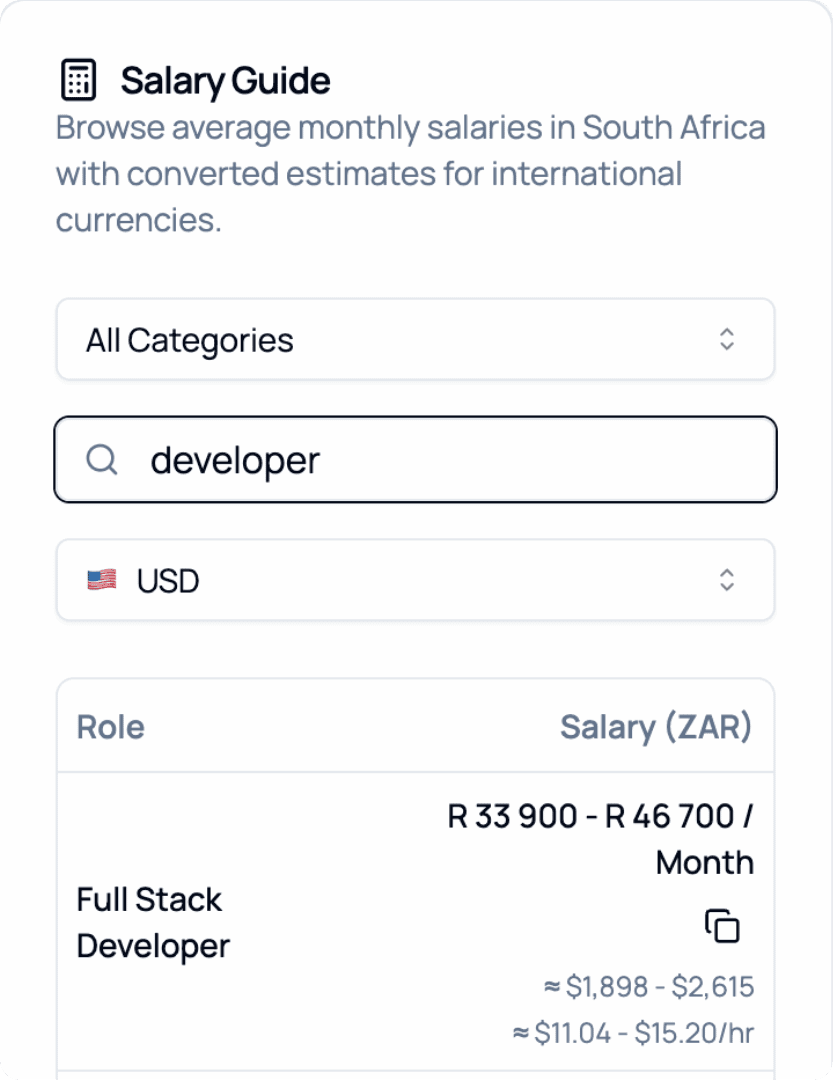
2026 Salary Guide: South Africa
Discover South African Salaries by Role. Compare costs and see how much you can save.