TL;DR
South Africa ranks #13 globally for English proficiency, offering native-level fluency superior to India or the Philippines.
The neutral South African accent and high "humor compatibility" ensure seamless communication with Western teams and customers.
South African professionals excel in high-EQ roles like customer experience and sales, delivering better First Contact Resolution rates.
Table of Contents
- Are remote workers in South Africa fluent in English?
- What is the South African accent like for customer-facing roles?
- How does South African English compare to the Philippines or India?
- What are the benefits of hiring fluent English speakers from South Africa?
- Which roles thrive best with South African talent?
- How to find and hire fluent English remote workers in South Africa?
For years, global outsourcing followed a simple, brutal formula: find the lowest hourly rate in an Asian hub and accept the "communication tax" as a cost of doing business. But as the remote work model matures, the primary currencies of business have shifted. Today, it’s no longer just about cost; it’s about finding talent with the cognitive flexibility, linguistic nuance, and emotional intelligence to act as a seamless extension of your home team.
South Africa has emerged as the "Goldilocks" solution for Western enterprises. It offers a workforce that possesses the native-level linguistic fluency of the Global North, the cultural affinity of a Western ally, and the cost structure of an emerging market.
Are remote workers in South Africa fluent in English?
Yes, South Africa is a global leader in English proficiency, currently ranking 13th in the world and 1st in Africa according to the 2024/2025 EF English Proficiency Index . Because English is the primary language for education, government, and corporate business, South African remote workers operate with a "Very High Proficiency" that consistently outperforms traditional BPO rivals like the Philippines and India.
The 200-Year Sociolinguistic Bedrock
Unlike other post-colonial contexts where English is a thin veneer, South African English (SAE) is a foundational element of the nation’s identity. English first took root in 1795, and by the mid-1800s, it was embedded in the nation’s schools, newspapers, and courts.
Today, while the country recognizes 11 official languages, English is the undisputed lingua franca of commerce. It is the medium of instruction for all university-level education. This means a South African professional hasn't just "learned English" - they have spent their entire lives learning in English, acquiring the rhetorical styles and argumentative structures of the Western intellectual tradition.
The "Bilingual-Plus" Cognitive Advantage
A unique differentiator for South African talent is their widespread multilingualism. Psycholinguistic research suggests this is a massive cognitive asset. Most professionals are "Bilingual-Plus" - they might speak an indigenous language at home but function professionally in English. This duality fosters high metalinguistic awareness, allowing them to "read the room" and adapt their tone to different client demographics with an agility that monolingual speakers often lack.
What is the South African accent like for customer-facing roles?
The South African accent is widely recognized for being neutral, professional, and exceptionally easy for Western ears to understand . With deep roots in British English, the accent lacks the heavy regional inflections that can cause friction in international customer support. This clarity significantly reduces "listening effort" for your customers, leading to higher satisfaction scores.
The Physics of Intelligibility
Why do Westerners find South African English so clear? It comes down to Stress-Timing.
- The Rhythm: English is a "stress-timed" language (DA-da-DA-da rhythm). Many Asian languages are "syllable-timed," giving each syllable equal weight, which can sound like a "machine-gun" effect to native ears.
- The Clarity: South African English retains the stress-timed rhythm of its British ancestor, making it cognitively easier for US or UK clients to decode.
- The Chameleon Effect: Due to heavy consumption of US media and British sport, South Africans are naturally malleable speakers. They can unconsciously modulate their accent to lean more "American" or "British," a phenomenon known as linguistic accommodation.
How does South African English compare to the Philippines or India?
South Africa consistently outperforms traditional hubs like the Philippines and India in English proficiency and cultural alignment . While South Africa sits in the elite "Very High Proficiency" band at rank #13 globally, the Philippines ranks #22 and India ranks #60.
| Metric | South Africa (SA) | India (IN) | The Philippines (PH) | | :---- | :---- | :---- | :---- | | EF EPI Ranking | #13 (Very High) | #60 (Moderate) | #22 (High) | | Accent Type | Neutral / Native-like | Variable / Heavy | Moderate (Americanized) | | First Contact Resolution (FCR) | High (~82%) | Moderate (~78%) | High | | Workforce Specialization | Complex Voice / High EQ | Technical / Volume | Transactional Voice | | Attrition (Staff Turnover) | Low to Moderate | High | High | | Cultural Interface | Deeply Western | Distant / Scripted | Americanized / Passive |
South Africa vs. India: The Empathy Frontier
India is a titan for high-volume back-office work, but South Africa is capturing the market for roles requiring high Emotional Intelligence (EQ).
- The Empathy Gap: While Indian agents can sometimes feel rigid or over-scripted, South Africans excel at "unscripted" engagement.
- First Contact Resolution (FCR): South African teams frequently solve issues in the first interaction because they don't struggle with colloquialisms or linguistic nuance. Data shows South African BPOs often exceed FCR targets (82% vs. 78% for India) shortly after launching.
South Africa vs. The Philippines: The Complexity Shift
The Philippines is the "Voice Capital" for transactional tasks, but South Africa thrives where the script ends. When a remote worker needs to negotiate a debt or de-escalate a legal dispute, the South African trait of assertive problem-solving becomes a differentiator. Furthermore, while Manila faces attrition rates of 40-60%, the South African workforce values stability, seeing remote work as a premium career rather than a "gig".
What are the benefits of hiring fluent English speakers from South Africa?
Hiring from South Africa offers a rare combination of 60-70% cost savings and elite-level communication skills . Beyond the language itself, the country provides a "Value Arbitrage" model where you can hire the top 1% of talent for the price of an entry-level worker in London or New York.
Cultural Affinity: The "Invisible" Operating System
South Africa’s cultural alignment with the West is its most underrated asset.
- Shared References: From the English Premier League to Netflix trends, South Africans share the same cultural touchpoints as your local team, making "small talk" effortless.
- Humor Compatibility: South Africans have a high "humor compatibility" with the UK and Australia, easily navigating irony and sarcasm that often get lost in translation elsewhere.
- "Maak ’n Plan" Resilience: There is a deep cultural trait known as maak ’n plan (make a plan). It speaks to a workforce that is wired for resourcefulness and improvisation - if the internet goes down or a tool breaks, they find a workaround independently rather than waiting for instructions.
Operational Resilience: The "Load Shedding" Factor
Western owners often worry about South Africa's power grid ("load shedding"). However, the professional remote sector has effectively "immunized" itself. Serious remote workers have moved toward power redundancy, utilizing UPS systems, inverters, and lithium batteries to ensure 99.9% uptime. Combined with world-class fiber-optic networks connected via multiple undersea cables, the digital infrastructure is surprisingly robust.
Which roles thrive best with South African talent?
South African professionals are not a monolith; they have developed "Centers of Excellence" in specific domains.
- High-EQ Customer Experience: Ideal for brands where customer retention is prioritized over call speed.
- Sales Development (SDRs): South African "hunters" often come from high-grit backgrounds like insurance or real estate, bringing a level of resilience that is difficult to train.
- The "Chief of Staff" VA: Many SA Virtual Assistants are overqualified for basic admin, often coming from legal or project management backgrounds to handle complex logistics and research.
- Specialized Knowledge (Legal & Creative): Because the SA legal system is a hybrid of Common Law, SA paralegals are highly compatible with UK and Australian firms.
How to find and hire fluent English remote workers in South Africa?
The most efficient way to access this talent is through a specialized marketplace like HireSava, which connects global businesses directly with South Africa’s top remote professionals.
Best Practices for Your Search:
- Perform a "Tech Audit": Don't take "good internet" at face value. Request speed tests to international servers and photographic proof of backup power solutions.
- Use an Employer of Record (EOR): To navigate South Africa’s strict labor laws, using an EOR is the standard best practice for handling payroll, tax, and compliance.
- Treat Them as Team Members: Because they speak the language and get the jokes, South Africans integrate fast. Don't treat them as an "offshore back office" - treat them as distributed team members.
Conclusion: Why Not South Africa?
The narrative of global outsourcing is shifting from "lowest cost" to "highest value". For English-speaking businesses in the US, UK, and Australia, South Africa represents a premier solution that offers elite proficiency, cultural synchronicity, and 60-70% economic logic.
In a world where customer experience and cognitive flexibility are the new currencies of business, the question is no longer "Why South Africa?" - it’s "Why not?".
Ready to tap into the world's most cost-effective native-level talent? Hire your South African VAs or South African Specialists today!
Explore related hiring options
Useful next pages based on this article's topic:
- Hire South African virtual assistants — core service page for evaluating HireSava's hiring model and next-step CTA
- South Africa virtual assistant cost guide — budget planning and quality-adjusted cost expectations
- South Africa VA rates benchmark — role-by-role compensation ranges and seniority bands
- South Africa hourly rate guide — hourly pricing expectations and hiring math
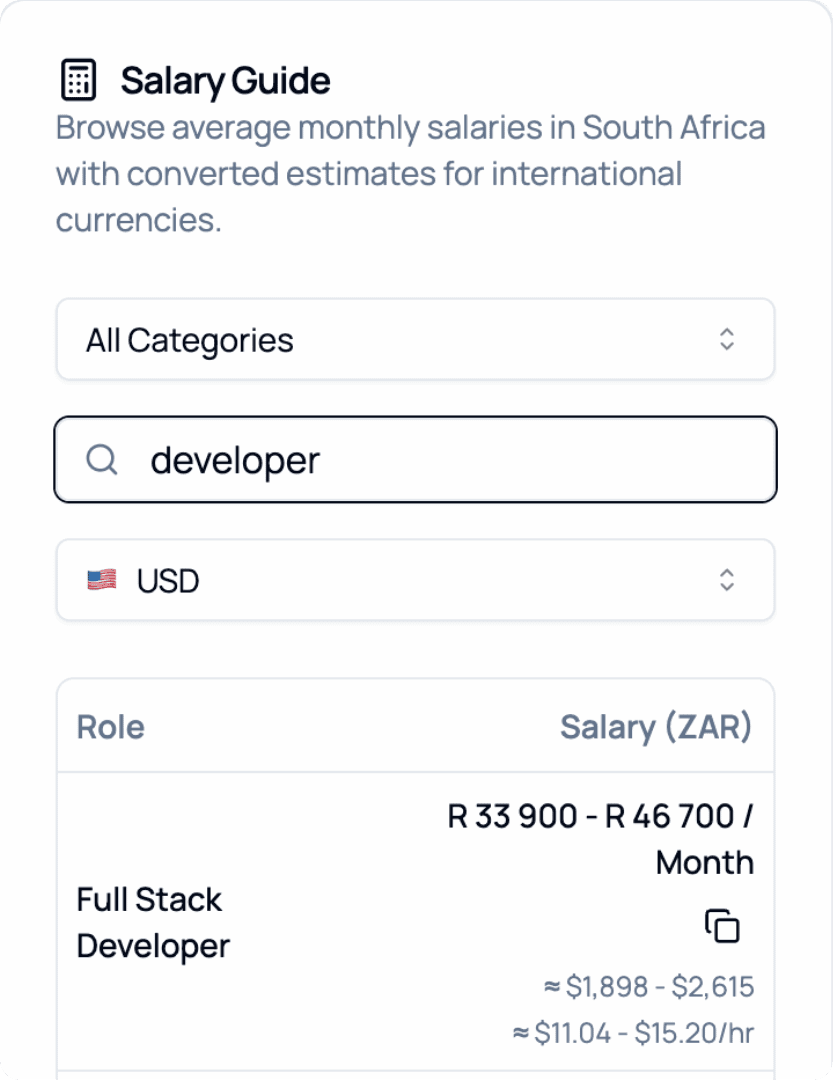
2026 Salary Guide: South Africa
Discover South African Salaries by Role. Compare costs and see how much you can save.