TL;DR
Compare contractor vs employee hiring in South Africa with a practical employer decision framework.
Understand costs, compliance obligations, and misclassification risk before you scale remote hiring.
Use clear implementation checklists to choose the right model for speed, control, and long-term growth.
Table of Contents
- What is the difference between an independent contractor and an employee in South Africa?
- Why hire a contractor instead of an employee?
- Is it better to hire employees or independent contractors?
- How do I hire employees in South Africa without setting up a local entity?
- What are the misclassification risks when hiring contractors in South Africa?
- Classification evidence matrix (use this before approving any offer)
- Borderline scenarios: where employers usually get it wrong
- Cost-of-misclassification calculator (executive version)
- One-page decision memo template (for founders/ops/legal)
- Real-world decision walkthroughs
- Non-negotiables regardless of model
- Final recommendation
Hiring in South Africa sounds simple until you need to choose the legal model. Most teams start with one question: should we hire a contractor or an employee?
That choice affects more than payroll. It changes your compliance exposure, your speed to hire, your day-to-day management style, and your long-term cost structure. Choose well, and you get strong talent with predictable operations. Choose badly, and you invite misclassification risk, rework, and expensive legal cleanup.
This guide is for employers hiring remote talent from South Africa in 2026. We’ll break down contractor vs employee, where an employer of record (EOR) fits, and how to make a clean decision that supports growth instead of creating hidden risk.
For adjacent hiring playbooks, see How to Hire Remote Talent Without Recruiting Fees, How to Hire a Virtual Assistant for Small Business in 2026, Virtual Assistant Cost Calculator Guide for SMB Teams, and Virtual Assistant Onboarding Checklist for 2026.
What is the difference between an independent contractor and an employee in South Africa?
Snippet answer: In South Africa, the practical distinction is control and dependency. Employees work under employer direction with statutory obligations and protections. Contractors operate independently, usually on defined deliverables, and manage their own tax obligations. If a “contractor” is managed like staff, classification risk rises quickly.
The legal labels on paper matter less than the operating reality. In plain language:
- Employees are integrated into your business model.
- Contractors are external service providers.
Practical control test employers should use
Before issuing an offer, score the role against these questions:
- Who controls working hours?
- Who controls method and process, not just outcomes?
- Is work ongoing and business-critical, or project-based?
- Does the worker serve multiple clients, or mostly you?
- Do you provide tools, systems, and mandatory internal routines?
The more your answers point to direct control and exclusivity, the closer you are to employee territory.
What changes operationally
When you hire as an employee (directly or through EOR), you take on broader obligations around payroll administration, statutory compliance, and labor standards. In a contractor model, your operational burden can be lighter, but only if the work setup is genuinely independent.
That is the trade-off most teams miss: contractors can be faster and cheaper up front, but only when role design, contract terms, and manager behavior stay aligned with contractor reality.
Why hire a contractor instead of an employee?
Snippet answer: Employers usually hire contractors for speed, flexibility, and short-to-medium-term scope. Contractor models work well for outcome-based projects and variable workloads. They are not a safe shortcut for long-term, tightly managed roles that function like full-time employment.
Contractors are often the right move when:
- You need to launch quickly.
- Scope is clearly defined.
- Workload may expand or shrink within a quarter.
- You need specialist expertise without permanent headcount.
Where contractor hiring creates real advantage
1) Faster launch timelines
You can usually contract faster than structuring a full employment setup, especially for pilot projects.
2) Variable cost structure
Contract models let you tie spend to deliverables or active scope windows.
3) Specialist access
You can engage niche capability without committing to long-term fixed cost.
Where contractor hiring breaks down
Contractors become risky when companies treat them like salaried team members but keep contractor paperwork for convenience. Typical failure patterns:
- Mandatory fixed schedules that mirror employment.
- Exclusive long-term dependency on one client.
- Deep daily supervision on process, not outputs.
- Continuous role expansion into core permanent functions.
If this is your real operating model, employee (or EOR employee) is usually the cleaner path.
Is it better to hire employees or independent contractors?
Snippet answer: It depends on role permanence, required control, and compliance tolerance. Contractors are usually best for bounded projects and flexible capacity. Employees are usually better for long-term, high-control, core operational roles. EOR can bridge the gap when you want employee structure without opening a local entity.
There is no universal “better.” There is only better for this role right now.
Decision matrix: contractor vs employee vs EOR
| Decision factor | Contractor | Employee (local entity) | Employee via EOR | | :--- | :--- | :--- | :--- | | Speed to start | High | Lower | Medium-High | | Employer control | Lower | High | High | | Compliance burden | Lower upfront, higher if misclassified | Highest direct burden | Lower administrative burden | | Best for | Project/variable scope | Long-term in-country scaling | Long-term compliant hiring without local entity | | Cost predictability | Medium | High (fixed) | Medium-High | | Misclassification exposure | Higher if role drifts | Low (if compliant) | Lower than contractor for full-time roles |
Cost model employers should actually use
Most teams compare base pay only. That misses real cost.
Use this model:
Effective Monthly Cost = Compensation + Admin + Tooling + Management Overhead + Risk-Adjusted Compliance Cost
Scenario A: 3-month project support
- Scope: structured, outcome-based, finite
- Better fit: contractor
- Why: speed and flexibility outweigh employment setup overhead
Scenario B: core full-time ops role
- Scope: ongoing, integrated, manager-led
- Better fit: employee or EOR employee
- Why: role permanence and control profile reduce contractor defensibility
Scenario C: growth-stage international hiring
- Scope: long-term but no local entity yet
- Better fit: EOR employee
- Why: compliance-first scaling while preserving operational control
Quick decision checklist
Choose contractor if most answers are “yes”:
- Is this scope clearly project-defined?
- Can success be measured by outcomes, not hours?
- Is role duration limited or intentionally flexible?
- Can the person operate independently without daily process control?
Choose employee/EOR if most answers are “yes”:
- Is this role permanent or core to your operations?
- Do you need consistent managerial control?
- Will this person run inside fixed internal systems and routines?
- Is continuity more important than short-term flexibility?
How do I hire employees in South Africa without setting up a local entity?
Snippet answer: Use an Employer of Record (EOR). The EOR becomes the local legal employer, handles payroll and statutory administration, and supports compliant employment operations. You still manage performance and business outcomes, but the local employment infrastructure is handled for you.
For international employers, EOR is often the fastest compliant path for long-term hiring in South Africa.
What an EOR typically covers
- Local employment contract structure
- Payroll processing and required deductions
- Statutory and compliance administration
- Employment lifecycle administration
What still stays with you
EOR is not a performance outsourcing model. You still own:
- Role design and scope clarity
- Manager accountability
- SOP quality and onboarding discipline
- KPI tracking and output standards
EOR vs entity setup: practical guidance
Use EOR when:
- You are validating market/team fit.
- Headcount is growing but still moderate.
- You want compliant speed without entity overhead.
Consider local entity when:
- Country headcount is large and stable.
- You need deep in-country operational infrastructure.
- Entity economics are justified by scale.
What are the misclassification risks when hiring contractors in South Africa?
Snippet answer: Misclassification risk appears when a contractor operates like an employee in practice. Consequences can include backdated liabilities, penalties, disputes, and forced operating changes. The fix is not better wording in contracts; it is alignment between contract terms and real day-to-day behavior.
Most misclassification events are process failures, not legal-document failures.
High-risk patterns to avoid
- “Contractor” works fixed internal hours indefinitely.
- “Contractor” has no meaningful client diversity and operates as embedded staff.
- Management controls exact process steps daily rather than deliverable outcomes.
- Role scope evolves from project support to core permanent function without model update.
Compliance control stack for employers
1) Contract clarity
- Define deliverables, acceptance criteria, and change-control process.
- Avoid employee-like language in contractor agreements.
2) Operating boundaries
- Manage outputs and deadlines, not minute-by-minute process.
- Keep role structure consistent with independent work status.
3) Documentation hygiene
- Maintain scope records, work statements, and decision logs.
- Document why the engagement model fits the role.
4) Quarterly classification review
- Re-evaluate contractor roles every quarter.
- Convert roles that have clearly shifted to employment reality.
Misclassification prevention checklist
Use this before extending or renewing contractor engagements:
- [ ] Scope still project-based and bounded
- [ ] Deliverables still outcome-defined
- [ ] Manager behavior still contractor-appropriate
- [ ] Contract terms still aligned with actual operations
- [ ] No silent transition into permanent employee-like role
If two or more checks fail, escalate classification review immediately.
Classification evidence matrix (use this before approving any offer)
Most teams over-index on headline cost. Senior teams score the role against evidence and document the decision.
Use this matrix and keep it in your hiring memo.
| Evidence dimension | Contractor-leaning signal | Employee/EOR-leaning signal | | :--- | :--- | :--- | | Time horizon | Finite project or variable workload | Ongoing role with no clear end boundary | | Control style | Outcome-led, low process micromanagement | Daily process supervision and fixed routines | | Dependency | Limited operational dependency | Core business dependency and continuity risk | | Client/market exposure | Can serve multiple clients | Expected exclusivity in practice | | Risk of error | Localized and recoverable | High-impact operational/compliance exposure |
Scoring rule:
- 4+ employee/EOR signals → choose employee/EOR.
- 4+ contractor signals → contractor can be valid.
- Mixed signals → run a 60-day pilot with explicit reclassification checkpoint.
This forces evidence-based decisions and protects you in later audits.
Borderline scenarios: where employers usually get it wrong
Scenario 1: "Project" role that never ends
You hire as contractor for a launch sprint. Six months later, same person owns a core workflow with daily manager control.
Correct move: trigger reclassification review. If role is now permanent and controlled, convert to employee/EOR.
Scenario 2: Cost-first contractor choice for core operations
Team uses contractor model to avoid short-term admin overhead, but role handles critical recurring operations.
Correct move: model is misaligned. Employee/EOR usually reduces total risk and hidden management cost.
Scenario 3: EOR selected but role ownership undefined
Team assumes EOR solves execution quality. It doesn’t. EOR solves employment infrastructure, not role clarity.
Correct move: keep internal ownership for onboarding, KPI definition, and process quality.
Cost-of-misclassification calculator (executive version)
When debating contractor vs employee, estimate downside before deciding.
Use this framework:
Potential Misclassification Cost = Backdated liabilities + Penalties + Legal/admin time + Operational disruption + Replacement/onboarding cost
Even rough estimates improve decision quality because they surface downside that “hourly rate only” models ignore.
Quick risk heatmap
- Low risk: bounded project, outcome-led management, low continuity dependency.
- Medium risk: mixed role signals, rising manager control, growing dependency.
- High risk: permanent scope, fixed schedule expectations, core workflow ownership.
If risk is high, employee/EOR is usually the defensible path.
One-page decision memo template (for founders/ops/legal)
Before approving any hire model, complete this one-page memo:
- Role objective and expected 90-day outcomes
- Chosen model (contractor / employee / EOR)
- Top 3 reasons for model choice
- Top 3 risks and mitigation steps
- Reclassification trigger conditions
- Named owner for quarterly model review
This keeps cross-functional alignment tight and reduces "we thought someone else owned it" failure.
Real-world decision walkthroughs
Walkthrough 1: US startup hiring first South Africa operations role
A seed-stage SaaS company wanted one South Africa-based operations hire to manage onboarding admin, CRM cleanup, and customer follow-up support. They initially leaned contractor for speed and lower visible overhead.
When scored against the evidence matrix, the role showed employee/EOR signals quickly: daily manager control, recurring core workflow ownership, and rising continuity dependency. Within six weeks, the manager was setting fixed routines and relying on this role for critical handoffs.
Best decision: move to EOR employee model early.
Why: reduced misclassification risk and stabilized operating expectations before scope expanded further.
What would have gone wrong if they stayed contractor: hidden risk would keep rising while documentation lagged behind real operating behavior.
Walkthrough 2: growth agency with variable delivery spikes
A marketing agency needed support across proposal formatting, reporting QA, and client dashboard updates. Workload changed week to week based on campaign cycles, and most deliverables were bounded by clear output criteria.
The matrix showed contractor-leaning signals: variable demand, outcome-led tasking, and lower need for daily process control. They implemented strict scope language, weekly hour caps, and written change-control for urgent asks.
Best decision: keep contractor model with governance.
Why: flexibility matched workload shape, and controls protected quality and cost predictability.
What would have gone wrong with premature employee conversion: unnecessary fixed-cost commitment before demand stabilized.
Non-negotiables regardless of model
Whatever model you choose, keep these constants:
- clear role scope,
- explicit quality standards,
- documented escalation path,
- regular model-fit review,
- evidence trail for decisions.
Model choice is important, but operating discipline is what protects outcomes.
Final recommendation
If you are hiring South African remote talent in 2026, start with this rule:
- Project, variable, outcome-based work: contractor can be right.
- Core, long-term, manager-led work: employee or EOR employee is usually safer and more durable.
The winning approach is not “contractor always” or “employee always.” It is role-model alignment with explicit controls.
If you want to scale safely, combine legal structure with operational discipline: clear role design, compliant contracts, manager training, quarterly audits, and measurable KPIs.
For next steps, use How to Hire Remote Talent Without Recruiting Fees, Virtual Assistant Onboarding Checklist for 2026, and Virtual Assistant Cost Calculator Guide for SMB Teams to build a hiring system that is fast, compliant, and actually sustainable.
Explore related hiring options
Useful next pages based on this article's topic:
- Hire South African virtual assistants — core service page for evaluating HireSava's hiring model and next-step CTA
- Fluent English remote workers in South Africa — proof of communication quality for customer-facing and judgment-heavy roles
- South Africa virtual assistant cost guide — budget planning and quality-adjusted cost expectations
- South Africa VA rates benchmark — role-by-role compensation ranges and seniority bands
- South Africa hourly rate guide — hourly pricing expectations and hiring math
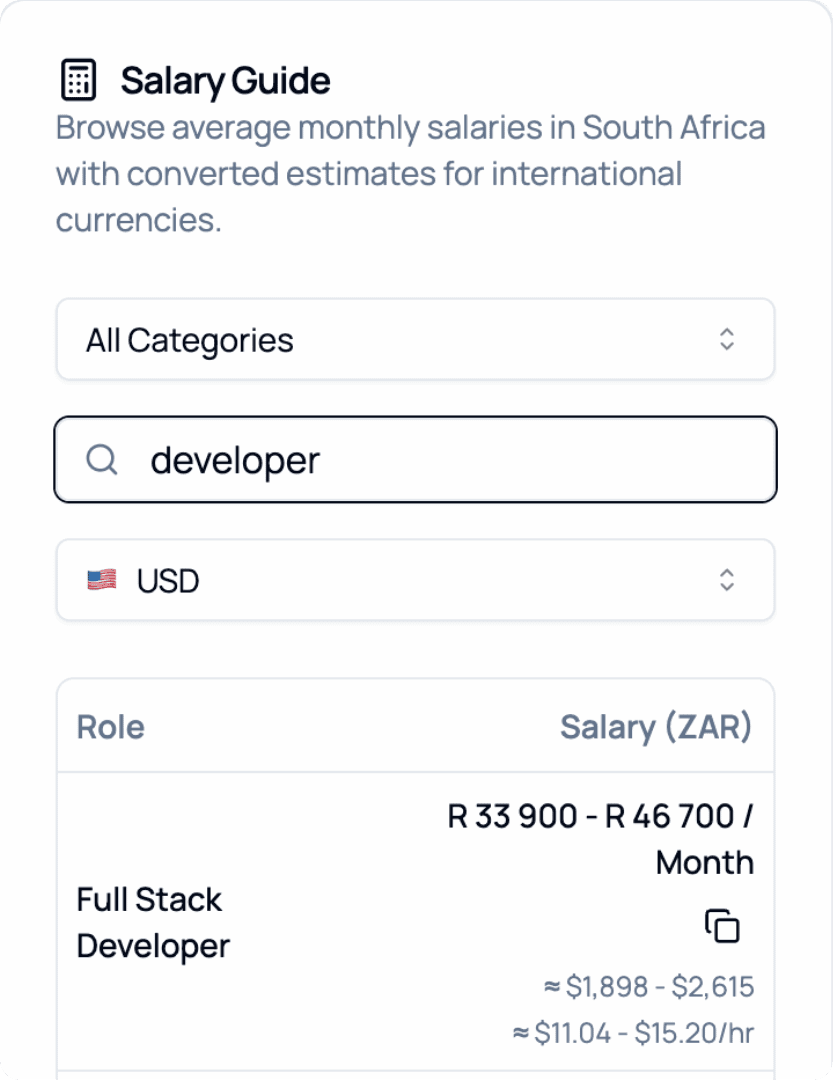
2026 Salary Guide: South Africa
Discover South African Salaries by Role. Compare costs and see how much you can save.