TL;DR
A practical employer guide to virtual assistant rates in South Africa, benchmarked by role complexity and seniority.
Learn what drives price, how to avoid low-cost hiring traps, and how to budget with quality-adjusted cost models.
Use compensation bands, scorecards, and onboarding controls to hire profitably and reduce churn.
Table of Contents
- What are typical virtual assistant rates in South Africa?
- Why do virtual assistant rates in South Africa vary so much?
- Is hourly or monthly pricing better for employers?
- How should employers benchmark virtual assistant rates by role and seniority?
- How can employers avoid overpaying or underpaying South African VAs?
- Employer budgeting model: what should you actually forecast?
- Rate benchmark integrity check (before you trust any number)
- Employer negotiation playbook: pay fairly without margin leakage
- Offer architecture: structure deals to reduce churn
- Scenario pricing models (how strong teams budget)
- Rate card stress test (quarterly)
- Compensation governance framework for scaling teams
- Hiring scorecard template for rate-to-output decisions
- Due-diligence red flags in pricing proposals
- Sample employer rate card structure (practical format)
- Market changes that can shift rates in 2026
- How to present compensation internally to leadership
- Mini-case comparisons: same rate, very different outcomes
- Final thoughts
If you’re searching for virtual assistant rates in South Africa, you’re probably trying to answer a bigger question: what should we pay to get reliable output without overpaying or creating churn?
Most rate guides fail employers because they only list numbers. They don’t explain role complexity, execution quality, onboarding cost, or what happens when “cheap” hires require heavy supervision and constant rework.
This guide gives you an employer benchmark framework for 2026: what rates usually signal, how to price by role and seniority, and how to build a cost model that protects margin.
For model selection first, see Hire South African Remote Contractors vs Employees (2026): Cost, Risk, and Compliance. For staffing execution, see How to Hire Remote Staff in South Africa: Employer Playbook (2026).
What are typical virtual assistant rates in South Africa?
Snippet answer: Typical South African virtual assistant rates vary by role scope, specialization, and reliability requirements. Entry admin support is usually the lowest band, while specialized or high-accountability roles command higher rates. Employers should benchmark by role outcomes and oversight burden, not by hourly number alone.
A useful way to think about rates:
- Low band: task-only support, limited ownership
- Mid band: process-driven support with consistent execution
- High band: specialist or high-accountability support with proactive ownership
Why generic rate lists mislead hiring teams
Two VAs at the same nominal rate can produce very different business outcomes. The difference usually comes from:
- quality of written communication,
- process discipline,
- independence under ambiguity,
- ability to protect manager time.
If you pay less but spend 8–10 extra management hours weekly, your real cost is higher.
Quick benchmark table by role level
| Level | Typical profile | Common employer need | Cost risk if underpriced | | :--- | :--- | :--- | :--- | | Entry admin | Task execution with clear SOPs | Inbox cleanup, scheduling, data updates | High oversight burden | | Mid operations | Process ownership with routine reporting | CRM hygiene, lead follow-up, coordination | Rework + inconsistency | | Specialist support | Niche workflow + judgment support | Executive ops, sales support, compliance admin | Churn + delivery risk |
This is why serious teams price based on expected accountability, not just task count.
Why do virtual assistant rates in South Africa vary so much?
Snippet answer: Rate variance is driven by role complexity, communication quality, turnaround expectations, and the business risk tied to mistakes. The more a role touches revenue, client experience, or compliance-sensitive work, the less useful “lowest rate” shopping becomes.
The four biggest rate drivers
-
Role complexity
Repetitive admin tasks price differently from cross-functional operations support. -
Ownership level
“Do tasks when told” costs less than “run this workflow and flag issues early.” -
Speed and responsiveness expectations
Faster SLAs and high-availability windows often require stronger talent and better process maturity. -
Error cost
If errors affect clients, revenue, or compliance posture, higher-quality hiring is usually cheaper in the long run.
Hidden price variable: manager time
Many teams ignore management overhead when comparing candidates. Add this to every budget discussion:
Effective Cost = Rate + Oversight Hours + Rework Cost + Delay Cost
This one line explains why low-rate hires can hurt unit economics.
Is hourly or monthly pricing better for employers?
Snippet answer: Monthly pricing is usually better for employers when scope is ongoing and process-driven, because it improves planning and accountability. Hourly pricing can work for variable or project-based tasks but often creates inefficiency if role ownership is unclear.
When hourly pricing works
- short-term projects,
- uneven workload by week,
- narrow task bundles.
When monthly pricing works better
- recurring workflows,
- defined role ownership,
- clear KPI targets and expected outcomes.
Hybrid model many teams use successfully
- base monthly retainer for core responsibilities,
- defined hourly blocks for overflow or special projects.
This keeps baseline reliability while preserving flexibility.
How should employers benchmark virtual assistant rates by role and seniority?
Snippet answer: Build compensation bands by role impact, not title. Benchmark each role against expected autonomy, communication standard, and quality threshold. Then calibrate seniority by how much oversight the person requires to deliver stable outcomes.
Use this framework when setting rate bands.
Step 1: classify role impact
- Operational support: internal admin and coordination
- Revenue support: lead follow-up, sales operations, client pipeline
- Risk-sensitive support: compliance-adjacent tasks, executive workflows
Higher impact roles justify higher compensation if they reduce costly errors.
Step 2: define seniority behaviorally
Don’t define seniority by years only. Define by execution behavior.
- Junior: follows SOPs; needs close guidance
- Mid: runs workflows with periodic checks
- Senior: owns outcomes, escalates early, improves process
Step 3: map compensation to outcomes
Link pay to what matters:
- SLA adherence,
- first-pass quality,
- rework reduction,
- manager time saved,
- retention stability.
If your pay model is disconnected from outcomes, negotiation becomes arbitrary and churn rises.
How can employers avoid overpaying or underpaying South African VAs?
Snippet answer: Avoiding bad pricing starts with role clarity and objective scorecards. Overpaying happens when scope is vague. Underpaying happens when expectations exceed role band. Both problems disappear when compensation is tied to explicit outcomes and quality thresholds.
Overpaying signals
- no defined KPI targets,
- no comparison rubric across candidates,
- premium compensation without ownership requirements.
Underpaying signals
- high churn within 90 days,
- slow response quality,
- repeated manager frustration and rework,
- constant rehiring for the same position.
Practical correction loop
Run a 30/60/90 compensation-fit review:
- Day 30: execution consistency and communication reliability
- Day 60: quality and oversight trend
- Day 90: retention signal + compensation alignment
Adjust rate bands only with data, not anecdote.
Employer budgeting model: what should you actually forecast?
Rate is one line item. Budget for the full operating system.
Core budget components
- compensation,
- tools and licenses,
- onboarding hours,
- manager oversight,
- quality assurance checks,
- replacement risk reserve.
Example budgeting logic (framework)
- Set role target outputs per month.
- Estimate baseline compensation band.
- Add management and QA overhead.
- Add risk reserve for ramp or turnover.
- Compare model options (contractor, EOR employee, direct employee).
This gives you an effective monthly cost you can defend.
Margin protection rule
Don’t evaluate hires by “can we afford this rate?”
Evaluate by “does this rate improve output per managed hour?”
That shift alone improves hiring ROI.
Rate benchmark integrity check (before you trust any number)
Most employers compare rates from mixed sources and assume they are equivalent. They’re not.
Before using any benchmark, validate five things:
- Scope parity: Are you comparing the same job or different jobs with similar titles?
- Seniority parity: Is “mid-level” defined the same way in each source?
- Model parity: Hourly, retainer, and employee-equivalent rates are not directly comparable.
- SLA parity: Faster response windows usually cost more.
- Quality parity: Benchmark data without quality assumptions is pricing noise.
If two or more parity checks fail, don’t use the benchmark for offer decisions.
Employer negotiation playbook: pay fairly without margin leakage
Rate negotiation should reduce uncertainty, not just lower numbers.
Step 1: negotiate scope before price
If scope is vague, every negotiated rate becomes unstable. Lock scope boundaries first.
Step 2: negotiate outcome commitments
Use explicit expectations:
- turnaround target,
- quality threshold,
- communication cadence,
- escalation standard.
Step 3: negotiate price with performance lanes
Instead of one static number, define progression lanes:
- base band for launch,
- adjustment trigger after proven quality,
- review points tied to measurable outputs.
This keeps compensation tied to value creation.
Offer architecture: structure deals to reduce churn
A good offer design reduces early exits and protects team productivity.
Include these in every offer package
- role objective and boundaries,
- KPI expectations,
- first 30-day milestones,
- review cadence,
- compensation review logic.
Candidates who understand “how success is measured” are less likely to churn from expectation mismatch.
Scenario pricing models (how strong teams budget)
Scenario A: lean operator model
- one VA role,
- high founder oversight,
- narrow scope.
Best strategy: moderate rate + strong process discipline. Overpaying won’t fix unclear systems.
Scenario B: growth operations model
- two to three VAs,
- recurring cross-functional workflows,
- moderate manager leverage.
Best strategy: role-tiered rates + shared KPI rubric + monthly calibration.
Scenario C: scale model
- five+ remote support roles,
- multiple managers,
- higher process complexity.
Best strategy: formal compensation governance with parity controls and exception review.
Rate card stress test (quarterly)
Run this test each quarter to avoid stale pay architecture.
Check:
- Are high performers underpaid relative to impact?
- Are low performers overpaid relative to output?
- Are manager oversight hours rising despite stable rates?
- Are rework trends eroding margin?
- Are exceptions becoming the norm?
If three or more conditions are true, redesign rate bands before adding new hires.
Compensation governance framework for scaling teams
As soon as you have more than two VAs, compensation decisions need governance. Otherwise each hire gets negotiated differently, internal parity drifts, and quality becomes inconsistent.
Build a simple compensation architecture
Use three layers:
- Role family (admin, operations, sales support, executive support, specialist)
- Seniority tier (junior, mid, senior)
- Performance modifier (based on scorecard metrics)
This structure gives flexibility without chaos.
Internal parity guardrails
To prevent team-wide pay friction:
- keep documented bands per role family,
- apply the same scorecard criteria across managers,
- review exceptions centrally,
- explain compensation decisions with data.
This protects both fairness and forecast quality.
Hiring scorecard template for rate-to-output decisions
Use this during final interviews and again at day 30/day 60.
| Dimension | Weight | Score (1-5) | Notes | | :--- | :---: | :---: | :--- | | Written communication clarity | 20% | | | | Process reliability | 20% | | | | Role-specific skill depth | 20% | | | | Ownership and escalation judgment | 20% | | | | Speed and consistency under load | 20% | | |
A candidate with a slightly higher rate but stronger weighted score is usually the better unit-economics decision.
Due-diligence red flags in pricing proposals
When evaluating agencies, platforms, or direct candidates, watch for these warning signs:
- unusually low rates with no quality controls,
- vague language around accountability,
- no measurable SLA definitions,
- no policy for replacements or continuity,
- no explanation of communication standards.
A low quote without operating controls is not a bargain. It’s deferred failure.
Sample employer rate card structure (practical format)
You don’t need to publish exact pay ranges publicly, but internally you should maintain a clean rate card by role family.
Example structure:
- Band A (Task Support): routine admin, high SOP dependency, close supervision.
- Band B (Process Support): recurring workflows, medium autonomy, periodic manager review.
- Band C (Outcome Ownership): complex coordination, proactive issue escalation, low supervision.
For each band, document:
- required capabilities,
- expected KPI baseline,
- acceptable oversight hours,
- review cadence,
- criteria for movement to next band.
This prevents title inflation and helps managers hire consistently across teams.
Market changes that can shift rates in 2026
Rate benchmarks are not static. Employers should re-check assumptions quarterly.
Key variables to monitor:
- demand spikes in specific role categories,
- exchange-rate volatility,
- new compliance requirements from hiring model providers,
- platform fee changes,
- seasonal workload cycles in your own business.
If you run hiring without periodic benchmark refreshes, you risk either losing strong talent (underpricing) or compressing margins (overpricing).
How to present compensation internally to leadership
If founders or finance teams question rate changes, use this short format:
- Business context: role scope and expected output.
- Benchmark context: current band vs market band.
- Performance evidence: quality/rework/oversight trend.
- Decision: keep, increase, or redesign role.
- Expected impact: forecast on output and manager hours.
This keeps compensation decisions objective and prevents emotional negotiations.
Mini-case comparisons: same rate, very different outcomes
Case 1: lower rate, high correction burden
A team hired at a lower-than-band rate for recurring operations support. First month looked cost-efficient on paper, but manager oversight remained high and rework consumed delivery cycles. Effective cost drifted above budget by week five.
Key lesson: low rate without execution reliability is a false economy.
Case 2: higher rate, lower oversight and faster handoff
Another team hired slightly above mid-band for the same role family, but with stronger process discipline and communication standards. First-pass completion stabilized quickly and oversight time dropped by month two.
Key lesson: moderate premium pricing can improve margin when it buys consistency.
Decision takeaway
When two offers are close, pick the one with stronger quality signal and lower expected oversight load. This is the fastest path to durable unit economics.
Before final sign-off, run one final check: can this hire improve output per managed hour within 30 days? If the answer is unclear, the offer is probably priced on hope rather than evidence.
Final thoughts
Virtual assistant rates in South Africa are not just a procurement decision. They are an operating decision. The right rate is the one that buys reliable execution at sustainable management cost.
If you benchmark by role impact, tie compensation to outcomes, and run a disciplined 30/60/90 review cycle, you can hire competitively without sacrificing quality.
If you want to build the full hiring system around these benchmarks, pair this guide with How to Hire Remote Staff in South Africa: Employer Playbook (2026), Hire South African Remote Contractors vs Employees (2026): Cost, Risk, and Compliance, and Virtual Assistant Cost Calculator Guide for SMB Teams.
Explore related hiring options
Useful next pages based on this article's topic:
- Hire South African virtual assistants — core service page for evaluating HireSava's hiring model and next-step CTA
- Fluent English remote workers in South Africa — proof of communication quality for customer-facing and judgment-heavy roles
- South Africa virtual assistant cost guide — budget planning and quality-adjusted cost expectations
- South Africa hourly rate guide — hourly pricing expectations and hiring math
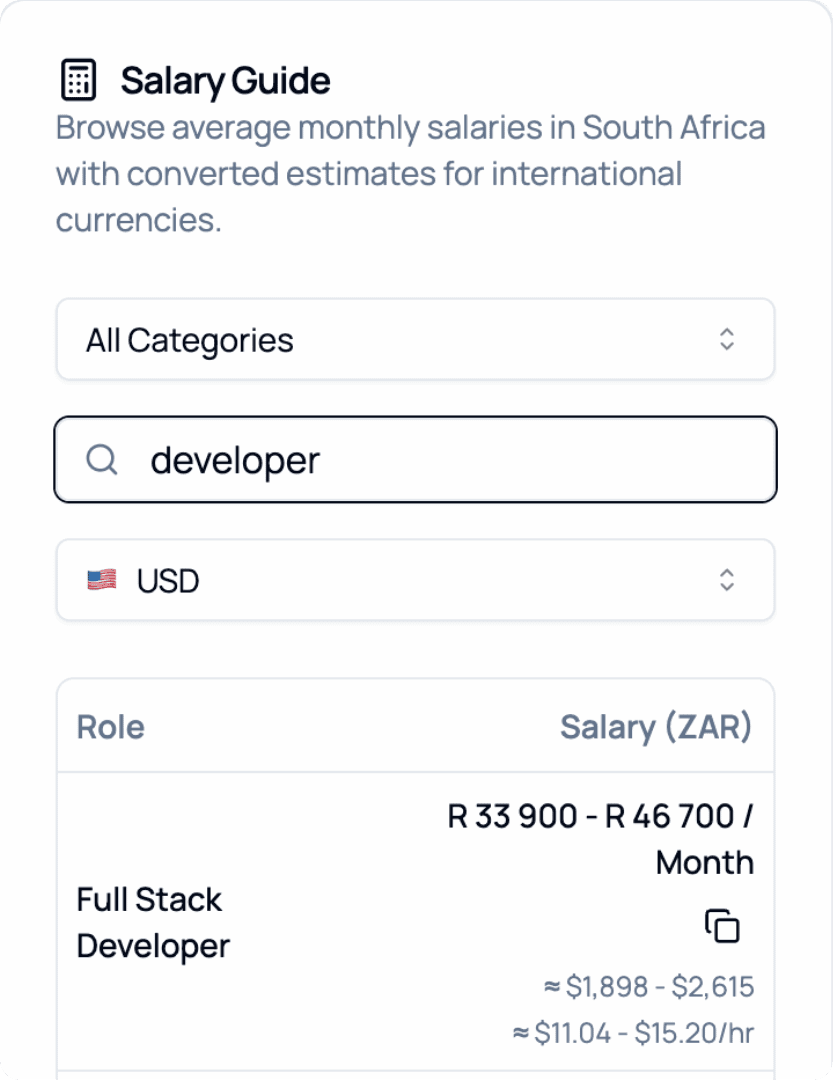
2026 Salary Guide: South Africa
Discover South African Salaries by Role. Compare costs and see how much you can save.