TL;DR
A strategic employer framework for deciding when and how to hire talent from South Africa.
Includes role-priority matrix, ROI model, risk register, and scaling sequence from first hire to stable team.
Built for business owners and operators who want predictable outcomes, not trial-and-error hiring.
Table of Contents
- Why do companies hire talent from South Africa?
- What roles are best to hire from South Africa first?
- How do employers evaluate ROI when hiring talent from South Africa?
- What risks should employers plan for when hiring from South Africa?
- How should companies scale from first hire to a reliable South Africa team?
- Executive decision memo template (board/founder-ready)
- Market-entry sequence for employers (practical timeline)
- Cross-post map: where each companion guide fits
- Readiness test: when not to hire from South Africa yet
- 12-month capability roadmap for South Africa hiring
- Executive metrics pack (what leadership should review monthly)
- Common strategic mistakes (and what strong operators do instead)
- Two strategic snapshots: why some teams compound and others stall
- Boardroom questions to answer before expanding headcount
- Communication plan for internal alignment
- Final recommendation
Hiring talent from South Africa is no longer a fringe tactic. For many employers, it is now a core lever for cost efficiency, execution capacity, and operational resilience.
But most teams still approach it like a sourcing experiment instead of a business system. They ask, “Can we find someone?” when the real questions are:
- Which roles should we move first?
- What model reduces risk without slowing execution?
- How do we measure ROI beyond salary arbitrage?
- What scaling pattern avoids quality collapse?
This guide is the strategic umbrella for those decisions. It is built for founders, operators, and hiring leads who want a practical framework for role fit, risk, and ROI—then a repeatable path from one hire to a stable South Africa talent lane.
If you need execution depth on specific sub-topics, use the companion guides: Hire South African Remote Contractors vs Employees (2026): Cost, Risk, and Compliance, How to Hire Remote Staff in South Africa: Employer Playbook (2026), and Virtual Assistant Rates in South Africa (2026): Employer Benchmarks by Role and Seniority.
Why do companies hire talent from South Africa?
Snippet answer: Employers hire talent from South Africa to increase output capacity at better unit economics while maintaining strong communication quality and reliable workflow integration. The strongest outcomes come from role-model alignment, not wage arbitrage alone.
South Africa appeals to employers for three practical reasons:
-
Talent quality relative to cost
Many roles can be staffed with strong capability at more efficient cost than major US/UK metro benchmarks. -
Communication and workflow compatibility
For employer-side operations, communication clarity and process discipline matter as much as technical skill. -
Scalable role coverage
Teams can begin with one role and expand into multi-role support pods as process maturity improves.
What mature teams understand early
The best-performing employers don’t treat South Africa hiring as “cheap labor.” They treat it as capacity design:
- move work that has clear outputs,
- preserve local high-leverage ownership,
- improve throughput without degrading quality.
When framed this way, hiring decisions become strategic and compounding.
What roles are best to hire from South Africa first?
Snippet answer: Start with roles that are process-driven, measurable, and bottleneck-relieving. Employers should prioritize functions where documentation quality, turnaround consistency, and communication reliability directly improve business throughput.
Role-priority matrix (first-hire decision tool)
| Role type | Best for | Complexity | Typical risk if rushed | First-hire priority | | :--- | :--- | :---: | :--- | :---: | | Admin/ops support | Founder time recovery | Low-Mid | Scope creep | High | | Revenue support ops | Pipeline follow-up, CRM hygiene | Mid | Quality inconsistency | High | | Executive coordination | Calendar, inbox, cross-team flow | Mid-High | Dependency concentration | Medium-High | | Specialist process roles | Compliance-heavy or technical workflows | High | Misfit and rework | Medium | | Strategic ownership roles | Cross-functional decision-heavy work | High | Premature delegation | Lower (start later) |
First-hire rule of thumb
If this is your first South Africa hire, prioritize a role that:
- already has repeatable tasks,
- has visible bottlenecks,
- can be measured in weekly outputs,
- does not require ambiguous strategic judgment on day one.
This improves early win probability and reduces onboarding chaos.
How do employers evaluate ROI when hiring talent from South Africa?
Snippet answer: Evaluate ROI using output economics, not salary alone. The right model combines compensation, oversight load, quality stability, rework, and speed-to-productivity. Employers should assess ROI at 30, 60, and 90 days before scaling.
Practical ROI model
Use this formula:
Hiring ROI = Value of Output Delivered - (Compensation + Onboarding Cost + Oversight Cost + Rework Cost + Delay Cost)
This reveals whether the hire is genuinely improving operating economics.
90-day ROI checkpoints
Day 30: ramp quality
- Is output meeting minimum quality standards?
- Is communication dependable?
- Is manager oversight manageable?
Day 60: efficiency trend
- Is rework declining?
- Is turnaround stabilizing?
- Is workflow ownership becoming reliable?
Day 90: scale readiness
- Is output predictable enough to add adjacent roles?
- Is effective cost within expected range?
- Is retention risk low to moderate?
If all three checkpoints are healthy, expansion becomes a strategic choice rather than a gamble.
What risks should employers plan for when hiring from South Africa?
Snippet answer: The highest risks are not geographic—they are operational: role-model mismatch, weak onboarding, inconsistent management standards, and lack of governance as headcount grows. Employers should run a formal risk register with named owners and mitigation actions.
Employer risk register (core risks + mitigation)
| Risk | Early signal | Business impact | Mitigation owner | Mitigation action | | :--- | :--- | :--- | :--- | :--- | | Role-model mismatch | Contractor behaving like employee role | Compliance and continuity risk | Ops + HR | Model-fit review + conversion trigger | | Weak onboarding | High confusion in first 2 weeks | Slow ramp, rework | Hiring manager | First-30-day onboarding plan | | Quality drift | Rework rises for 2 cycles | Margin compression | Ops lead | QA cadence + SOP calibration | | Oversight overload | Manager hours rising | Leadership bandwidth loss | Function lead | Scope redesign + delegation cleanup | | Scaling inconsistency | Different managers, different standards | Unstable outcomes | Operations | Shared scorecards + calibration |
Risk governance rule
Don’t run “awareness-only” risk lists. Every risk should have:
- one owner,
- one measurable early signal,
- one documented mitigation action,
- one review cadence.
That’s what converts risk management into execution.
How should companies scale from first hire to a reliable South Africa team?
Snippet answer: Scale in stages: prove one role, then build a 3-role pod, then standardize governance for 5+ roles. Do not expand based on excitement alone—expand only after quality and oversight metrics stabilize.
Stage 1: prove one role (0→1)
Objective: validate role-model fit and onboarding process.
Required conditions before next hire:
- quality stable,
- rework declining,
- manager oversight trending down,
- role documentation current.
Stage 2: build a small pod (1→3)
Objective: remove founder/manager bottlenecks with role separation.
Typical structure:
- execution role,
- coordination role,
- quality/control role.
Key control: define handoff boundaries clearly to avoid overlap confusion.
Stage 3: build repeatable lane (3→5+)
Objective: move from “talent hires” to “operating system.”
Required upgrades:
- shared hiring scorecards,
- consistent onboarding templates,
- monthly cross-manager calibration,
- role-based compensation governance,
- keep/convert/replace decision cadence.
This is where long-term leverage is created.
Executive decision memo template (board/founder-ready)
Before approving new South Africa hiring cycles, use this one-page memo:
- Business objective: what bottleneck this hire solves.
- Role selection rationale: why this role now.
- Model choice: contractor, employee, or EOR and why.
- ROI expectation: 90-day economics assumption.
- Top risks: with owners and mitigation plan.
- Scale trigger: what must be true before adding next role.
This keeps hiring strategy aligned with business outcomes, not ad hoc urgency.
Market-entry sequence for employers (practical timeline)
Month 1: foundation
- finalize role matrix,
- lock model decision criteria,
- set hiring and onboarding scorecards,
- establish KPI baseline definitions.
Months 2–3: validation
- run first role through 90-day checkpoints,
- document process improvements,
- identify reusable templates and controls.
Months 4–6: controlled expansion
- add adjacent role only after quality stability,
- install governance cadences,
- benchmark economics by role family,
- maintain risk register reviews monthly.
This sequence is slower than impulsive scaling and faster than cleaning up bad scaling later.
Cross-post map: where each companion guide fits
To avoid strategy overload, use this map:
- Strategic umbrella (this post): whether and how to build the South Africa lane.
- Model decision deep-dive: Contractor vs employee/EOR.
- Execution playbook: Hire remote staff in South Africa.
- Pricing benchmark: Virtual assistant rates.
- Hourly model controls: Virtual assistant hourly rate guide.
- Selection rigor: Vetting/trial/scaling playbook.
- Contractor execution controls: Contractor employer checklist.
This architecture makes each page complementary instead of cannibalistic.
Readiness test: when not to hire from South Africa yet
Hiring from South Africa is powerful, but timing still matters. Some companies should pause and fix internal issues first.
Delay hiring if these conditions are true
- You cannot clearly define role outcomes for 30/60/90 days.
- You have no manager with weekly review bandwidth.
- Your SOPs are missing or scattered across chat threads.
- You can’t decide contractor vs employee/EOR with confidence.
- You don’t have a quality measurement baseline yet.
If three or more are true, pausing for two weeks to fix fundamentals is usually the smarter move.
What to fix before hiring
- Write one-page role briefs.
- Assign one accountable manager per role.
- Define KPI baseline and reporting cadence.
- Finalize model-selection criteria.
- Set escalation and change-control rules.
This prep is not bureaucracy—it is speed insurance.
12-month capability roadmap for South Africa hiring
To turn hiring into a durable advantage, think in capabilities, not just headcount.
Quarter 1: launch capability
- prove one role economically,
- establish onboarding and QA rhythm,
- document role and process standards.
Quarter 2: repeatability capability
- expand to adjacent roles,
- enforce consistent scorecards,
- introduce monthly calibration across managers.
Quarter 3: governance capability
- install compensation governance,
- run quarterly benchmark refresh,
- formalize keep/convert/replace decision process.
Quarter 4: resilience capability
- add continuity and backup planning,
- strengthen knowledge transfer systems,
- test scale readiness with controlled volume increases.
By end of year, the goal is not “more people hired.” The goal is a stable, measurable operating lane that can scale without quality collapse, founder burnout, or margin erosion.
Executive metrics pack (what leadership should review monthly)
Leadership should track a compact set of metrics to avoid narrative-driven decisions.
Core metrics
- hiring cycle time by role type,
- 30/60/90-day success rate,
- effective cost by role family,
- quality trend (first-pass and rework),
- manager oversight hours,
- retention trend by manager,
- model conversion rate (contractor to employee/EOR when appropriate).
Why this matters
When these metrics are visible monthly, decisions become evidence-based. Without them, teams overreact to anecdotes and underreact to system drift.
Common strategic mistakes (and what strong operators do instead)
Mistake 1: Start with broad headcount plans
Better: start with one high-leverage bottleneck role and prove economics.
Mistake 2: Choose model by convenience
Better: choose by role reality and risk profile.
Mistake 3: Treat hiring as recruiting-only task
Better: treat hiring as operating system design.
Mistake 4: Scale before standardization
Better: lock scorecards, onboarding, and governance before expansion.
Mistake 5: Judge success by salary savings
Better: judge by output per managed hour and stability over 90 days.
Two strategic snapshots: why some teams compound and others stall
Snapshot A: compounding team
A services business started with one operations support role, used a strict 90-day ROI check, then expanded to a 3-role pod only after rework and oversight stabilized. By month five, leadership capacity improved and client delivery consistency increased.
Why they compounded: staged scaling + governance before expansion.
Snapshot B: stalled team
Another business hired three roles in parallel without clear role boundaries or unified scorecards. Short-term output rose, then quality noise and manager overload erased gains.
Why they stalled: headcount growth outpaced operating maturity.
Strategic takeaway: build the lane before widening the lane.
Boardroom questions to answer before expanding headcount
If this program is strategic, leadership should be able to answer these questions clearly:
- What exact bottleneck are we solving next?
- Which role type creates the highest output leverage per manager hour?
- What model choice is being used, and why is it defensible?
- What is our target 90-day ROI for this next hire?
- What is the top execution risk, and who owns mitigation?
- What metric threshold must be met before adding another role?
When teams can’t answer these, expansion usually becomes reactive and expensive.
Communication plan for internal alignment
Many hiring programs fail because finance, operations, and hiring teams run on different assumptions. Use one monthly communication rhythm.
Monthly alignment memo format
- last month outcomes,
- economics summary,
- risks and mitigations,
- decisions requested,
- next month focus.
Stakeholder by stakeholder focus
- Finance: effective cost stability and variance drivers.
- Operations: output quality and oversight burden.
- Leadership: scale/no-scale recommendation with evidence.
This format prevents surprise objections and accelerates decision cycles.
Done well, this alignment layer also protects hiring quality during rapid growth. Teams can scale decision speed without lowering standards because everyone is reviewing the same evidence, in the same format, on the same cadence.
Final recommendation
If you’re deciding whether to hire talent from South Africa, the answer is usually yes when you approach it as a system:
- role-first prioritization,
- model-fit discipline,
- ROI tracking beyond salary,
- active risk ownership,
- staged scaling with governance.
Done this way, South Africa hiring becomes more than cost efficiency. It becomes a durable operating advantage that survives leadership changes, market shifts, and execution volatility.
If you’re ready to move from strategy to execution, start with How to Hire Remote Staff in South Africa: Employer Playbook (2026) and then apply the model-specific guides based on your role mix. Sequence matters more than speed.
Explore related hiring options
Useful next pages based on this article's topic:
- Hire South African virtual assistants — core service page for evaluating HireSava's hiring model and next-step CTA
- Fluent English remote workers in South Africa — proof of communication quality for customer-facing and judgment-heavy roles
- South Africa virtual assistant cost guide — budget planning and quality-adjusted cost expectations
- South Africa VA rates benchmark — role-by-role compensation ranges and seniority bands
- South Africa hourly rate guide — hourly pricing expectations and hiring math
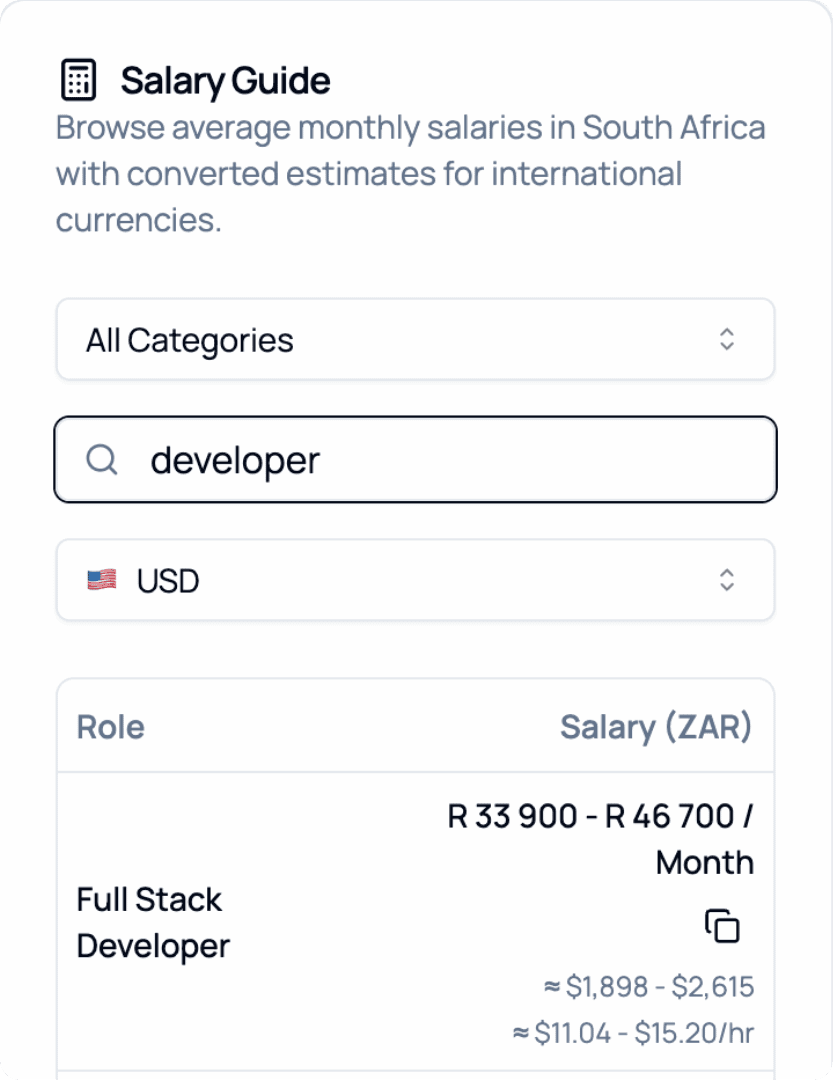
2026 Salary Guide: South Africa
Discover South African Salaries by Role. Compare costs and see how much you can save.