TL;DR
A practical employer system for hiring remote talent in South Africa with better selection accuracy and lower churn.
Learn how to vet candidates, run paid trials, and make clean hire/no-hire decisions using scorecards.
Scale from one remote hire to a reliable team with clear quality controls and KPI governance.
Table of Contents
- How do employers hire remote talent in South Africa effectively?
- What should I look for when vetting South African remote talent?
- How long should a paid trial be before making a long-term offer?
- What are common hiring mistakes when building remote teams in South Africa?
- How do I scale from one remote hire to a reliable team?
- Vetting and trial toolkit employers can copy
- Hiring funnel diagnostics: find where your process is leaking
- Trial design integrity checks (to avoid false positives)
- Candidate risk index (for final decision reviews)
- Red flags that predict churn early
- Hiring decision framework: move from opinion to evidence
- Manager calibration: reduce interviewer variance
- Offer design: improve acceptance and early retention
- Retention by design: what to do after the hire
- Failure recovery playbook when a hire is off-track
- Offer committee checklist for final approval
- Onboarding signal board (first 4 weeks)
- Quarterly talent system audit for scaling employers
- Final thoughts
If you want to hire remote talent in South Africa, your biggest risk is usually not talent supply. It is selection quality.
Most teams fail in one of two ways:
- they hire too fast using vibe-based interviews,
- or they overanalyze resumes and still skip real work-sample testing.
The result is predictable: slow ramp, misaligned expectations, manager frustration, and avoidable churn.
This guide gives you an employer operating system for better outcomes: how to vet candidates, run paid trials, make cleaner hiring decisions, and scale from one strong hire into a repeatable team.
For legal model decisions first, use Hire South African Remote Contractors vs Employees (2026): Cost, Risk, and Compliance. For compensation strategy, pair this with Virtual Assistant Rates in South Africa (2026): Employer Benchmarks by Role and Seniority.
How do employers hire remote talent in South Africa effectively?
Snippet answer: Employers hire effectively by using a structured sequence: role design, scorecard-based interviews, paid trial tasks, and KPI-led onboarding. Hiring speed matters, but decision quality matters more. The goal is not “fill the seat,” it is “reduce downstream management cost while improving output reliability.”
A high-performing hiring process is operational, not improvisational.
The 8-step hiring flow that works
- Define role outcomes (30/60/90 expectations)
- Set selection scorecard before interviews begin
- Source and screen for communication + role fit
- Interview with rubric, not free-form chats
- Run paid trial with real task conditions
- Score trial output against objective criteria
- Make hire/no-hire call with clear thresholds
- Launch structured onboarding with weekly checkpoints
Each step reduces the chance of emotional hiring.
The principle most teams miss
You are not hiring for “impressive profile.” You are hiring for predictable execution in your operating context. A modest resume with strong execution discipline often outperforms a flashy candidate with weak process habits.
What should I look for when vetting South African remote talent?
Snippet answer: Vet for execution signals, not only credentials. Focus on written communication precision, process reliability, ownership behavior, and decision quality under ambiguity. The best predictor of remote success is consistent follow-through with low supervision.
Core vetting dimensions
Use five dimensions with weighted scoring:
- Written communication clarity (20%)
- Role-specific execution quality (25%)
- Process reliability and documentation habits (20%)
- Ownership and escalation judgment (20%)
- Responsiveness under real workload (15%)
This creates comparability across candidates.
Interview questions that reveal execution behavior
Ask behavior-based prompts:
- “Describe a workflow you improved without being asked.”
- “Tell me about a task where requirements were unclear. What did you do?”
- “How do you prevent repeated errors on recurring work?”
- “What do you escalate immediately versus solve independently?”
Listen for specific operating details, not polished generic answers.
Red flags during vetting
- vague ownership examples,
- poor written structure in follow-up messages,
- blame-heavy explanations for missed outcomes,
- inability to describe repeatable process habits,
- over-reliance on manager direction for basic decisions.
These signals usually show up before hire. Believe them early.
How long should a paid trial be before making a long-term offer?
Snippet answer: Most employers get the best signal from a structured 7–14 day paid trial for scoped roles, or 30 days for higher-complexity roles. Trial duration matters less than trial design. A short, realistic trial with clear scoring is more useful than a long unstructured trial.
Trial formats by role complexity
- 7-day trial: routine admin/process tasks
- 14-day trial: cross-functional support with communication dependencies
- 30-day trial: complex ownership roles or high-stakes workflows
Trial design checklist
A good trial includes:
- task set that mirrors real work,
- clear definition of done,
- known SLA expectations,
- constrained tool stack,
- explicit scoring rubric,
- one owner for feedback and decision.
If trial tasks are disconnected from real role context, results are misleading.
Trial scoring template
Score each category 1–5:
- quality of output,
- turnaround reliability,
- communication clarity,
- initiative and problem framing,
- ability to apply feedback quickly.
Set a pass threshold before trial starts. Do not move goalposts afterward.
What are common hiring mistakes when building remote teams in South Africa?
Snippet answer: The most common mistakes are vague role design, unstructured interviews, weak trial design, and inconsistent onboarding ownership. These failures create false negatives (rejecting strong people) and false positives (hiring misaligned candidates).
Mistake 1: role ambiguity
When roles are poorly defined, candidates are evaluated against shifting expectations.
Fix: use one-page role briefs with clear outcomes and ownership boundaries.
Mistake 2: resume-led selection
Strong resumes can mask weak operational discipline.
Fix: prioritize trial output and behavioral evidence over profile polish.
Mistake 3: free-form interviews only
Unstructured interviews produce bias and weak comparability.
Fix: use weighted scorecards and standardized questions.
Mistake 4: trial without rubric
A trial without objective scoring becomes opinion-based.
Fix: define pass/fail criteria and quality standards in advance.
Mistake 5: onboarding as an afterthought
Many teams hire correctly but lose quality in month one due to weak handoff.
Fix: assign one onboarding owner and run weekly quality check-ins.
How do I scale from one remote hire to a reliable team?
Snippet answer: Scale by standardizing what worked with the first successful hire: role brief format, scorecard, trial process, onboarding cadence, and KPI review. Add headcount only when quality remains stable at current load. Scaling without process standardization creates compounding chaos.
Phase 1: prove one role
Before second hire, confirm:
- stable output quality,
- low rework trend,
- manageable oversight load,
- clear SOP documentation.
If these are not stable, hiring faster will amplify problems.
Phase 2: expand to a 3-person pod
Build role separation early:
- role A: execution,
- role B: process coordination,
- role C: quality or client-facing operations.
Use shared documentation and weekly sync rhythm to avoid siloed execution.
Phase 3: scale to 5+ with governance
Install light governance:
- monthly scorecard review,
- compensation and scope calibration,
- role-change approval flow,
- retention risk checks.
This protects quality as team complexity increases.
Vetting and trial toolkit employers can copy
Tool 1: one-page role brief
Fields to include:
- role objective,
- top five responsibilities,
- decision boundaries,
- first-month deliverables,
- reporting cadence,
- success metrics.
Tool 2: candidate evaluation form
Track:
- screening notes,
- interview scores,
- trial scores,
- concern flags,
- final decision rationale.
This creates an auditable decision trail.
Tool 3: trial task library
Maintain reusable tasks by role family:
- admin operations,
- revenue support,
- executive support,
- process documentation,
- customer communication.
Reusable libraries improve consistency and speed for future hires.
Hiring funnel diagnostics: find where your process is leaking
Most teams track hires closed, not selection quality by stage. That hides where hiring performance breaks.
Track your funnel in four stages:
- Screen pass rate (are you filtering correctly?)
- Interview pass quality (are interviews identifying true operators?)
- Trial conversion quality (are trials predictive or noisy?)
- 90-day success rate (did your process choose people who actually perform?)
Funnel leak interpretation
- High interview pass + low trial pass → interview rubric too soft.
- High trial pass + low 90-day success → trial tasks not representative.
- Low screen pass + low quality pipeline → sourcing criteria too generic.
- High 90-day success but low offer acceptance → offer design is weak.
Diagnose the right leak before changing the whole system.
Trial design integrity checks (to avoid false positives)
A trial can look rigorous and still be useless if it doesn’t mirror production reality.
Use these integrity checks:
- real tools and constraints included,
- realistic deadlines (not classroom pace),
- ambiguous inputs similar to live work,
- required communication updates during execution,
- scoring rubric finalized before trial starts.
If trial tasks are too clean, you select for test performance—not job performance.
Candidate risk index (for final decision reviews)
Before offer, assign a risk index based on observed behavior.
Score each from 1 (low risk) to 5 (high risk):
- execution consistency,
- communication reliability,
- feedback adoption speed,
- escalation judgment,
- documentation discipline.
Decision rule:
- Average ≤2.2 with no category above 3 → strong hire signal.
- Average 2.3–3.0 → conditional hire with explicit onboarding controls.
- Average >3.0 or any category 5 → no-hire or extended trial.
This adds structure to final decision meetings and reduces bias drift.
Red flags that predict churn early
Watch for these in first 30 days:
- repeated missed deadlines without proactive escalation,
- weak documentation habits,
- high dependency on manager for routine decisions,
- communication inconsistency under pressure,
- low feedback adoption speed.
Early intervention can save the hire. Ignoring patterns usually leads to expensive replacement cycles.
Hiring decision framework: move from opinion to evidence
A hiring process is only as strong as its decision rule. If final decisions rely on “gut feel,” consistency collapses when different managers run interviews.
Use a weighted decision model
Set explicit weights before interviews:
- role-specific execution quality: 30%
- communication and clarity: 20%
- ownership and escalation behavior: 20%
- reliability under time pressure: 15%
- process documentation discipline: 15%
Then apply one rule:
- any critical-risk score below threshold = no-hire,
- otherwise compare weighted totals.
This prevents charismatic but risky candidates from slipping through.
Separate “can do” from “will do”
Many candidates can do tasks. Fewer consistently do them at the quality and speed your business requires.
Measure both:
- Can do signal: trial task correctness.
- Will do signal: consistency, communication, and follow-through over trial window.
Strong hiring decisions require both.
Manager calibration: reduce interviewer variance
Even good scorecards fail when interviewers score inconsistently.
Monthly calibration routine
Once per month, review:
- last 3 hiring decisions,
- score patterns by interviewer,
- pass/fail rationale quality,
- post-hire outcomes versus interview scores.
If one interviewer consistently over-scores or under-scores, recalibrate with examples.
Calibration questions to standardize
- What does a “4/5 communication” answer actually sound like?
- What constitutes a red-flag ownership response?
- Which trial mistakes are coachable versus disqualifying?
This keeps hiring standards stable as team size grows.
Offer design: improve acceptance and early retention
Selection quality matters, but offer quality affects conversion and first-90-day stability.
Offer components that reduce early churn
- clear responsibilities and ownership boundaries,
- transparent performance expectations,
- defined communication cadence,
- realistic onboarding plan,
- role growth pathway after first 90 days.
Candidates who understand success criteria upfront perform better and stay longer.
48-hour offer acceptance checklist
Before finalizing offer:
- [ ] role scope aligns with trial scope,
- [ ] manager and candidate agree on working rhythm,
- [ ] compensation structure is documented clearly,
- [ ] first-week plan is ready,
- [ ] access/tooling owner is assigned.
Many day-one failures come from offer-to-onboarding gaps, not candidate quality.
Retention by design: what to do after the hire
Hiring does not end at acceptance. Retention starts immediately.
First 2 weeks: confidence and clarity
- daily check-ins for blockers,
- explicit priority list,
- quick feedback loops,
- no hidden expectations.
Weeks 3–6: autonomy ramp
- shift from instruction-heavy to outcome-based management,
- reward proactive issue identification,
- measure independent execution quality.
Weeks 7–12: role hardening
- finalize long-term KPI baseline,
- identify automation/delegation opportunities,
- set next-quarter development targets.
This progression reduces dependency and improves team leverage.
Failure recovery playbook when a hire is off-track
Not every miss requires immediate replacement. Use a structured recovery test first.
14-day recovery sprint
- Identify top two performance gaps.
- Clarify success examples and non-examples.
- Set daily output targets.
- Run short feedback cycles.
- Re-score at day 14.
If performance remains below threshold after a focused recovery sprint, exit quickly and feed lessons back into selection criteria.
Post-mortem template for failed hires
Capture:
- where selection signal failed,
- which interview/trial indicators were missed,
- onboarding factors that amplified failure,
- process updates required before next hire.
Every failed hire should improve the system. If not, the same failure repeats.
Offer committee checklist for final approval
Before sending an offer, run a short committee check (ops + hiring manager + founder/lead).
Approve only if all are true:
- [ ] trial score meets threshold with documented evidence,
- [ ] risk index is acceptable,
- [ ] role scope and onboarding owner are confirmed,
- [ ] compensation band aligns with role impact,
- [ ] first-30-day targets are written and agreed.
This check takes 10 minutes and prevents expensive “close fast, regret later” decisions.
Onboarding signal board (first 4 weeks)
Use a visible signal board with three colors:
- Green: output on target, proactive communication, low correction.
- Yellow: mixed quality, delayed escalation, uneven follow-through.
- Red: repeated misses, weak feedback adoption, unclear ownership behavior.
Escalation rule:
- 2 consecutive yellows → targeted coaching sprint.
- 1 red week → manager intervention + scope clarification.
- 2 red weeks → exit or redesign decision.
This keeps early-stage performance decisions objective and fast.
Quarterly talent system audit for scaling employers
As hiring volume grows, run a quarterly audit to keep quality high.
Check:
- scorecard validity against real 90-day outcomes,
- trial task relevance by role family,
- interviewer calibration drift,
- retention trend by manager,
- time-to-productivity trend by role.
If these metrics degrade while hiring volume rises, pause expansion and fix system quality first.
Final thoughts
Hiring remote talent in South Africa can deliver excellent outcomes when employers run a disciplined selection system. The edge is not luck, network, or charisma in interviews. The edge is process quality.
Build your hiring engine around role clarity, scorecard-driven vetting, paid trial evidence, and KPI-based onboarding. Then scale only when quality is stable.
If you want the full operating stack, combine this with How to Hire Remote Staff in South Africa: Employer Playbook (2026), Virtual Assistant Hourly Rate in South Africa (2026): What Employers Should Actually Pay, and How to Hire a Virtual Assistant for Small Business in 2026.
Explore related hiring options
Useful next pages based on this article's topic:
- Hire South African virtual assistants — core service page for evaluating HireSava's hiring model and next-step CTA
- Fluent English remote workers in South Africa — proof of communication quality for customer-facing and judgment-heavy roles
- South Africa virtual assistant cost guide — budget planning and quality-adjusted cost expectations
- South Africa VA rates benchmark — role-by-role compensation ranges and seniority bands
- South Africa hourly rate guide — hourly pricing expectations and hiring math
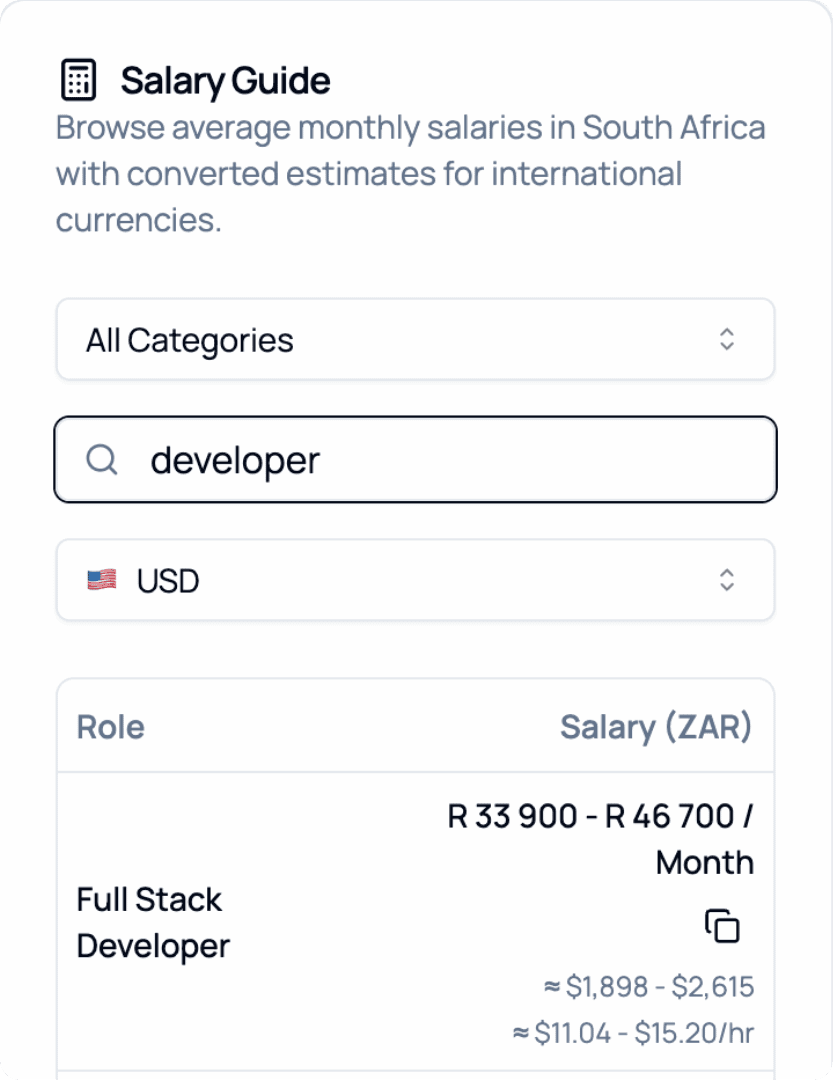
2026 Salary Guide: South Africa
Discover South African Salaries by Role. Compare costs and see how much you can save.