TL;DR
A practical employer checklist for hiring South African remote contractors with lower compliance and delivery risk.
Learn how to structure contracts, define scope, control invoices, and run quality governance from day one.
Use conversion triggers to decide when contractor roles should move to employee or EOR models.
Table of Contents
- How do I hire South African remote contractors legally and efficiently?
- What should be included in a contractor agreement for South African remote talent?
- How do employers prevent misclassification when managing remote contractors?
- How should I price and pay South African remote contractors?
- When should I convert a contractor into an employee or EOR hire?
- Employer toolkit: contractor management templates
- Contractor governance maturity score (CGMS)
- Contractor dispute prevention and resolution map
- Red flags in contractor hiring and management
- Leadership reporting format for contractor portfolio
- Pre-hire due diligence checklist (before signing)
- Contractor quality assurance framework
- Communication operating rhythm for contractor success
- SLA design for contractor work
- Performance review and compensation adjustment policy
- Multi-contractor portfolio management (for scaling teams)
- Exit and continuity planning (don’t skip this)
- Invoice anomaly playbook (catch issues before month-end)
- Keep/convert/exit decision meeting checklist
- Quarterly contractor benchmark refresh
- Final thoughts
Hiring South African remote contractors can be one of the fastest ways to add execution capacity. But “fast” only works when the operating model is clean.
Most problems aren’t about talent quality. They come from weak contractor design: vague scope, loose invoice rules, and manager behavior that drifts into employee-style control.
This guide is the employer execution playbook for contractor hiring in 2026: how to structure contracts, prevent misclassification, control cost, and maintain quality as you scale.
If you’re still deciding model, start with Hire South African Remote Contractors vs Employees (2026): Cost, Risk, and Compliance. If you already chose contractor and need operational control, this guide is for you.
How do I hire South African remote contractors legally and efficiently?
Snippet answer: Hire efficiently by locking role scope and contractor model before sourcing, then run a structured workflow: role brief, compliant agreement, scoped paid trial, and KPI-led onboarding. Speed comes from preparation and process consistency, not skipping controls.
Employer hiring workflow (contractor lane)
-
Define contractor-appropriate scope
Outcome-based, project or variable workflow ownership. -
Set contractor scorecard
Evaluate communication, reliability, and execution independence. -
Run interview + paid trial
Test real role tasks, not generic assignment fluff. -
Issue contract pack
Include deliverables, billing logic, revision rules, and confidentiality/IP terms. -
Launch onboarding with guardrails
Role boundaries, escalation flow, weekly review rhythm. -
Perform 30-day model-fit review
Confirm role still behaves like contractor engagement.
Fast without chaos: the hiring SLA
Use realistic internal SLAs:
- 48h for role brief and scorecard approval
- 7 days for shortlist and interviews
- 7–14 days for paid trial
- 48h for final hire/no-hire decision
This keeps cycle time fast while preserving decision quality.
What should be included in a contractor agreement for South African remote talent?
Snippet answer: A strong contractor agreement must define deliverables, payment mechanics, revision limits, confidentiality/IP obligations, and termination handoff terms. The contract should mirror how work is actually managed. Good legal language cannot fix bad operating behavior.
Minimum contract clauses (employer checklist)
Include:
- scope of work with measurable outputs,
- deliverable acceptance criteria,
- payment terms and invoice cadence,
- billable vs non-billable activity definitions,
- revision limits and change-control process,
- confidentiality and data handling obligations,
- IP ownership terms,
- termination notice and handoff requirements.
Scope of work (SOW) standards
Every SOW should answer:
- what gets delivered,
- quality criteria,
- expected turnaround,
- dependencies needed from employer,
- escalation trigger if blocked.
If these are unclear, billing disputes and quality drift are almost guaranteed.
Practical contract rule
Avoid vague language like “support as needed.”
It sounds flexible and behaves like scope explosion.
How do employers prevent misclassification when managing remote contractors?
Snippet answer: Prevent misclassification by aligning day-to-day management with contractor reality. Focus on outcomes, not employee-style process control. Review role drift quarterly and convert engagements that become permanent, high-control, and core to operations.
Misclassification risk triggers
Watch for:
- fixed schedules that mimic internal employment,
- deep daily process control,
- role exclusivity over long periods,
- scope expansion into core permanent functions,
- manager treatment that mirrors full-time employee governance.
These are operational signals, not just contract issues.
Prevention controls that work
-
Outcome-based management
Manage deliverables and deadlines, not minute-level workflow control. -
Quarterly classification review
Re-check role behavior against contractor model assumptions. -
Role-change approval gate
If scope shifts materially, trigger legal model review immediately. -
Manager training
Ensure managers understand contractor boundaries in practice.
Contractor-to-employee early warning score
Create a simple score (1 point each):
- fixed schedule required daily,
- full operational exclusivity,
- ongoing role with no project boundary,
- high process supervision.
If score is 3+, initiate conversion review.
How should I price and pay South African remote contractors?
Snippet answer: Use pricing structures tied to scope clarity and workload variability. Hourly works for variable/project work with strict caps and change control. Monthly retainers fit stable recurring scope. Employers should evaluate true cost, including oversight and rework—not just headline rate.
Pricing model options
- Hourly: flexible but needs cap governance
- Retainer/monthly: predictable for recurring workflows
- Hybrid: monthly core + hourly overflow
Payment control framework
Before first invoice, define:
- invoice format standards,
- required work logs,
- approval owner,
- approval timeline,
- dispute handling flow.
Without this, finance friction and trust erosion follow quickly.
True cost formula for contractor pricing
True Contractor Cost = Base Compensation + Oversight Cost + Rework Cost + Delay Cost + Admin Cost
This prevents “cheap contractor” illusions.
Invoice governance checklist
- [ ] billed work maps to approved scope,
- [ ] over-cap hours pre-approved,
- [ ] revision charges align with contract rules,
- [ ] delivery quality meets acceptance criteria,
- [ ] unresolved blockers documented.
This keeps cash flow predictable and avoids late-cycle disputes.
When should I convert a contractor into an employee or EOR hire?
Snippet answer: Convert when contractor engagements become long-term, high-control, and business-critical. If the role now operates like employment, conversion reduces legal and operational risk. Delaying conversion often costs more than executing it early.
Conversion triggers employers should use
Convert when two or more are true:
- role is core and ongoing,
- manager requires fixed-day process control,
- contractor is operationally exclusive,
- continuity risk is high if role exits,
- scope no longer project-based.
Conversion pathways
- Direct employee if you have local entity infrastructure.
- EOR employee if you need compliant speed without local entity setup.
Conversion execution checklist
- classification review completed,
- updated compensation model approved,
- revised role brief and KPI targets set,
- transition date and handoff plan defined,
- documentation updated for audit trail.
Don’t convert reactively during failure. Convert proactively when role reality changes.
Employer toolkit: contractor management templates
Template 1: contractor role brief
Include:
- objective and outcomes,
- top responsibilities,
- decision boundaries,
- communication cadence,
- SLA expectations,
- escalation path.
Template 2: weekly contractor review (30 minutes)
- Planned vs delivered outputs
- Hours billed vs cap
- Rework patterns
- Upcoming dependency risks
- Scope changes requiring approval
Template 3: change-control request
- request summary,
- business reason,
- estimated hours,
- impact on current priorities,
- approval owner,
- deadline.
These templates reduce variance across managers and improve performance consistency.
Contractor governance maturity score (CGMS)
If you manage more than one contractor, rate your system maturity before scaling.
Score 0–4 in each area:
- Scope clarity and change control
- Billing transparency and approval ownership
- Quality measurement consistency
- Manager behavior aligned with contractor model
- Continuity and handoff readiness
Interpretation:
- 17–20: scalable contractor system
- 12–16: workable but fragile
- 0–11: high drift risk; stabilize before adding headcount
This score creates a fast executive signal for whether growth is operationally safe.
Contractor dispute prevention and resolution map
Most contractor conflicts are predictable and avoidable. Use a clear escalation ladder.
Tier 1: operational clarification
Use when issue is scope ambiguity or missing context.
- confirm scope line item,
- clarify expected output,
- document revised definition of done.
Tier 2: billing variance review
Use when invoice and output don’t align.
- compare billed hours to approved scope,
- identify variance source,
- agree corrective action for next cycle.
Tier 3: performance remediation
Use when quality/reliability repeatedly misses threshold.
- run 14-day corrective sprint,
- set explicit success criteria,
- make keep/exit decision at sprint close.
This process reduces emotional back-and-forth and keeps disputes evidence-based.
Red flags in contractor hiring and management
Watch for:
- no written SOW,
- ad hoc billing categories,
- unlimited hourly expansion,
- missing acceptance criteria,
- unclear ownership over approvals,
- repeated late-scope additions without change control.
These are process failures, not talent failures.
Leadership reporting format for contractor portfolio
For teams managing multiple contractors, send a monthly summary:
- Contractor roster and role objective
- Cost vs budget
- Output quality trend
- Misclassification risk flags
- Keep/convert/exit recommendations
This keeps strategy aligned with finance, legal, and operations.
Pre-hire due diligence checklist (before signing)
Before you onboard any contractor, run this due-diligence pass.
Role and scope diligence
- [ ] Is the role clearly project-based or variable by design?
- [ ] Are outcomes measurable with objective acceptance criteria?
- [ ] Are dependencies from your internal team documented?
- [ ] Is there a named owner responsible for scope decisions?
Operational diligence
- [ ] Are tools and access requirements mapped?
- [ ] Are communication channels and response expectations defined?
- [ ] Is weekly reporting format agreed in writing?
- [ ] Are escalation paths documented?
Financial diligence
- [ ] Is pricing model chosen intentionally (hourly/retainer/hybrid)?
- [ ] Are billing categories and cap rules explicit?
- [ ] Is invoice review ownership clear?
- [ ] Is there a reserve plan for unexpected peak workload?
This one checklist catches most problems before they become expensive.
Contractor quality assurance framework
A contractor relationship fails when quality controls start late. Install QA on day one.
QA layer 1: output checks
For each deliverable, score:
- correctness,
- completeness,
- clarity,
- SLA adherence.
Keep this lightweight but consistent.
QA layer 2: trend analysis
Every month, evaluate:
- first-pass completion trend,
- rework categories,
- turnaround consistency,
- repeat error rate.
If trend worsens for two cycles, treat it as system issue, not isolated incident.
QA layer 3: role-model fit review
Quarterly, ask:
- does this role still fit contractor structure?
- is manager behavior drifting toward employee-style control?
- is continuity risk now too high for contractor model?
This protects against silent drift.
Communication operating rhythm for contractor success
Most contractor underperformance is communication design failure.
Recommended weekly rhythm
- Monday: priorities + output targets
- Midweek: blocker and dependency check
- Friday: completed outputs + next-week planning
This cadence balances flexibility with accountability.
Documentation rules
- all scope changes logged,
- all approvals visible,
- all escalations timestamped,
- all quality notes linked to deliverables.
When communication data is scattered across chats, disputes increase and quality drops.
SLA design for contractor work
Use SLAs appropriate to task category.
Example structure:
- routine task updates: within 24 hours,
- standard deliverables: within agreed weekly cycle,
- urgent support items: same business day when pre-approved,
- escalation response: within 2–4 hours during active windows.
SLA clarity prevents conflict around “responsiveness expectations.”
Performance review and compensation adjustment policy
Contractor compensation should be tied to evidence.
Monthly review criteria
- quality trend,
- reliability trend,
- manager oversight trend,
- scope complexity increase.
Adjustment rules
- increase compensation when sustained higher-complexity ownership is proven,
- hold compensation when performance is stable but scope unchanged,
- redesign scope or exit when quality and reliability remain below target.
This keeps cost governance fair and predictable.
Multi-contractor portfolio management (for scaling teams)
Once you manage more than three contractors, ad hoc management breaks quickly.
Portfolio control dashboard
Track per contractor:
- role objective,
- monthly spend vs budget,
- quality score,
- rework percentage,
- oversight hours,
- model-fit risk level.
Review this monthly with operations and finance together.
Portfolio risk tiers
Use simple labels:
- Green: stable quality, low oversight, in-budget.
- Yellow: emerging issues (quality drift, repeated cap exceptions).
- Red: persistent delivery risk or model misfit requiring intervention.
Tie each tier to action rules so reviews lead to decisions, not just discussion.
Capacity planning rule
Do not add new contractor headcount while two or more existing roles remain in red tier. Stabilize system quality first.
Exit and continuity planning (don’t skip this)
Even high-performing contractors may exit. Plan continuity before it happens.
Continuity checklist
- [ ] SOPs and process docs current
- [ ] critical workflows documented end-to-end
- [ ] backup coverage identified
- [ ] handoff template ready
- [ ] access offboarding checklist prepared
Smooth transition rule
Require handoff artifacts as part of final milestone acceptance. If knowledge transfer is optional, transitions become expensive and chaotic.
Invoice anomaly playbook (catch issues before month-end)
Run this quick anomaly check every week, not only at month close.
Flag as anomaly when:
- billed hours jump >25% without approved scope change,
- revision hours exceed planned threshold,
- recurring blockers generate repeated billable idle time,
- urgent requests dominate planned work repeatedly.
Response protocol
- confirm data accuracy,
- map anomaly to scope/priority decisions,
- apply correction (cap, scope reduction, SLA reset),
- re-check trend next week.
This keeps contractor economics predictable and prevents cumulative invoice surprises.
Keep/convert/exit decision meeting checklist
Hold a monthly 20-minute decision review for each contractor lane.
Review in order:
- quality trend,
- reliability trend,
- oversight burden,
- model-fit risk,
- continuity risk.
Decision outcomes:
- Keep: model fit remains strong and economics stable.
- Convert: role now behaves like employee/EOR use case.
- Exit/replace: quality or reliability remains below threshold despite remediation.
A fixed decision rhythm avoids drifting for months in a suboptimal setup.
Quarterly contractor benchmark refresh
Contractor economics and availability shift throughout the year. Refresh your benchmarks quarterly.
Review:
- current pricing bands by role family,
- quality and retention outcomes by contractor tier,
- average oversight cost trend,
- conversion rate from contractor to employee/EOR,
- recurring failure patterns in onboarding or scope control.
Use this review to update scorecards, contract templates, and approval rules. Teams that update systems quarterly avoid stale processes and protect margin as they scale.
Final thoughts
Hiring South African remote contractors can be high-leverage for employers who treat contractor management as a system, not a shortcut.
If you define scope clearly, enforce invoice controls, and monitor model drift, contractor hiring can deliver speed with manageable risk. If you skip those controls, you’ll spend the “savings” on rework and cleanup.
For a full operating stack, combine this checklist with Hire South African Remote Contractors vs Employees (2026): Cost, Risk, and Compliance, How to Hire Remote Talent in South Africa (2026): Employer System for Vetting, Trialing, and Scaling, and Virtual Assistant Hourly Rate in South Africa (2026): What Employers Should Actually Pay.
Explore related hiring options
Useful next pages based on this article's topic:
- Hire South African virtual assistants — core service page for evaluating HireSava's hiring model and next-step CTA
- Fluent English remote workers in South Africa — proof of communication quality for customer-facing and judgment-heavy roles
- South Africa virtual assistant cost guide — budget planning and quality-adjusted cost expectations
- South Africa VA rates benchmark — role-by-role compensation ranges and seniority bands
- South Africa hourly rate guide — hourly pricing expectations and hiring math
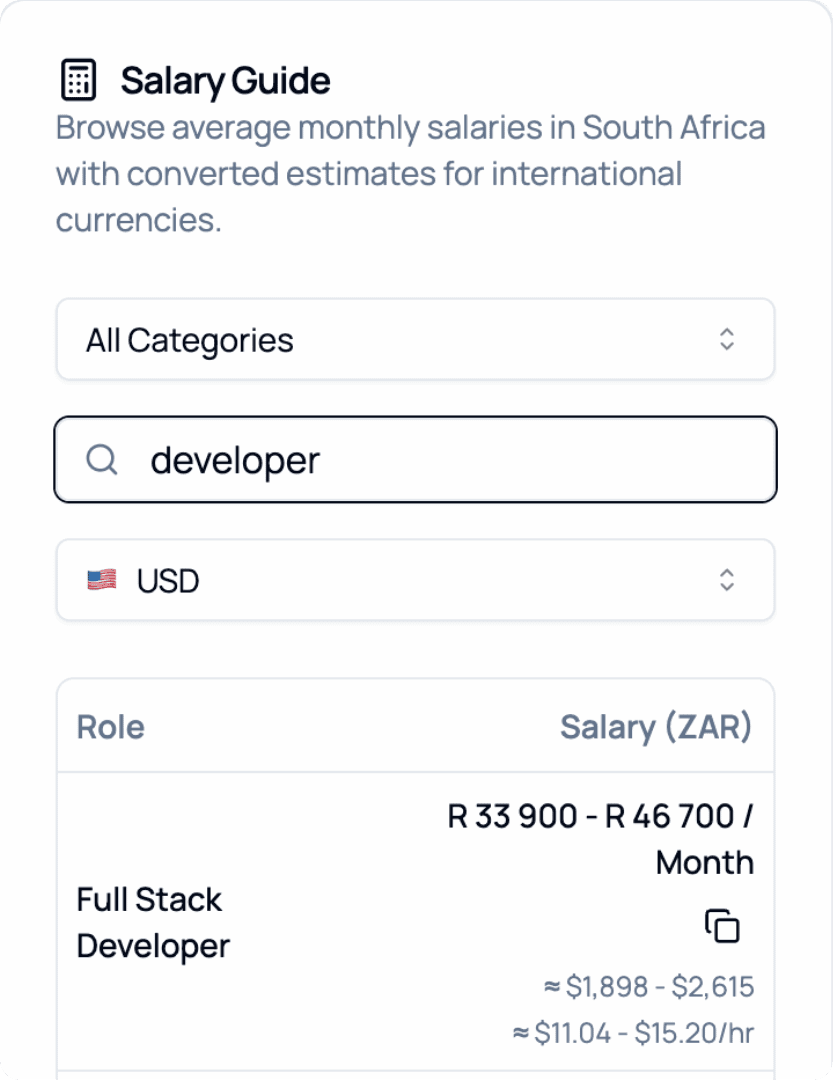
2026 Salary Guide: South Africa
Discover South African Salaries by Role. Compare costs and see how much you can save.