TL;DR
Distinguish between a Virtual Assistant (task execution) and a Remote Worker (outcome ownership) to make the right hire.
Choose a VA for process-driven tasks like email management and scheduling to quickly scale support flexibility.
Invest in a Remote Worker when you need a specialized professional to drive strategy, lead teams, and own results.
Table of Contents
- Virtual Assistant and a Remote Worker: What is the Difference?
- Virtual Assistant vs. Remote Worker: Comparing Ownership and Quality
- Why Hire a South African Virtual Assistant? (The Sweet Spot)
- When Should You Hire a VA vs. a Remote Worker?
- How to Successfully Manage a Virtual Assistant / Remote Worker
- FAQs
As businesses become increasingly digital in 2026, the lines between different types of remote talent are blurring. You know you need help, and you know you don't need someone sitting in a cubicle next to you. But when you start looking for talent, you're faced with two common terms: Virtual Assistant and Remote Worker.
Are they the same thing? (Hint: No). Does one take on more responsibility than the other? (Yes). And most importantly, which one aligns with what your business actually needs?
Understanding the distinction between a virtual assistant vs. a remote worker is critical. Making the wrong choice can lead to mismatched expectations—either overpaying for simple task support or under-resourcing a role that requires true ownership and autonomy.
In this comprehensive guide, we'll break down the key differences in scope, specialization, and ownership, explore the unique advantages of South African talent, and give you a clear decision framework for your hiring strategy in 2026.
Virtual Assistant and a Remote Worker: What is the Difference?
The core difference between a virtual assistant and a remote worker isn't just about employment status—it's about scope of responsibility and ownership.
1. The Virtual Assistant (Supportive Partner for Specific Needs)
A Virtual Assistant (VA) is a flexible support professional who assists with specific tasks, projects, or operational needs. Think of a VA as an extension of your capacity—someone who helps you get things done, but under your direction and within a defined scope.
- Role Scope: Task-based and support-oriented. VAs handle specific, delegated work rather than owning an entire function.
- Direction: You define the tasks. The VA executes. They work for you on what you assign.
- Employment Status: Typically an independent contractor (1099/B2B). Flexible engagement.
- Commitment: Scalable—hourly, part-time, or full-time retainer based on your needs.
- Cost: Flat fee. No benefits, no payroll taxes, no equipment costs.
- Best For: Email management, calendar scheduling, data entry, travel booking, social media posting, customer support, research, CRM updates—any task you need handled but don't need someone to "own."
Example Use Case: A busy real estate agent hires a VA for 20 hours/week to schedule property showings, respond to inquiry emails, update listings on the MLS, and send follow-up messages to leads. The agent defines the tasks; the VA executes them reliably and efficiently.
The VA Mindset: "Tell me what you need done, and I'll do it well."
2. The Remote Worker (Specialized Professional with Role Ownership)
A Remote Worker is a specialized professional who takes full ownership of their role and responsibilities. They don't just execute tasks—they own outcomes, make decisions, and drive results within their area of expertise.
- Role Scope: Function-based and ownership-oriented. Remote workers own a domain, project, or team—not just individual tasks.
- Direction: You set goals and expectations. They figure out how to achieve them. They work with you as a partner.
- Employment Status: Often a full-time employee (W-2) or a senior-level contractor with significant autonomy.
- Commitment: Long-term relationship. Expected to grow with the company.
- Cost: Salary + Benefits + Payroll Taxes + Equipment. Higher investment, but deeper integration.
- Best For: Marketing strategy, product development, team leadership, sales management, software engineering—any role that requires expertise, decision-making, and accountability for results.
Example Use Case: A SaaS company hires a remote Head of Content Marketing. This person doesn't just write blog posts—they develop the content strategy, define the editorial calendar, manage freelance writers, analyze performance metrics, and continuously optimize for conversions. They own the entire content function.
The Remote Worker Mindset: "Here are the goals. I'll figure out how to hit them and take responsibility for the results."
Comparison at a Glance
| Feature | Virtual Assistant | Remote Worker |
|---|---|---|
| Primary Role | Support & Task Execution | Specialized Function Ownership |
| Scope of Work | Defined tasks assigned by you | Owns outcomes within their domain |
| Decision-Making | Low (follows your direction) | High (makes independent decisions) |
| Specialization | Generalist support skills | Deep expertise in a specific area |
| Accountability | Task completion | Outcome & results ownership |
| Cost Structure | Flat hourly or monthly rate | Salary + 30-50% overhead |
| Best For | Operational support & execution | Strategy, leadership & expertise |
Virtual Assistant vs. Remote Worker: Comparing Ownership and Quality
The distinction between VA and Remote Worker isn't about "better" or "worse"—it's about the level of ownership and autonomy the role requires.
Task Execution vs. Outcome Ownership
This is the fundamental difference:
-
A Virtual Assistant excels at executing tasks you define. You say "Schedule these 10 meetings," and they schedule them perfectly. You say "Post this content on social media," and it goes live on time. The VA's value is in reliable, efficient execution of your instructions.
-
A Remote Worker excels at owning outcomes you care about. You say "We need to increase website traffic by 30%," and they develop the strategy, execute the tactics, analyze the results, and iterate. The remote worker's value is in taking a goal and figuring out how to achieve it—without you having to manage every step.
When to Choose Each
Choose a VA when:
- You know exactly what needs to be done
- The tasks are process-driven and repeatable
- You want to stay in control of strategy and decisions
- You need flexibility to scale support up or down
Choose a Remote Worker when:
- You need someone to own a function, not just execute tasks
- The role requires expertise, judgment, and decision-making
- You want to delegate outcomes, not just activities
- You're building long-term capability in a specialized area
The Quality Question
Both VAs and Remote Workers can deliver exceptional quality—the difference is in what kind of quality you need.
- VA Quality = Accuracy, reliability, efficiency, and consistency in task execution. Did they do what you asked, correctly and on time?
- Remote Worker Quality = Expertise, initiative, problem-solving, and results delivery. Did they achieve the outcome you needed, even when the path wasn't obvious?
Neither is inherently "higher quality"—they're just different kinds of value.
Why Hire a South African Virtual Assistant? (The Sweet Spot)
If you're looking for reliable support talent with Western-level communication skills at offshore pricing, South Africa is the undisputed "sweet spot" for 2026.
While regions like the Philippines and India have dominated the outsourcing conversation for decades, South Africa offers a unique combination of advantages that make it the premium choice for discerning businesses.
1. Cost Efficiency Without Compromise
Hiring a US-based VA or support professional might cost you $25-$40/hour or more.
Hiring a reliable virtual assistant in South Africa through HireSava gives you access to talented, English-native professionals for $12-$20/hour ($1,500 – $2,800 per month full-time).
That is a 50-70% saving that goes straight to your bottom line.
And unlike bargain-bin offshoring destinations, you're not sacrificing communication quality, work ethic, or reliability.
2. Native English (The "Hidden" Efficiency)
Every time you have to re-explain something, clarify a cultural reference, or decode an email that "sounds off," you lose time. These micro-frictions compound into hours of lost productivity every week.
With South African talent:
- Native English: South Africa is a native English-speaking nation. English is the primary language of business, education, and media. There is no "lost in translation."
- Western Alignment: South African professionals understand Western business etiquette—humor, sarcasm, directness, and politeness. They "get" your references without needing a cultural manual.
- Professional Norms: South Africa's business culture is heavily influenced by UK and US standards. Your VA will naturally understand concepts like "EOD" deadlines and proactive communication.
3. The Time Zone Advantage (GMT+2)
South Africa's GMT+2 position offers strategic advantages:
- Europe/UK: Only a 1-2 hour difference. Near real-time collaboration.
- US East Coast: A 6-7 hour difference. Perfect for overnight task handoffs and morning overlap calls.
- Australia: Only a 6-8 hour difference, with afternoon overlap for Australian mornings.
4. Education and Work Ethic
South Africa has a robust higher education system. Many South African VAs hold university degrees—giving you well-educated support talent at a fraction of Western costs.
Beyond education, the South African work ethic is renowned. The cultural concepts of "Ubuntu" (community and mutual support) and "Boer maak 'n plan" (resourcefulness) translate into professionals who are proactive, resilient, and solution-oriented.
When Should You Hire a VA vs. a Remote Worker?
Not sure which model fits your current needs? Use this decision matrix.
Hire a Virtual Assistant If:
- You need support with specific tasks—email, scheduling, data entry, social media, customer service.
- You want to stay in control of strategy and decision-making.
- Your workload fluctuates and you need flexibility to scale support up or down.
- You want to avoid the overhead of full-time employment (benefits, taxes, HR compliance).
- You're a startup or small business looking to stay lean and agile.
- The work is process-driven and you can clearly define what needs to be done.
Hire a Remote Worker If:
- You need someone to own a function, not just complete tasks—marketing, sales, product, engineering.
- The role requires specialized expertise and professional judgment.
- You want to delegate outcomes, not just activities.
- You're building long-term capability and want someone to grow with the company.
- The role involves team leadership or managing other people.
- You have the budget for salary, benefits, and employment infrastructure.
How to Successfully Manage a Virtual Assistant / Remote Worker
Hiring a VA is only half the battle. The other half is setting them up for success. Here are best practices:
1. Define Clear, Specific Tasks
VAs thrive on clarity. Instead of "help with social media," provide specific deliverables: "Post 5 Instagram Reels per week using our brand templates, respond to DMs within 2 hours, and send a weekly analytics report every Friday."
2. Use Asynchronous Communication
Tools like Loom (for video walkthroughs), Slack (for quick questions), and Asana/ClickUp (for task management) allow you to communicate efficiently across time zones without endless meetings.
3. Establish Weekly Check-Ins
A 15–30 minute weekly sync is often all you need to review completed work, align on priorities, and address blockers.
4. Document Your Processes
Create simple SOPs (Standard Operating Procedures) for recurring tasks. Even a quick Loom video walkthrough counts. The more you document, the faster your VA can operate independently.
5. Measure Outputs, Not Hours
Focus on task completion and quality, not time logged. Use project management dashboards to maintain visibility without micromanaging.
FAQs
Q: Is a virtual assistant an employee or independent contractor?
In almost all cases, a virtual assistant is an independent contractor. You pay a simple invoice for services rendered. The VA is responsible for their own taxes, equipment, and insurance. This is a major cost advantage over hiring employees.
Q: How much does a remote worker cost vs. a virtual assistant?
A US-based remote professional might cost $60,000-$100,000+/year (salary + benefits + overhead). A South African Virtual Assistant from HireSava costs $1,500-$2,800/month ($18,000-$33,600/year). Potential savings: $30,000-$70,000+ annually for support roles.
Q: Can a virtual assistant work full-time?
Yes! Many VAs prefer dedicated full-time engagements (40 hours/week) with a single client. This gives you consistency and focus while maintaining the flexibility and cost savings of a contractor relationship.
Q: When should I "upgrade" a VA to a Remote Worker role?
Consider upgrading when you need someone to stop just executing tasks and start owning outcomes. If you find yourself wanting your VA to make more decisions, develop strategy, or lead initiatives independently, it may be time to hire (or promote) into a true remote worker role with greater ownership.
Q: What tasks can a virtual assistant handle?
VAs excel at: email management, calendar scheduling, travel booking, social media posting, customer support, data entry, CRM updates, bookkeeping support, lead research, appointment setting, and general administrative tasks. If you can define the task clearly, a skilled VA can execute it.
Q: Is South African talent reliable?
Absolutely. South African professionals are known for their strong work ethic, excellent English, and cultural alignment with Western business norms. At HireSava, we pre-vet the top talent to ensure reliability is never a question.
Ready to build your team? Whether you need flexible support or specialized expertise, find the right talent for your business. Explore Virtual Assistants on HireSava today.
Explore related hiring options
Useful next pages based on this article's topic:
- Virtual Assistant role overview — hiring and onboarding guidance
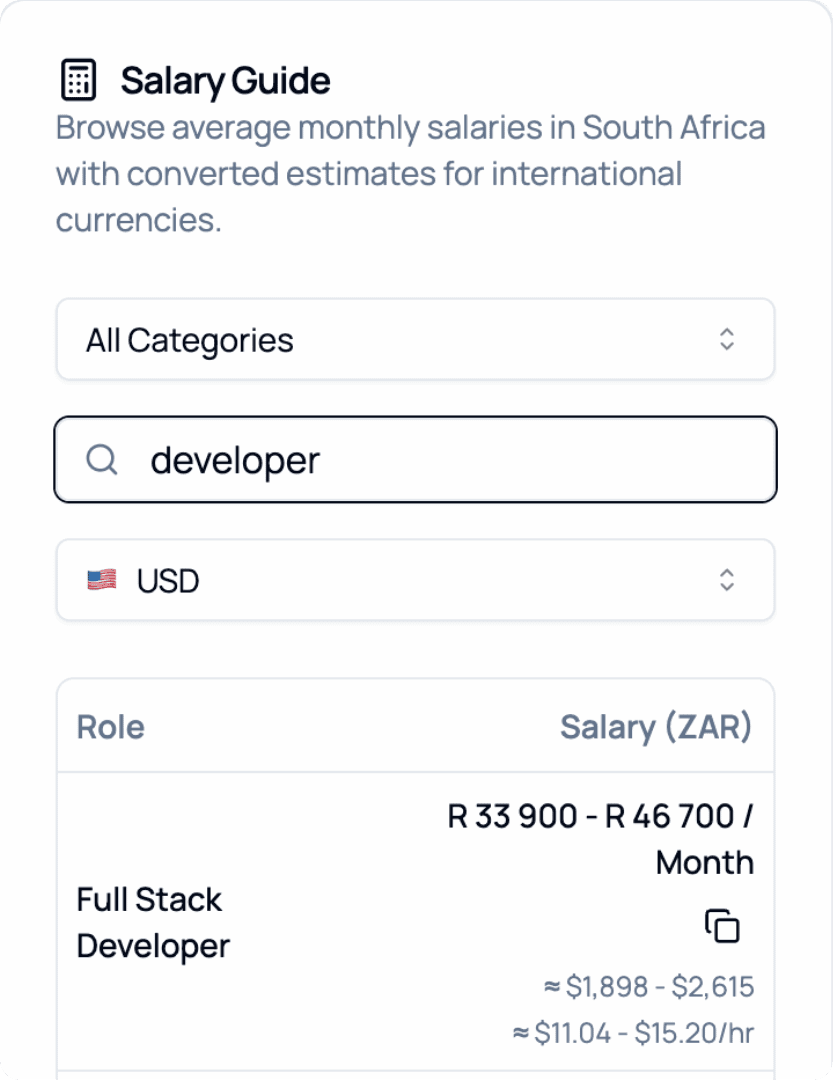
2026 Salary Guide: South Africa
Discover South African Salaries by Role. Compare costs and see how much you can save.