TL;DR
Learn how to outsource construction permit and compliance admin workflows without losing timeline control, documentation quality, or accountability.
Use a practical operating model for intake checklists, jurisdiction tracking, packet QA, revision loops, and approval logging.
Apply cost, KPI, and scale frameworks that help US contractors reduce permit delays and improve project launch reliability.
Table of Contents
- Introduction
- What permit and compliance admin tasks can a construction VA handle?
- Which permit/admin workflows should contractors delegate first?
- How much does permit/admin outsourcing support cost and what ROI should you expect?
- How do you avoid permit delays and documentation errors?
- How do you scale permit/compliance admin support across more projects?
- Final Thoughts
Introduction
If you are building support capacity in this vertical, review the construction industry page first for broader role and staffing context.
Permit and compliance admin work is one of the biggest silent schedule risks in construction operations. Teams can estimate well, coordinate well, and still lose time because packet readiness is inconsistent, jurisdiction requirements are tracked in fragmented notes, and revision requests are handled reactively instead of through a governed workflow.
That is why more contractors are outsourcing permit and compliance admin workflows. Done correctly, this is not “cheap admin labor.” It is process architecture that protects start dates, improves handoff quality, and reduces avoidable escalation overhead.
This guide explains how US contractors can outsource permit and compliance admin operations without losing control. You will get delegation boundaries, first-wave workflow priorities, control frameworks, KPI and ROI models, and a scale playbook for multi-project operations.
For adjacent context, pair this with Construction Virtual Assistant Guide for US Contractors (2026), Construction Estimating Virtual Assistant Playbook for US Contractors (2026), Construction Project Coordination Virtual Assistant Guide for US Contractors (2026), Virtual Assistant Onboarding Checklist for 2026, Virtual Assistant Cost Calculator Guide for SMB Teams, and How to Hire Remote Talent Without Recruiting Fees.
For external references, use practical public guidance from OSHA construction, U.S. Small Business Administration, Associated General Contractors, International Code Council resources, and IRS recordkeeping requirements.
What permit and compliance admin tasks can a construction VA handle?
Snippet answer: A construction VA can own repeatable permit/compliance admin workflows such as checklist setup, packet assembly support, due-date tracking, revision routing, and approval log updates while technical and legal decisions remain with licensed or designated internal leaders.
Most permit delays are not technical failures. They are process failures. Missing documents, unclear ownership, and late follow-ups are operational issues that can be systematically reduced.
A construction VA can reliably support:
- Jurisdiction-specific permit intake checklist setup.
- Document completeness verification against required lists.
- File naming and version control discipline.
- Submission status board updates and due-date reminders.
- Revision request tracking and response coordination.
- Approval evidence capture and archive hygiene.
- Compliance checklist progression reporting for PM/owner review.
Role boundaries that protect risk
A permit/compliance admin VA should not make legal or engineering decisions. Keep boundaries explicit:
- No code interpretation decisions without designated technical review.
- No direct regulatory representation outside approved communication protocols.
- No final signoff authority for technical compliance assertions.
- No unsupervised submission if required documents fail QA threshold.
This keeps the role execution-focused while preserving risk controls.
Where this role creates leverage first
You usually see immediate gains in:
- Packet readiness speed before submission.
- Revision turnaround clarity after agency feedback.
- Cross-team visibility on permit status and blockers.
These gains reduce avoidable idle time between field readiness and project start.
Which permit/admin workflows should contractors delegate first?
Snippet answer: Delegate high-frequency, checklist-driven workflows first: intake setup, requirement mapping, document collection follow-up, packet QA precheck, revision log updates, and approval archive maintenance.
Start where delay costs are high and ambiguity can be removed via SOP.
First-wave delegation stack
Lane 1: Permit intake and requirement mapping
- Build permit case record from standardized template.
- Capture jurisdiction, permit type, project scope class, and due dates.
- Attach required document checklist and owner assignments.
Lane 2: Packet readiness tracking
- Track document completion against requirement list.
- Flag missing elements with owner + due date.
- Prevent submission attempts until minimum readiness threshold is met.
Lane 3: Submission and status governance
- Maintain submission logs and confirmation records.
- Update status board with timestamps and ownership.
- Escalate delayed responses by SLA tier.
Lane 4: Revision cycle management
- Log revision requests with category and impact notes.
- Route to responsible internal owners.
- Track response target dates and closure status.
Lane 5: Approval and audit trail archiving
- Store approvals in a structured archive.
- Maintain retrieval-ready metadata (project, permit type, date, owner).
- Confirm downstream PM/billing awareness after key status changes.
Delegation filter checklist
Before delegating a workflow, confirm:
- Is the process repeatable?
- Can completion be measured with objective criteria?
- Can escalation rules be defined clearly?
- Is cycle-time reduction meaningful for project economics?
If all four are yes, that workflow should be in the first wave.
What not to delegate in phase 1
- Final technical interpretation of ambiguous code requirements.
- Contractual/legal response commitments.
- Final licensed professional approval tasks.
- Risk exceptions without owner-level signoff.
This preserves safety and governance while still unlocking operational speed.
How much does permit/admin outsourcing support cost and what ROI should you expect?
Snippet answer: ROI is primarily driven by reduced permit-related delays, faster packet completion, and lower rework—not by hourly labor comparison alone.
Permit/admin outsourcing should be measured as schedule-risk reduction plus leadership time recovery.
Cost model components
Direct costs
- Monthly support fee or staffing cost.
- Tooling and system access seats.
- Onboarding and SOP training time.
- QA/review oversight hours.
Indirect costs
- Rework from poor version/document control.
- Delay costs due to avoidable submission misses.
- PM/owner context-switch time spent on routine follow-up.
- Launch lag impact on billing and resource utilization.
Practical ROI model
Use:
ROI = recovered PM/owner admin time + delay-chain reduction value + reduced rework cost - total support cost
Example baseline:
- PM/owner currently spends 26 hrs/month on permit/compliance admin follow-up.
- Delegation-safe share = 60% (15.6 hrs/month).
- Blended management value = $165/hr.
- Recovered leadership value = $2,574/month.
Additional value often comes from:
- fewer incomplete packets,
- faster response to revision requests,
- better visibility that prevents same-week surprises.
KPI baseline for first 90 days
Track weekly:
- Intake completeness on day 1.
- Packet QA pass rate before submission.
- Submission-to-response cycle time.
- Revision closure cycle time.
- Missing-document incident count.
- Permit-related schedule slip incidents.
You want trend improvement, not one-off wins.
How do you avoid permit delays and documentation errors?
Snippet answer: Avoid permit delays by enforcing strict packet QA gates, single-source status tracking, revision governance, due-date SLAs, and documented escalation paths.
Most delays are preventable if controls are explicit and consistently executed.
Control framework (5 layers)
- Input control
- no intake record without required metadata.
- Readiness control
- no submission before packet threshold is met.
- Version control
- one active package with clear archive protocol.
- Revision control
- structured capture, owner assignment, and closure tracking.
- Escalation control
- SLA-based triggers with named decision owners.
Packet QA gate example
Before any submission, confirm:
- required forms complete,
- project scope references attached,
- current revision version verified,
- supporting docs mapped to checklist,
- owner signoff path completed.
If one critical field fails, submission is blocked and escalated.
Revision governance pattern
Every revision request should be logged with:
- request source,
- request category,
- impact summary,
- owner,
- due date,
- closure evidence.
This simple pattern eliminates “lost revision” failure modes.
Communication protocol for permit admin lane
Use one protocol:
- one status board,
- one document repository standard,
- one urgency tag model,
- one daily digest for unresolved blockers,
- one weekly trend review.
Fragmented communication is the fastest way to lose permit control at scale.
Root-cause tracking for recurring delays
Tag recurring failures using a stable taxonomy:
- missing intake fields,
- incomplete support docs,
- owner approval lag,
- version mismatch,
- external response delay,
- unclear requirement interpretation.
Monthly review of these tags helps you patch system issues instead of repeatedly firefighting symptoms.
How do you scale permit/compliance admin support across more projects?
Snippet answer: Scale by splitting permit admin into clear lanes, assigning backup ownership, standardizing escalation, and monitoring queue health so throughput remains reliable as project volume rises.
The first outsourced support role should stabilize the lane. Scale requires structure that does not depend on one person’s memory.
Scale phases
Phase 1: lane stabilization (0-60 days)
- One admin support owner.
- Core SOP baseline.
- KPI baseline and escalation matrix active.
Phase 2: lane split (60-120 days)
- Separate intake/readiness from revision/status lane.
- Add backup owner for critical workflows.
- Introduce exception taxonomy dashboards.
Phase 3: system governance (120+ days)
- Add coordination lead oversight.
- Run monthly process redesign reviews.
- Standardize cross-project workload balancing logic.
Signals it is time to scale
- Backlog age increasing despite steady effort.
- Repeat SLA misses in one lane.
- PM/owner pulled into routine permit follow-up repeatedly.
- Rising launch delays tied to admin/process causes.
If these persist, you are capacity-limited by process design.
30-60-90 rollout playbook
Days 1-30
- Define role boundaries.
- Publish SOPs for intake, packet QA, and revision routing.
- Configure one status board + one file system standard.
- Capture baseline KPIs.
Days 31-60
- Enforce SLA timers and escalation tiers.
- Add exception taxonomy and daily digest.
- Patch top three recurring blockers.
Days 61-90
- Add backup ownership for high-risk workflows.
- Tune workload balancing by project complexity.
- Decide whether to add second support role or coordinator layer.
Internal links for implementation support
- Construction Virtual Assistant Guide for US Contractors (2026)
- Construction Estimating Virtual Assistant Playbook for US Contractors (2026)
- Construction Project Coordination Virtual Assistant Guide for US Contractors (2026)
- Virtual Assistant Onboarding Checklist for 2026
- Virtual Assistant Cost Calculator Guide for SMB Teams
- How to Hire Remote Talent Without Recruiting Fees
Monthly scorecard template
Use weighted dimensions:
- Timeliness (25%)
- SLA adherence
- backlog age trend
- Quality (25%)
- packet QA pass rate
- revision rework rate
- Control (25%)
- escalation compliance
- archive integrity
- Commercial impact (25%)
- permit-driven delay reduction
- launch readiness trend
This scorecard keeps operations decisions objective.
SOP blueprint for permit/compliance lane
For each SOP, document:
- Trigger
- Owner + backup owner
- Inputs required
- Output required
- SLA target
- Escalation trigger
- QA checkpoint
- Audit artifact location
This structure shortens onboarding and protects consistency.
14-day stabilization checklist
- publish role boundary memo,
- launch intake and QA SOPs,
- enforce naming/version protocol,
- start daily blocker digest,
- run day-7 KPI review,
- close top recurring process gaps by day 14.
Executing this checklist usually delivers immediate workflow clarity.
Risk controls for schedule and compliance integrity
- no submission without packet threshold pass,
- no revision closure without evidence,
- no status change without owner attribution,
- no unresolved critical blocker beyond escalation SLA.
These controls are simple and high impact.
Jurisdiction complexity playbook
Permit workflows break fastest when teams assume all jurisdictions behave the same. They do not. The right model is to treat each jurisdiction as a variation on a core process, not as a completely separate system.
Use this structure:
- Core workflow (always the same): intake, packet QA, submission log, revision log, approval archive.
- Jurisdiction overlay (changes by locale): required forms, submission channel, expected response cadence, local evidence requirements.
Keep the core process stable and maintain overlays in a compact reference table. This avoids retraining the full workflow for every project.
Permit queue triage model
When volume rises, you need deterministic triage. A practical triage matrix can be based on:
- Project start dependency level (how much schedule risk if delayed)
- Commercial impact level (revenue/margin effect)
- Complexity level (expected revision likelihood)
Assign each permit case to a triage tier (A/B/C) and set SLA targets accordingly. This ensures critical work does not get delayed by lower-impact admin noise.
Approval evidence standards
A permit admin lane is only as strong as its evidence quality. Set explicit standards for what counts as closure evidence:
- submission confirmation with timestamp,
- response/approval artifact captured in source format,
- linked project/permit identifiers,
- owner attribution and date,
- downstream update confirmation (PM/schedule/billing visibility).
If evidence is incomplete, status should remain "pending" even if team members believe the issue is done.
Archive design for retrieval speed
Many teams store files but cannot retrieve them quickly under pressure. Use retrieval-first archive design:
- top-level folder by project ID,
- permit type subfolders,
- strict date/version naming,
- status tags in filename or metadata,
- one index record per permit case.
During audits, disputes, or urgent client requests, retrieval speed becomes a risk-control asset.
Cross-functional handoff template
A permit/compliance admin handoff should include:
- current status,
- open blockers,
- next action owner,
- due date,
- required supporting docs,
- risk note if deadline exposure exists.
Standard handoffs reduce interpretation errors and protect coordination quality between PM, owner, and office support.
Weekly permit operations review agenda
A useful 30-minute agenda:
- KPI snapshot by lane
- Top overdue items and root causes
- Revision-cycle bottlenecks
- Escalation compliance gaps
- SOP patch decisions and owners
Keeping this agenda fixed prevents meetings from becoming unstructured status conversations.
SLA design guidance for permit workflows
Do not set one SLA for every step. Use stage-specific SLAs:
- intake logging SLA,
- packet completion SLA,
- response follow-up SLA,
- revision closure SLA,
- archive completion SLA.
This creates actionable accountability and makes bottlenecks obvious.
Candidate screening criteria for permit/admin support role
For this lane, prioritize:
- checklist reliability,
- documentation precision,
- escalation discipline,
- communication consistency,
- comfort with repetitive, deadline-sensitive workflows.
Domain knowledge helps, but process discipline is usually the stronger predictor of success.
60-day quality milestone checklist
By day 60, a healthy permit/admin outsourcing lane should have:
- stable intake accuracy,
- visible queue health dashboard,
- predictable revision closure cadence,
- low missing-document recurrence,
- reliable archive retrieval quality.
If these are not present, pause scaling and patch process gaps first.
Leadership dashboard metrics that matter
Keep leadership reporting short and decision-ready:
- active permit volume by tier,
- overdue critical items,
- revision cycle median,
- schedule impact incidents tied to permit/admin causes,
- trend direction vs prior month.
This lets owners and PM leads intervene where leverage is highest.
Process hardening principle
Hardening should follow this order:
- simplify workflow,
- enforce ownership,
- instrument KPI tracking,
- automate only where failure modes are understood.
Automation before process clarity creates faster mistakes.
Final Thoughts
Permit and compliance admin outsourcing works when it is treated as a governed operations lane, not a generic support add-on. The objective is predictable execution: cleaner packets, faster revision cycles, and better launch reliability.
Use the construction industry page to align permit/admin support design with your wider staffing model, then scale through SOP discipline, KPI governance, and explicit escalation ownership.
When this lane is stable, the rest of the project system gains resilience: less avoidable delay, fewer documentation errors, stronger execution confidence, better launch predictability, and healthier operational decision speed across every active project each month consistently.
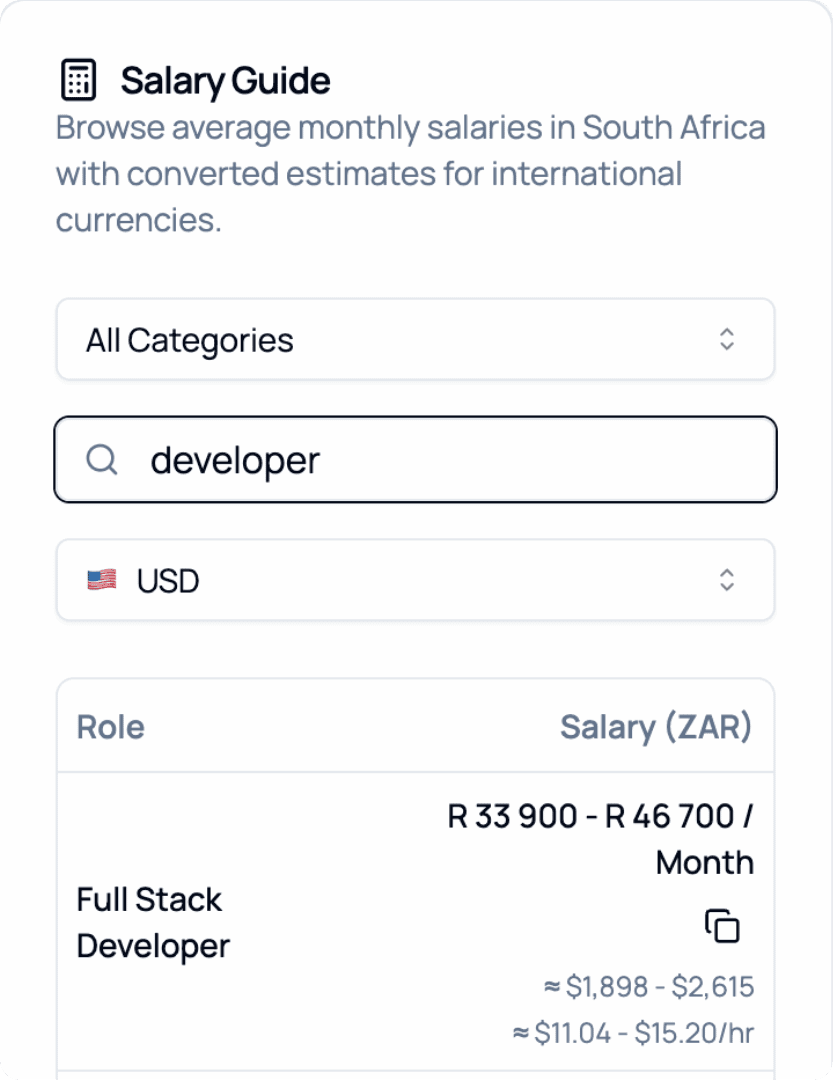
2026 Salary Guide: South Africa
Discover South African Salaries by Role. Compare costs and see how much you can save.