TL;DR
Learn how education businesses can delegate operations without losing student experience quality or compliance discipline.
Use a practical framework for admissions follow-up, scheduling, records support, and communication handoffs.
Apply KPI and ROI methods to scale enrollment support with fewer operational bottlenecks.
Table of Contents
- Introduction
- What does an education-focused virtual assistant do?
- Which tasks should you delegate first in education operations?
- How much does it cost and what ROI should an education team expect?
- How do you keep quality and compliance while delegating?
- How do you scale from one VA to a durable education operations system?
- Final Thoughts
- Education Operations Blueprint: Inquiry → Enrollment → Onboarding
Introduction
Education businesses do not usually fail from lack of demand; they fail from inconsistent operations during growth. Inquiries pile up, follow-up is late, application status is unclear, and staff time gets consumed by repetitive admin work. A clear operations support role fixes this.
This guide shows how to use virtual assistant support to improve admissions flow, communication reliability, scheduling execution, and CRM discipline while protecting quality and compliance expectations.
Internal implementation references:
- Education industry page
- How to Hire a Virtual Assistant for Small Business in 2026
- Virtual Assistant Onboarding Checklist for 2026
- Virtual Assistant Cost Calculator Guide for SMB Teams
- How to Hire Remote Talent Without Recruiting Fees
- What Is an Onshore and Offshore Team?
What does an education-focused virtual assistant do?
Snippet answer: An education-focused VA owns repeatable operations such as inquiry triage, admissions coordination, scheduling, parent/student communications, records support, and CRM hygiene so academic teams can focus on delivery and outcomes.
Education businesses grow when operations are documented, measured, and consistently executed. A virtual assistant helps stabilize execution around enrollment, communication, scheduling, and records workflows. The key is role clarity: delegate process work, keep judgment calls with internal leaders, and enforce QA checkpoints before stage transitions.
Practical implementation details
Education operators should define service-level targets for every core workflow. For example, inquiry response within two business hours, application-status updates every 48 hours, and reminder flows triggered automatically 72/48/24 hours before key milestones. These standards create operational predictability and reduce avoidable drop-off.
Create a single source of truth for pipeline and communication status. Whether you use HubSpot, Pipedrive, Airtable, or another CRM, every student inquiry should have one owner, one current stage, next action date, and risk flag. When ownership is ambiguous, follow-up delays become normal and conversion quality drops.
Use a weekly review that includes: stage aging, stuck applications, no-response cohorts, parent/student support backlog, and SLA misses by category. This makes operational issues visible before they become revenue or experience problems.
For security and privacy, apply least-privilege access controls and role-specific permissions for tools and student data. Use checklists for handoffs, documentation quality, and communication approvals. External references worth aligning with include NIST small business cybersecurity guidance, FTC data security guidance, and SBA operations resources.
KPI scorecard example for education teams
Track weekly and monthly:
- inquiry response median time
- inquiry-to-application conversion
- application-to-enrollment conversion
- no-response and stall-rate by stage
- scheduling completion rate
- parent/student ticket resolution time
- admin backlog and overdue count
- operator hours recovered from repetitive admin
Use these metrics for decisions, not vanity reporting. If conversion falls while response time remains strong, the issue may be messaging quality or stage criteria. If backlog grows while conversion is stable, capacity design likely needs lane specialization.
Which tasks should you delegate first in education operations?
Snippet answer: Start with repetitive and delay-sensitive tasks: inbox triage, inquiry response, calendar coordination, application-status updates, reminder workflows, and documentation prep with clear QA checkpoints.
Education businesses grow when operations are documented, measured, and consistently executed. A virtual assistant helps stabilize execution around enrollment, communication, scheduling, and records workflows. The key is role clarity: delegate process work, keep judgment calls with internal leaders, and enforce QA checkpoints before stage transitions.
Practical implementation details
Education operators should define service-level targets for every core workflow. For example, inquiry response within two business hours, application-status updates every 48 hours, and reminder flows triggered automatically 72/48/24 hours before key milestones. These standards create operational predictability and reduce avoidable drop-off.
Create a single source of truth for pipeline and communication status. Whether you use HubSpot, Pipedrive, Airtable, or another CRM, every student inquiry should have one owner, one current stage, next action date, and risk flag. When ownership is ambiguous, follow-up delays become normal and conversion quality drops.
Use a weekly review that includes: stage aging, stuck applications, no-response cohorts, parent/student support backlog, and SLA misses by category. This makes operational issues visible before they become revenue or experience problems.
For security and privacy, apply least-privilege access controls and role-specific permissions for tools and student data. Use checklists for handoffs, documentation quality, and communication approvals. External references worth aligning with include NIST small business cybersecurity guidance, FTC data security guidance, and SBA operations resources.
KPI scorecard example for education teams
Track weekly and monthly:
- inquiry response median time
- inquiry-to-application conversion
- application-to-enrollment conversion
- no-response and stall-rate by stage
- scheduling completion rate
- parent/student ticket resolution time
- admin backlog and overdue count
- operator hours recovered from repetitive admin
Use these metrics for decisions, not vanity reporting. If conversion falls while response time remains strong, the issue may be messaging quality or stage criteria. If backlog grows while conversion is stable, capacity design likely needs lane specialization.
How much does it cost and what ROI should an education team expect?
Snippet answer: ROI comes from faster inquiry response, improved conversion from application to enrollment, lower admin overload, and more consistent student/parent experience—not just hourly labor savings.
Education businesses grow when operations are documented, measured, and consistently executed. A virtual assistant helps stabilize execution around enrollment, communication, scheduling, and records workflows. The key is role clarity: delegate process work, keep judgment calls with internal leaders, and enforce QA checkpoints before stage transitions.
Practical implementation details
Education operators should define service-level targets for every core workflow. For example, inquiry response within two business hours, application-status updates every 48 hours, and reminder flows triggered automatically 72/48/24 hours before key milestones. These standards create operational predictability and reduce avoidable drop-off.
Create a single source of truth for pipeline and communication status. Whether you use HubSpot, Pipedrive, Airtable, or another CRM, every student inquiry should have one owner, one current stage, next action date, and risk flag. When ownership is ambiguous, follow-up delays become normal and conversion quality drops.
Use a weekly review that includes: stage aging, stuck applications, no-response cohorts, parent/student support backlog, and SLA misses by category. This makes operational issues visible before they become revenue or experience problems.
For security and privacy, apply least-privilege access controls and role-specific permissions for tools and student data. Use checklists for handoffs, documentation quality, and communication approvals. External references worth aligning with include NIST small business cybersecurity guidance, FTC data security guidance, and SBA operations resources.
KPI scorecard example for education teams
Track weekly and monthly:
- inquiry response median time
- inquiry-to-application conversion
- application-to-enrollment conversion
- no-response and stall-rate by stage
- scheduling completion rate
- parent/student ticket resolution time
- admin backlog and overdue count
- operator hours recovered from repetitive admin
Use these metrics for decisions, not vanity reporting. If conversion falls while response time remains strong, the issue may be messaging quality or stage criteria. If backlog grows while conversion is stable, capacity design likely needs lane specialization.
How do you keep quality and compliance while delegating?
Snippet answer: Protect quality by using SOPs, approval gates, communication templates, and escalation rules. Keep authority decisions in-house while delegating process execution.
Education businesses grow when operations are documented, measured, and consistently executed. A virtual assistant helps stabilize execution around enrollment, communication, scheduling, and records workflows. The key is role clarity: delegate process work, keep judgment calls with internal leaders, and enforce QA checkpoints before stage transitions.
Practical implementation details
Education operators should define service-level targets for every core workflow. For example, inquiry response within two business hours, application-status updates every 48 hours, and reminder flows triggered automatically 72/48/24 hours before key milestones. These standards create operational predictability and reduce avoidable drop-off.
Create a single source of truth for pipeline and communication status. Whether you use HubSpot, Pipedrive, Airtable, or another CRM, every student inquiry should have one owner, one current stage, next action date, and risk flag. When ownership is ambiguous, follow-up delays become normal and conversion quality drops.
Use a weekly review that includes: stage aging, stuck applications, no-response cohorts, parent/student support backlog, and SLA misses by category. This makes operational issues visible before they become revenue or experience problems.
For security and privacy, apply least-privilege access controls and role-specific permissions for tools and student data. Use checklists for handoffs, documentation quality, and communication approvals. External references worth aligning with include NIST small business cybersecurity guidance, FTC data security guidance, and SBA operations resources.
KPI scorecard example for education teams
Track weekly and monthly:
- inquiry response median time
- inquiry-to-application conversion
- application-to-enrollment conversion
- no-response and stall-rate by stage
- scheduling completion rate
- parent/student ticket resolution time
- admin backlog and overdue count
- operator hours recovered from repetitive admin
Use these metrics for decisions, not vanity reporting. If conversion falls while response time remains strong, the issue may be messaging quality or stage criteria. If backlog grows while conversion is stable, capacity design likely needs lane specialization.
How do you scale from one VA to a durable education operations system?
Snippet answer: Scale by splitting lanes (enrollment, scheduling, communications, records), assigning backups, and running KPI-led weekly governance reviews to prevent process drift.
Education businesses grow when operations are documented, measured, and consistently executed. A virtual assistant helps stabilize execution around enrollment, communication, scheduling, and records workflows. The key is role clarity: delegate process work, keep judgment calls with internal leaders, and enforce QA checkpoints before stage transitions.
Practical implementation details
Education operators should define service-level targets for every core workflow. For example, inquiry response within two business hours, application-status updates every 48 hours, and reminder flows triggered automatically 72/48/24 hours before key milestones. These standards create operational predictability and reduce avoidable drop-off.
Create a single source of truth for pipeline and communication status. Whether you use HubSpot, Pipedrive, Airtable, or another CRM, every student inquiry should have one owner, one current stage, next action date, and risk flag. When ownership is ambiguous, follow-up delays become normal and conversion quality drops.
Use a weekly review that includes: stage aging, stuck applications, no-response cohorts, parent/student support backlog, and SLA misses by category. This makes operational issues visible before they become revenue or experience problems.
For security and privacy, apply least-privilege access controls and role-specific permissions for tools and student data. Use checklists for handoffs, documentation quality, and communication approvals. External references worth aligning with include NIST small business cybersecurity guidance, FTC data security guidance, and SBA operations resources.
KPI scorecard example for education teams
Track weekly and monthly:
- inquiry response median time
- inquiry-to-application conversion
- application-to-enrollment conversion
- no-response and stall-rate by stage
- scheduling completion rate
- parent/student ticket resolution time
- admin backlog and overdue count
- operator hours recovered from repetitive admin
Use these metrics for decisions, not vanity reporting. If conversion falls while response time remains strong, the issue may be messaging quality or stage criteria. If backlog grows while conversion is stable, capacity design likely needs lane specialization.
Final Thoughts
If you want better enrollment reliability and smoother student/parent experience, treat delegation as a systems design project, not a task dump. Build clear SOPs, define service levels, track operational KPI, and review exceptions weekly. Then scale lanes only after baseline quality is stable.
For implementation context, align this with the Education industry page and continue building with documented workflows, ownership clarity, and measurable outcomes.
Education Operations Blueprint: Inquiry → Enrollment → Onboarding
Education businesses need one operating spine that connects inquiry handling, admissions decisions, and onboarding readiness. When these stages are disconnected, teams feel busy but conversion and experience quality stay inconsistent.
Stage map and ownership model
Use this baseline flow:
- Inquiry intake (owner: support VA)
- capture source, intent, program interest, urgency
- confirm first-response SLA and assign next action
- Qualification and follow-up (owner: admissions support VA)
- run structured follow-up cadence
- collect required documents and pre-screen data
- Admissions decision handoff (owner: internal admissions lead)
- decision authority remains in-house
- VA prepares complete review packet
- Enrollment confirmation (owner: support VA + admissions lead)
- send acceptance next steps and timeline milestones
- Onboarding readiness (owner: onboarding VA)
- orientation logistics, schedule confirmations, resource checklist
The rule is simple: delegate workflow execution, keep decision authority with internal leaders.
Service-level targets to prevent pipeline leakage
A practical SLA set for education operations:
- first inquiry response: within 2 business hours
- unresolved inquiries: follow-up every 24–48 hours by stage
- application status updates: at least every 3 business days
- onboarding reminder cadence: 7 days, 3 days, and 24 hours before start
Use one escalation trigger: any record with no owner or no next-action date is auto-flagged for same-day correction.
Required artifacts for every stage
Each stage should produce one required artifact:
- inquiry stage: intake summary + source attribution
- qualification stage: follow-up log + current objections
- admissions review stage: document checklist + readiness score
- enrollment stage: acceptance and payment status confirmation
- onboarding stage: orientation packet + attendance readiness confirmation
Without stage artifacts, handoffs become opinion-based and quality drops under volume.
Weekly governance review (30 minutes)
Run a fixed weekly review with these agenda items:
- stage aging report (where applications are stalling)
- SLA misses by category
- no-response cohort analysis
- top 3 communication failure patterns
- process patches to ship this week
This review should end with owner-assigned fixes and deadlines. No open-ended “we should improve this” discussions.
Common failure modes in education ops
- Fast first response but weak follow-up discipline
- fix: stage-based sequence templates and stop rules
- Applications submitted but not decision-ready
- fix: mandatory completeness checklist before review
- Onboarding confusion after acceptance
- fix: single onboarding timeline with owner and timestamped confirmations
- Parent/student communication drift
- fix: communication templates by scenario + approval rules for exceptions
KPI dashboard for leadership
Track a focused scorecard:
- inquiry response median time
- inquiry-to-application conversion
- application-to-enrollment conversion
- average stage age by pipeline step
- onboarding completion before start date
- unresolved communication ticket age
Use these KPI to trigger interventions. If response time is healthy but conversion drops, investigate qualification quality and messaging, not staffing volume.
First 14-day implementation sprint for this post’s model
Days 1–3
- map current pipeline stages and owners
- define SLA targets
- publish intake and follow-up templates
Days 4–7
- enforce required fields in CRM for every stage
- launch status update cadence and escalation rules
- start daily queue hygiene checks
Days 8–10
- run first aging report and identify top leakage points
- patch stage definitions and checklist gaps
Days 11–14
- publish weekly KPI dashboard
- run first governance meeting
- lock next 30-day optimization backlog
This gives education operators immediate control without overengineering early.
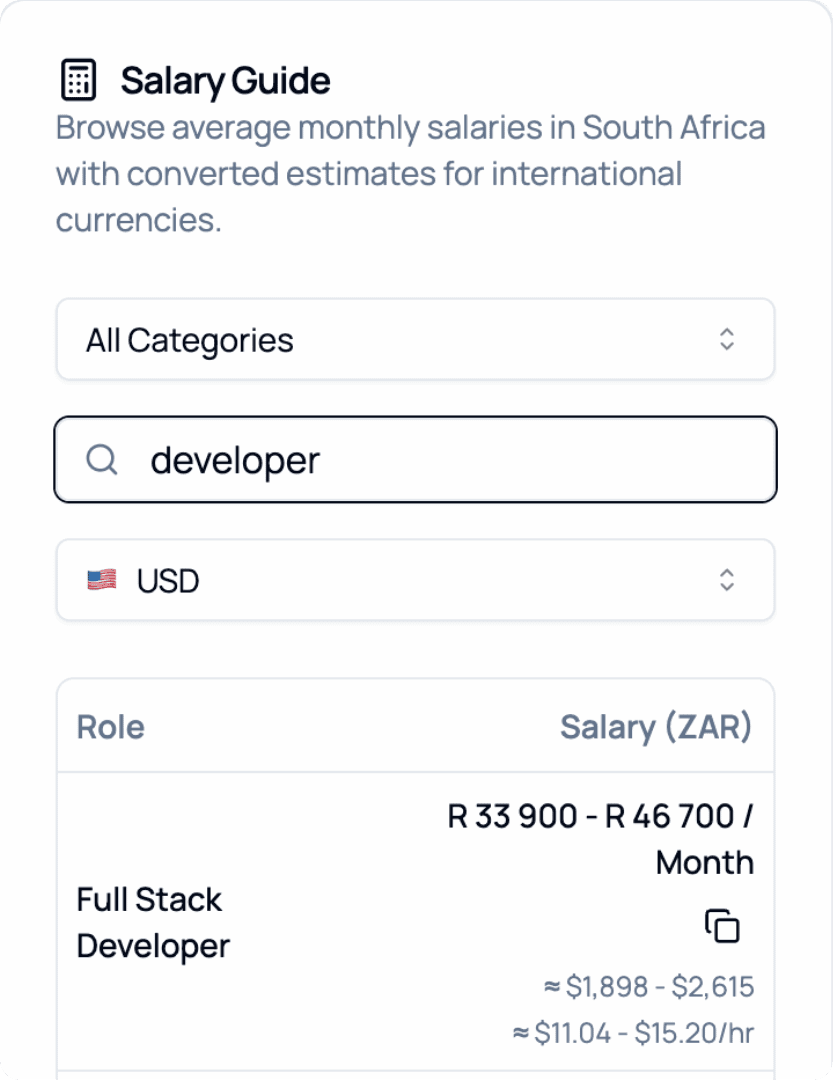
2026 Salary Guide: South Africa
Discover South African Salaries by Role. Compare costs and see how much you can save.