TL;DR
Learn how creative founders can delegate back-office admin operations without losing control over quality, cash timing, or client communication.
Use a practical system for inbox and calendar governance, invoicing cadence, vendor/admin controls, and exception handling.
Apply KPI and ROI frameworks that recover founder focus, improve operational reliability, and support profitable creative growth.
Table of Contents
- Introduction
- What back-office tasks should creative founders delegate to a VA?
- Which admin workflows should you delegate first for immediate ROI?
- How much does creative admin VA support cost and what ROI should you expect?
- How do you prevent admin errors that hurt cash flow and client trust?
- How do you scale creative back-office support as your business grows?
- Final Thoughts
Introduction
If you are planning support capacity in this vertical, start with the creatives industry page to align back-office delegation with your broader growth model.
Creative founders often believe their main bottleneck is production. In reality, growth usually breaks at the back office first: inbox chaos, calendar overload, delayed follow-ups, inconsistent invoicing, unresolved admin exceptions, and weak reporting rhythms. These are not dramatic failures, but they quietly tax margin and focus every week.
A virtual assistant can solve this when the role is structured around back-office system ownership. The objective is not to “offload random admin.” It is to create predictable workflows around communication, scheduling, billing support, documentation control, and operating cadence.
This guide shows how to do that practically. You will get role boundaries, delegation sequencing, risk controls, KPI and ROI models, and scale patterns for creative businesses moving from founder-led operations to system-led execution.
For adjacent context, pair this with Virtual Assistant for Creative Entrepreneurs Guide (2026), Creative Entrepreneur Client Onboarding and Intake Playbook (2026), Creative Revision Workflow and Client Feedback Playbook (2026), How Creative Entrepreneurs Scale Content Production with a Virtual Assistant (2026), Virtual Assistant Cost Calculator Guide for SMB Teams, and Virtual Assistant Onboarding Checklist for 2026.
For external references, use practical guidance from SBA small business resources, IRS recordkeeping guidance, AICPA business resources, NIST small business cybersecurity guidance, and PMI project operations guidance.
What back-office tasks should creative founders delegate to a VA?
Snippet answer: Delegate repeatable back-office workflows such as inbox triage, calendar coordination, meeting prep, invoice support, follow-up cadence, documentation hygiene, and reporting prep while founders retain strategic and commercial decision authority.
Creative businesses usually need a reliable operations spine before they need additional specialized headcount.
Core delegable tasks include:
- Inbox triage and priority routing by rule set.
- Calendar governance and scheduling coordination.
- Follow-up workflows for open decisions and commitments.
- Invoice packet prep and payment reminder cadence.
- Vendor/admin document maintenance.
- Operations dashboard prep and meeting recap synthesis.
- Exception queue maintenance and escalation routing.
Role boundaries that protect decision quality
Back-office delegation should increase clarity, not blur ownership.
Boundaries:
- No autonomous pricing or contract decisions.
- No final client dispute resolution decisions.
- No strategic scope commitment changes.
- No process policy changes outside agreed governance loop.
The VA owns system execution; founder/lead owns strategic and commercial calls.
Where founders usually see immediate gains
Most teams see early value in:
- Faster communication response reliability.
- Lower scheduling and coordination friction.
- Better invoicing rhythm and follow-up consistency.
These gains translate directly to recovered founder focus.
Which admin workflows should you delegate first for immediate ROI?
Snippet answer: Delegate high-frequency, checklist-driven workflows first: inbox and calendar rules, follow-up queues, invoice support cadence, vendor-file tracking, and weekly reporting prep.
First-wave delegation should reduce repetitive friction without creating authority risk.
First-wave back-office delegation stack
Lane 1: Inbox operations and priority routing
- Categorize inbound items by urgency and owner.
- Apply response-time rules by category.
- Route unresolved items into tracked queue.
Lane 2: Calendar governance
- Manage scheduling windows and conflict checks.
- Prepare meeting context notes.
- Confirm attendance and agenda handoffs.
Lane 3: Follow-up and accountability queue
- Track open commitments and due dates.
- Trigger reminders by SLA tier.
- Escalate overdue decision items.
Lane 4: Invoice and collections support cadence
- Prepare invoice support packets.
- Run reminder cadence for pending payments.
- Log payment status and exceptions.
Lane 5: Vendor/admin documentation controls
- Maintain required file completeness.
- Track expirations and missing docs.
- Route compliance/admin issues to owner.
Delegation filter
Before assigning a task, confirm:
- Is it recurring?
- Is output objectively verifiable?
- Is delay costly?
- Is escalation path explicit?
If yes, include it in phase 1.
What to keep founder-side in phase 1
- Strategic pricing and offer decisions.
- Contract and legal judgment calls.
- High-risk relationship or dispute handling.
- Final decision on non-standard exceptions.
This preserves decision leverage while reducing operational drag.
How much does creative admin VA support cost and what ROI should you expect?
Snippet answer: Strong ROI comes from reclaimed founder time, cleaner billing cadence, fewer admin errors, and better operating reliability—not just lower labor cost.
Back-office inefficiency is expensive because it drains high-value attention and creates compounding process friction.
Cost model components
Direct costs
- Monthly VA fee/compensation.
- Tool seats and integrations.
- Onboarding and SOP setup time.
- Weekly QA/review overhead.
Indirect costs
- Rework from missed follow-ups or poor documentation.
- Delayed cash collection from weak invoice cadence.
- Founder context-switch costs.
- Client-trust impact from inconsistent communication.
Practical ROI framework
Use:
ROI = recovered founder/lead hours + cash-timing improvements + error reduction value - total support cost
Illustrative baseline:
- Founder/lead spends 32 hrs/month on repetitive admin ops.
- Delegation-safe share = 60% (19.2 hrs).
- Blended value = $170/hr.
- Recovered value = $3,264/month.
Likely additional value:
- fewer overdue operational commitments,
- cleaner collections rhythm,
- lower stress in high-volume weeks.
KPI baseline for first 90 days
Track weekly:
- inbox response-time SLA adherence,
- calendar conflict/meeting prep error rate,
- follow-up queue backlog age,
- invoice reminder completion rate,
- payment lag trend,
- founder admin time recovered.
These KPIs indicate whether the operating lane is stabilizing.
How do you prevent admin errors that hurt cash flow and client trust?
Snippet answer: Prevent admin errors with strict checklist controls, one source of truth for status, SLA-based escalations, approval evidence requirements, and recurring exception reviews.
Most admin errors are process errors. They are preventable with governance.
Control stack for back-office reliability
- Input control
- required fields and artifact checks before task acceptance.
- Workflow control
- one queue system with owner, due date, status, and next action.
- SLA control
- deadlines by priority tier with escalation triggers.
- Approval control
- no critical closure without owner evidence.
- Exception control
- every exception tagged, owned, and resolved with trace.
Exception taxonomy model
Tag recurring issues as:
- missing input,
- owner approval delay,
- client no-response,
- payment exception,
- document/compliance gap,
- scheduling conflict.
Monthly trend review of these categories helps eliminate root causes.
Cash-flow protection protocol
Use a simple collections protocol:
- invoice readiness checklist,
- send timeline rules,
- reminder cadence schedule,
- escalation path for aging items,
- status logging and owner visibility.
This improves cash predictability without aggressive communication.
Trust-protection communication standards
For each client-facing update, include:
- what changed,
- what is next,
- who owns next step,
- when next update is expected.
Consistency in this structure improves confidence and reduces confusion.
Weekly quality review model
Run a fixed 30-minute review:
- KPI pulse,
- oldest unresolved queue items,
- recurring exception categories,
- SLA misses and causes,
- SOP patch actions.
Without cadence, small issues become recurring operating debt.
How do you scale creative back-office support as your business grows?
Snippet answer: Scale by splitting lanes, assigning backup ownership, enforcing queue-health dashboards, and making capacity decisions from KPI trends rather than reactive urgency.
A single VA can stabilize. Sustainable scale requires architecture.
Scale phases
Phase 1: stabilization (0-60 days)
- one VA owns core back-office lane,
- SOP baseline and KPI baseline live,
- escalation matrix active.
Phase 2: lane specialization (60-120 days)
- split communication/scheduling lane from billing/admin lane,
- assign backups for critical tasks,
- deploy exception dashboard by category.
Phase 3: governance (120+ days)
- add ops lead oversight,
- monthly process redesign loop,
- capacity balancing by client segment and service mix.
Scale signals to monitor
- rising backlog age,
- repeated SLA misses,
- founder still handling routine admin traffic,
- increased payment or communication exceptions.
These indicate process capacity constraints.
30-60-90 rollout playbook
Days 1-30
- define role boundaries,
- publish inbox/calendar/invoice SOPs,
- launch one queue board and exception tags,
- baseline KPI capture.
Days 31-60
- enforce SLA timers,
- weekly trend review cadence,
- patch top recurring failure modes,
- refine escalation matrix.
Days 61-90
- add backup ownership,
- split overloaded lanes,
- tune KPI thresholds,
- decide next capacity investment.
Internal links for implementation
- Virtual Assistant for Creative Entrepreneurs Guide (2026)
- Creative Entrepreneur Client Onboarding and Intake Playbook (2026)
- Creative Revision Workflow and Client Feedback Playbook (2026)
- How Creative Entrepreneurs Scale Content Production with a Virtual Assistant (2026)
- Virtual Assistant Cost Calculator Guide for SMB Teams
- Virtual Assistant Onboarding Checklist for 2026
Monthly scorecard template
Use weighted dimensions:
- Timeliness (25%)
- SLA adherence
- backlog age trend
- Quality (25%)
- admin error trend
- documentation completeness
- Control (25%)
- escalation compliance
- approval-trace completeness
- Commercial impact (25%)
- payment lag trend
- founder focus-time recovery
Use scorecard data to prioritize systems improvement.
SOP blueprint for back-office lane
For each SOP include:
- Trigger
- Owner + backup
- Inputs required
- Output required
- SLA target
- Escalation trigger
- QA checkpoint
- Artifact location
This blueprint makes delegation scalable and reliable.
14-day stabilization checklist
- role boundary memo published,
- inbox/calendar/invoice SOPs active,
- queue board + exception taxonomy launched,
- day-7 KPI review completed,
- top recurring blockers patched by day 14.
This checklist creates rapid reliability gains.
Risk controls for operational and commercial integrity
- no critical item closure without approval trace,
- no unresolved critical exception beyond SLA,
- no invoice readiness without required checks,
- no client-impacting update without owner attribution.
Simple controls, strong protection.
Leadership dashboard metrics
Monthly dashboard should show:
- active back-office load by category,
- overdue critical items,
- payment lag trend,
- communication exception trend,
- founder coordination load trend.
This keeps intervention focused and timely.
Governance ownership principle
Assign one owner for back-office SOP governance and KPI integrity. Without explicit ownership, process drift returns quickly during growth.
Inbox operating system design
Inbox chaos is a major founder drain. A structured inbox operating system should define:
- triage categories,
- response SLA by category,
- owner routing logic,
- escalation triggers,
- closure criteria.
A VA can run this system daily and convert scattered communication into controlled workflow.
Calendar architecture for creative founders
Calendar issues are rarely about scheduling tools; they are about priority governance. Use:
- protected deep-work blocks,
- meeting type templates,
- pre-meeting prep requirements,
- post-meeting action capture standards,
- weekly capacity review.
This helps protect strategic and creative focus while maintaining responsiveness.
Invoice and collections cadence framework
For stable cash flow, run a fixed cadence:
- invoice readiness precheck,
- send-window discipline,
- reminder sequence with tone standards,
- aging escalation policy,
- dispute resolution queue.
This cadence improves payment predictability without creating client friction.
Vendor/admin record hygiene standards
A reliable vendor/admin lane should maintain:
- required document checklist,
- expiry tracking,
- owner assignment,
- source-of-truth archive location,
- exception notes for incomplete records.
This reduces operational surprises and protects continuity.
Queue health dashboard design
A useful dashboard includes:
- active items by category,
- overdue critical items,
- queue age distribution,
- exception volume by type,
- owner load distribution.
Reviewing this weekly helps prevent hidden backlog accumulation.
Back-office exception taxonomy
Tag exceptions consistently:
- missing input,
- delayed approval,
- no-response,
- payment discrepancy,
- documentation gap,
- scheduling conflict.
A stable taxonomy makes process improvement data-driven.
SLA strategy by workflow class
Not all tasks need the same SLA. Define class-based targets:
- communication-critical items,
- scheduling-critical items,
- billing-critical items,
- low-risk administrative items.
Class-based SLAs improve both speed and realism.
Approval matrix for admin decisions
Use a clear matrix:
- founder-only decisions,
- founder + finance review,
- VA-executable within policy,
- escalation-required exceptions.
A matrix prevents decision ambiguity and protects governance.
Weekly operations war-room template
Use a fixed 25-minute agenda:
- KPI pulse,
- oldest unresolved items,
- exception root causes,
- immediate patch actions,
- ownership confirmations.
Short, structured reviews maintain operational momentum.
60-day reliability milestones
By day 60, healthy back-office operations should show:
- faster response consistency,
- lower queue age,
- fewer billing exceptions,
- cleaner documentation completeness,
- measurable founder time recovery.
If these are not improving, redesign before scaling headcount.
Capacity planning for growth windows
When volume spikes, apply tiered prioritization:
- Tier A: client-impacting/financially critical,
- Tier B: standard operational tasks,
- Tier C: deferrable low-impact admin tasks.
This protects high-impact work from being crowded out.
Candidate rubric for back-office VA role
Prioritize candidates with:
- process discipline,
- written clarity,
- escalation judgment,
- detail precision,
- calmness under volume pressure.
These traits outperform generic “assistant experience” in growth-stage operations.
Leadership monthly decision memo
Use one page for:
- KPI trend summary,
- recurring failure patterns,
- fixes shipped,
- unresolved risks,
- next-month investment decision.
Decision-oriented reporting improves execution quality faster.
Process hardening sprint
Run periodic hardening sprints:
- identify top recurring failures,
- update SOPs/templates,
- retrain on escalation rules,
- benchmark KPI movement,
- lock updated standards.
This keeps systems resilient as complexity increases.
Operational resilience controls for high-demand weeks
In high-demand weeks, operational noise can increase quickly. Add resilience controls:
- daily queue health review,
- stricter critical-item SLA monitoring,
- temporary WIP caps by owner,
- protected founder decision blocks,
- explicit non-critical deferral rules.
These controls reduce chaos without compromising important commitments.
Client-facing communication quality protocol
Back-office quality directly affects client trust. A communication protocol should ensure each update includes:
- current status,
- what changed,
- next action owner,
- expected timing,
- escalation path if blocked.
A VA can standardize this structure across accounts.
Financial hygiene checklist
Before closing any billing cycle segment, verify:
- invoice state and status are current,
- reminder cadence executed,
- exceptions documented,
- owner decisions captured,
- next review date assigned.
This checklist improves cash rhythm and reduces avoidable misses.
Delegation maturity stages
Use maturity stages to decide next changes:
- Stage 1: founder-led with basic VA support,
- Stage 2: VA-led execution with founder oversight,
- Stage 3: system-led operations with dashboard-driven governance.
Moving intentionally through stages helps prevent premature complexity.
Cross-functional handoff contract
When back-office work touches delivery workflows, enforce a handoff contract:
- required context,
- required artifacts,
- owner assignment,
- due-date SLA,
- acceptance criteria.
This prevents misalignment between admin and delivery teams.
Forecasting and planning layer
A stable back-office system should support short-term forecasting:
- expected approvals and billing events,
- projected exception load,
- owner capacity pressure,
- risk windows for delayed decisions.
Forecasting converts admin operations into a strategic planning asset.
Audit-readiness baseline
Keep documentation audit-ready by default:
- clear archive structure,
- decision trail integrity,
- timestamp consistency,
- retrievable evidence for critical actions.
Audit readiness also improves internal confidence and operational speed.
Final Thoughts
Creative founder operations become scalable when back-office execution is system-led instead of founder-memory-led. A virtual assistant can anchor that shift by owning repeatable admin workflows with clear controls and escalation discipline.
Use the creatives industry page to align this back-office lane with your wider growth architecture, then scale through SOP clarity, queue visibility, and measurable operating cadence.
When this lane is stable, you protect trust, improve cash rhythm, and free founders to lead strategy and creative direction with less daily operational noise.
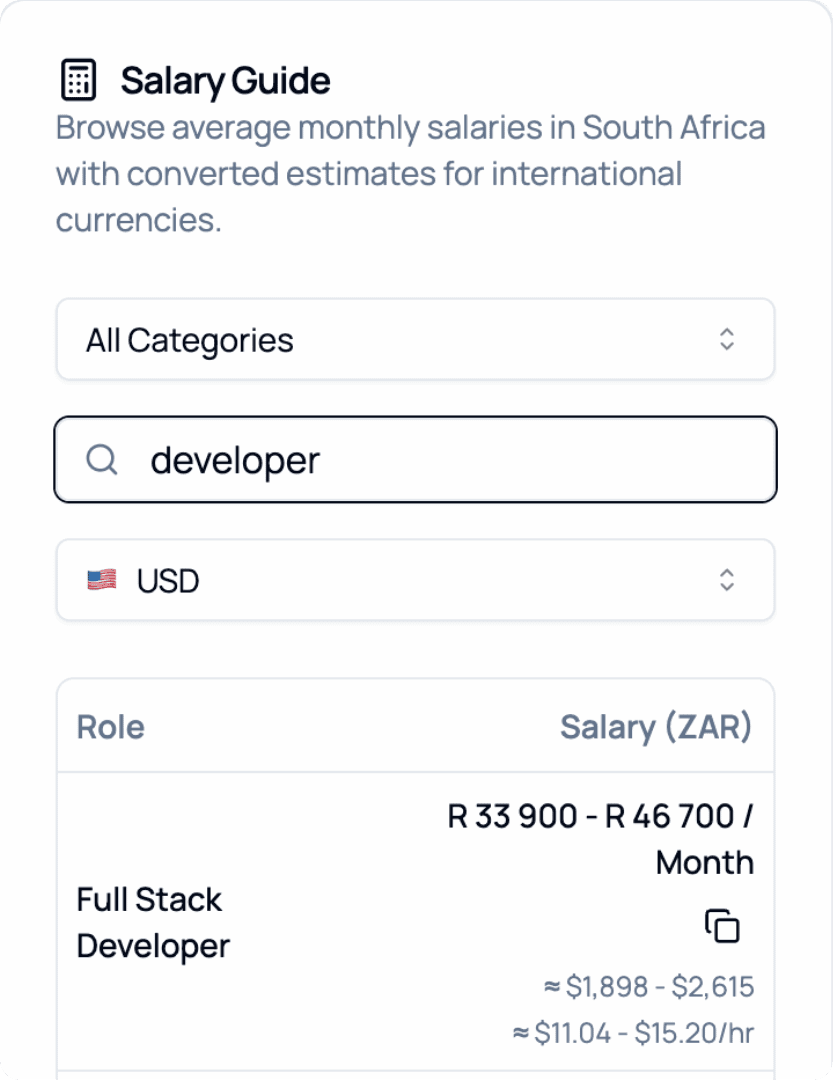
2026 Salary Guide: South Africa
Discover South African Salaries by Role. Compare costs and see how much you can save.