TL;DR
Learn how to delegate creative client onboarding and intake workflows without losing quality, scope clarity, or timeline control.
Use a practical process for discovery scheduling, project intake, kickoff readiness, communication setup, and first-week delivery governance.
Apply KPI and ROI frameworks that improve onboarding consistency, reduce revision friction, and scale client operations safely.
Table of Contents
- Introduction
- What onboarding tasks can a VA handle for creative entrepreneurs?
- Which intake and kickoff workflows should be delegated first?
- How much does onboarding-focused VA support cost and what ROI should you expect?
- How do you prevent onboarding gaps that cause revision and timeline issues later?
- How do you scale onboarding operations as client volume increases?
- Final Thoughts
Introduction
If you are building support systems in this vertical, begin with the creatives industry page to align onboarding workflows with your broader operating model.
For creative founders, the first two weeks of a client relationship often determine whether the project will run smoothly or become revision-heavy and stressful. Most delivery issues are seeded early: unclear scope boundaries, weak intake data, scattered communication channels, and onboarding steps that exist in someone’s memory instead of in a governed workflow.
That is why onboarding and intake are among the highest-leverage lanes to delegate to a virtual assistant. Not because the work is “easy,” but because consistency matters. A creative operations assistant can enforce checklist discipline, cadence control, and handoff quality so your team starts projects with clarity instead of ambiguity.
This playbook shows exactly how to do that. You will get role boundaries, delegation priorities, risk controls, KPI and ROI frameworks, and a practical scale path as client volume increases.
For supporting context, pair this with Virtual Assistant for Creative Entrepreneurs Guide (2026), How to Hire a Virtual Assistant for Small Business in 2026, Virtual Assistant Onboarding Checklist for 2026, Virtual Assistant Cost Calculator Guide for SMB Teams, How to Hire Remote Talent Without Recruiting Fees, and What Is an Onshore and Offshore Team?.
For external references, use practical guidance from SBA small business resources, PMI project management guidance, NIST small business cybersecurity guidance, IRS recordkeeping guidance, and AICPA resources.
What onboarding tasks can a VA handle for creative entrepreneurs?
Snippet answer: A VA can own repeatable onboarding workflows such as discovery scheduling, intake form processing, kickoff checklist control, communication setup, timeline board initialization, and documentation hygiene while founders retain final scope and creative authority.
Onboarding fails when critical steps are inconsistent. A VA role works best when these steps are codified and measured.
Common onboarding responsibilities for a creative ops VA:
- Discovery and kickoff scheduling management.
- Intake questionnaire distribution, collection, and validation.
- Project board creation with stage templates and owners.
- Shared folder architecture and file naming enforcement.
- Communication channel setup and protocol recap.
- Scope summary draft and approval routing support.
- First-week milestone tracking and status recap preparation.
Role boundaries that preserve quality and authority
To avoid role confusion, define boundaries explicitly:
- No final creative or strategic recommendation decisions.
- No unilateral scope/pricing changes.
- No unapproved timeline commitments to clients.
- No policy/process changes outside agreed SOP update path.
A VA should run the system; founders should steer creative and commercial decisions.
Immediate impact areas
Early improvements usually appear in:
- Faster onboarding cycle completion.
- Higher scope clarity before production starts.
- Fewer first-week communication breakdowns.
These gains reduce downstream revision pressure.
Which intake and kickoff workflows should be delegated first?
Snippet answer: Delegate high-frequency, checklist-driven onboarding tasks first: scheduling, intake completeness checks, kickoff packet prep, project-board setup, communication protocol onboarding, and first-week follow-up cadence.
You want the first delegation wave to reduce ambiguity and protect production readiness.
First-wave onboarding stack
Lane 1: Scheduling and confirmation control
- Discovery and kickoff call scheduling.
- Confirmation reminders and reschedule handling.
- Meeting context packet prep.
Lane 2: Intake quality control
- Collect intake forms and required assets.
- Validate required fields and flag missing items.
- Route clarification requests before kickoff.
Lane 3: Kickoff packet readiness
- Prepare summary sheet (goals, scope assumptions, constraints).
- Confirm communication channels and owners.
- Verify access setup and reference materials.
Lane 4: Board and workspace setup
- Create project board from template.
- Assign stage owners and due-date defaults.
- Link deliverable and feedback checkpoints.
Lane 5: First-week cadence execution
- Run status check schedule.
- Track open actions and dependencies.
- Escalate blockers to owner by SLA.
Delegation filter
Before delegating, confirm:
- Is this task repeated across clients?
- Can success be objectively checked?
- Does delay create downstream rework?
- Is escalation path clear?
If yes, delegate in the first wave.
What to keep founder-side initially
- Offer positioning and strategic scope decisions.
- Final budget and timeline commitments.
- Sensitive client relationship or conflict conversations.
- High-stakes quality tradeoff decisions.
This protects creative leadership while reducing admin overload.
How much does onboarding-focused VA support cost and what ROI should you expect?
Snippet answer: ROI usually comes from faster onboarding throughput, lower revision-causing ambiguity, better first-week execution, and recovered founder hours—not labor rate arbitrage alone.
When onboarding is inconsistent, cost shows up as invisible rework and relationship strain.
Cost components to model
Direct costs
- Monthly VA fee/compensation.
- Tool seats (PM board, docs, comms).
- Onboarding and SOP training investment.
- QA and weekly review time.
Indirect costs
- Scope confusion-driven rework.
- Delayed starts and missed milestone windows.
- Founder context switching and admin drag.
- Billing delays tied to weak kickoff discipline.
Practical ROI framework
Use:
ROI = recovered founder/lead time + reduced rework value + faster onboarding cycle value - total support cost
Illustrative baseline:
- Founder/lead spends 28 hrs/month on repetitive onboarding ops.
- Delegation-safe share = 60% (16.8 hrs).
- Blended value = $165/hr.
- Recovered value = $2,772/month.
Additional value often appears as:
- fewer early revision loops,
- faster project start confidence,
- stronger client trust in first month.
KPI baseline for first 90 days
Track weekly:
- onboarding completion cycle time,
- intake completeness rate,
- kickoff checklist pass rate,
- first-week blocker count,
- revision incidents linked to onboarding gaps,
- founder admin time recovered.
If these improve, your system is working.
How do you prevent onboarding gaps that cause revision and timeline issues later?
Snippet answer: Prevent onboarding gaps by enforcing strict intake standards, kickoff readiness gates, communication protocol clarity, and SLA-based escalation for missing inputs or stalled decisions.
Most downstream revision pain can be traced to upstream onboarding misses.
Onboarding control stack
- Intake control
- no kickoff without minimum data threshold.
- Scope clarity control
- assumptions and exclusions summarized and acknowledged.
- Workspace control
- one board and one folder architecture per project.
- Communication control
- cadence, owners, and channels confirmed.
- Escalation control
- missing input and delayed decisions trigger owner review.
Kickoff readiness gate
Before kickoff is marked complete, verify:
- required intake fields complete,
- core assets uploaded,
- scope assumptions documented,
- owners assigned,
- communication protocol acknowledged.
If any critical item fails, onboarding stays open.
Communication protocol design
Use one protocol with:
- update cadence by stage,
- urgency tags,
- response-time expectations,
- owner escalation path.
This reduces ambiguity and keeps projects moving.
Exception taxonomy for onboarding failures
Tag recurring issues:
- missing client inputs,
- unclear scope definition,
- access/setup delays,
- owner approval lag,
- communication no-response.
Monthly review of these tags helps patch process design quickly.
Weekly quality review model
Run a fixed 30-minute review:
- onboarding KPI snapshot,
- oldest open onboarding cases,
- recurring failure patterns,
- SOP patch priorities,
- next-week risk list.
Without this review, small onboarding defects become recurring delivery problems.
How do you scale onboarding operations as client volume increases?
Snippet answer: Scale by splitting onboarding lanes, enforcing backup ownership, and using queue-health metrics so increased volume does not degrade onboarding quality.
The first VA stabilizes onboarding. Scale needs structure.
Scale phases
Phase 1: stabilization (0-60 days)
- One VA owns onboarding lane.
- SOP and KPI baselines established.
- Escalation matrix active.
Phase 2: lane split (60-120 days)
- Separate intake/scheduling lane from kickoff/first-week lane.
- Add backup owners.
- Introduce queue dashboard by stage.
Phase 3: governance (120+ days)
- Add ops lead oversight.
- Monthly process redesign loop.
- Capacity balancing by project complexity/type.
Scale signals to watch
- Rising onboarding cycle times.
- Repeated first-week blockers.
- Founder pulled into routine onboarding tasks.
- Increased revision incidents tied to onboarding misses.
If these trend upward, scale architecture needs upgrade.
30-60-90 rollout playbook
Days 1-30
- finalize role boundaries,
- publish intake and kickoff SOPs,
- launch one board + one folder protocol,
- capture KPI baseline.
Days 31-60
- enforce SLA timers,
- start exception taxonomy,
- run weekly trend reviews,
- patch top recurring blockers.
Days 61-90
- add backup ownership,
- split overloaded lanes,
- refine escalation thresholds,
- choose capacity expansion path.
Internal links for execution
- Virtual Assistant for Creative Entrepreneurs Guide (2026)
- How to Hire a Virtual Assistant for Small Business in 2026
- Virtual Assistant Onboarding Checklist for 2026
- Virtual Assistant Cost Calculator Guide for SMB Teams
- How to Hire Remote Talent Without Recruiting Fees
- What Is an Onshore and Offshore Team?
Monthly scorecard template
Use weighted dimensions:
- Timeliness (25%)
- onboarding cycle-time trend
- SLA adherence
- Quality (25%)
- intake completeness
- kickoff pass rate
- Control (25%)
- escalation compliance
- protocol adherence
- Commercial impact (25%)
- revision reduction trend
- first-month delivery confidence indicators
Use this scorecard to prioritize improvements, not just report status.
SOP blueprint for onboarding lane
For each SOP, document:
- Trigger
- Owner + backup
- Inputs required
- Output required
- SLA target
- Escalation trigger
- QA checkpoint
- Artifact location
This blueprint makes onboarding reliable at higher volume.
14-day stabilization checklist
- publish role boundary memo,
- deploy intake and kickoff SOPs,
- enforce communication protocol,
- launch queue board,
- run day-7 KPI review,
- patch top three recurring gaps by day 14.
This checklist creates quick operational lift.
Risk controls for client experience protection
- no kickoff completion without readiness pass,
- no stage transition without owner attribution,
- no unresolved critical blocker past SLA,
- no scope-note changes without approval trace.
These controls protect trust and delivery quality.
Leadership dashboard metrics
Keep monthly dashboard concise:
- active onboarding volume,
- overdue onboarding items,
- first-week blocker trend,
- onboarding-linked revision incidents,
- founder time recovery trend.
This gives clear intervention points.
Governance ownership principle
Assign one owner for onboarding SOP governance and scorecard integrity. Without explicit governance ownership, process drift returns quickly.
Onboarding architecture by client type
Not every client profile should run through the exact same onboarding intensity. A scalable model uses core process consistency with client-type overlays.
Project-based clients
- Need stronger milestone clarity up front.
- Benefit from explicit deliverable acceptance criteria.
- Require tighter scope-change documentation to avoid overrun.
Retainer clients
- Need recurring cadence clarity and communication rhythm.
- Benefit from monthly/weekly planning templates.
- Require clear issue escalation boundaries to avoid always-on chaos.
Campaign clients
- Need dependency mapping across multiple assets/channels.
- Benefit from launch-critical path visibility.
- Require frequent status synchronization to protect deadlines.
A VA-managed onboarding lane can apply these overlays without changing your core SOP stack.
Intake quality score model
A simple intake quality score improves consistency and surfaces risk early.
Use a 100-point scoring model:
- Business objective clarity (20)
- Audience and brand guidance quality (20)
- Asset completeness (20)
- Scope and success criteria clarity (20)
- Stakeholder/approver mapping completeness (20)
Set thresholds:
- 85+ = kickoff-ready
- 70-84 = kickoff with flagged dependencies
- below 70 = block kickoff and escalate for missing inputs
This keeps project starts objective and prevents “we’ll figure it out later” scope debt.
Kickoff agenda template that reduces future revisions
A high-quality kickoff should cover:
- objective and success criteria recap,
- scope boundaries and exclusions,
- timeline and milestone checkpoints,
- approval workflow and named approvers,
- revision policy and round expectations,
- communication protocol and escalation path.
When these six items are consistently covered, revision chaos typically drops.
First-week execution control points
The first week determines operational momentum. Add mandatory control points:
- day-1 readiness check,
- day-2 ownership confirmation,
- day-3 risk review,
- day-5 progress and blocker summary.
A VA can run this cadence and produce concise reporting that gives founders early visibility without micromanagement.
Scope-change governance model
Creative teams often lose margin through informal scope drift. Use formal scope-change governance:
- log change request,
- classify impact (timeline, effort, cost),
- assign decision owner,
- document decision and rationale,
- update board and client summary.
No scope change should be treated as “small” without logging impact.
Delivery handoff quality checklist
Before first major delivery, verify:
- deliverables mapped to agreed scope,
- files follow naming/version protocol,
- approval-state evidence attached,
- communication summary drafted,
- next-step actions and owners assigned.
This checklist dramatically reduces avoidable back-and-forth.
Queue health dashboard for onboarding lanes
A dashboard should include:
- active onboarding cases by stage,
- cases blocked >24h,
- overdue kickoff tasks,
- missing-input incidents,
- cycle-time distribution by client type.
This lets you identify systemic issues before they affect delivery outcomes.
Capacity planning for growth weeks
When demand spikes, use tiered onboarding prioritization:
- Tier A: high-value/high-risk projects requiring tight oversight.
- Tier B: standard projects with complete intake and clear scope.
- Tier C: low-urgency projects that can be scheduled into the next cycle.
Pair this with clear SLA targets by tier so teams avoid overload without sacrificing critical commitments.
Team communication library standards
A VA-managed communication library should include approved templates for:
- onboarding completion confirmations,
- missing input requests,
- risk/escalation notices,
- schedule changes,
- handoff-ready updates.
Template libraries improve consistency and reduce founder drafting overhead.
Candidate selection criteria for onboarding-specialized VA
Beyond generic admin skill, prioritize:
- process discipline under deadline pressure,
- written communication clarity,
- escalation judgment quality,
- detail orientation in checklist execution,
- calm handling of ambiguous client requests.
These traits are better predictors of onboarding success than broad tool familiarity alone.
60-day reliability milestone checklist
By day 60, a healthy onboarding lane should show:
- stable intake quality scores,
- shorter onboarding cycle times,
- reduced first-week blocker counts,
- lower onboarding-linked revision incidents,
- measurable founder time recovery.
If these are not visible, improve SOP quality before adding more volume.
Monthly leadership decision memo template
Use a one-page memo with:
- KPI trend summary,
- recurring failure modes,
- process fixes completed,
- unresolved risk areas,
- recommendation: add capacity or redesign workflow.
This keeps improvements tied to business decisions, not just operations reporting.
Final Thoughts
Creative onboarding is where delivery quality is either protected or compromised before production begins. Delegating this lane to a well-structured VA role gives founders consistency without losing creative control.
Use the creatives industry page to align your onboarding support model with your broader scaling plan, then operate through clear SOPs, queue visibility, and escalation ownership.
When onboarding is stable, project execution gets cleaner, revisions get calmer, and your team can scale creative work with less operational friction. Over time, this consistency improves retention quality, forecasting confidence, and founder capacity for strategic growth decisions with less daily operational noise overall every week consistently.
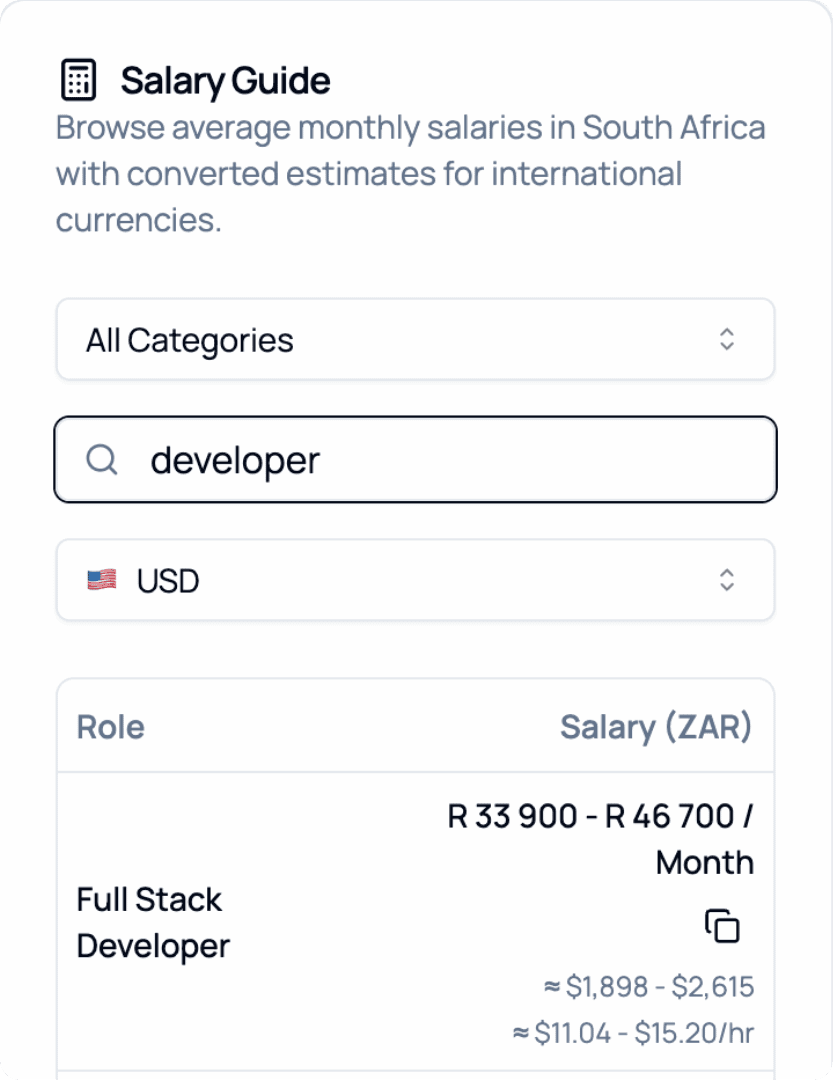
2026 Salary Guide: South Africa
Discover South African Salaries by Role. Compare costs and see how much you can save.