TL;DR
Learn how creative founders can delegate operations without losing quality, brand consistency, or client experience control.
Use a practical system for scheduling, project tracking, revision workflows, asset handoffs, and invoicing support.
Apply KPI and ROI frameworks to scale creative delivery with fewer bottlenecks and better client communication cadence.
Table of Contents
- Introduction
- What does a virtual assistant for creative entrepreneurs do?
- Which creative operations tasks should you delegate first?
- How much does a creatives-focused VA cost and what ROI should you expect?
- How do you prevent revision chaos and client communication breakdowns?
- How do you scale from one assistant to a repeatable creative support system?
- Final Thoughts
Introduction
If you are building support capacity in this vertical, start with the creatives industry page to align role design with your broader operating model.
Many creative businesses stall not because demand is weak, but because the founder is trapped in coordination overhead. Projects are active, but updates are scattered. Client feedback loops run late. File versions are inconsistent. Invoices are delayed. Follow-ups are ad hoc. The studio can produce strong work, yet operations remain fragile.
A virtual assistant for creative entrepreneurs helps solve this when the role is designed as a system owner for repeatable workflows. This is not about reducing creative control. It is about protecting creative time by stabilizing everything around production and client delivery.
This guide explains exactly how to do that. You will get delegation boundaries, first-wave task design, revision and communication controls, cost and ROI modeling, and a scale path from one assistant to a dependable creative operations layer.
For adjacent context, pair this with How to Hire a Virtual Assistant for Small Business in 2026, Virtual Assistant Onboarding Checklist for 2026, Virtual Assistant Cost Calculator Guide for SMB Teams, How to Hire Remote Talent Without Recruiting Fees, What Is an Onshore and Offshore Team?, and 5 Best Countries to Find Remote Talent in 2026.
For external references, use practical sources including SBA small business operations guidance, PMI project management resources, IRS recordkeeping guidance, AICPA business resources, and NIST small business cybersecurity guidance.
What does a virtual assistant for creative entrepreneurs do?
Snippet answer: A creative-focused VA owns repeatable operational workflows—scheduling, client communication cadence, project-board hygiene, revision tracking, asset organization, and invoice/admin support—so founders can focus on high-value creative work.
Creative businesses often need one role that keeps projects moving without taking over creative judgment. That is the sweet spot for this position.
Typical responsibilities include:
- Managing discovery calls, proposal follow-ups, and client scheduling.
- Updating project boards with current stage, owners, due dates, and blockers.
- Tracking revision rounds and feedback deadlines.
- Maintaining file and asset naming/version protocols.
- Coordinating internal and client-facing status updates.
- Preparing invoice packets and follow-up reminders.
- Supporting launch/checklist execution for deliverables.
Role boundaries that protect quality
A strong VA role should accelerate operations without diluting creative standards. Keep boundaries explicit:
- No final creative direction decisions.
- No unsupervised client scope commitments.
- No unilateral timeline changes without owner/lead approval.
- No ad hoc process changes outside agreed SOP updates.
When these boundaries are clear, output quality stays high while delivery speed improves.
Immediate leverage zones
Most creative teams see first gains in:
- Response-time consistency with prospects and clients.
- Revision-cycle clarity with fewer missed feedback loops.
- Admin throughput (invoicing, follow-up, handoff prep).
These gains directly reduce founder context switching.
Which creative operations tasks should you delegate first?
Snippet answer: Delegate repetitive, delay-sensitive tasks first: calendar and intake management, project-board updates, revision tracking, asset organization, status updates, and invoice follow-up support.
Early delegation should target work that is structured and recurring.
First-wave delegation stack
Lane 1: Intake and scheduling
- Lead inquiry capture.
- Discovery call scheduling and confirmation workflows.
- Proposal follow-up reminders and status updates.
Lane 2: Project board hygiene
- Stage transitions and ownership updates.
- Due-date and dependency tracking.
- Blocker flagging and escalation notes.
Lane 3: Revision workflow control
- Round-by-round feedback log management.
- Review deadline reminders.
- Approval-state tracking before final delivery.
Lane 4: Asset and file governance
- Folder structures and naming conventions.
- Version discipline across drafts/finals.
- Handoff packet readiness checks.
Lane 5: Invoice and follow-up support
- Invoice prep packet assembly.
- Payment-follow-up cadence execution.
- Client status recap notes for open actions.
Delegation filter checklist
Before assigning tasks, ask:
- Is the task repeatable?
- Is quality objectively checkable?
- Does delay hurt delivery or cash timing?
- Can escalation be standardized?
If yes, delegate in phase 1.
What to keep founder-side in phase 1
- Final creative decisions and approval authority.
- High-stakes client negotiation conversations.
- Scope-change pricing or strategic offer decisions.
- Brand voice decisions for flagship deliverables.
Start narrow, then expand with KPI proof.
How much does a creatives-focused VA cost and what ROI should you expect?
Snippet answer: ROI typically comes from recovered founder/lead time, fewer delivery delays, cleaner revision cycles, and improved client retention—not hourly cost reduction alone.
Creative founders often underestimate the economic impact of operational drag. Small coordination failures create timeline slippage, which lowers client confidence and increases rework.
Cost model components
Direct costs
- Monthly VA fee/compensation.
- Tooling seats (project board, storage, communication).
- Onboarding and SOP setup time.
- Weekly quality review overhead.
Indirect costs
- Rework caused by version confusion.
- Late delivery penalties or rushed revisions.
- Founder opportunity cost from admin-heavy work.
- Collection delays from weak invoice cadence.
Practical ROI model
Use:
ROI = recovered founder/lead hours + cycle-time reduction value + reduced rework/retention gains - total support cost
Illustrative baseline:
- Founder/lead spends 34 hrs/month on repetitive ops/admin.
- Delegation-safe share = 55% (18.7 hrs).
- Blended value = $170/hr.
- Recovered value = $3,179/month.
Add likely gains:
- fewer missed feedback windows,
- faster handoff readiness,
- better invoice and follow-up cadence,
- lower project chaos during busy weeks.
KPI baseline for first 90 days
Track weekly:
- response-time median for leads/clients,
- revision-cycle completion rate,
- overdue task count by stage,
- delivery-on-time rate,
- invoice follow-up completion rate,
- founder admin hours reclaimed.
These KPIs show whether operations quality is actually improving.
How do you prevent revision chaos and client communication breakdowns?
Snippet answer: Prevent chaos by enforcing one source of truth for project status, strict revision round governance, standardized communication cadence, and escalation thresholds for stalled feedback.
Most revision chaos is not a creative issue. It is an ownership and workflow issue.
Revision governance framework
Use a 5-layer model:
- Round definition
- clearly define what counts as one revision round.
- Feedback capture standard
- centralize feedback in one structured log.
- Deadline policy
- set response windows for each round.
- Approval gate
- require explicit signoff before moving stage.
- Escalation trigger
- escalate when feedback window exceeds threshold.
Communication cadence architecture
Run fixed cadence instead of ad hoc updates:
- kickoff recap after alignment call,
- mid-cycle status check,
- pre-delivery confirmation,
- post-delivery action summary.
This cadence reduces confusion and improves client trust.
Status control protocol
Maintain one status system with:
- current stage,
- owner,
- next due date,
- blocker tag,
- action notes.
If status lives in multiple channels, missed handoffs become inevitable.
Escalation matrix
Define three levels:
- Level 1: minor lag, still within buffer.
- Level 2: at-risk lag, needs same-day owner decision.
- Level 3: critical lag, immediate escalation with decision path.
Clear escalation prevents silent deadline drift.
Weekly quality review agenda
Use 30 minutes:
- overdue tasks by age,
- recurring revision failure patterns,
- communication misses,
- SOP patch decisions,
- next-week risk list.
This keeps process quality compounding.
How do you scale from one assistant to a repeatable creative support system?
Snippet answer: Scale by splitting lanes (intake/comms, revision/asset control, finance follow-up), assigning backup ownership, and managing queue health with KPI-driven decisions.
The first assistant proves the model. Scaling requires architecture.
Scale phases
Phase 1: stabilization (0-60 days)
- One VA handles core coordination/admin lanes.
- SOP baseline and KPI baseline live.
- Escalation matrix active.
Phase 2: lane specialization (60-120 days)
- Split client comms lane from revision/asset lane.
- Add backup owner for critical workflows.
- Introduce exception taxonomy for recurring failures.
Phase 3: system governance (120+ days)
- Add operations lead/coordinator oversight.
- Monthly process redesign loop.
- Capacity balancing by project type and complexity.
Scale signals to watch
- Overdue task age increasing despite effort.
- Founder still handling repetitive coordination weekly.
- Revision confusion incidents repeating.
- Client updates delayed in high-volume weeks.
These indicate system limits rather than effort limits.
30-60-90 rollout
Days 1-30
- finalize role boundaries,
- publish SOPs for intake, revision, and handoff,
- establish one status board + one file protocol,
- capture KPI baseline.
Days 31-60
- enforce SLA timers,
- launch exception taxonomy,
- run weekly trend reviews,
- patch top recurring blockers.
Days 61-90
- add backup ownership,
- split overloaded lanes,
- refine escalation thresholds,
- decide next capacity move (add role vs redesign process).
Internal links for implementation
- How to Hire a Virtual Assistant for Small Business in 2026
- Virtual Assistant Onboarding Checklist for 2026
- Virtual Assistant Cost Calculator Guide for SMB Teams
- How to Hire Remote Talent Without Recruiting Fees
- What Is an Onshore and Offshore Team?
- 5 Best Countries to Find Remote Talent in 2026
Monthly scorecard template
Use weighted dimensions:
- Timeliness (25%)
- response-time SLA adherence
- overdue trend
- Quality (25%)
- revision error/rework trend
- handoff completeness score
- Control (25%)
- escalation compliance
- asset/version governance consistency
- Commercial impact (25%)
- on-time delivery rate
- invoice follow-up completion trend
Use scorecard data for decisions, not just reporting.
SOP blueprint for creative ops lane
For each SOP include:
- Trigger
- Owner + backup
- Inputs required
- Output required
- SLA target
- Escalation trigger
- QA checkpoint
- Artifact location
This reduces ambiguity and speeds onboarding.
14-day stabilization checklist
- publish role boundary memo,
- deploy intake/revision SOPs,
- enforce naming/version protocol,
- launch status board and exception tags,
- run day-7 KPI review,
- patch top recurring blockers by day 14.
This checklist usually delivers quick operational clarity.
Risk controls for creative delivery integrity
- no delivery-stage transition without approval evidence,
- no revision closure without centralized feedback log,
- no status updates without owner attribution,
- no critical blocker beyond escalation SLA window.
These controls are simple and high impact.
Leadership dashboard metrics
Keep monthly reporting concise:
- active project load by stage,
- overdue critical items,
- revision-cycle median time,
- communication miss incidents,
- delivery and collection readiness trend.
This gives founders a clear intervention map.
Governance ownership principle
Assign one owner for SOP governance and scorecard integrity. Without explicit governance ownership, process drift returns even with strong talent.
Client onboarding operations blueprint
Creative teams often lose momentum in the first two weeks of engagement. A standardized onboarding blueprint prevents early confusion.
Recommended onboarding sequence:
- intake questionnaire and objective alignment,
- communication channel and cadence setup,
- project board stage map confirmation,
- revision and feedback protocol walkthrough,
- approval authority mapping,
- billing milestone and invoice process confirmation.
A VA can own this sequence end-to-end, ensuring every new client starts with operational clarity instead of assumptions.
Asset management standards that reduce rework
File chaos causes hidden margin loss. Enforce simple standards:
- project-level folder architecture,
- draft/final naming protocol,
- revision index with timestamp + owner,
- source file retention rules,
- client-delivery packet checklist.
When asset standards are enforced consistently, handoffs are faster and quality reviews are less stressful.
Revision economics model
A useful internal model is to treat revisions as a measurable cost center.
Track:
- average revision rounds per project,
- median turnaround per round,
- percent of revisions caused by unclear brief vs execution quality,
- founder/lead time spent inside revision loops.
A VA-run feedback governance system often reduces preventable revision rounds simply by improving input quality and timeline discipline.
Capacity planning by project mix
Not all creative projects consume equal coordination effort. Build capacity models by project type:
- short-form high-frequency deliverables,
- long-form strategic deliverables,
- campaign bundles with cross-channel coordination,
- retainers with recurring review cadence.
Assign estimated coordination load per type, then plan weekly VA capacity against active mix. This avoids “fully booked but operationally underwater” scenarios.
Client communication templates that improve trust
A VA-managed communication library should include:
- kickoff recap template,
- revision-received confirmation template,
- delivery-ready confirmation template,
- delay/escalation notice template,
- next-step summary template.
Template consistency improves response quality and reduces interpretation drift across accounts.
Approval workflow guardrails
Approval chaos is one of the top causes of creative delays. Add guardrails:
- one named approver per client stream,
- escalation path when approver is unavailable,
- explicit “approved with changes” handling protocol,
- no stage transitions without approval evidence in the system.
These guardrails protect delivery cadence and reduce last-minute surprises.
Weekly queue health review model
A practical queue review should capture:
- active items by stage,
- items aging beyond SLA,
- blockers by category,
- projects at risk this week,
- handoff failures and fixes.
This model helps teams shift from reactive updates to proactive risk control.
Financial operations tie-in for creatives
Creative teams often separate delivery workflows from billing workflows. That separation creates delays.
Add explicit tie-ins:
- delivery completion triggers invoice packet prep,
- missing approval blocks invoice readiness,
- payment-follow-up cadence linked to project status ownership,
- dispute notes logged in same source-of-truth board.
These tie-ins improve cash timing without adding unnecessary process overhead.
Candidate interview rubric for creative ops VA
Beyond generic VA traits, test for:
- process clarity under ambiguity,
- communication precision,
- comfort with revision-heavy environments,
- checklist discipline,
- escalation judgment quality,
- ability to maintain calm under deadline pressure.
This rubric helps identify candidates who can protect creative delivery quality, not just complete tasks.
60-day reliability milestone checklist
By day 60, you should see:
- response-time stability,
- consistent revision governance,
- lower overdue task age,
- cleaner delivery handoffs,
- improved founder focus time.
If these are not visible, improve SOP quality before adding project volume.
Leadership monthly decision memo template
Keep a one-page monthly memo with:
- what improved,
- what regressed,
- recurring failure modes,
- process fixes shipped,
- capacity recommendation for next month.
This converts operational data into clear business decisions.
Final Thoughts
A virtual assistant for creative entrepreneurs works best when treated as a systems role, not a miscellaneous admin role. The objective is stable execution around your creative core: clearer communication, cleaner revisions, better handoffs, and stronger delivery consistency.
Use the creatives industry page to align this support model with your broader growth plan, then scale through SOP discipline, queue visibility, and explicit escalation ownership.
When this lane is stable, you reclaim founder bandwidth while improving client experience and operational confidence. Over time, the biggest payoff is not only faster throughput; it is better strategic focus, cleaner forecasting, and fewer fire-drill moments that interrupt your best creative work during growth phases. That consistency compounds into stronger client retention, healthier team morale, and a more resilient creative business model that can scale without sacrificing quality standards, client trust, or your creative leadership focus over time and under pressure consistently.
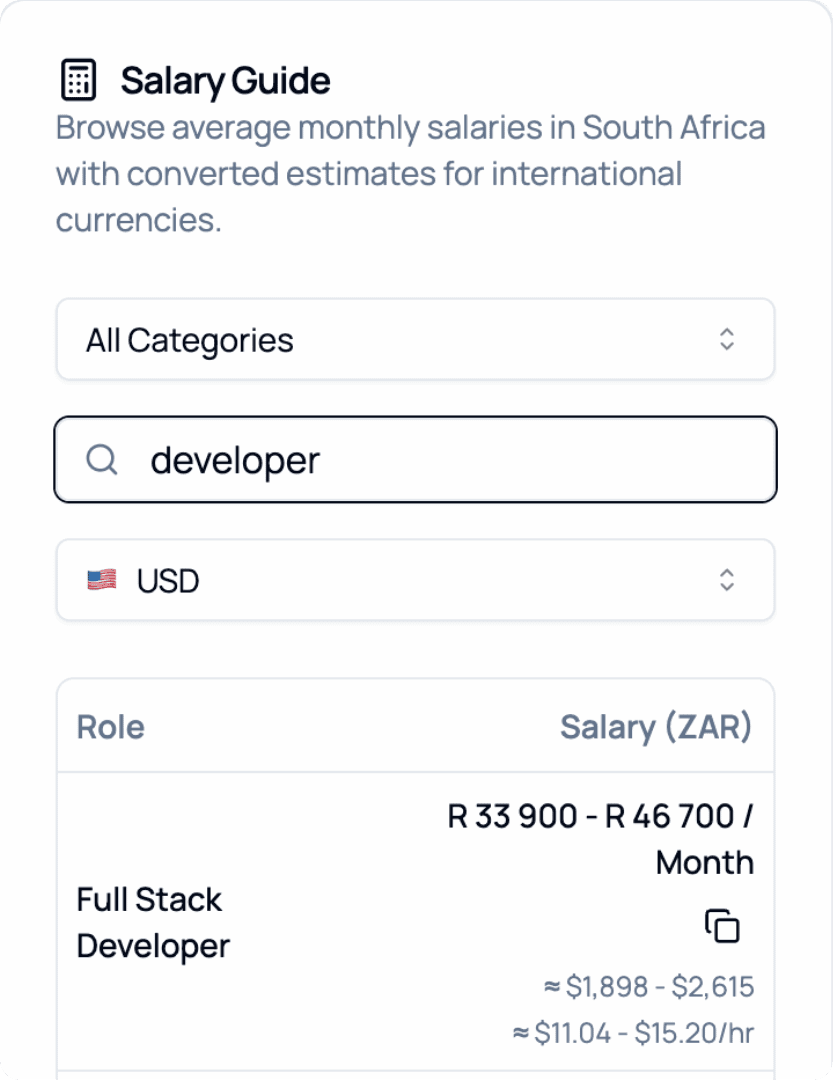
2026 Salary Guide: South Africa
Discover South African Salaries by Role. Compare costs and see how much you can save.