TL;DR
Learn how to run revision workflows that protect quality, reduce avoidable rework, and keep client communication clear.
Use a practical model for feedback intake, prioritization, batching, approval routing, and delivery confirmation.
Apply KPI and ROI frameworks that improve revision cycle speed, reduce founder context switching, and scale creative operations safely.
Table of Contents
- Introduction
- What revision and feedback tasks can a creative VA handle?
- Which revision workflows should creative founders delegate first?
- How much does revision-focused VA support cost and what ROI should you expect?
- How do you reduce rework and avoid endless client feedback loops?
- How do you scale revision operations across multiple active projects?
- Final Thoughts
Introduction
If you are building support systems in this vertical, start with the creatives industry page to align revision workflows with your broader operating model.
Creative teams rarely lose margin because they receive feedback. They lose margin because feedback processing is inconsistent. Notes come through scattered channels. Round boundaries are unclear. Approval ownership is ambiguous. Revision requests are mixed with net-new scope. Founders become traffic managers instead of creative leaders.
A well-designed revision workflow solves this. And one of the fastest ways to stabilize that workflow is to delegate the operations lane to a virtual assistant who owns process hygiene while creative leads retain final quality authority.
This guide gives you a practical system to do exactly that: revision governance, feedback controls, SLA design, approval routing, KPI tracking, and scale patterns for multi-project creative operations.
For adjacent context, pair this with Virtual Assistant for Creative Entrepreneurs Guide (2026), Creative Entrepreneur Client Onboarding and Intake Playbook (2026), How to Hire a Virtual Assistant for Small Business in 2026, Virtual Assistant Onboarding Checklist for 2026, Virtual Assistant Cost Calculator Guide for SMB Teams, and How to Hire Remote Talent Without Recruiting Fees.
For external references, use practical guidance from PMI project management resources, SBA small business resources, NIST small business cybersecurity guidance, IRS recordkeeping guidance, and AICPA business resources.
What revision and feedback tasks can a creative VA handle?
Snippet answer: A creative VA can own feedback operations: collecting and normalizing feedback, categorizing requests, tracking revision rounds, maintaining approval logs, coordinating timelines, and preparing delivery-ready handoff packets.
The revision lane is a process lane. This is why delegation works when roles are clear.
Tasks a creative VA can reliably own:
- Feedback intake consolidation across agreed channels.
- Feedback normalization into structured request logs.
- Categorization (typo/minor adjustment/major revision/new-scope candidate).
- Revision round tracking with SLA timers.
- Approval-state and decision trail documentation.
- Client update cadence and reminder workflows.
- Delivery confirmation and post-delivery action tracking.
Role boundaries that preserve creative quality
A revision operations VA should not make final creative judgment calls.
Boundaries:
- No final acceptance of subjective creative direction decisions.
- No autonomous scope acceptance outside approved framework.
- No direct commitment to timeline changes without owner approval.
- No policy changes to revision rules without governance review.
This structure protects both speed and quality.
Immediate value zones
Teams usually see first gains in:
- Faster feedback-to-action conversion.
- Lower “lost feedback” incidents.
- Clearer approval progression and fewer ambiguous handoffs.
These directly reduce founder overload.
Which revision workflows should creative founders delegate first?
Snippet answer: Delegate repetitive and delay-sensitive workflows first: feedback consolidation, categorization, revision board updates, SLA reminders, approval routing support, and post-delivery closure checks.
Your first delegation wave should reduce ambiguity and queue friction.
First-wave revision operations stack
Lane 1: Feedback intake normalization
- Collect feedback into one structured log.
- Remove duplicate/conflicting requests.
- Attach owner and context metadata.
Lane 2: Revision categorization and triage
- Classify request type and urgency.
- Separate revision vs scope-change candidate items.
- Route unresolved ambiguity for owner decision.
Lane 3: Round governance and SLA tracking
- Maintain round deadlines.
- Trigger reminders and escalation notices.
- Track status transitions and blockers.
Lane 4: Approval routing support
- Ensure designated approver path is followed.
- Capture approval evidence.
- Prevent stage transitions without approval record.
Lane 5: Delivery closure support
- Confirm accepted deliverable state.
- Log final status and remaining actions.
- Prepare concise closure notes for archive.
Delegation filter
Before assigning a task, confirm:
- Is this task recurring?
- Can completion be objectively verified?
- Is delay costly?
- Is escalation rule clear?
If yes, delegate early.
What to keep with creative lead/founder in phase 1
- Final creative tradeoff decisions.
- Strategic scope shifts.
- High-risk client relationship interventions.
- Final quality signoff for flagship deliverables.
This keeps creative authority where it belongs.
How much does revision-focused VA support cost and what ROI should you expect?
Snippet answer: ROI comes from fewer rework cycles, faster revision completion, improved approval throughput, and recovered founder time—not from labor-rate comparison alone.
Revision chaos has hidden costs: delayed delivery, lower client confidence, and compounding admin overhead.
Cost model components
Direct costs
- Monthly VA fee/compensation.
- Tooling seats for boards/docs/comms.
- Onboarding and SOP setup.
- Weekly QA and operations review time.
Indirect costs
- Rework from unclear feedback handling.
- Delays from approval bottlenecks.
- Founder context switching across scattered requests.
- Retention risk from repeated communication failures.
Practical ROI framework
Use:
ROI = recovered founder/lead time + reduced rework value + cycle-time gains - total support cost
Illustrative baseline:
- Founder/lead spends 30 hrs/month on revision coordination admin.
- Delegation-safe share = 58% (17.4 hrs).
- Blended value = $170/hr.
- Recovered value = $2,958/month.
Additional gains usually include:
- fewer revision rounds caused by process error,
- better timeline predictability,
- lower client-friction moments.
KPI baseline for first 90 days
Track weekly:
- feedback intake-to-categorization time,
- revision round cycle time,
- overdue revision item count,
- approval lag median,
- scope-change leakage incidents,
- founder admin hours reclaimed.
These KPIs reveal whether your revision system is healthy.
How do you reduce rework and avoid endless client feedback loops?
Snippet answer: Reduce rework by enforcing explicit revision round policies, one feedback source of truth, acceptance criteria, scope-change routing rules, and SLA-driven escalation.
Endless feedback loops are usually governance failures, not client personality problems.
Revision control framework
- Round policy clarity
- define max rounds and response windows.
- Single feedback source of truth
- no action from unlogged feedback.
- Acceptance criteria
- define what constitutes done for each deliverable.
- Scope-change gate
- route non-revision requests through change protocol.
- Escalation matrix
- trigger owner decision when loops exceed thresholds.
Scope-change separation protocol
To prevent scope creep disguised as revisions:
- tag each request as revision or net-new scope,
- document impact on timeline/effort,
- require approval for scope additions,
- update board and client summary with decision trace.
This protects margin and keeps timelines credible.
Feedback quality checklist
Before actioning feedback, verify:
- request specificity,
- expected outcome clarity,
- owner assignment,
- priority level,
- due date,
- dependency notes.
Low-quality feedback should be clarified, not blindly actioned.
Approval routing control
Use explicit approval guardrails:
- one named approver per stream,
- backup approver defined,
- no stage transitions without approval evidence,
- escalation if approval SLA is breached.
This prevents silent bottlenecks.
Weekly revision review model
Run a fixed 30-minute review:
- round-cycle KPI snapshot,
- oldest unresolved revision items,
- recurring rework causes,
- escalation compliance,
- SOP patch priorities.
This keeps revision quality improving over time.
How do you scale revision operations across multiple active projects?
Snippet answer: Scale by splitting revision lanes, assigning backup ownership, standardizing triage by project criticality, and monitoring queue health dashboards.
A single coordinator can stabilize revision ops. Scale needs lane architecture.
Scale phases
Phase 1: stabilization (0-60 days)
- one revision ops owner,
- SOP baseline,
- KPI baseline,
- escalation matrix active.
Phase 2: lane split (60-120 days)
- separate intake/categorization lane from approval/closure lane,
- add backup ownership,
- deploy exception taxonomy dashboard.
Phase 3: governance (120+ days)
- add ops lead oversight,
- monthly redesign loop,
- capacity balancing by project type and value.
Scale signals to watch
- rising revision backlog age,
- repeated approval SLA misses,
- founder still handling routine revision traffic weekly,
- increasing scope-change leakage incidents.
These indicate process capacity limits.
30-60-90 rollout
Days 1-30
- finalize role boundaries,
- publish intake/triage and approval SOPs,
- launch one revision board + one log protocol,
- capture KPI baseline.
Days 31-60
- enforce SLA timers,
- start exception taxonomy,
- run weekly trend reviews,
- patch recurring blockers.
Days 61-90
- add backup owner coverage,
- split overloaded lanes,
- refine escalation thresholds,
- choose capacity expansion move.
Internal links for implementation
- Virtual Assistant for Creative Entrepreneurs Guide (2026)
- Creative Entrepreneur Client Onboarding and Intake Playbook (2026)
- How to Hire a Virtual Assistant for Small Business in 2026
- Virtual Assistant Onboarding Checklist for 2026
- Virtual Assistant Cost Calculator Guide for SMB Teams
- How to Hire Remote Talent Without Recruiting Fees
Monthly scorecard template
Use weighted dimensions:
- Timeliness (25%)
- revision cycle-time trend
- overdue item rate
- Quality (25%)
- rework incident trend
- acceptance criteria adherence
- Control (25%)
- escalation compliance
- approval evidence completeness
- Commercial impact (25%)
- delivery predictability trend
- client-friction incident reduction
Use scorecard outcomes to prioritize process investment.
SOP blueprint for revision lane
For each SOP document:
- Trigger
- Owner + backup
- Inputs required
- Output required
- SLA target
- Escalation trigger
- QA checkpoint
- Artifact location
This blueprint enables repeatability at higher volume.
14-day stabilization checklist
- role boundary memo published,
- intake and triage SOPs active,
- round policy and approval guardrails enforced,
- queue board launched,
- day-7 KPI review completed,
- top recurring process gaps patched by day 14.
This checklist creates early revision-lane stability.
Risk controls for creative and commercial protection
- no revision closure without evidence,
- no stage transition without approval trace,
- no unresolved critical item past SLA,
- no scope-change processing outside formal gate.
These controls reduce costly process drift.
Leadership dashboard metrics
Monthly dashboard should include:
- active revision load by project,
- overdue critical revision items,
- approval lag trend,
- scope-change leakage incidents,
- founder coordination hours trend.
This keeps interventions focused and timely.
Governance ownership principle
Assign one owner for revision SOP governance and scorecard integrity. Without explicit ownership, revision quality drifts quickly at scale.
Feedback channel governance matrix
Many creative teams accept feedback across too many channels, then lose control. A governance matrix keeps intake reliable.
Recommended matrix:
- Primary feedback channel: required for actionable requests.
- Secondary channels: allowed for context, not for final action instructions.
- Non-compliant feedback: logged and redirected to primary channel.
This prevents missed requests and contradictory edits.
Request quality standards
A revision request should include:
- what needs to change,
- why it needs to change,
- where the change applies,
- required outcome,
- priority and due date.
If one element is missing, route to clarification before assigning production work.
Revision batching strategy
Batching reduces context-switch cost and improves quality. Use batch windows:
- daily small batch for urgent corrective items,
- scheduled batch for standard revisions,
- strategic batch for larger directional changes.
A VA can enforce batch windows and keep expectations clear for clients and team members.
Creative approval rubric
Approval should follow a fixed rubric to reduce subjective churn:
- objective alignment,
- brand consistency,
- technical readiness,
- channel-fit or format-fit,
- required changes vs optional preferences.
This rubric reduces “revision by preference drift” and keeps teams focused on high-impact changes.
Rework root-cause framework
Track rework cause categories:
- unclear initial brief,
- late stakeholder input,
- poor feedback specificity,
- process missed step,
- true quality issue.
This framework helps teams fix the source of rework rather than blaming execution alone.
Multi-stakeholder feedback control
When multiple stakeholders are involved, enforce order:
- one decision owner,
- one consolidated feedback pass,
- conflict-resolution protocol,
- final approval checkpoint.
Without this control, revision loops can become unbounded.
Delivery-readiness gate
Before shipping any revised asset:
- all critical feedback resolved,
- approval evidence attached,
- naming/version standard verified,
- handoff notes prepared,
- follow-up action owner assigned.
This gate prevents avoidable post-delivery corrections.
Queue triage by commercial impact
Prioritize revision queues using:
- delivery deadline proximity,
- client value/contract priority,
- scope risk if delayed,
- dependency impact on other deliverables.
This keeps high-impact work moving when queue pressure rises.
SLA policy design by request class
Set SLA targets by class:
- typo/minor correction,
- standard creative revision,
- structural/content-direction revision,
- scope-change candidate.
Class-based SLAs create realistic expectations and better resource planning.
Weekly revision governance meeting template
Use a fixed agenda:
- cycle-time and backlog snapshot,
- top recurring blockers,
- approval delays and owners,
- scope-leak incidents,
- SOP patch actions.
This keeps quality improvement disciplined and continuous.
Candidate screening rubric for revision coordinator VA
Test for:
- pattern recognition in feedback,
- precise written communication,
- escalation judgment,
- checklist discipline,
- calm under deadline pressure.
These competencies matter more than broad tool familiarity.
60-day reliability milestone checklist
By day 60, healthy revision ops should show:
- reduced backlog age,
- improved approval turnaround,
- lower process-caused rework,
- clearer delivery readiness,
- reduced founder coordination load.
If these are not visible, patch controls before adding scale.
Monthly leadership decision memo template
Use one page:
- KPI trends,
- major failure modes,
- fixes implemented,
- unresolved risks,
- next-month capacity recommendation.
Decision-focused reporting keeps operations aligned with growth goals.
Revision economics dashboard design
A useful dashboard for founders and ops leads should show:
- average rounds per deliverable,
- median time per round,
- ratio of revision vs scope-change requests,
- rework hours by cause category,
- value-at-risk from delayed approvals.
This makes revision costs visible and supports better pricing and capacity decisions.
Scope-creep containment protocol
Scope creep is usually a protocol failure, not a communication accident. Use a clear containment process:
- identify request as potential scope expansion,
- quantify impact on timeline and effort,
- route for owner decision,
- document approved path,
- update project board and client summary.
If this protocol is consistently enforced, margin leakage drops materially.
Client education layer for revision policy
The best revision systems include a client education step. During kickoff and before first delivery, clearly communicate:
- what counts as a revision,
- how many rounds are included,
- how feedback should be submitted,
- expected response windows,
- how scope-change requests are handled.
A VA can run this education step with templates and acknowledgment tracking.
Team load-balancing model
As volume grows, revision queues become uneven across projects. Use load balancing rules:
- assign priority score by deadline and commercial value,
- reserve daily capacity for urgent corrective edits,
- protect strategic work blocks from interruption,
- rotate low-priority tasks into scheduled batch windows.
This reduces burnout and preserves high-quality output.
Revision quality QA checklist
Before closing any revision ticket, verify:
- requested change implemented accurately,
- no unintended side effects introduced,
- updated version logged correctly,
- approval evidence attached,
- follow-up communication sent.
This checklist lowers reopen rates and improves trust.
Tooling stack governance
A stable tooling stack should define:
- one canonical feedback platform,
- one canonical project board,
- one canonical archive location,
- allowed integrations and ownership.
Too many parallel tools usually create hidden failure points.
Escalation SLA framework
Define escalation SLAs by risk tier:
- Tier 1: minor delay, no immediate delivery risk,
- Tier 2: moderate delay with timeline impact,
- Tier 3: critical delay affecting committed deadline.
Each tier should have named owner response expectations.
14-day process hardening sprint
Run a focused hardening sprint:
- day 1-2: baseline KPI capture,
- day 3-5: SOP gap identification,
- day 6-8: template and checklist updates,
- day 9-11: escalation matrix refinement,
- day 12-14: review results and lock new standards.
This sprint format creates fast, measurable improvements.
Leadership review questions that matter
Use these monthly questions:
- Where are revisions slowing delivery most?
- What % of rework was preventable?
- Which clients need policy reset conversations?
- Is capacity or process the current bottleneck?
- What is the highest-impact fix for next month?
Strong questions improve operations faster than larger dashboards.
Governance principle for long-term consistency
Process consistency is a leadership asset. Assign explicit owners for:
- SOP updates,
- KPI integrity,
- exception taxonomy maintenance,
- escalation compliance audits.
Without governance ownership, revision operations drift back into reactive mode.
Final Thoughts
Revision operations are where creative delivery quality is often won or lost. Delegating this lane to a system-oriented VA role protects creative leaders from traffic-control overload while improving execution consistency.
Use the creatives industry page to align revision governance with your broader operations plan, then scale through clear SOPs, queue visibility, and escalation discipline.
When revision workflows are stable, projects move faster, communication gets cleaner, and your creative business scales with less friction and stronger client trust.
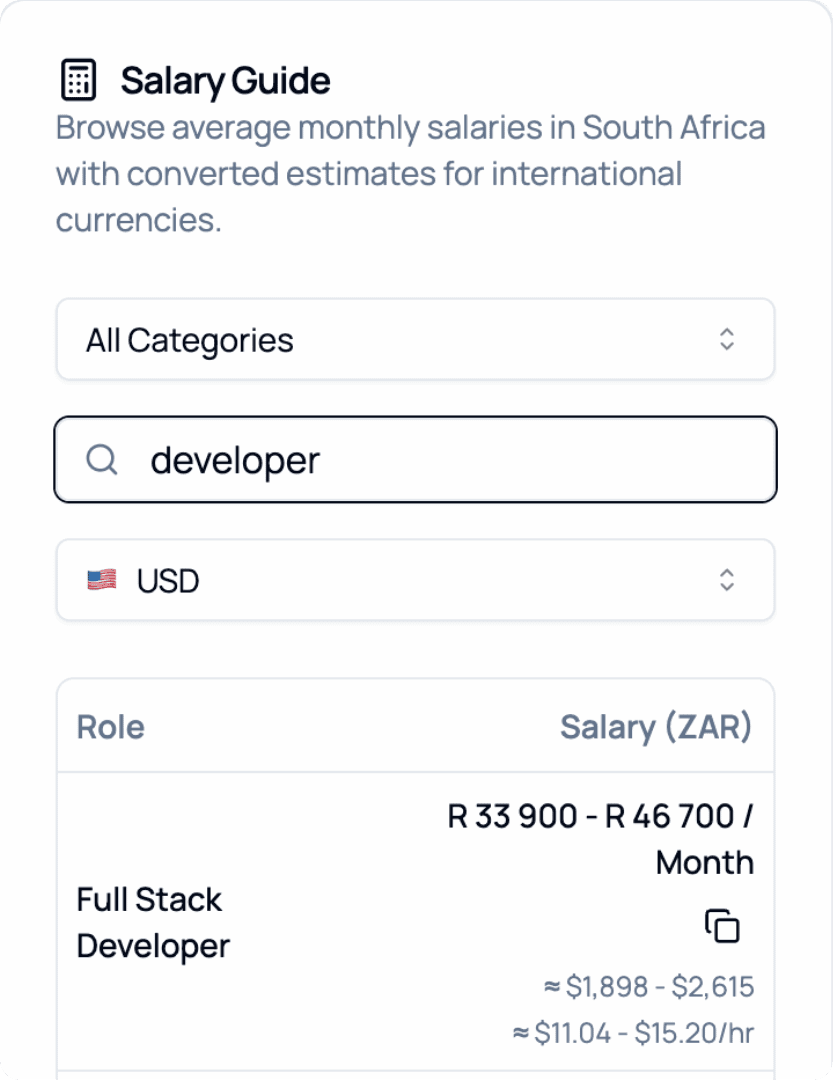
2026 Salary Guide: South Africa
Discover South African Salaries by Role. Compare costs and see how much you can save.