TL;DR
Publishers outsource the work that follows a style sheet and comes back with every title: copyediting, proofreading, typesetting, ebook conversion, metadata, permissions requests and royalty statements. Acquisitions, contracts, pricing, rights deals and final sign-off stay in-house.
Since June 28, 2025, the European Accessibility Act has covered ebooks sold to consumers in the EU. Ask for EPUB files with accessibility metadata, image descriptions you approved and an Ace by DAISY report. Microenterprises that provide services are exempt.
Two 80,000-word novels a month need about 107 to 171 hours of copyediting and proofreading. At US freelance median rates for 2025 work that is $5,120 to $7,520 a month. A South African editor at the PayScale average salary costs about $1,164 a month.
Table of Contents
- What to hand off, and what to keep
- A production vendor, freelancers or a remote hire
- Size the work in hours
- What it costs in 2026
- Ebook files that meet the accessibility rules
- AI use: what to disclose and what to write down
- Who owns the edits, the index and the cover
- Unpublished files and account access
- For author-publishers
- A paid test before you hire
- The first month
- Turnaround across time zones
- Hiring a South African editor or publishing assistant through HireSava
- Sources and notes
Publishers outsource the work that follows a style sheet and comes back with every title: copyediting, proofreading, typesetting, ebook conversion, metadata, permissions requests and royalty statements. Acquisitions, author contracts, pricing, rights deals and final sign-off stay in-house, whether the work goes to a production vendor, a freelancer or a remote hire on your own team.
The brief now has to cover more than house style. Since June 28, 2025, the European Accessibility Act has applied to e-books sold to consumers in the EU, so the files an outside team delivers have to work with screen readers and other assistive technology and describe their accessibility features in metadata. Amazon KDP requires publishers to disclose text, images or translations created by an AI tool. In the US, an index, a translation or illustrations a contractor makes for your book belong to the contractor unless you both sign an agreement that says otherwise.
What to hand off, and what to keep
The US Bureau of Labor Statistics says editors "plan, review, and revise content for publication." At a small press the planning stays with you. Much of the reviewing and revising, and nearly all of the production and admin work around it, can run through someone else's queue.
| Work | The outside person does | You keep |
|---|---|---|
| Copyediting | Applies your style sheet and house dictionary, queries the author on unclear passages, and checks names, dates and cross-references for consistency | Substantive changes, author relations and acceptance of the edit |
| Proofreading | Checks typeset pages against the edited manuscript and marks errors, bad breaks, running heads and page references | Sign-off on final proofs |
| Typesetting and layout | Flows text into your templates and prepares print-ready PDFs to the printer's specification | The design and approval of first pages |
| Ebook conversion | Builds EPUB 3 files, drafts image descriptions, adds accessibility metadata and runs an accessibility check | Approval of image descriptions and of the accessibility claim you publish |
| Metadata | Enters titles in your ONIX feed or retailer dashboards with subject codes, keywords, descriptions and contributor bios | Price, territories, publication dates and which ISBN goes on which edition |
| Permissions | Logs third-party material, sends requests, follows up and records fees and credit lines | Whether to use the material, and every rights deal |
| Royalties | Builds statements from distributor and retailer sales reports | Approval and payment |
| Submissions | Logs queries and manuscripts, sends acknowledgments and does first reads against your criteria | Every acquisition decision |
| Marketing support | Keeps advance review copy lists, sends review requests and schedules newsletters and posts from approved copy | Budgets, positioning and anything said in the author's name |
Two of these jobs are easy to underrate. Metadata shapes how a title appears in retailer search and library catalogs: BISAC subject codes, keywords, descriptions and contributor names, entered once in your ONIX feed or in each retailer's dashboard. The Book Industry Study Group releases a new edition of the BISAC subject headings every fall, so the codes need a yearly check across the backlist. Permissions work is slow and record-heavy: every epigraph, song lyric, chart or photo from a third party needs a request, a follow-up and a record of the answer and the fee.
A production vendor, freelancers or a remote hire
A production vendor quotes per page or per title and staffs the job itself. It suits large or irregular lists and projects that need a team at once, such as converting a backlist to EPUB. You get a project manager and capacity, but you rarely choose who works on your books.
Freelancers charge per word, per page or per hour. They suit occasional titles and specialist work you need a few times a year, such as indexing or editing in a technical field. Quality and availability vary with each person, and your schedule competes with their other clients.
A remote hire costs a monthly salary and works your queue every day. That pays off when titles arrive steadily, because the same person learns your house style and how each of your authors works. You manage the work, and you carry the duties of an employer.
The routes combine well. A remote hire can run the steady work, such as copyediting, proofs, metadata and permissions, while freelancers cover indexing, specialist subjects and the months when several titles land at once.
Size the work in hours
Editorial pace is a better guide than job titles. The Editorial Freelancers Association's latest rates survey, answered by more than 1,100 members about work done in 2025, reports median paces of 6 to 10 pages an hour for copyediting fiction and 10 to 15 pages an hour for proofreading it, counting a page as 250 words. Nonfiction runs slower: 5 to 9 pages an hour to copyedit and 7 to 12 to proofread.
Here is a worked example for a press that publishes two 80,000-word novels a month:
- Each manuscript is 320 pages of 250 words.
- Copyediting at 6 to 10 pages an hour takes 32 to 53 hours per title.
- Proofreading at 10 to 15 pages an hour takes 21 to 32 hours per title.
- Two titles need 107 to 171 hours a month.
A 40-hour week averages about 173 hours a month, so this list is close to one full-time editor. Typesetting, ebook conversion and metadata would need a second person or freelance help. Once you have timed a paid test, replace the survey paces with the candidate's own.
What it costs in 2026
The table prices the copyediting and proofreading in the worked example through each route.
| Route | Rate used | Two 80,000-word novels a month |
|---|---|---|
| US freelancers | EFA medians for 2025 work: 2.0 to 2.7 cents a word to copyedit fiction and 1.2 to 2.0 cents to proofread it | $5,120 to $7,520 |
| UK freelancers | CIEP suggested minimums from March 1, 2026: £37.11 an hour to copyedit and £31.92 to proofread, at the hours above | £3,737 to £6,001 |
| A US editor on staff | BLS median wage of $77,920 a year (May 2025), with wages at 70.0 percent of private employers' compensation costs (June 2026) | $6,493 in pay, about $9,276 with benefits |
| A South African editor hired directly | PayScale average base salary of R244,094 a year, at R17.475 to the dollar | About $1,164 |
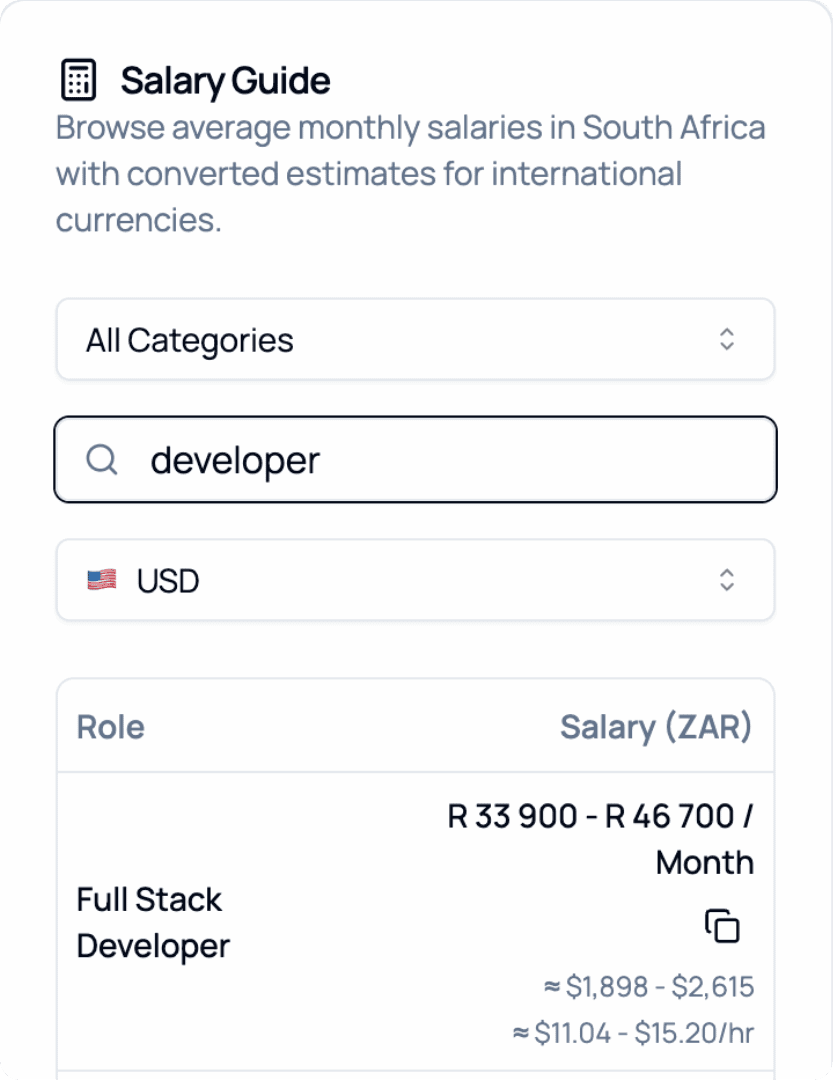
| A South African publishing assistant | HireSava salary guide: $4 to $15+ an hour for general admin, for metadata, permissions and upload work rather than editing | $640 to $2,400+ full-time |
The freelance figures are survey medians and suggested minimums, not quotes, and the CIEP says it cannot tell editors what to charge. PayScale's South African figure comes from 65 self-reported salaries and spans R37,000 to R615,000 between the 10th and 90th percentiles, so set an offer from the paid test and the candidate's book credits rather than from the average. On top of pay, budget for software seats, your HireSava plan and any freelancers you keep for indexing or specialist subjects.
Ebook files that meet the accessibility rules
The European Accessibility Act applies to "e-books and dedicated software" provided to consumers after June 28, 2025. It defines an e-book as a service: digital files that convey an electronic version of a book, together with the software used to read them. If you sell ebooks to readers in the EU, plan the files for these rules.
The Act exempts microenterprises that provide services, which it defines as firms that employ fewer than 10 persons and have an annual turnover or balance sheet total of no more than EUR 2 million. Because an e-book counts as a service, a very small press may fall outside it. The retailers and distributors that sell into the EU set their own file requirements, so check theirs too.
For everyone else, Annex I of the Act lists what an e-book must do:
- Where it contains audio as well as text, provide synchronized text and audio.
- Keep its files from stopping assistive technology, such as screen readers, from working properly.
- Give access to the content, its navigation and its layout, including layout that reflows, with choice in how the content is presented.
- Allow alternative renditions that work with a range of assistive technologies.
- Describe its accessibility features in metadata so readers can find accessible titles.
- Use digital rights management that does not block accessibility features.
The working standard for meeting those requirements is EPUB Accessibility 1.1, a W3C Recommendation. It requires WCAG 2 Level A conformance and strongly recommends Level AA. It requires three pieces of discovery metadata in the package, accessMode, accessibilityFeature and accessibilityHazard, and recommends an accessibilitySummary. A file that conforms states its claim in a dcterms:conformsTo property, written as EPUB Accessibility 1.1 - WCAG 2.2 Level AA. When the ebook has a print edition, the specification says it should carry page navigation, and once it does it must include a page list, so a reader using assistive technology can follow page references to the print book.
Turn that into four instructions for whoever converts your files:
- Build EPUB 3 files from the final text with real headings, a navigation document, a logical reading order and tables marked up as tables rather than pasted in as images.
- Draft a description for every informative image and mark decorative images as decorative. The author or editor approves the descriptions, because they are part of the content.
- Fill in the accessibility metadata in the package and the matching codes in your ONIX feed. EDItEUR, which maintains ONIX, says that when a feed lists images in a title's content but no List 196 code says they have descriptions, the assumption must be that the title is not fully accessible.
- Run Ace by DAISY, a free checker from the DAISY Consortium, on every file and keep its report in the title folder. Ace tests against WCAG 2 Level A and AA and the EPUB accessibility specification, but its own documentation says a clean report is not the same as meeting WCAG, so someone still checks a sample by hand.
Educational publishers have a US date to plan for. The Justice Department's ADA Title II rule requires state and local governments, including public colleges and school districts, to make web content and mobile apps they provide "directly or through contractual, licensing, or other arrangements" meet WCAG 2.1 Level AA. An interim final rule published April 20, 2026 moved the compliance dates to April 26, 2027 for public entities with a total population of 50,000 or more, and to April 26, 2028 for smaller ones and special district governments. Digital course materials a public college licenses for its students fall inside that scope for the college, which is a reason to build those files to WCAG 2.1 AA now.
AI use: what to disclose and what to write down
Amazon KDP requires publishers to tell it about AI-generated content, which it defines as "text, images, or translations created by an AI-based tool," when they publish a new book or edit and republish one. The rule applies "even if you applied substantial edits afterwards." Content you created and then edited, refined or error-checked with AI tools counts as AI-assisted, and KDP does not require you to disclose it.
For outsourced work, that splits cleanly. An editor who runs your author's chapters through an AI grammar check produces AI-assisted work. A cover image, interior illustration or translation generated by an AI tool is AI-generated, and you have to disclose it to KDP.
Copyright registration has its own rule. Since March 16, 2023, the US Copyright Office has required applicants to disclose AI-generated content in a work submitted for registration and to explain the human author's contribution briefly. Its January 2025 report on copyrightability concluded that AI outputs can be protected "where AI is used as a tool, and where a human has been able to determine the expressive elements they contain," while prompts alone are unlikely to qualify.
Write two rules into the contract:
- The hire tells you before using any AI tool to generate text, images or translations, and records each use in the title file, so your KDP disclosure and any copyright application are accurate.
- Unpublished manuscripts go into an AI tool only with your written permission, and only into a tool whose terms you have approved.
Who owns the edits, the index and the cover
Under 17 U.S.C. 101, a work commissioned from a contractor is a "work made for hire" only when it falls into one of nine categories and both parties sign a written agreement that says so. The categories include a translation, a compilation, an instructional text and a "supplementary work," which the statute illustrates with forewords, pictorial illustrations, maps, charts, tables, editorial notes, bibliographies, appendixes and indexes. An index, maps or a translation made for your book can therefore be a work made for hire, but only with that signed agreement.
For other work, and as a backup, take a written assignment. Under 17 U.S.C. 204(a), a transfer of copyright is not valid unless it is in writing and signed by the owner of the rights. Name every deliverable in the agreement: edits, indexes, image descriptions, cover files, ebook files and metadata copy.
If the person works from South Africa, its Copyright Act starts from the author owning the work. A person who commissions and pays for certain works, such as a photograph or a portrait, owns them, and an employer owns work made under a contract of service. An assignment of copyright has no effect unless it is in writing and signed by the person assigning it. A signed agreement that assigns every deliverable to you addresses both laws. The contract generator and the NDA generator give you a first draft for a lawyer to review, and the virtual assistant contract post explains the clauses.
Unpublished files and account access
Manuscripts are worth stealing. On January 6, 2023, a former publishing worker based in London pleaded guilty to wire fraud in federal court in New York over a scheme that impersonated people in the publishing industry to obtain more than a thousand unpublished manuscripts, according to the US Attorney's Office for the Southern District of New York. He agreed to pay $88,000 in restitution.
Set these rules on day one:
- Manuscripts and proofs move through a shared drive with named access, never as attachments sent to a new address.
- A request for a manuscript from an unfamiliar address is checked with a known contact before anything is sent.
- Two-step verification is on for email, the shared drive and every retailer and distributor account.
- Access ends the day the work ends. The offboarding checklist generator lists the accounts to close, and the data security planner sets access by role.
KDP's help page on authorizing others to manage an account describes no way to add an assistant as a separate user. It says KDP does not recommend multiple users using the same login credentials, partly because a two-step verification code sent to one person's phone may not reach the other. Keep the KDP sign-in yourself. Your assistant prepares the upload package in the shared drive: interior and cover files, description, keywords, categories and a proposed price. You review it and press publish.
Buy ISBNs in the publisher's own name. KDP's free ISBNs show the imprint as "Independently published" and cannot be used outside KDP. With your own ISBN, the imprint is your publishing name, and KDP checks it against the record held by the ISBN agency before it lets the book go live.
For author-publishers
An author who publishes their own books can hand a virtual assistant the recurring work around the writing:
- Reader email, review requests and advance review copy reminders.
- Newsletter scheduling from drafts you wrote or approved.
- Launch calendars, metadata drafts and keyword lists for your review.
- A weekly sheet of sales and ad results.
- Speaking and podcast bookings, with a one-page media kit.
Keep the writing, the KDP account and its publish button, pricing, contracts, cover approval and every AI disclosure decision. The author virtual assistant role page and the author platform management service list more tasks.
A paid test before you hire
Test candidates on the work itself, using material from a book you have already published.
| Test | What you send | What to look for |
|---|---|---|
| Copyedit | Ten pages (2,500 words) of a past manuscript, your style sheet and the house dictionary | The style sheet applied throughout, short and specific author queries, the author's voice left alone and the spelling you asked for |
| Proofread | Ten typeset pages with errors you planted, plus the edited manuscript | How many planted errors are caught, and marks that follow your markup convention |
| Ebook | One chapter with two images and a table | An EPUB 3 file, its Ace report, drafted image descriptions and the accessibility metadata filled in |
| Metadata | One backlist title | Subject codes with a reason for each, keywords and a description that fits your retailer's limits |
Pay for the test at the hourly rate you plan to offer. South African English follows British spelling, so a US list needs US spelling and its dictionary written into the style sheet. The Chicago Manual of Style names the dictionary at Merriam-Webster.com as its first choice. A UK list has less to change. The skills test generator helps write the instructions, and the candidate scorecard keeps the comparison between finalists consistent.
The first month
- In week 1, set up access to the shared drive and accounts, share the style sheet and templates, and have the new hire re-edit ten pages of a book you already published so you can compare the two versions.
- In week 2, move to live copyediting and proofs on one title, and review every pass. Log each correction in one shared document.
- In week 3, add metadata and permissions for upcoming titles, and the first ebook conversion with its Ace report.
- In week 4, review deadlines met, corrections per pass and Ace results, then turn repeated corrections into rules in the style sheet.
When the corrections log stays short, hand over the full production schedule. The SOP generator turns the style sheet and the upload steps into procedures a second hire could follow.
Turnaround across time zones
South Africa keeps UTC+2 all year, with no daylight saving time. Until US clocks go forward on March 14, 2027, Johannesburg is 7 hours ahead of New York and 10 ahead of Los Angeles. It is 2 hours ahead of London until UK clocks go forward on March 28, 2027, and 1 hour ahead after that. Proofs sent at the end of a US working day can come back marked up the next morning, and a UK press shares most of its working day with the editor. The time zone overlap calculator checks the hours against your city, and the load shedding and internet reliability guide lists what to ask about backup power and connections.
Hiring a South African editor or publishing assistant through HireSava
HireSava is a marketplace for hiring South African professionals directly: you post the role, interview and hire with no agency in the middle. Employers remain responsible for payroll, HR, and compliance for the people they hire. The service pages for publishing coordination, proofreading and editing, book formatting and typesetting, e-book and PDF design and manuscript submission coordination list typical tasks. The role pages cover the remote publishing coordinator, the remote publishing editor and the publishing virtual assistant, and the creatives industry page shows related roles. The job description generator drafts the posting from the scope you settled above.
When the style sheet, the access plan and the paid test are ready, create an employer account and post the role. The pricing page lists the employer plans.
Sources and notes
This is general information for publishers and authors, not legal advice. Sources were checked on November 27, 2026:
- European Accessibility Act: Directive (EU) 2019/882, Article 2(2) for e-books and e-commerce services provided to consumers after June 28, 2025; Article 3 for the definitions of an e-book and a microenterprise; Article 4(5) for the microenterprise exemption; Article 31 for the application date; and Annex I, Section IV(f) for the e-book requirements. The European Commission's European Accessibility Act page lists the products and services covered.
- W3C: EPUB Accessibility 1.1, W3C Recommendation, for conformance, discovery metadata, the conformance statement and page navigation.
- DAISY Consortium: Ace by DAISY in the Accessible Publishing Knowledge Base.
- EDItEUR: ONIX code list 196 and the application note Accessibility metadata in ONIX.
- Book Industry Study Group: the BISAC FAQ, for the yearly release of the subject headings.
- US Department of Justice: the ADA.gov fact sheet on the Title II web and mobile app rule, with the compliance dates set by the interim final rule published April 20, 2026; and 28 CFR 35.200 for the scope and the WCAG 2.1 standard.
- Amazon KDP Help: Content Guidelines, for AI-generated and AI-assisted content; Manage Your KDP Account, for shared logins; and What is an ISBN and Imprint?
- US Copyright Office: Copyright Registration Guidance for Works Containing AI-Generated Materials, effective March 16, 2023; Copyright and Artificial Intelligence, Part 2: Copyrightability, published January 29, 2025; 17 U.S.C. 101 for works made for hire; and 17 U.S.C. 204 for transfers of copyright ownership.
- South Africa's Copyright Act 98 of 1978: section 21, ownership of copyright, and section 22, assignment and licences.
- US Attorney's Office for the Southern District of New York: guilty plea in the manuscript theft and impersonation scheme, January 6, 2023.
- US Bureau of Labor Statistics: the Occupational Outlook Handbook entry for editors, for duties and May 2025 pay, last modified October 29, 2026; and Employer Costs for Employee Compensation for June 2026, released September 9, 2026.
- Editorial Freelancers Association: Editorial Rates, median ranges from a member survey run from November 2025 to mid-January 2026 on work done in 2025.
- Chartered Institute of Editing and Proofreading: Suggested minimum rates for 2026 to 2027, starting March 1, 2026.
- PayScale for South African editor pay, updated June 22, 2026: a secondary source built from self-reported salaries, used because it publishes a figure for this job title.
- HireSava's South African salary guide, for general admin rates.
- Federal Reserve data on FRED: R17.4750 to the US dollar on November 20, 2026, the latest daily rate published.
- CMOS Shop Talk: Spelling in Context: Choosing Variants, for Chicago's first-choice dictionary.
- Time zones: the IANA Time Zone Database, and 15 U.S.C. 260a for US daylight saving time.
Monthly figures divide annual figures by 12, and rand amounts are converted to dollars at the exchange rate above. The worked example uses the EFA's median paces and per-word rates for fiction; replace them with figures from your own paid test.
Frequently Asked Questions
Explore related hiring options
Useful next pages based on this article's topic:
- Virtual Assistant role overview — hiring and onboarding guidance
2026 Salary Guide: South Africa
Discover South African Salaries by Role. Compare costs and see how much you can save.