TL;DR
A market research virtual assistant collects and organizes evidence: competitor prices and ads, review themes, public market data and survey fieldwork. Study design, interpretation and recommendations stay with you or an analyst.
The 2025 ICC/ESOMAR International Code makes the client responsible for checking that its contractors know and follow the Code, and says the client must be told when AI is used. Write those duties into the brief, along with a ban on pretexting and on pricing talks with competitors.
The US median wage for market research analysts and marketing specialists was $78,760 in May 2025 (BLS). PayScale puts South African market research analysts at an average base salary of R258,000 a year, about $14,760. Time etc sells US assistant hours at $36 to $39.
Table of Contents
- What a market research VA does
- A research VA, a competitor research specialist or an analyst
- Free sources a research VA should know
- What changed in the 2025 ICC/ESOMAR Code
- Rules to put in the brief
- What it costs in 2026
- A paid test before you hire
- The first month and the weekly digest
- Working hours across time zones
- Hiring a South African research VA through HireSava
- Sources and notes
A market research virtual assistant collects and organizes the evidence behind business decisions: competitor prices and packaging, the ads rivals are running, themes in customer reviews, public market data, and survey fieldwork with the spreadsheets and summaries built from it. Hire one when the questions repeat every week or month and someone on your side can set them, and keep study design, interpretation and anything that touches a competitor's confidential information with you or a senior analyst.
Two things have changed what a careful brief looks like. In 2025 the ICC/ESOMAR International Code, the self-regulatory standard for market research, got its first revision since 2016, with new duties covering AI, synthetic data and contractors. And when AI tools draft desk research, they can invent sources: OpenAI's own help center lists fabricated citations among the errors its models make. Checking sources is now the core of the job. Everything below was checked against its source on November 24, 2026.
What a market research VA does
The US Bureau of Labor Statistics describes the work of market research analysts in a list of duties that includes "Gather data on consumers, competitors, and market conditions," "Devise and evaluate methods for collecting data, such as surveys, questionnaires, and opinion polls" and "Analyze data using statistical software." A VA takes the collection and upkeep end of that list and works to a brief that someone else wrote.
| Task | Hand it to a VA? | What you check |
|---|---|---|
| Competitor pricing and packaging tracker | Yes | Every cell links to the live page and shows the date it was checked |
| Ad and messaging monitoring in public ad libraries | Yes | Each screenshot carries the library link and the date the ad was seen |
| Review mining on G2, Capterra, app stores or Amazon | Yes | Quotes are copied word for word with links, and theme counts match the quotes |
| Public data pulls: SEC filings, Companies House accounts, Census business counts | Yes | The table, data year and definitions are named next to every number |
| Survey programming and fieldwork | Yes, from a questionnaire you approved | Test links, quotas and screening questions before launch |
| Coding open-ended survey answers | Yes, against a codebook you approved | Re-code one answer in ten yourself and compare |
| Interview scheduling, recording and transcripts | Yes | Consent is captured before any recording starts |
| Market sizing | Inputs only; you or an analyst build the model | Each input has a source, a year and a stated assumption |
| Questionnaire design, sample choice, conclusions and recommendations | No | Stays with you or an analyst |
The split matches a rule the 2025 ICC/ESOMAR Code writes down for researchers in Article 7(d): findings, the researcher's interpretation of them, and any conclusions or recommendations must be clearly distinguished. Ask for a weekly digest that labels which is which. The interpretation is the part to read hardest.
A research VA, a competitor research specialist or an analyst
Three job titles cover this work, and they differ in how much judgment the person supplies.
A research VA gathers sources, verifies facts, builds lists and keeps research trackers. Hire one when the questions are already set and the bottleneck is hours of searching and checking. The research VA role page lists typical tasks.
A market research VA, or a competitor research specialist when the work is mostly about rivals, runs recurring competitive monitoring: pricing trackers, ad and review digests, first drafts of battlecards, and survey fieldwork. Hire one when the same competitive picture needs refreshing every week. The market research VA role page and the competitor research service page describe the scope.
A market research analyst designs studies, analyzes data with statistical software and presents results and recommendations to management. Hire one when the question is new, the decision is expensive or the result will be published. See the remote market research analyst role page.
Many teams need an analyst and a VA at different moments: the analyst designs a pricing study once, and the VA keeps the tracker current every week after it.
Free sources a research VA should know
Most competitor research runs on public records that cost nothing. A VA who knows them works faster and can give you a link for every claim.
| Source | What it shows | Use it for |
|---|---|---|
| Meta Ad Library | Ads currently active on Meta's apps. Inactive ads stay searchable only if they are about social issues, elections or politics, and Meta stores those for 7 years | A weekly log of each competitor's live ads and offers, with screenshots |
| Google Ads Transparency Center | Ads served by verified advertisers across Search, YouTube and Display, with the region, the last date shown and the format | Which competitors buy search and video ads, where, and how recently |
| LinkedIn Ad Library | Ads that ran after June 1, 2023, kept for one year after their last impression, searchable by advertiser, payer, keyword, country and date range | B2B positioning and campaign themes |
| SEC EDGAR full-text search | The full text of electronic filings since 2001, exhibits included | Public competitors' segment revenue, risk factors and customer counts |
| Companies House | UK company accounts and filings, free to view, with document images free from 2003. A free Follow service emails you when a company files | The size and health of UK competitors, and new filings as they land |
| US Census Bureau County Business Patterns | Establishments, employment and payroll by industry and employment size; 2023 is the most current year on the Census site | Counting potential customers by industry and area |
| USPTO trademark search | US trademark applications and registrations. A company with a bona fide intention to use a mark can apply before using it | New product names, sometimes before launch |
| Internet Archive Wayback Machine | Dated snapshots of public web pages | What a pricing or features page said six or twelve months ago |
Paid databases add speed and coverage, not new rights. Buy seats in your company's name so the saved searches and history stay with you when the person leaves, and give the VA their own login rather than a shared one.
What changed in the 2025 ICC/ESOMAR Code
The ICC/ESOMAR International Code on Market, Opinion and Social Research and Data Analytics sets the ethical rules for research. It is mandatory for ESOMAR members and for organizations in the associations that adopt it, and the ICC says more than 60 associations in over 50 countries back it. In 2025, ICC and ESOMAR replaced the 2016 edition with a fifth edition; the ICC's publication page is dated September 29, 2025. A company outside any association still meets the Code through the agencies and panel providers it hires, and the Code is a ready-made standard for a VA's brief.
These changes matter most when you hand research work to a contractor.
The client now carries a duty for its contractors. In the Code's words, the revision "imposes an additional responsibility on the client/commissioner of the research to ensure that any contractors they hire are both aware of the Code and comply fully with it." Article 12(a) encourages all parties to put a clause in their contracts confirming compliance with the Code.
AI use has to be disclosed. Under Article 7(e), the client must be told when AI or other emerging technologies are used to compile datasets, analyze, report or interpret findings, including synthetic data and synthetic personas, and "the extent of human oversight must be stated." Article 7(f) requires research data used with AI to stay confidential, with access "strictly limited to a secure and controlled environment."
Synthetic personas have to be announced. Article 4(a)(ii) says the use of a synthetic persona for data collection must be clearly notified to the data subject at the beginning of the research. An AI interviewer that presents itself as a person is the obvious case.
Methods and limits go to the client. Article 7(c) requires researchers to give clients "sufficient technical information, including method, sources of data, quality controls, analysis used and possible limitations."
Rules to put in the brief
A brief turns those duties into instructions a VA can follow. Put these rules into it, and into the contract, before the first task.
Collect openly
When a VA surveys or interviews people, they identify themselves promptly and in a way respondents can verify, as Article 4(a)(i) of the Code requires of researchers. The same honesty applies to competitors: the VA never poses as a prospective customer, job applicant, student or journalist to get a competitor's demo, price list or internal documents.
Trade secret law is the reason. In the US, the Defend Trade Secrets Act defines improper means to include "theft, bribery, misrepresentation, breach or inducement of a breach of a duty to maintain secrecy," and excludes "reverse engineering, independent derivation, or any other lawful means of acquisition" (18 U.S.C. 1839(6)). In the UK, acquiring, using or disclosing a trade secret is unlawful where it "constitutes a breach of confidence in confidential information" (regulation 3 of the Trade Secrets (Enforcement, etc.) Regulations 2018). Reading a published price page or a filing is lawful collection. Lying to obtain a sales deck is misrepresentation, one of the improper means the US statute names.
If anyone offers the VA a document marked confidential, including a competitor's former employee, the VA stops and tells you.
Published prices, never price talks
Tracking competitors' published prices is ordinary research. The FTC's guide to price fixing says matching competitors' pricing "may be good business," as long as the decision was not based on "any agreement or coordination with a competitor." It also says antitrust scrutiny "may occur when competitors discuss" topics that include present or future prices, pricing policies, costs and discounts. The brief should say that the VA collects prices from public pages and ad libraries, and never contacts a competitor's staff about pricing, even informally.
Accounts and terms of use
The VA works from seats your company owns, under their own name: no fake profiles, no borrowed logins and no getting around a paywall. Check a site's terms of use before any automated collection, including page monitors and scrapers.
Surveys and interviews
Respondents are told who is running the research and why, and research stays separate from selling. Article 1(e) of the Code says respondents must be informed of any non-research activity, such as promotional or customer experience follow-up, before data collection begins, and that separate consent is needed for it. A survey VA does not pass respondents' names to sales unless they agreed to that separately.
Share the minimum. Under Article 3(b), only the minimum personal data needed for the agreed services may go to subcontractors and other third-party suppliers, and it must not be used for any other purpose. To code open-ended answers, a VA usually needs the answers and a respondent ID, not names or email addresses.
Personal data across borders
Most personal data in research sits in survey and interview files. If you are in the UK and the VA is a contractor rather than your employee, giving them access to that data is a restricted transfer: the ICO's guidance gives the example of "a contractor (eg a separate sole trader) rather than an employee" accessing personal information from abroad, because the contractor is a separate legal entity. Your own staff working abroad within the same legal entity are not a restricted transfer, though you still need security measures.
For personal data from the EU, South Africa does not appear on the European Commission's list of adequacy decisions, so a transfer needs a mechanism such as standard contractual clauses. The VA data security planner lists the contracts for GDPR, POPIA and other regimes. Often the simplest route is to strip names and contact details before a file reaches the VA.
AI tools and source checks
Write down which AI tools the VA may use, and on which account. OpenAI says that by default it does not use inputs or outputs from ChatGPT Business, ChatGPT Enterprise, ChatGPT Edu or its API to train models, while content from its plans for individuals may be used for training unless the user turns off the "Improve the model for everyone" setting. Survey files and anything containing personal data go only into a business account you control, in line with Article 7(f).
Then require a person to check every source. OpenAI's help center lists "Fabricated quotes, studies, citations or references to non-existent sources" among the forms of hallucination and advises: "Always verify quotes, data, technical information or references to external documents." The rule for the VA is short. Every figure in a deliverable carries a link the VA opened and the date they checked it, and the digest says where AI drafted or summarized, as Article 7(e) requires.
What it costs in 2026
Published figures from the US, the UK and South Africa frame the budget, and the monthly amounts are calculated from them.
| Option | Published figure | Per month | Source |
|---|---|---|---|
| In-house employee in the US | $78,760 median annual wage in May 2025 for market research analysts and marketing specialists; the lowest 10 percent earned less than $43,390 and the highest 10 percent more than $155,480 | $6,563 in wages, or about $9,380 with benefits at the private industry average | BLS; Employer Costs for Employee Compensation, June 2026 |
| Virtual assistant company, US plans | Time etc: $390 a month for 10 hours, $760 for 20, $1,480 for 40 and $2,160 for 60 | $36 to $39 an hour | Time etc US pricing page, November 24, 2026 |
| Virtual assistant company, UK plans | Time etc: £310 a month for 10 hours to £1,680 for 60, excluding VAT at 20% | £28 to £31 an hour before VAT | Time etc UK pricing page, November 24, 2026 |
| Local pay in South Africa | Average base salary of R258,000 a year for market research analysts, R136,000 to R407,000 from the 25th to the 75th percentile | About R21,500, or $1,230 at R17.475 to the dollar | PayScale, updated May 14, 2026, 6 salary profiles |
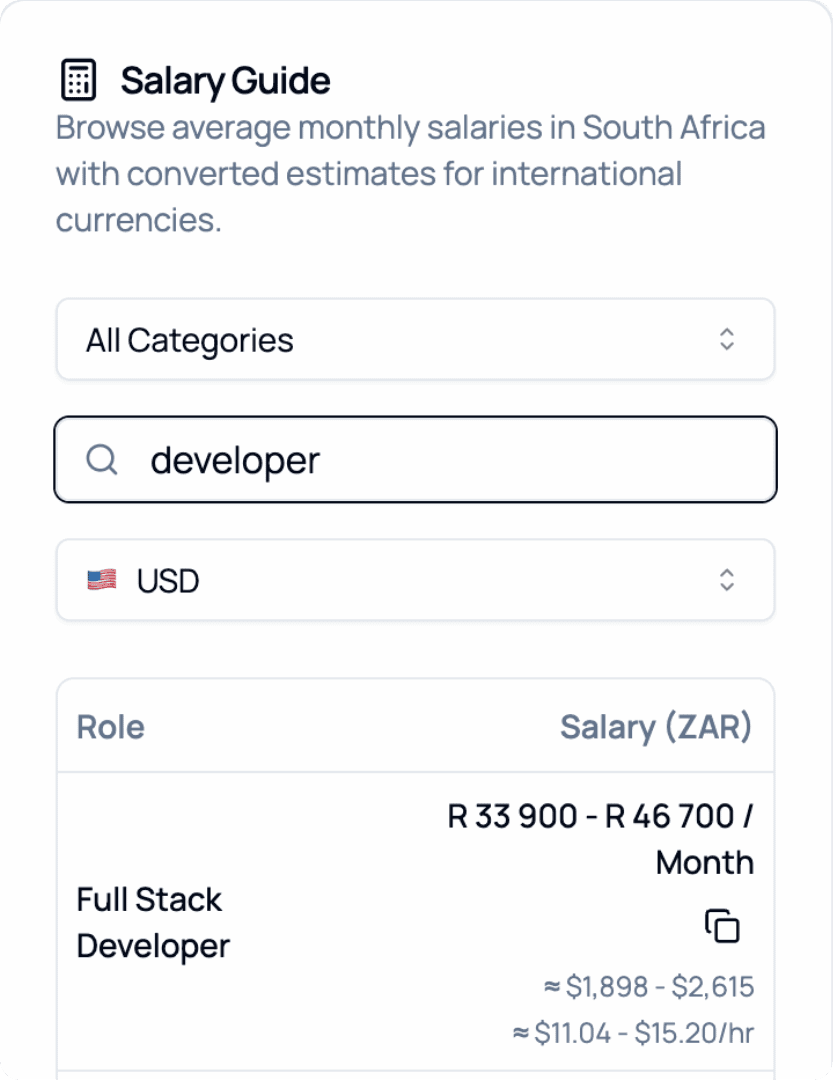
| Remote planning rate for South Africa | $800 to $1,100 a month for full-time VAs doing web research, spreadsheet upkeep and list work; $1,300 to $1,900 for experienced VAs whose work includes reporting | As listed, for 160 hours | HireSava salary guide |
The benefits estimate divides the median wage by 0.70, because wages and salaries made up 70.0% of private industry compensation costs in the BLS June 2026 survey, with benefits the other 30.0%. PayScale's South African figure rests on six self-reported profiles, so treat it as a rough marker rather than a benchmark. The South African salary guide gives the planning ranges for remote work paid by foreign employers. Agree the rate and the currency before the paid test starts.
Tools and survey sample are the other lines in the budget:
- Visualping watches pages for changes. Its free plan covers 150 checks a month across 5 pages. Personal 1K costs $14 a month, or $120 a year, for 10 pages, and Business 20K costs $140 a month for 200 pages and 5 users.
- SurveyMonkey's Team Advantage plan costs $30 per user a month, billed annually, starting at 3 users, with 50,000 responses a year.
- Prolific recruits survey participants. It sets a minimum participant pay of £6.00 or $8.00 an hour, recommends at least £9.00 or $12.00, and says its platform fee is usually 42.8% for corporate customers and 33.3% for academic or non-profit ones.
- The ad libraries, EDGAR, Companies House, County Business Patterns and the USPTO search are free.
A worked example: a full-time South African market research VA budgeted at $1,600 a month, the middle of the experienced band, plus Visualping Personal 1K on annual billing at $10 a month, costs $1,610 a month. A one-off consumer survey of 300 completes on Prolific, at 10 minutes each and the recommended $12 an hour, adds $600 in participant pay and $256.80 in platform fees, $856.80 in total, before any survey software seats.
A paid test before you hire
Give every shortlisted candidate the same paid task, about two hours long, built from your real market:
- Name five competitors. For each, record the entry plan's price and what it includes, with the URL and the date checked.
- Find one ad that each competitor is running now in the Meta Ad Library or the Google Ads Transparency Center, with a screenshot and the library link.
- Compare each pricing page with a Wayback Machine snapshot from about six months earlier and note what changed.
- Where a price is not published, write "not published." Do not estimate it, and do not contact the company.
- Finish with a short summary of what changed, with each sentence labelled as a finding or an interpretation.
Spot-check five cells against the live pages. Score accuracy, whether every claim has a working link and a date, whether the candidate marked gaps instead of filling them, and how cleanly the summary separates what the pages say from what the candidate thinks. Read the written English closely, because the digest is the product. The VA skills test generator builds a test from your scope, and the candidate scorecard keeps scores comparable across candidates.
The first month and the weekly digest
Spend the first week on setup. The VA lists the competitors and sources, builds the tracker and a source log (URL, date checked, the claim it supports) and writes a short process for each recurring task. The VA SOP generator gives a template. From the second week the work settles into a cadence.
| When | Task | Output |
|---|---|---|
| Weekly | Pricing pages through a page monitor, the ad libraries, competitors' release notes and new job postings | A one-page digest of what changed, with links, and a short list of items that need your decision |
| Monthly | Review themes and a messaging comparison | Theme counts with sample quotes, and headlines and offers side by side |
| Quarterly | Battlecard refresh, market data refresh and new trademark filings | Updated battlecards and a list of what moved since last quarter |
| Per project | Survey fieldwork or customer interviews | A clean data file, the codebook, and a methods note that states the limitations, as Article 7(c) expects |
Job postings belong in the weekly digest: a competitor hiring for a new country or product line is public evidence of a plan. The daily report generator gives the VA a format for end-of-day notes that roll up into the digest.
Working hours across time zones
South Africa keeps UTC+2 all year, with no daylight saving time. Until US clocks go forward on March 14, 2027, Johannesburg is 7 hours ahead of New York, 10 ahead of Los Angeles, 2 ahead of London and 9 behind Sydney. A VA working 08:00 to 17:00 in South Africa overlaps a London office day for six hours and a New York day for one hour.
Research suits that gap. For a US team, the VA works while the office is closed, and the digest is waiting at the start of the day. A weekly call in the overlap covers questions. The time zone overlap calculator checks a schedule against your city.
Hiring a South African research VA through HireSava
HireSava is a marketplace for hiring South African professionals directly: you post the role, interview and hire with no agency in the middle. Employers remain responsible for payroll, HR, and compliance for the people they hire. The role pages above list typical tasks, and the service pages cover competitor price monitoring, market and competitor analysis and market research surveys. The job description generator drafts the posting from the scope you settled above, and the VA NDA generator covers confidentiality before the first file changes hands.
When the brief and the access plan are settled, create an employer account and post the role. The pricing page lists the employer plans.
Sources and notes
This is general information for employers, not legal advice. Sources were checked on November 24, 2026:
- ICC and ESOMAR: the ICC/ESOMAR International Code on Market, Opinion and Social Research and Data Analytics (PDF, updated as of July 2025), for the client responsibility for contractors and Articles 1(e), 3(b), 4(a), 7(c) to 7(f) and 12(a); and the ICC's publication page of September 29, 2025.
- US Bureau of Labor Statistics: the Occupational Outlook Handbook entry for market research analysts, for duties and May 2025 pay for SOC 13-1161, market research analysts and marketing specialists, and Employer Costs for Employee Compensation for June 2026, released September 9, 2026.
- Trade secrets and competition: 18 U.S.C. 1839 for the definition of improper means; regulation 3 of the Trade Secrets (Enforcement, etc.) Regulations 2018; and the FTC's guide to price fixing.
- Data protection: the ICO's guidance Are we making a restricted transfer? and the European Commission's list of adequacy decisions.
- AI: OpenAI's enterprise privacy page, updated January 8, 2026; its help articles How your data is used to improve model performance and Does ChatGPT tell the truth?.
- Free sources: Meta's help page What is the Meta Ad Library and how do I search it?; Google's March 29, 2023 announcement of the Ads Transparency Center; LinkedIn's help page on its Ad Library; the SEC's EDGAR full-text search FAQ; GOV.UK's Searching the Companies House register, last updated June 9, 2026; the Census Bureau's County Business Patterns; and 15 U.S.C. 1051 for applications based on a bona fide intention to use a mark.
- Prices: the Time etc US and Time etc UK pricing pages, and the pricing pages of Visualping, SurveyMonkey and Prolific, all viewed November 24, 2026.
- PayScale for South African market research analyst pay: a secondary source built from self-reported salaries, used because it is the published figure for this job title.
- Federal Reserve data on FRED: R17.4750 to the US dollar on November 20, 2026, the latest daily rate published.
- Time zones: the IANA Time Zone Database, and 15 U.S.C. 260a for US daylight saving time.
The monthly figures divide the annual figures by 12, and the rand amounts are converted to dollars at the exchange rate above.
Frequently Asked Questions
Explore related hiring options
Useful next pages based on this article's topic:
- Remote SEO Specialist role — organic growth execution and reporting
- On-Page SEO Optimization service — content relevance and ranking improvement
2026 Salary Guide: South Africa
Discover South African Salaries by Role. Compare costs and see how much you can save.