TL;DR
Learn what a bookkeeping virtual assistant should own, what to keep in-house, and how to structure a reliable monthly close process.
Use a practical US-focused framework for delegation, controls, onboarding, and KPI tracking across AP, AR, reconciliations, and reporting.
Model cost and ROI with clear assumptions so you can scale finance operations without losing compliance discipline.
Table of Contents
- Introduction
- What does a bookkeeping virtual assistant do for a US business?
- How much does a bookkeeping virtual assistant cost in the US, and what ROI should you expect?
- Which bookkeeping tasks should you delegate first, and what should stay in-house?
- How do you keep bookkeeping accurate and compliant when the work is remote?
- How do you onboard and manage a bookkeeping virtual assistant for consistent monthly close?
- Final Thoughts
Introduction
If you are evaluating finance support options, start with the accounting industry page for broader staffing context.
A lot of US businesses do not have a revenue problem first. They have an operations visibility problem. Revenue may be growing, but cash timing is unclear, reconciliation is delayed, and leadership decisions are based on reports that are already stale. When bookkeeping falls behind, founders and operators lose trust in their numbers, and every planning conversation gets harder than it should be.
That is why demand for a bookkeeping virtual assistant keeps rising among startups, agencies, ecommerce brands, and local service businesses. Teams want reliable execution on recurring finance-admin tasks without forcing an immediate full-time local hire. If you are mapping support options in this vertical, the accounting industry page provides the broader context for role design and staffing paths.
This guide goes deeper into execution. You will see what a bookkeeping virtual assistant should actually own, where the role boundaries should stay firm, how to protect data quality and compliance, what costs to expect, and which metrics prove value in the first 90 days.
To help you build a complete operating model, this article also connects to adjacent hiring and remote-team playbooks: How to Hire a Virtual Assistant for Small Business in 2026, Virtual Assistant Cost Calculator Guide for SMB Teams, Virtual Assistant Onboarding Checklist for 2026, How to Hire Remote Talent Without Recruiting Fees, What Is an Onshore and Offshore Team?, and 5 Best Countries to Find Remote Talent in 2026.
For external references, we will anchor to practical US sources including the IRS recordkeeping guidance for businesses, U.S. Small Business Administration finance resources, FASB standards overview, AICPA resources, and FFIEC guidance for information security in financial systems.
What does a bookkeeping virtual assistant do for a US business?
Snippet answer: A bookkeeping virtual assistant handles structured, repeatable finance operations such as transaction categorization, AP/AR support, reconciliations, receipt management, and reporting prep under a defined review workflow led by your controller, CPA, or finance owner.
Most confusion around this role comes from vague job descriptions. If your posting says "support bookkeeping," you will likely get inconsistent output because candidates and managers interpret that phrase differently. High-performing teams define the role by workflow lane, system access, and review cadence.
In practical terms, a bookkeeping virtual assistant is a process owner for recurring financial admin work that must be completed accurately, on schedule, and with clear documentation. The role is not there to provide tax strategy, legal advice, or independent accounting judgments. It is there to keep the operating engine clean so your accountant and leadership can make decisions from trustworthy data.
Typical responsibilities include:
- Daily transaction coding support based on your chart of accounts and SOP rules.
- Accounts payable preparation: invoice intake, coding suggestions, due-date tracking, and approval routing.
- Accounts receivable support: invoice issuance workflows, payment follow-up, and aging report updates.
- Bank and credit-card reconciliation preparation with exception logging.
- Expense receipt collection, naming standards, and document linking in your accounting stack.
- Monthly close checklist coordination with status tracking and handoff notes.
- Basic financial reporting package preparation for management review.
Most businesses use cloud tools for this lane. Common stack examples include QuickBooks Online, Xero, Bill.com, Stripe dashboards, Shopify payout reports, and document systems like Google Drive or SharePoint. The exact toolset matters less than control clarity. A mediocre stack with disciplined SOPs often outperforms a premium stack with fuzzy ownership.
Role clarity by responsibility level
A useful framework is to split bookkeeping work into three decision layers:
- Process execution: repetitive and rule-based tasks with clear instructions.
- Exception handling: non-routine cases that need documented escalation.
- Financial judgment: accounting policy decisions and tax-sensitive interpretation.
A bookkeeping virtual assistant should own layer 1, support layer 2, and escalate layer 3. If this boundary is maintained, you get speed without compromising financial integrity.
Where this role creates the most value
The value is not only lower labor cost. The biggest gain is operating consistency. Businesses with a strong remote bookkeeping lane typically see:
- Fewer month-end surprises because reconciliations happen continuously.
- Better cash visibility from consistent AP/AR tracking.
- Faster close cycles due to checklist discipline.
- Reduced founder interruption from routine finance admin requests.
- Cleaner audit trail for accountants, lenders, and diligence events.
This matters especially in businesses where one person currently handles "all admin and books" by habit. As volume grows, that setup becomes fragile. A dedicated bookkeeping virtual assistant introduces process redundancy and accountability before finance chaos appears.
What this role is not
A bookkeeping virtual assistant is not a replacement for every finance function. Keep these boundaries explicit:
- No independent tax filing decisions without licensed oversight.
- No final policy calls on revenue recognition or complex accrual treatment.
- No unsupervised changes to chart-of-accounts structure.
- No direct access expansion without approval and logging.
The right mental model is simple: this role manages flow, hygiene, and repeatability. Your CPA, controller, or owner remains accountable for accounting policy and final review.
How much does a bookkeeping virtual assistant cost in the US, and what ROI should you expect?
Snippet answer: Costs vary by scope, experience, and staffing model, but ROI is usually driven by reclaimed leadership time, reduced close delays, lower error correction, and better cash control rather than hourly rate alone.
Many teams ask for a single market number. That usually leads to a bad decision because bookkeeping support is not a commodity when quality controls differ. A lower fee with weak reconciliation discipline can become more expensive than a higher fee with consistent close performance.
Use a total-cost view instead of an hourly-only view.
Direct cost components
- Service fee or compensation for the bookkeeping virtual assistant.
- Software seat licenses (accounting system, AP/AR tools, password manager).
- Onboarding time for SOP walkthrough and process shadowing.
- QA/review time from your internal finance owner.
Indirect cost components
- Rework from miscategorization or missed reconciliations.
- Delay cost if month-end closes slip and decisions are deferred.
- Opportunity cost when founders or senior managers handle low-value finance admin.
- Attrition risk if no backup process or documentation exists.
Simple ROI model for SMB teams
Use this baseline formula:
- Estimate hours your high-value team currently spends on bookkeeping admin.
- Estimate how many of those hours can be delegated safely.
- Multiply recovered hours by blended internal value per hour.
- Subtract total program cost (not just base fee).
Illustrative example:
- Founder/ops lead currently spends 28 hours/month on bookkeeping admin.
- Safe delegation estimate: 70% (19.6 hours/month).
- Blended internal value: $140/hour.
- Recovered value: $2,744/month.
- Total support program cost: $1,350/month.
- Net monthly operating gain: about $1,394 before secondary benefits.
Secondary benefits often matter more over time:
- Faster invoicing and collection improves working capital.
- Cleaner books reduce tax-season scramble and accountant clean-up fees.
- Better reporting cadence improves pricing, hiring, and spend decisions.
Cost by operating maturity
Early-stage businesses usually start with part-time structured support. Growth-stage businesses with high transaction volume often move to broader lane ownership with stronger monthly-close coordination.
A practical progression:
- Stage A (founder-led books): 10-20 hours/week, heavy SOP build and cleanup.
- Stage B (steady operations): 20-30 hours/week, recurring AP/AR/recon lane ownership.
- Stage C (multi-entity complexity): 30-40+ hours/week plus deeper controller collaboration.
This is why a cost conversation without scope definition is misleading. Before comparing candidates or providers, define the top 20 recurring tasks and quality standard for each task.
Pricing mistakes to avoid
- Buying the cheapest support before documenting your chart-of-accounts logic.
- Ignoring QA time in the first 30-60 days.
- Failing to budget for secure tooling and access controls.
- Treating one successful month as proof that controls are mature.
If you need a broader budgeting baseline, compare this model with Virtual Assistant Cost Calculator Guide for SMB Teams and then calibrate specifically for bookkeeping risk and review requirements.
Which bookkeeping tasks should you delegate first, and what should stay in-house?
Snippet answer: Delegate high-frequency, rules-based bookkeeping tasks first, while keeping accounting policy decisions, tax positions, and complex judgment-heavy exceptions with your CPA, controller, or finance lead.
The best delegation sequence starts with work that is repetitive, documented, and easy to QA. Do not start with the hardest exceptions first. Build confidence with controlled lanes, then expand scope once error rates stabilize.
Best first-wave tasks to delegate
- Transaction categorization using approved coding rules.
- AP intake and due-date tracking with approval routing.
- AR follow-up workflows and aging status updates.
- Bank-feed cleanup and reconciliation prep checklist items.
- Receipt/document collection with naming and storage standards.
- Weekly cash-flow snapshot prep for management review.
These tasks share three traits: high repetition, measurable output, and clear SOP potential.
Tasks to keep in-house or under licensed oversight
- Final accounting policy decisions (accrual methods, revenue recognition decisions).
- Tax strategy, filing judgments, and tax authority responses.
- Material adjustments at close that affect lender, board, or investor reporting.
- Complex multi-entity consolidation decisions.
Even when remote support is strong, these decision lanes should remain with your qualified finance owner.
Delegation matrix that prevents chaos
Use a written matrix with three categories:
Delegate by defaultDelegate with reviewDo not delegate
Example logic:
- Recurring software subscription invoice coding: delegate by default.
- Unusual vendor payment with unclear documentation: delegate with review.
- Revenue recognition treatment for prepaid contracts: do not delegate.
This matrix reduces ambiguity and protects quality during high-volume weeks.
30-60-90 sequencing for scope expansion
Days 1-30:
- Start with 5-8 high-frequency tasks.
- Require daily check-ins for blockers and exception review.
- Track initial error patterns without pushing speed targets.
Days 31-60:
- Expand to 10-15 tasks once baseline accuracy is stable.
- Introduce weekly QA scorecards and category-level error trends.
- Tighten close checklist deadlines by workflow step.
Days 61-90:
- Shift to exception-based supervision on mature lanes.
- Add backup coverage documentation and handoff templates.
- Formalize KPI targets for close-time and reconciliation completeness.
A phased rollout is slower up front but faster over the quarter because it prevents rework loops.
Common delegation failure patterns
- Delegating too many tasks before SOPs are complete.
- Mixing bookkeeping execution with policy judgments in the same lane.
- Skipping exception tagging, so recurring issues look random.
- Letting each stakeholder give conflicting instructions.
To avoid this, assign one decision owner for bookkeeping policy interpretation and one daily workflow owner for execution.
Internal linkages for broader remote-ops design
If your team is still shaping role scope across departments, these related guides can help keep the model consistent:
- How to Hire a Virtual Assistant for Small Business in 2026
- Virtual Assistant Onboarding Checklist for 2026
- How to Hire Remote Talent Without Recruiting Fees
- What Is an Onshore and Offshore Team?
- The Untapped Talent Pool: Why US Companies Are Hiring Remote Staff from South Africa
How do you keep bookkeeping accurate and compliant when the work is remote?
Snippet answer: Accuracy and compliance in remote bookkeeping come from explicit controls: role-based access, documented SOPs, dual-review checkpoints, evidence retention, and recurring QA tied to a clear escalation path.
Remote work itself is not the risk. Uncontrolled workflows are the risk. A local employee with weak processes can create the same failures as a remote assistant. The strongest control model is process-based, not location-based.
Core control framework
- Access control: grant minimum necessary permissions by task lane.
- Documentation control: require source document linkage for every material transaction.
- Review control: set threshold-based review rules (for example, by amount, account type, or exception category).
- Audit control: maintain change logs, reconciliation sign-offs, and close checklists.
- Incident control: define how errors are reported, corrected, and prevented from recurring.
Practical data governance standards
- Use MFA across accounting and finance-adjacent systems.
- Centralize credential management in a business password manager.
- Restrict personal-email usage for financial files and approvals.
- Define retention windows and naming conventions for financial evidence.
- Use standardized templates for exception documentation.
The IRS recordkeeping guidance and SBA financial management resources are useful anchors for small-business finance hygiene. For organizations with stricter controls, frameworks referenced by the FFIEC help structure information security discussions with auditors and leadership.
Quality assurance cadence that works
Daily:
- Reconciliation exception review.
- AP/AR blocker resolution.
- Task-board closeout status.
Weekly:
- Sample-based transaction coding QA.
- Aging report review and collection action check.
- Missing-document audit.
Monthly:
- Full close checklist sign-off.
- KPI report on timeliness, accuracy, and exception volume.
- SOP update based on recurring error themes.
Quarterly:
- Access review and permission cleanup.
- Process-risk review with accountant/controller.
- Backup and continuity drill for critical workflows.
Compliance scope awareness
Not every business has the same compliance load, but every business needs consistent record integrity. Depending on your industry, finance workflows may also intersect with sector-specific rules or contractual obligations.
A practical baseline:
- Align bookkeeping practices with your accountant's requirements for financial statement preparation.
- Preserve evidence trails for deductible expenses and revenue support.
- Keep policy decisions and final sign-offs with qualified finance leadership.
- Document who changed what, when, and why.
Use references like FASB and AICPA for standards and professional context, while treating your own CPA guidance as the operational source of truth.
Red flags that signal control drift
- Reconciliations regularly completed late without root-cause notes.
- Large journal adjustments appearing late in close.
- Repeated uncategorized transactions in the same account lanes.
- Missing receipts concentrated in specific spend categories.
- Multiple stakeholders giving contradictory coding instructions.
When these appear, pause scope expansion and fix process clarity first.
How do you onboard and manage a bookkeeping virtual assistant for consistent monthly close?
Snippet answer: Onboard with a structured 30-60-90 plan that combines tool access, SOP training, controlled delegation, KPI scorecards, and recurring review rhythms focused on month-end close reliability.
Onboarding is where most bookkeeping programs either become stable or become expensive. If you rush tool access before role clarity, you create preventable mistakes and trust erosion. If you over-document without live workflow practice, productivity stalls.
Use a phased plan that balances speed with control.
Week 1-2: Foundations
- Confirm role boundaries and delegation matrix.
- Set up secure access with least-privilege permissions.
- Review chart of accounts, naming standards, and escalation rules.
- Walk through prior month close artifacts and known pain points.
Deliverables:
- Signed SOP acknowledgement.
- Access checklist complete.
- First set of shadowed tasks with QA feedback.
Week 3-4: Controlled ownership
- Assign recurring daily and weekly tasks.
- Require documented exception notes for non-routine items.
- Start KPI baseline tracking (not full target enforcement yet).
Deliverables:
- Task completion trend report.
- Exception log by category.
- First independent reconciliation prep with review notes.
Days 31-60: Performance shaping
- Expand ownership into AP/AR and reconciliation lanes.
- Introduce response-time and quality targets.
- Hold weekly review with finance owner to resolve recurring issues.
Deliverables:
- Weekly QA scorecards.
- Reduced exception recurrence in top 3 categories.
- Improved close-readiness checklist completion.
Days 61-90: Scale readiness
- Move mature workflows to exception-based supervision.
- Add backup coverage and cross-training documentation.
- Finalize dashboard used for ongoing management.
Deliverables:
- Stable month-end close timeline.
- Clear handoff rules for accountant/controller review.
- Documented continuity plan for absences or surge weeks.
KPI dashboard for finance operations
Track both speed and quality. Speed without quality creates rework. Quality without speed creates reporting lag.
Core KPIs:
- Days to close month-end books.
- Reconciliation completion rate by due date.
- AP processing turnaround time.
- AR aging movement and follow-up completion.
- Transaction QA error rate.
- Exception recurrence by category.
Leadership KPIs:
- Founder/manager hours recovered from bookkeeping admin.
- Forecast confidence trend based on reporting timeliness.
- Clean-up hours requested by external accountant.
Meeting cadence
- Daily 10-minute blocker sync during ramp-up.
- Weekly 30-minute QA and workflow calibration.
- Monthly close retrospective with improvement actions.
This rhythm keeps accountability lightweight but consistent.
Documentation standards that reduce turnover risk
A bookkeeping function should survive personnel changes without operational collapse. Build documentation as you operate, not as a separate project.
Minimum documentation set:
- Task-level SOPs with screenshots where useful.
- Monthly close checklist with owner and due date per step.
- Exception playbook for top recurring issue types.
- Access map by system and permission level.
- Handoff template for accountant/controller communication.
If you want a broader people-ops template for this process, use Virtual Assistant Onboarding Checklist for 2026 and adapt it to finance-specific control requirements.
Final Thoughts
A bookkeeping virtual assistant can be one of the highest-leverage hires for a US business when the role is defined as an operating system, not an ad hoc helper. The teams that get strong results are not the ones with the fanciest software. They are the ones that define ownership, review thresholds, escalation rules, and KPI accountability from day one.
Start with a narrow lane, stabilize quality, then scale scope deliberately. That approach protects accuracy, improves close speed, and gives leadership better data for decision-making.
If you are building this capability now, align your role design with the broader accounting industry page so staffing, process, and growth priorities stay connected.
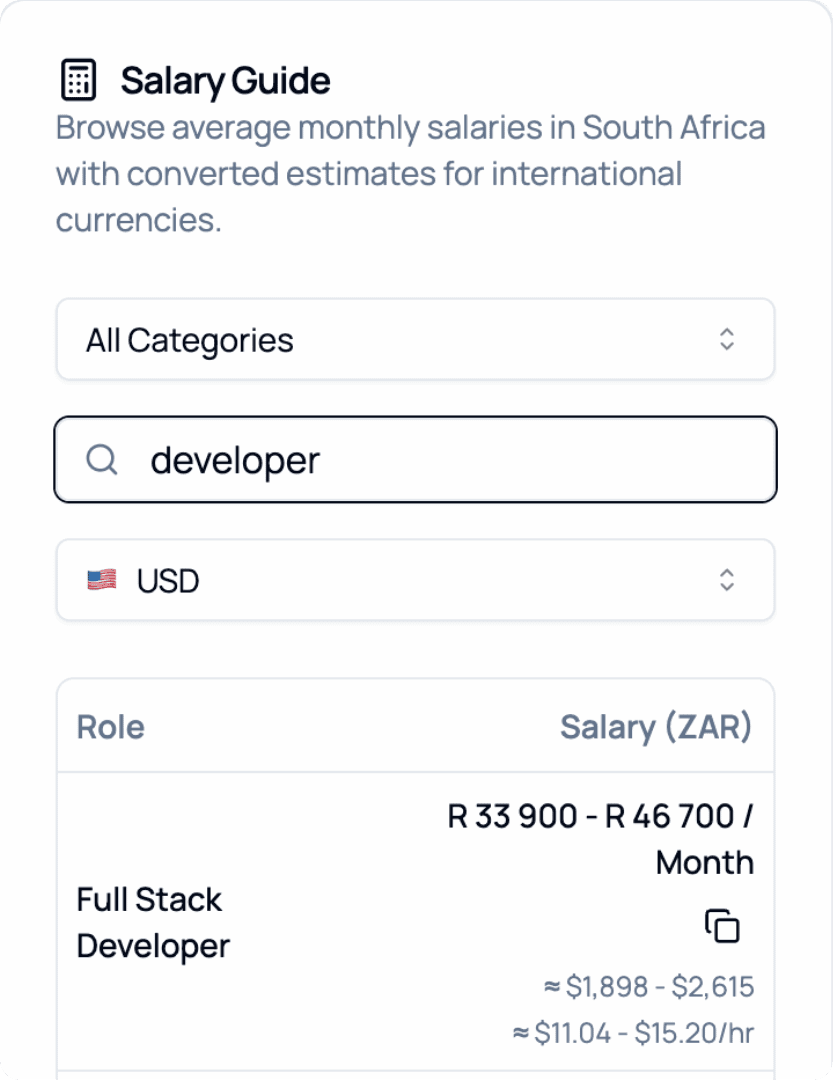
2026 Salary Guide: South Africa
Discover South African Salaries by Role. Compare costs and see how much you can save.