TL;DR
A practical employer comparison of South Africa vs Latin America virtual assistants for 2026 hiring decisions.
Compare communication, timezone overlap, role fit, management load, and quality-adjusted cost instead of shopping by hourly rate alone.
Use this guide to choose the better hiring lane for customer-facing support, operations, and growth roles.
Table of Contents
- South Africa vs Latin America virtual assistants: which is better for employers?
- Cost comparison: South Africa vs Latin America VA hiring
- Timezone overlap and collaboration fit
- Communication quality and customer-facing work
- Which region fits different role types?
- Management overhead: where the real cost shows up
- Employer decision framework: South Africa vs Latin America VAs
- Common employer mistakes in South Africa vs Latin America comparisons
- Should you hire virtual assistants from South Africa or Latin America?
- Final thoughts
If you’re comparing South Africa vs Latin America virtual assistants, you’re not just comparing wages. You’re choosing what kind of support model your business can run without creating avoidable management pain.
That distinction matters because these two hiring lanes usually solve different employer problems.
Latin America often gets attention for North America-friendly timezone overlap. South Africa often wins when employers care about polished English communication, customer-facing confidence, and quality-adjusted value in roles that need judgment.
So the real question is not, “Which region is cheaper?”
It is, which region helps this role reach stable output faster with less drag on the team?
If you want South Africa-specific pricing context first, start with How Much Does a Virtual Assistant Cost in South Africa? Employer Guide for 2026, Virtual Assistant Hourly Rate in South Africa (2026): What Employers Should Actually Pay, and Virtual Assistant Rates in South Africa (2026): Employer Benchmarks by Role and Seniority.
South Africa vs Latin America virtual assistants: which is better for employers?
Snippet answer: South Africa is often the stronger fit for communication-heavy, judgment-heavy, and customer-trust-sensitive roles. Latin America is often attractive when employers need tighter US timezone overlap, fast same-day collaboration, and easier scheduling with North American teams.
Neither region is automatically better.
If your role depends on nuanced writing, client communication, or executive support quality, South Africa often has the edge.
If your workflow depends on real-time collaboration across US business hours, Latin America can be a strong fit.
The expensive mistake is pretending those are the same hiring problem. They aren’t.
Cost comparison: South Africa vs Latin America VA hiring
Snippet answer: Latin America can look more expensive or cheaper depending on country, role, and market segment, but employers should compare quality-adjusted cost rather than headline hourly rate. South Africa often performs well when stronger communication and lower rework reduce the real operating cost of the role.
A pure rate comparison is lazy math.
Use this instead:
True Cost = Direct Cost + Oversight Time + Rework Cost + Delay Cost
That formula matters because a role that seems cheaper on paper can become expensive very fast if managers spend more time correcting work, clarifying tasks, or filling communication gaps.
Where South Africa often looks stronger on value
South Africa tends to compete well when the role includes:
- executive support,
- customer communication,
- recruiting coordination,
- sales support,
- operations coordination,
- tasks where polished English and contextual judgment matter.
In those roles, first-pass quality changes the economics more than a small hourly-rate gap.
Where Latin America can make strong economic sense
Latin America often looks attractive when:
- the team wants high overlap with US business hours,
- the role needs quick Slack responsiveness,
- managers want more real-time collaboration,
- the workflow includes live handoffs or same-day iteration,
- bilingual or regional market coverage matters.
That can be especially useful for North America-based teams that treat responsiveness as part of the role, not just a bonus.
Timezone overlap and collaboration fit
Snippet answer: Latin America often wins on pure timezone alignment for US employers, while South Africa usually offers partial overlap that can still work well for structured collaboration. The right choice depends on whether the role needs live collaboration all day or just a clean overlap window.
This is where many comparisons get oversimplified.
Yes, Latin America often gives US employers easier calendar alignment. That is real.
But not every role needs eight hours of live overlap.
South Africa can still work extremely well when the role needs:
- a strong overlap window for meetings and escalations,
- high-quality async execution,
- clear handoffs into the next work block,
- support for UK teams or globally distributed operations.
Latin America often fits best when
- same-day collaboration is constant,
- managers want quick iteration cycles,
- customer support or sales tasks happen during US hours,
- the team is heavily meeting-driven.
South Africa often fits best when
- a few overlap hours are enough,
- work quality matters more than constant pings,
- the role blends async execution with live touchpoints,
- the business serves both US and UK stakeholders.
Timezone fit matters. It just should not be the only thing in the room.
Communication quality and customer-facing work
Snippet answer: South Africa often stands out for polished English communication, especially in customer-facing, executive-support, and commercially sensitive roles. Latin America can be highly effective too, but communication quality varies more by country, role, and English-fluency expectations.
This is one of the biggest reasons employers choose South Africa.
When the role touches inboxes, prospects, customers, executives, or hiring candidates, communication quality is not cosmetic. It is the actual output.
A support hire who responds quickly but writes awkwardly can still create friction, reduce trust, and hurt conversion.
That is why many employers are not just asking for affordable remote support. They are asking for support that sounds credible to customers and leadership.
For a broader view of that employer logic, see Why US Companies Hire from South Africa and Hire Remote Staff in South Africa: Employer Playbook.
Which region fits different role types?
Snippet answer: South Africa is often stronger for roles that require communication judgment and professional polish. Latin America is often attractive for roles that depend on deep US-hour overlap, fast turnarounds, and collaborative execution during the North American workday.
South Africa often fits best for
- executive assistants,
- client success support,
- recruiting coordination,
- sales support,
- customer-facing admin,
- operations roles that need written judgment.
Latin America often fits best for
- roles with heavy live collaboration,
- support tasks tied closely to US office hours,
- fast-iteration growth or operations support,
- bilingual workflows,
- coordination-heavy roles where immediate back-and-forth matters.
Again: start with the workflow, not the map.
Management overhead: where the real cost shows up
Snippet answer: Management overhead often matters more than rate differences when comparing South Africa and Latin America. The best region is usually the one that lowers correction loops, preserves communication quality, and fits the way your team actually works day to day.
Ask this before you hire:
How many managed hours per week will this role consume until it reaches stable output?
That question is more useful than “Which region is cheaper?”
If your business is founder-led, moving fast, and still somewhat messy, South Africa often has an advantage in judgment-heavy roles because communication quality can reduce chaos.
If your team already runs on live collaboration throughout the US workday, Latin America may reduce scheduling friction enough to justify the choice.
Either way, if you ignore management overhead, your comparison is fake.
Employer decision framework: South Africa vs Latin America VAs
Use this five-question filter before choosing a hiring lane.
1. Does this role need constant US-hour overlap?
If yes, Latin America may be the cleaner fit.
2. How communication-sensitive is the role?
If the role touches customers, leaders, or revenue workflows, South Africa often deserves a serious look.
3. How expensive are mistakes?
The higher the downside of sloppy communication or weak judgment, the less helpful pure rate shopping becomes.
4. How async-friendly is your team?
If your team documents well and can work with structured overlap, South Africa can perform extremely well.
5. Do you need regional language or market coverage?
If Spanish or Portuguese coverage matters, Latin America may offer a strategic advantage beyond timezone.
That is the adult version of the comparison.
Common employer mistakes in South Africa vs Latin America comparisons
Snippet answer: The biggest mistakes are choosing by timezone alone, ignoring communication quality, and comparing rates without modeling management load. Employers should compare regions based on workflow requirements, not sourcing clichés.
Mistake 1: choosing by geography before defining the role
No clear role means no useful comparison.
Mistake 2: treating timezone as the whole decision
Better overlap is useful, but it does not fix weak execution.
Mistake 3: ignoring customer-facing communication risk
If the role affects trust or revenue, poor communication can erase any labor-cost advantage.
Mistake 4: skipping the management-cost math
Your invoice is not your operating cost.
Mistake 5: assuming all Latin America hiring lanes behave the same
Mexico, Colombia, Argentina, and other markets can differ meaningfully in pay expectations, English proficiency, and role fit. Lumping them together without checking the actual hiring lane is lazy.
Should you hire virtual assistants from South Africa or Latin America?
If your business needs polished English communication, better customer-facing confidence, and lower-friction support for judgment-heavy work, South Africa is often the better choice.
If your business depends on live US-hour collaboration, fast same-day coordination, or bilingual market coverage, Latin America may be the better fit.
The smart answer is operational, not ideological.
Choose the region that reduces managed hours, protects quality, and matches the way your team actually works.
That is the comparison that saves money.
Final thoughts
South Africa vs Latin America is not a fight about which region is “best.” It is a decision about workflow design, communication demands, timezone needs, and business risk.
For many employers, South Africa wins when communication quality and customer trust matter more than perfect timezone overlap. For others, Latin America wins when real-time collaboration is the bottleneck.
If you want a South Africa-first hiring lane built around employer outcomes, continue with South Africa vs Philippines Virtual Assistants: Employer Comparison for 2026, How Much Does a Virtual Assistant Cost in South Africa? Employer Guide for 2026, and How to Hire Remote Staff in South Africa: Employer Playbook (2026).
Explore related hiring options
Useful next pages based on this article's topic:
- Hire South African virtual assistants — core service page for evaluating HireSava's hiring model and next-step CTA
- Fluent English remote workers in South Africa — proof of communication quality for customer-facing and judgment-heavy roles
- South Africa virtual assistant cost guide — budget planning and quality-adjusted cost expectations
- South Africa VA rates benchmark — role-by-role compensation ranges and seniority bands
- South Africa hourly rate guide — hourly pricing expectations and hiring math
- Hire remote staff in South Africa playbook — screening, onboarding, and first-hire execution steps
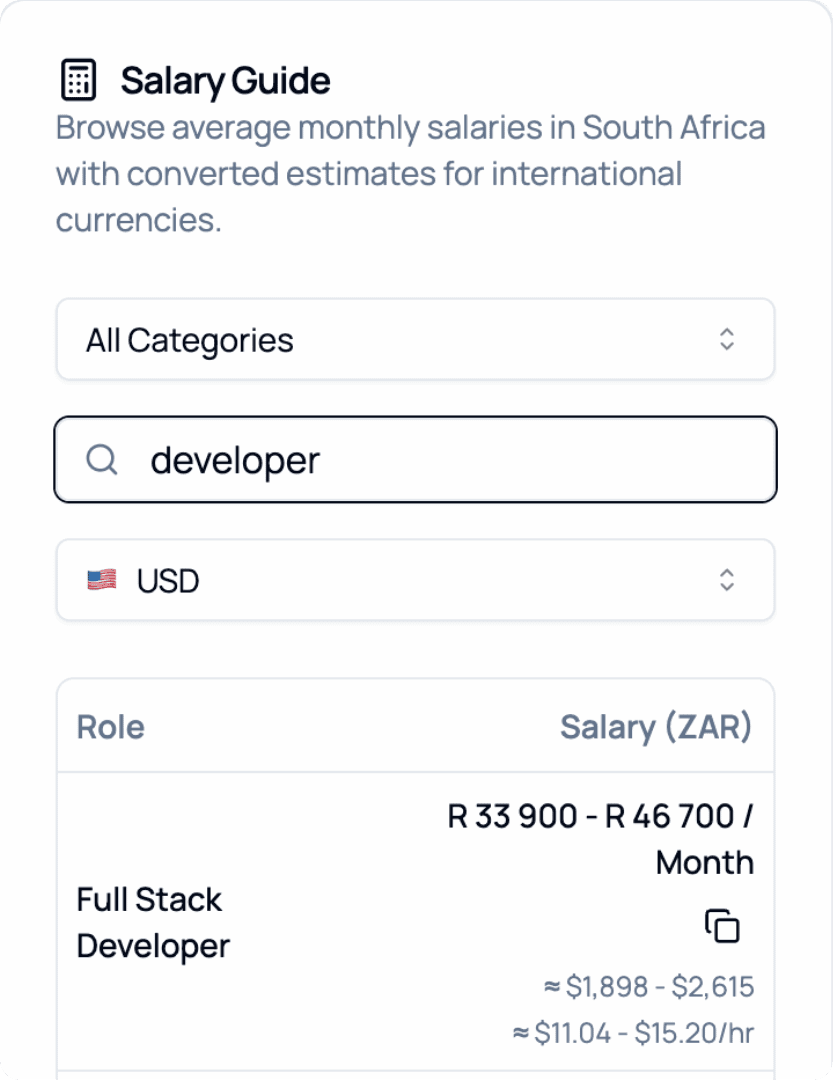
2026 Salary Guide: South Africa
Discover South African Salaries by Role. Compare costs and see how much you can save.