TL;DR
A CA(SA) takes about seven years to qualify: a SAICA-endorsed degree and postgraduate diploma, two SAICA exams and a three-year training contract. ICAEW, ICAS, CA ANZ and HKICPA offer CAs(SA) reciprocal membership.
A US tax practice needs each client's signed consent before return information goes to anyone outside the United States, its own staff included, and must mask Social Security numbers unless both sides keep an adequate data protection safeguard.
A US accountant at the May 2025 median wage costs about $119,500 a year with benefits. A full-time South African CA(SA) contracted at $3,000 a month, close to what newly qualified CAs earn at home, costs about $37,200.
Table of Contents
- What the designations on a South African CV mean
- US client work: consent, Social Security numbers and PTINs
- UK practices: screening, insurance and data transfers
- Australian practices: permission, supervision and APES 305
- Reporting standards and the work to hand over
- Working hours against your deadlines
- What it costs next to a local hire
- Before you make an offer
- Sources and notes
A South African accountant or bookkeeper can prepare the books, accounts and returns a US, UK or Australian practice would give its own staff, under that practice's review. The qualifications travel: a CA(SA) can join the ICAEW or CA ANZ through reciprocal membership, and bookkeepers sit national exams set at NQF levels 3 to 6. The rules that change are the ones on your side. A US tax practice needs each client's signed consent before return information leaves the United States, a UK practice has to bring the hire inside its anti-money laundering procedures, and an Australian practice needs client permission and, if it follows APES 305, must tell clients where outsourced work is done.
You can engage a South African accountant as an independent contractor, or employ one through a South African company or an employer of record. The guide to hiring employees in South Africa compares those routes, and the contractor or employee checker tests a planned arrangement against South African law. The professional rules for your practice apply on either route, with the differences noted where they come up.
What the designations on a South African CV mean
SAQA, the South African Qualifications Authority, registers the country's professional bodies and their designations, and its public register lists what each one requires. The table covers the accounting designations awarded by SAICA and SAIPA and the ICB's bookkeeping qualifications.
| Designation or qualification | Awarded by | What it takes | Remote work it fits |
|---|---|---|---|
| CA(SA), Chartered Accountant (South Africa) | SAICA | A SAICA-endorsed BCom (NQF 7) and postgraduate diploma in accounting (NQF 8), the Initial Assessment of Competence, a three-year training contract at an accredited training office, a professional program and the Assessment of Professional Competence | IFRS reporting, month-end close and consolidation, reviewing junior work, tax and audit file preparation, forecasting |
| AGA(SA), Associate General Accountant | SAICA | A SAICA-endorsed degree and a completed SAICA training contract, or recognized workplace experience instead of the contract | Financial and management accounts, client accounting in a practice |
| MAT(SA), Member Accounting Technician | SAICA | An accounting certificate at NQF 5, one year of relevant work and the Test of Professional Competence | Bookkeeping, reconciliations, payables and receivables |
| Professional Accountant (SA) | SAIPA | A SAIPA-accredited bachelor's degree covering financial accounting, tax, auditing, commercial law and management accounting; three years at an approved training center or six years of relevant experience; the four-hour Professional Evaluation exam | Small-company accounts and tax, management accounts, client accounting in a practice |
| National Certificate: Bookkeeping (NQF 3) and FET Certificate: Bookkeeping (NQF 4) | ICB exams | Exams set by the ICB, an independent examination body; membership designations come from a separate body, the ICBA | Day-to-day bookkeeping, bank reconciliations, data entry |
| National Diploma: Technical Financial Accounting (NQF 5) and National Diploma: Financial Accounting (NQF 6) | ICB exams | Further ICB exams; SAQA describes the level 5 diploma as training financial accounting technicians and the level 6 diploma as training financial accountants | Bookkeeping through to financial statements, management reporting, tax workpapers |
SAICA puts the degree behind a CA(SA) at NQF level 7 and the postgraduate diploma at level 8. A student who passes every step first time takes about seven years from first-year university to the designation, and SAICA reports that 74% of the chief financial officers of the 200 largest JSE-listed companies are CAs(SA). SAICA's first board exam has been the Initial Assessment of Competence since 2025, so a candidate who sat it before then passed its predecessor, the Initial Test of Competence (ITC).
Reciprocity covers membership, not licenses. SAICA's agreements let a CA(SA) apply for full membership of the ICAEW (as an ACA), ICAS, CA ANZ and HKICPA, of CPA Canada after a short course, and of Chartered Accountants Ireland usually after local company law and tax exams. SAICA states that the agreements "are in place for membership rights only". A US CPA license takes longer: SAICA lists seven more years of relevant experience after qualifying, then the IQEX exam, then an application to a state board.
Check a CA(SA), AGA(SA) or MAT(SA) with SAICA's Verify a Member search, which takes a member number, an ID or passport number, or a name. For a SAIPA or ICB credential, ask for the certificate and confirm it with the body that issued it. The background check planner covers degree verification through SAQA, criminal record checks and the consent each one needs. One date to know when reading an ICB certificate: SAQA's register shows the National Certificate: Bookkeeping and the National Diploma: Technical Financial Accounting past their registration end date, with 30 June 2027 as the last date for new enrolments and 30 June 2030 as the last date to complete.
US client work: consent, Social Security numbers and PTINs
These rules bind US tax return preparers: CPA firms, enrolled agents and any business that prepares returns for pay. Section 7216 governs what a preparer does with a client's information, so a company sharing its own records with its own bookkeeper is outside it.
Signed consent comes before the first file
The exceptions that let a US preparer pass a client's return information to its own staff and to other preparers without consent apply only when the recipient is in the United States (26 CFR 301.7216-2). Sending it to staff or a preparer outside the United States, including the firm's own employee in Cape Town, needs the client's written consent first (26 CFR 301.7216-3).
For clients who file in the Form 1040 series, Revenue Procedure 2013-14 sets the form of that consent:
- It is a separate document, which can be attached to the engagement letter. On paper it uses at least 12-point type; on screen the client signs by typing their name or a PIN of at least five characters.
- The client must opt in. A form that asks clients to untick disclosures they do not want is not valid.
- It carries the mandatory federal statements plus this sentence: "This consent to disclose may result in your tax return information being disclosed to a tax return preparer located outside the United States."
- If the client does not set a duration, the consent lasts one year from the date of signature.
Because the disclosure is part of preparing the return, the prescribed wording lets you decline the engagement or change its price if a client will not sign. Consent to uses outside return preparation, such as marketing, cannot be made a condition of service. An unauthorized disclosure is a misdemeanor under section 7216, with a fine of up to $1,000, up to a year in prison, or both, and section 6713 adds a civil penalty of $250 per disclosure, up to $10,000 a year.
Social Security numbers stay masked unless you meet the safeguard test
For Form 1040 filers, a US preparer may not even ask for consent to send a Social Security number to a preparer abroad, and must redact or mask it before the information leaves, unless both preparers keep an "adequate data protection safeguard" when the consent is signed and when the data is sent. Revenue Procedure 2013-14 defines that as a management-approved and implemented security program, with administrative, technical and physical safeguards, that conforms to a recognized framework such as the AICPA/CICA Privacy Framework or IRS Publication 1075. The consent then needs a longer statement that names the Social Security number and warns that federal agencies may not be able to enforce US privacy law against a preparer outside the United States.
For a small practice, masking is usually the simpler path. If your tax software can mask identification numbers by user role, give the South African preparer a masked role; if it cannot, redact source documents before they are uploaded, and keep identity checks and e-file signatures with US staff.
PTINs, and who speaks to the IRS
Anyone who prepares or helps prepare federal returns for pay needs a preparer tax identification number. The fee is $18.75 for a new PTIN or a renewal. A foreign person who has no Social Security number and is not eligible for one applies online or by mail with Form W-12 and Form 8946. Since the October 2025 revision, every applicant supplies two current government-issued identity documents, at least one with a photo, and the IRS asks paper applicants to allow six weeks.
A PTIN carries no right to represent a client. The IRS says enrolled agents, CPAs and attorneys have unlimited representation rights, Annual Filing Season Program participants have limited rights, and other PTIN holders have none. The split that works: the South African hire prepares, and a US credential holder reviews, signs as the paid preparer and handles IRS contact.
AICPA members have three more steps
The AICPA Code of Professional Conduct, updated through September 2026, adds three requirements when a third-party service provider such as a contractor works on client files:
- Before disclosing confidential client information to the provider, inform the client, preferably in writing. If the client objects, either do the work without the provider or decline the engagement (interpretation 1.150.040). Administrative support such as record storage, software hosting or e-file transmission is exempt from this notice; bookkeeping and return preparation are not.
- Either sign a contract with the provider that keeps the information confidential and gives reasonable assurance it has procedures against unauthorized release, or get the client's specific consent (1.700.040).
- Check the provider's qualifications before the work starts, and plan and supervise the work so it meets the professional standards that apply (1.300.040).
Separately, federal law requires tax and accounting professionals to keep a written information security plan, because the Gramm-Leach-Bliley Act treats them as financial institutions (IRS release IR-2026-92, 18 August 2026). The plan has to cover the South African hire's access, and a contractor's agreement should require them to keep the safeguards you set. IRS Publication 5708 is a template written for small practices, and the data security planner builds a least-privilege access plan for the hire.
UK practices: screening, insurance and data transfers
A UK practice that uses a South African accountant stays responsible for the work and for its anti-money laundering compliance. Regulation 21 of the Money Laundering Regulations 2017 requires a supervised firm, where its size and nature make it appropriate, to screen relevant employees before they are appointed and during the appointment, assessing their skills and knowledge and their conduct and integrity.
ICAEW's helpsheet on using a subcontractor, last updated on 11 February 2025, describes a subcontractor as "a quasi-employee of the practice that is itself supervised". It expects the practice to give the subcontractor AML training (or rely on evidence of training they already hold), to bind them by contract to the practice's procedures, including reporting suspicions to the practice's MLRO, and to include them in staff screening. It also says the practice should tell its professional indemnity insurer the subcontractor's name and status, so the policy's anti-subrogation clause extends to them.
Client personal data is where the contract type matters. ACCA's guidance for practices notes that the UK transfer rules do not apply when the receiver is an employee of the sender, so an accountant on your own payroll is covered by your existing UK GDPR obligations. A contractor, or staff employed by an outsourcing company, receives a restricted transfer. South Africa had no UK adequacy regulations as of February 2026, according to ACCA, so the transfer needs the ICO's International Data Transfer Agreement or the Addendum to the EU standard contractual clauses, signed after a transfer risk assessment, which the Data (Use and Access) Act now calls the data protection test. Articles 13 and 14 of the UK GDPR require your privacy notice to tell people about the transfer and the safeguard used.
ACCA has no rules written for outsourcing, but its code of ethics still applies: members review the work outsourced providers produce and do due diligence on their expertise. Both the ICAEW and ACCA codes treat client information as confidential, so state in your engagement terms that staff or subcontractors outside the UK may work on the file.
Australian practices: permission, supervision and APES 305
For a registered tax or BAS agent, Code item 6 in section 30-10 of the Tax Agent Services Act 2009 comes first: unless you have a legal duty to disclose, you must not disclose information about a client's affairs to a third party without the client's permission. The Tax Practitioners Board counts outsourced service providers as third parties. Get the permission in writing, for example in the engagement terms the client signs, and say that the work may be done in South Africa.
The TPB's outsourcing and offshoring guidance, now TPB(GS) 31/2018, keeps responsibility for the quality of outsourced work with the registered agent. Supervision and control should match the nature and extent of the work, and the TPB has said agents should not state or imply that all their work is done in Australia when it is not.
Members of CA ANZ, CPA Australia and the IPA also follow APES 305 Terms of Engagement. For engagements starting on or after 1 July 2021, a member who uses outsourced services must document and communicate the provider's details, where the outsourced work is performed, and its nature and extent. If your practice is covered by the Privacy Act 1988, Australian Privacy Principle 8 also applies: before personal information goes to an overseas recipient, take reasonable steps to make sure the recipient does not breach the privacy principles, because your practice remains accountable for what it does with the data.
Reporting standards and the work to hand over
South African accountants train on IFRS. The JSE has required IFRS for listed companies since 1 January 2005, and South Africa adopted the IFRS for SMEs Standard without changes for companies the Companies Act Regulations allow to use it (IFRS Foundation jurisdiction profile). That training carries over closely to Australia, whose Tier 1 standards incorporate IFRS, and to the UK, where FRS 102 is broadly based on the IFRS for SMEs (FRC). US GAAP and US tax are separate bodies of rules, so a US practice should either train a South African hire on them or recruit one who has already worked on US files.
Tax is local everywhere. A CA(SA) studied South African tax, so test the tax you need with a work sample rather than reading it off the CV. Work that suits a remote South African accountant or bookkeeper:
- Bookkeeping, bank and card reconciliations, payables and receivables
- Month-end close, accruals and management accounts
- Return and workpaper preparation under review: US 1040, 1065 and 1120-S returns, UK self assessment, Australian individual and company returns
- Audit support such as sampling, confirmations and file preparation for the reviewing partner
- Budgets, forecasts and board packs
Keep these with a local owner: signing returns and opinions, advice on tax positions, payments out of client or company bank accounts, and any work a license reserves.
A good work sample takes one to two hours and uses redacted real data: a bank reconciliation with two planted errors, a short set of adjusting journals, or a return prepared from a redacted organizer. The skills test generator helps structure the test, and the candidate scorecard keeps the comparison between candidates consistent.
Working hours against your deadlines
South Africa keeps South African Standard Time (UTC+2) all year, with no daylight saving, so the gap to your office moves when your clocks change.
| Your office | Gap in November 2026 | A South African 08:00 to 17:00 day, your time | Next change |
|---|---|---|---|
| New York | South Africa 7 hours ahead | 01:00 to 10:00 EST | 6 hours from 14 March 2027 |
| Los Angeles | South Africa 10 hours ahead | 22:00 the previous evening to 07:00 PST | 9 hours from 14 March 2027 |
| London | South Africa 2 hours ahead | 06:00 to 15:00 GMT | 1 hour from 28 March 2027 |
| Sydney | Sydney 9 hours ahead | 17:00 to 02:00 AEDT | 8 hours from 4 April 2027 |
A US practice gets a preparation queue worked overnight, but only an hour of live overlap with New York (09:00 to 10:00 EST) from a standard South African day. Moving the shift to 10:00 to 19:00 South African time gives three hours, until noon in New York, and four hours after 14 March. Three South African public holidays fall in the last weeks before the 15 April 2027 filing deadline: Monday 22 March (Human Rights Day, moved from Sunday 21 March), Good Friday 26 March and Family Day on Monday 29 March. Plan the queue around them.
A UK practice shares most of the working day: six hours of overlap in winter and seven once British Summer Time starts on 28 March 2027. An Australian practice gets little live overlap, since 08:00 in Johannesburg is 17:00 in Sydney until 4 April 2027, so the work runs as a handover: Sydney staff leave a queue at the end of their day and pick up finished files the next morning. The time zone overlap calculator works out a shift for your city, and the public holiday planner lists every South African holiday through 2030.
What it costs next to a local hire
| Hire | Pay | What the employer adds | Source |
|---|---|---|---|
| US accountant or auditor, median | $83,680 a year (May 2025) | Benefits were 30.0% of private industry compensation in June 2026, so about $119,500 in total | BLS Occupational Outlook Handbook; BLS Employer Costs for Employee Compensation |
| US bookkeeping, accounting or auditing clerk, median | $50,670 a year (May 2025) | About $72,400 on the same basis | BLS |
| UK private practice accountant | £28,000 starting to £60,000 experienced | Employer National Insurance at 15% above £5,000 a year for 2026 to 2027, plus pension: a £45,000 salary costs £51,000 before pension and any Employment Allowance | National Careers Service; HMRC |
| UK bookkeeper | £24,000 starting to £35,000 experienced | The same National Insurance and pension costs | National Careers Service |
| Australian accountant, median full-time | A$2,003 a week (about A$104,200 a year) | 12% superannuation guarantee: about A$116,700 | Jobs and Skills Australia (ABS, May 2025) |
| Australian bookkeeper, median full-time | A$1,400 a week (about A$72,800 a year) | About A$81,500 with superannuation | Jobs and Skills Australia |
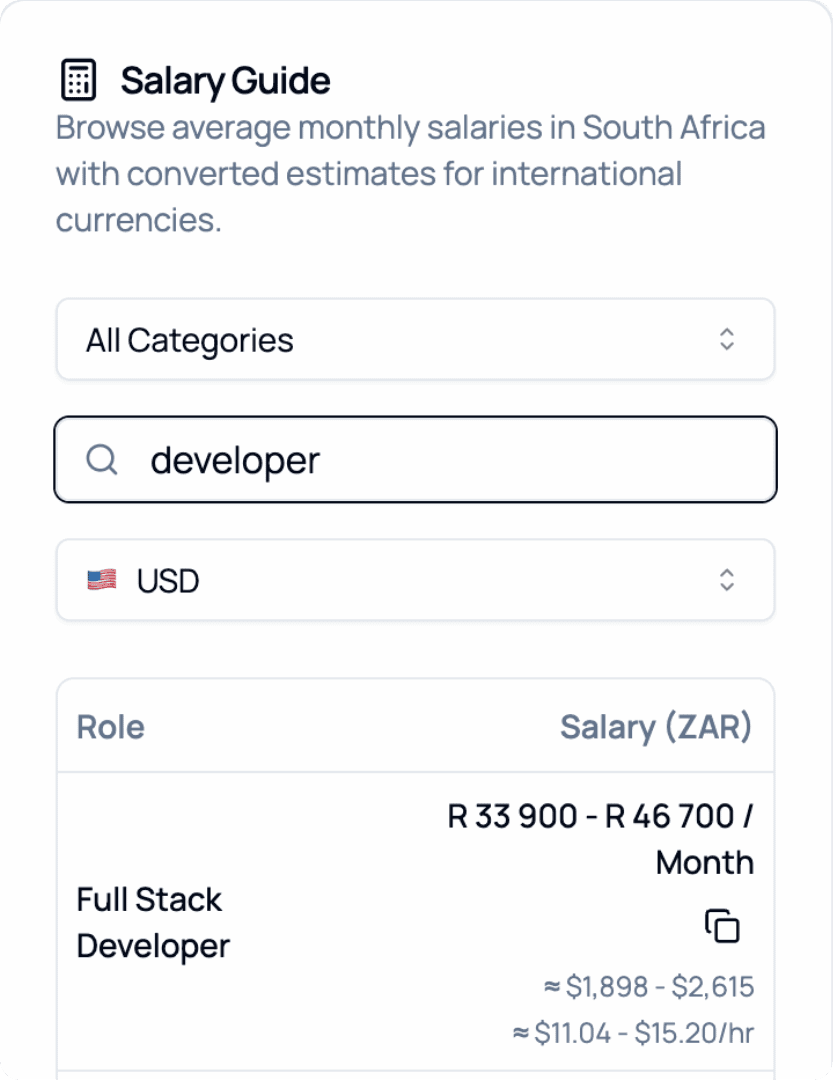
| South African bookkeeper, full-time remote | $640 to $960 a month at entry level; $1,280 to $1,920 certified in Xero or QuickBooks | As a contractor, nothing: they invoice you and pay their own tax | HireSava South African salary guide |
| South African chartered accountant, full-time remote | $2,400 a month and up; newly qualified CAs earn about R600,000 a year (about $35,400) at home | As above | HireSava salary guide; Robert Walters 2025 salary survey |
Take a US practice adding one full-time preparer. A US accountant at the median wage costs about $119,500 a year with benefits. A CA(SA) two years past qualifying, contracted full time at $3,000 a month, costs $36,000; that is about R50,900 at R16.96 to the US dollar in mid-November 2026, in line with what newly qualified CAs earn in South Africa. Add $18.75 for the PTIN and $1,188 if you kept a HireSava Premium plan all year, and the total is about $37,200, a little under a third of the US figure. A bookkeeper certified in Xero or QuickBooks at $1,600 a month (about R27,100) costs $19,200 a year, or about $20,000 with a Pro plan kept all year, against about $72,400 for a US clerk at the median wage. Budget reviewer time in the first season either way, as you would for any new preparer.
A contractor invoices you in US dollars or rand, whichever you agree. The contractor payment planner covers Form W-8BEN, withholding and the payment route, and the currency planner compares paying in rand with paying in your own currency.
Before you make an offer
- Pick the engagement route and confirm which of your country's rules apply to the work: tax preparation, AML-supervised services or registered agent services.
- Verify the designation with SAICA's member search or the issuing body, and run the checks in the background check planner.
- Run a paid work sample on redacted data, scored the same way for every candidate.
- US practices: client consent forms in the Revenue Procedure 2013-14 format, a masking plan for Social Security numbers, a PTIN, an updated written information security plan, and the AICPA notice and confidentiality contract.
- UK practices: screening and AML training, a reporting line to your MLRO, notice to your PII insurer, and the IDTA or Addendum for a contractor, reflected in your privacy notice.
- Australian practices: client permission and the APES 305 disclosures in your engagement terms, and a supervision plan you could show the TPB.
- Set up access in your own systems with individual logins and multi-factor authentication, and add South African public holidays to the team calendar.
HireSava is a job board for hiring South Africans directly: you post the role, message applicants, and hire and pay the person yourself, with no agency in between. When the scope is set, create an employer account and post the job; the pricing page lists the plans. For role scopes, see the remote accountant and remote bookkeeper role pages and the accounting industry page.
Sources and notes
This is general information for accounting practices and employers, not legal or tax advice. Confirm the rules for your practice with your professional body or a lawyer before you share client data. Sources were checked on 15 November 2026:
- SAQA register of professional designations: CA(SA), MAT(SA) and Professional Accountant (SA). SAQA qualification register: National Certificate: Bookkeeping (ID 58375), National Diploma: Technical Financial Accounting (ID 36213) and National Diploma: Financial Accounting (ID 20366).
- SAICA: how to become a CA(SA), the learner page for the seven-year estimate and the JSE figure, how to become an AGA(SA), and reciprocity and affiliations.
- ICB: the difference between the ICB and the ICBA.
- 26 CFR 301.7216-2 and 301.7216-3; IRS Revenue Procedure 2013-14, sections 3, 5 and 6; IRS PTIN requirements page; Form 8946 (Rev. October 2025); IRS page on tax return preparer credentials for representation rights; IRS release IR-2026-92 and Publication 5708.
- AICPA Code of Professional Conduct, updated for official releases through September 2026: interpretations 1.150.040, 1.300.040 and 1.700.040.
- Money Laundering Regulations 2017, regulation 21; ICAEW helpsheet on using a subcontractor (updated 11 February 2025); ACCA guidance for practices on the extended team, UK adequacy regulations and its rulebook; ICO guidance on restricted transfers.
- Tax Agent Services Act 2009, section 30-10; Tax Practitioners Board guidance on confidentiality and TPB(GS) 31/2018. The TPB site did not load during checking, so the point on implying that work is done in Australia comes from Accountants Daily's report on the original practice note, TPB(PN) 2/2018, a secondary source. APES 305 as summarized by CPA Australia.
- IFRS Foundation jurisdiction profile for South Africa; FRC comparison of FRS 102 and the IFRS for SMEs.
- BLS Occupational Outlook Handbook (May 2025 wages) and Employer Costs for Employee Compensation (June 2026, released 9 September 2026). National Careers Service job profiles for private practice accountant and bookkeeper. HMRC rates and thresholds for employers, 2026 to 2027. Jobs and Skills Australia occupation profiles for accountants and bookkeepers. ATO: the super guarantee rate of 12% that has applied since 1 July 2025.
- HireSava South African salary guide for remote bookkeeper and accountant rates. The figure for newly qualified CAs comes from Robert Walters' 2025 South African salary survey as reported by BusinessTech, a secondary source used because no official dataset publishes South African pay by accounting designation.
- Trading Economics for the rand to US dollar rate (16.96) in mid-November 2026, a secondary source.
Time differences and public holiday dates were computed with the IANA time zone database and the Public Holidays Act rule that a holiday falling on a Sunday moves to the Monday.
Frequently Asked Questions
2026 Salary Guide: South Africa
Discover South African Salaries by Role. Compare costs and see how much you can save.