TL;DR
Online stores get a median of 19 to 46 support tickets per 100 orders depending on category (Gorgias, March 2026), so a store shipping 6,000 apparel orders a month should plan for about 1,320 tickets.
At small volumes the reply window sets headcount: answering 12 hours a day, seven days a week takes two full-time agents even when the tickets would keep one busy.
In the worked example, two US in-house agents cost about $10,660 a month ($8.08 a ticket), an outsourcing firm $3,000 to $8,000, and two South African direct hires $1,379 to $3,939 ($1.04 to $2.98 a ticket).
Table of Contents
- Count the tickets before you count the agents
- Turn tickets into agent hours
- Cover US, UK and Australian hours from South Africa
- Plan the Black Friday to New Year peak now
- Rules your agents apply on every shift
- What to hand over on day one, and what to keep
- What each staffing route costs per ticket
- Test your first agent on real situations
- Sources and notes
An ecommerce store needs enough customer service capacity to answer every order, delivery, return and product question inside the reply window it promises, and that capacity can be worked out from order volume before anyone is hired. Gorgias, a helpdesk built for online stores, reports a median of 19 to 46 support tickets per 100 orders depending on what the store sells, so the support queue grows in step with sales.
Until a store reaches several thousand orders a month, the reply window decides headcount more than the tickets do: answering 12 hours a day, seven days a week takes two full-time agents even when the tickets would keep one busy. South Africa runs on UTC+2 all year, so an agent there can clear the US overnight queue on an ordinary day shift or cover the US morning on an afternoon shift. Every figure below was checked on November 14, 2026.
Count the tickets before you count the agents
Your contact rate is tickets divided by orders. Export eight weeks of tickets from the helpdesk and eight weeks of orders from the store, remove spam, auto-replies and internal notes, and divide one by the other. Eight weeks keeps a single promotion or a bad week at the carrier from skewing the number.
A store without clean history can start from the medians Gorgias publishes from its own customer base. These come from its Ecom Lab data for brands at about $10 million in annual sales, measured in March 2026.
| Category | Tickets per 100 orders | Median first response time |
|---|---|---|
| Electronics | 46 | 4.8 hours |
| Vehicles and parts | 46 | 4.4 hours |
| Hardware | 41 | 1.6 hours |
| Home and garden | 32 | 4.4 hours |
| Luggage and bags | 32 | 7.7 hours |
| Sporting goods | 32 | 5.8 hours |
| Animals and pet supplies | 25 | 3.6 hours |
| Business and industrial | 25 | 4.0 hours |
| Baby and toddler | 24 | 5.3 hours |
| Apparel and accessories | 22 | 8.8 hours |
| Arts and entertainment | 21 | 9.1 hours |
| Health and beauty | 21 | 5.2 hours |
| Food and beverages | 20 | 5.1 hours |
| Toys and games | 19 | 8.3 hours |
Treat your category row as an opening estimate and replace it with your own rate after two months. The all-industry median first response time in the same data is 6.3 hours. That describes what stores manage today; set your own target from what your customers expect and what you can staff.
Then tag every ticket by type for two weeks. A workable starting set: where is my order, return or exchange, order change or cancellation, damaged or wrong item, product or sizing question, discount or checkout problem, and subscription change. The mix shows which macros and policies to write first, and which tickets a new agent can close without asking anyone.
Turn tickets into agent hours
Take a US apparel store shipping 6,000 orders a month.
- At the apparel median of 22 tickets per 100 orders, 6,000 orders produce 1,320 tickets a month.
- At 6 minutes a ticket, including reading the order history and writing the reply, that is 7,920 minutes, or 132 hours of handling. Gorgias gives 5 to 7 minutes as a handle time target for live chat. Replace the 6 with your helpdesk's real average once the agent has settled in.
- A 40-hour week averages 173 hours a month (40 × 52 ÷ 12). Set aside 30% for breaks, training, team meetings, quality reviews, leave and sick days, and about 121 hours remain for tickets. The 30% is an assumption, and your own schedule data should replace it.
- Handling divided by productive hours is 132 ÷ 121, or 1.1 agents of work.
- Answering from 06:00 to 18:00 US Eastern every day of the week takes 84 staffed hours a week. One full-time agent works 40, so the schedule needs two agents, plus cover for leave or a shorter weekend window.
So the store hires two agents for coverage and carries 1.1 agents of work. Between them the pair has about 242 productive hours a month, which leaves roughly 45% of their ticket time free in an ordinary month. That slack absorbs a late carrier or a run of returns without the reply time slipping. It disappears in a hard December: if tickets double, the pair needs 264 hours and is about 22 hours short.
On the same assumptions, two agents can handle about 2,400 tickets a month. That is roughly 5,000 orders in electronics or 11,000 in apparel. Below that volume, choose the reply window first and let it set the headcount. Above it, tickets set the headcount and the reply window sets the schedule.
Live chat changes the math. Gorgias gives one minute as the first response target for chat, so an agent has to be free when a chat arrives instead of working down a queue. If chat is more than a small share of your tickets, schedule the chat hours first and let email fill the gaps between chats.
Cover US, UK and Australian hours from South Africa
South Africa Standard Time (SAST) is UTC+2 with no daylight saving, so the gap to your customers changes only when their clocks do. US clocks went back on November 1, 2026 and go forward on March 14, 2027. The UK moves to summer time on March 28, 2027, and Sydney and Melbourne leave summer time on April 4, 2027.
| Customers in | Time difference | Shift in South Africa | Customer time covered |
|---|---|---|---|
| US Eastern | South Africa 7 hours ahead (6 from March 14, 2027) | 08:00 to 16:00 | 01:00 to 09:00, so overnight email is answered before the US morning |
| US Eastern | South Africa 7 hours ahead (6 from March 14, 2027) | 14:00 to 22:00 | 07:00 to 15:00, covering live chat through the morning and early afternoon |
| US Pacific | South Africa 10 hours ahead (9 from March 14, 2027) | 15:00 to 23:00 | 05:00 to 13:00 |
| United Kingdom | South Africa 2 hours ahead (1 from March 28, 2027) | 10:00 to 18:00 | 08:00 to 16:00 |
| Sydney and Melbourne | South Africa 9 hours behind (8 from April 4, 2027) | 08:00 to 16:00 | 17:00 to 01:00, the Australian evening |
A South African day shift gives a US store overnight replies without anyone working a US night. An email sent at 21:00 Eastern on a weeknight lands at 04:00 in South Africa, and an agent who starts at 08:00 SAST answers it from 01:00 Eastern, so the customer wakes up to a reply. Compare that with the 6.3 hour all-industry median above.
Shifts that run past 18:00 have a legal side when the agent is your employee. Section 17 of South Africa's Basic Conditions of Employment Act treats work after 18:00 and before 06:00 as night work, which needs the employee's agreement and an allowance or shorter hours, and regular work after 23:00 adds health and safety duties. An independent contractor sets their own hours, but hours that you set are one of the signs of employment under South African law, so check the arrangement with the contractor vs employee checker. For other cities, the time zone overlap calculator shows the working hours you share.
Plan the Black Friday to New Year peak now
Thanksgiving falls on Thursday, November 26, 2026, Black Friday on November 27 and Cyber Monday on November 30. Adobe projects US online spending of $275.1 billion from November 1 to December 31, up 6.7% on 2025, with Cyber Monday the largest day at $15.1 billion and Black Friday at $12.9 billion. Spread evenly, the season averages about $4.5 billion a day, so Cyber Monday runs at roughly 3.3 times an ordinary day of the season.
Support volume follows orders with a delay. Order changes and discount problems arrive the same day, but delivery questions start once the promised date passes, so the busiest support days trail the busiest sales days by about your delivery time. A store that delivers in five days can expect the delivery questions from Cyber Monday orders in the first week of December.
US Thanksgiving and Black Friday are ordinary working days in South Africa. The South African public holidays inside the peak are Wednesday, December 16 (Day of Reconciliation), Friday, December 25 (Christmas Day), Saturday, December 26 (Day of Goodwill) and Friday, January 1, 2027. A holiday that falls on a Sunday moves to the Monday, and none does this season. Agree now who works those days and settle December leave. The public holiday planner and the leave entitlement calculator cover the dates and the statutory minimums for employees.
Before November 27:
- Write the delay notice macro described in the next section and test it on a real order.
- Put the holiday shipping cutoff dates and the returns window in the order confirmation email and the help center.
- Agree extra shifts or overtime in writing, with the rate, for the weeks either side of Cyber Monday.
- Set a temporary first response target and state it in the auto-reply. Gorgias suggests allowing 1.5 to 2 times your normal target during the peak.
- Update the tracking, return label and exchange macros with the holiday dates.
Rules your agents apply on every shift
Much of a support agent's day is policy, and part of the policy is law. These are the rules that reach the inbox most often for stores selling to the US, the EU and the UK.
Late orders in the US
The FTC's Mail, Internet, or Telephone Order Merchandise Rule requires a store to ship within the time it states, or within 30 days if it states none. When an order will be late, the customer must get a delay notice with a new ship date and the option to cancel for a full refund. If the new date is no more than 30 days after the original promise, the customer's silence can count as consent. A second delay needs the customer's express agreement, or the order is cancelled. Refunds on cancelled orders are due within seven working days, and email is an acceptable way to send the notice. Write the notice as a macro and send it the day a ship date slips.
Review requests in the US
The FTC rule on consumer reviews and testimonials, in force since October 21, 2024, lets a store offer an incentive for a review only if the incentive does not depend, openly or by implication, on the review being positive. "Leave us five stars for 10% off" breaks the rule. "Leave an honest review for 10% off" does not. The rule also bars intimidation and groundless legal threats used to get a review removed, and courts can impose civil penalties for knowing violations. Agents can still reply to a bad review in public and ask a customer whose problem was solved whether they would update it.
Injury and safety reports in the US
Under section 15 of the Consumer Product Safety Act, manufacturers, importers, distributors and retailers must tell the Consumer Product Safety Commission within 24 hours of obtaining information that a product could create a substantial risk of injury or an unreasonable risk of serious injury or death. Nobody has to have been hurt, and the CPSC's advice is to report when in doubt. The support inbox is often the first place that information arrives, so any report of an injury, fire, burn or choking goes to the owner the same day.
Cancellations and refunds in the EU and UK
Shoppers in the EU and the UK can cancel an online order within 14 days of delivery without giving a reason. The refund is due within 14 days, although for goods the store can hold it until the item comes back or the customer shows proof of sending it, whichever happens first. It goes back to the original payment method unless the customer agrees otherwise, and the store cannot charge a fee for it. If the store never told the customer about the right to cancel, the window runs for up to 12 months longer. Agents need the delivery date on screen and the refund deadline in the macro.
Card numbers in chat and email
PCI DSS requirement 4.2.2 prohibits sending unprotected card numbers through end-user messaging, and the PCI Security Standards Council counts email, instant messaging, SMS and chat as end-user messaging. Agents should never ask for a card number. Give them a macro for the customer who pastes one in anyway: it asks the customer to pay through a secure payment link instead, and the agent redacts the number if the helpdesk allows it.
Customer data that leaves the EU or the UK
South Africa has no EU adequacy decision, so an EU store that gives a South African agent access to customer records needs a transfer safeguard, usually the European Commission's standard contractual clauses. For UK customer data, the ICO's tools are the International Data Transfer Agreement or the UK Addendum to the EU clauses, together with a transfer risk assessment. The EU clauses alone are not valid for UK transfers. Pair the clauses with a confidentiality agreement and least-privilege access. The data security planner and the NDA generator set out the working controls.
What to hand over on day one, and what to keep
A new agent can own these from the first week, inside written policies:
- order status, tracking and carrier follow-up
- address and item changes before the order is fulfilled
- product, sizing and stock questions answered from your product data
- returns and exchanges inside the written policy
- refunds up to a written limit per order
- delay notices, holiday auto-replies and review requests sent from approved macros
- a tag on every ticket, so the weekly report shows the mix
Keep these with the owner, or escalate them the same day:
- refunds above the limit or outside policy, and goodwill credits
- chargebacks, payment disputes and suspected fraud
- injury, fire, choking and other safety reports
- legal threats, regulator complaints, and press or influencer requests
- requests to see or erase personal data
- any change to the policy itself
On Shopify, give the agent a staff account, never the owner login. Order permissions are split finely, from viewing and editing orders to returns and cancellations, and refunds come as two separate permissions: one to the original payment method and one to store credit. Customer permissions include separate rights to erase personal data and to request data, and those can stay with the owner. Shopify cannot limit a permission to particular orders or customers, so the refund limit has to live in the written policy and in a weekly review of the refunds issued. The SOP generator turns each policy into a step-by-step procedure the agent can follow.
What each staffing route costs per ticket
For the example store, with 1,320 tickets a month handled by two full-time agents:
| Route | Two agents, per month | Per ticket | What the figure covers |
|---|---|---|---|
| US in-house employees | $10,660 | $8.08 | BLS median pay of $44,770 a year each, grossed up so that wages are 70% of the total, the private industry average in June 2026. Hiring, management and quality review are yours. |
| Outsourcing firm, dedicated agents | $3,000 to $8,000 | $2.27 to $6.06 | Helpware's published range of $1,500 to $4,000 per agent per month. The same source lists setup fees of $500 to $5,000, quality assurance and management surcharges of 5 to 10%, and a 10 to 25% premium for quick Black Friday scaling. |
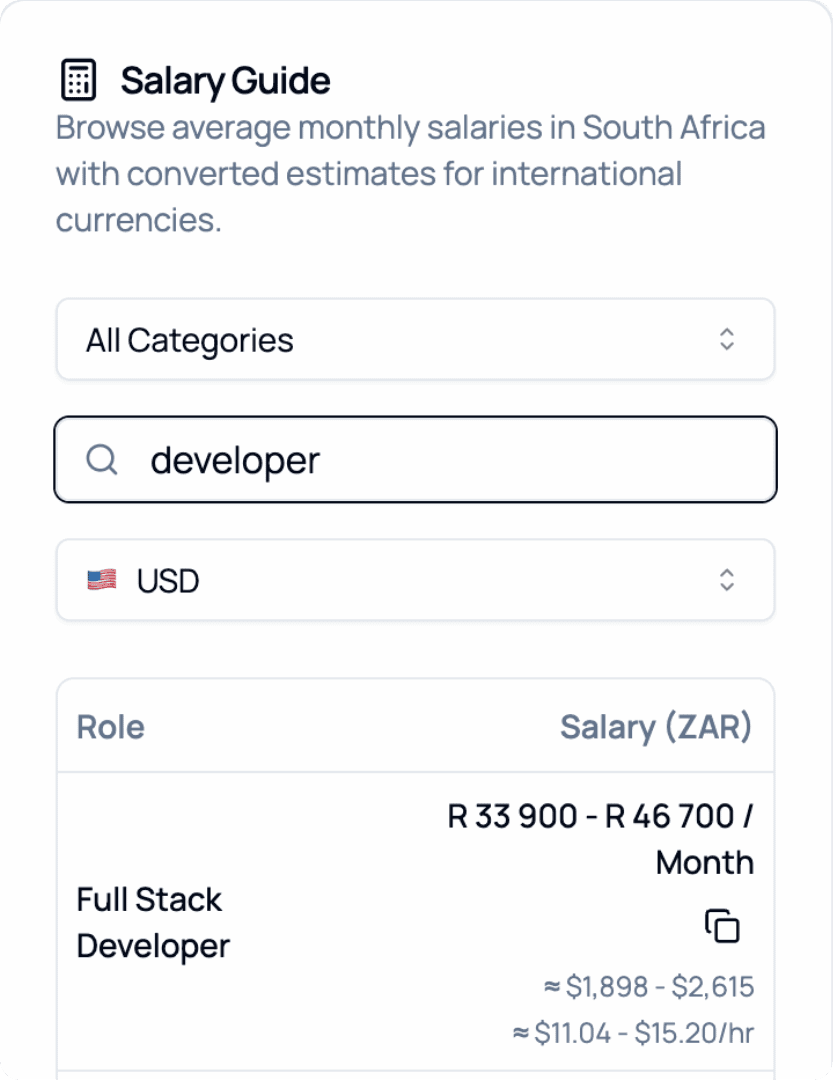
| South African direct hires through HireSava | $1,379 to $3,939 | $1.04 to $2.98 | Two agents at $640 to $1,920 a month each, the salary guide range for customer and chat support, plus the $99 Premium plan. You hire and train the agents and review their work. |
Helpdesk software, apps and any phone line cost the same on every route, so they are left out. The South African figures assume independent contractors paid monthly. Employing through your own South African company or an employer of record adds the costs set out in the guide to hiring employees in South Africa. At the middle of the salary guide range, $8 an hour, two South African agents cost $2,659 a month including the plan, 75% less than the US in-house figure.
Price is not the only difference. An outsourcing firm can add agents for the peak and cover sick days from its own bench, at the premiums in the table. A direct hire costs the least and keeps the same person on your products and customers, but you write the policies and review the tickets yourself. US in-house staff earn their premium when phone support during US hours is the main channel, or when the role mixes support with work that needs someone in the US.
HireSava is a marketplace where employers hire South Africans directly, with no agency in the middle. You post the role and agree terms with the person you hire.
Test your first agent on real situations
Before the interview, send shortlisted candidates eight fictional tickets and your written policies as a paid one-hour test. Build the set from the rules above:
- an order that will miss its ship date
- an EU customer cancelling 13 days after delivery
- a customer offering a five-star review in exchange for a discount
- a card number pasted into chat
- a report that a product overheated
- a refund request above the written limit
- a sizing question answered from the product page
- an angry message about a parcel that tracking shows as delivered
Score policy accuracy first, then tone, then speed. The strongest candidates send the delay notice with the cancel option, process the EU cancellation, turn down the review swap politely, escalate the safety report and the large refund, and ask a question before guessing. The skills test generator builds a work-sample test with a time limit and a scoring guide, and the contract generator covers hours, confidentiality and notice.
The customer support VA, chat support VA and ecommerce chat support specialist pages list typical scopes, and the ecommerce customer support service page sets out the tasks a South African hire usually covers. When the reply window, the policies and the test are ready, create an employer account and post the role. Plans and prices are on the pricing page.
Sources and notes
This is general information for store owners, not legal advice. Consumer and data protection rules differ by country and change over time, so confirm your obligations with a lawyer in each market you sell to. Sources were checked on November 14, 2026:
- Gorgias, customer support metrics: Ecom Lab medians at $10 million GMV, March 2026, for tickets per 100 orders and first response time by category, and the 6.3 hour all-industry median. These are a vendor's figures from its own customers, used because no public body publishes ecommerce contact rates.
- Gorgias, customer service benchmarks, updated October 5, 2026: the handle time and live chat response targets and the peak season response window. Gorgias presents these as targets, not measurements.
- US Bureau of Labor Statistics, Occupational Outlook Handbook: customer service representatives: median pay of $21.53 an hour and $44,770 a year, May 2025.
- US Bureau of Labor Statistics, Employer Costs for Employee Compensation, June 2026, released September 9, 2026: wages 70.0% and benefits 30.0% of private industry compensation costs.
- Adobe, 2026 US holiday shopping forecast, September 28, 2026: the season total, Cyber Monday and Black Friday projections.
- South African Government, public holidays: the 2026 and 2027 dates and the Sunday rule.
- Basic Conditions of Employment Act 75 of 1997, section 17 (Acts Online): night work.
- Labour Relations Act 66 of 1995, section 200A (Acts Online): the presumption of employment, which counts hours controlled by another person as one factor.
- Federal Trade Commission, Business Guide to the Mail, Internet, or Telephone Order Merchandise Rule: shipping times, delay notices and refund deadlines.
- Federal Trade Commission, Consumer Reviews and Testimonials Rule: Questions and Answers: review incentives, review suppression and the effective date.
- Consumer Product Safety Commission, Duty to Report: who reports, the 24 hour deadline and the trigger.
- European Union, Your Europe: returns, and Directive 2011/83/EU, Article 10 and Article 13: the withdrawal period, the 12 month extension and refund timing.
- Consumer Contracts (Information, Cancellation and Additional Charges) Regulations 2013, regulations 30, 31 and 34: the UK cancellation period, its extension and refunds.
- PCI Security Standards Council, FAQ 1085: card numbers in email, chat, SMS and instant messaging.
- European Commission, adequacy decisions and standard contractual clauses.
- Information Commissioner's Office, the UK IDTA and the Addendum.
- Shopify Help Center, store permissions: order, refund and customer permissions.
- Helpware, ecommerce support outsourcing, updated October 7, 2026: published outsourcing price ranges and add-on costs. A vendor's own figures, used because there is no public dataset of outsourcing prices.
- HireSava, South African salary guide: the monthly range for customer support and chat support, based on a 160 hour month.
The worked example assumes 6 minutes per ticket, 30% of paid time spent away from tickets, a reply window of 12 hours a day, seven days a week, and two agents on independent contractor terms for the South African route.
Frequently Asked Questions
Explore related hiring options
Useful next pages based on this article's topic:
- Remote Ecommerce Specialist role — store operations and channel performance
- Inventory Management & Forecasting service — stock planning and margin protection
2026 Salary Guide: South Africa
Discover South African Salaries by Role. Compare costs and see how much you can save.