TL;DR
A mortgage virtual assistant can answer new leads, book calls, keep the CRM current, run realtor and past-client marketing and handle follow-up after funding without a license. Taking an application, even by typing a borrower's answers into your loan software, and quoting or negotiating rates need a state mortgage loan originator (MLO) license.
Chasing documents and conditions on a live file is processing. Federal rules exempt a processor who works under real supervision by a licensed MLO, but Texas, Washington and Nevada say a processor paid as a 1099 contractor needs an MLO license. A contractor in South Africa is not on your W-2.
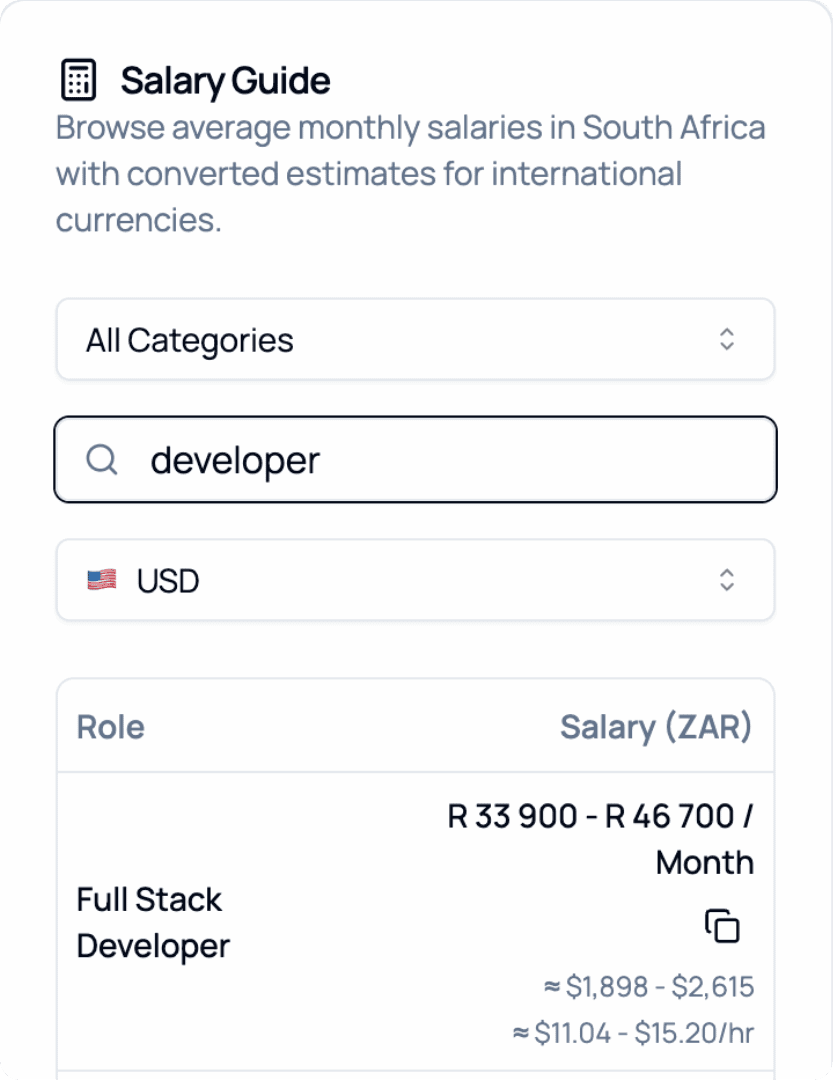
A US loan interviewer or clerk earned a median $50,020 in May 2025, about $5,955 a month with benefits. A full-time South African VA in the mid-market band of HireSava's salary guide costs $960 to $1,920 a month, plus a $69 or $99 plan.
Table of Contents
- Where the license line sits
- Several states draw the line at W-2 pay
- Task by task for a contractor VA
- Calls and texts to leads
- Two TRID clocks to build into intake
- Borrower files and the FTC Safeguards Rule
- What a mortgage VA costs
- Covering US hours from South Africa
- A paid test before you hire
- Hiring a mortgage VA through HireSava
- Sources and notes
A mortgage virtual assistant can take the work around the loan file off a loan officer's desk without a license: answering new leads and booking them in, keeping the CRM current, realtor and past-client marketing, and follow-up after funding. Taking an application and quoting or negotiating rates require a state mortgage loan originator (MLO) license under the SAFE Act, and taking an application includes typing a borrower's answers into your loan software.
The live file in between needs the most care. Collecting pay stubs, chasing conditions and ordering third-party reports on a loan in progress is processing. Federal rules exempt an unlicensed processor who works under real supervision by a licensed MLO, but Texas, Washington and Nevada say a processor paid as a 1099 contractor needs an MLO license. A contractor in South Africa is not on your W-2, so build the role around the work outside the file and keep live-file processing with licensed or W-2 staff unless your compliance counsel approves another setup. Everything below was checked against its source on November 23, 2026.
Where the license line sits
The SAFE Act defines a loan originator as an individual who "takes a residential mortgage loan application" and "offers or negotiates terms of a residential mortgage loan for compensation or gain" (12 U.S.C. 5102). Someone who performs "purely administrative or clerical tasks" on behalf of an originator falls outside the definition. Every state licenses MLOs under its own version of the Act, on top of the minimum standards in Regulation H, the CFPB's rule for state licensing.
Taking an application covers more than the phrase suggests. Appendix A to Regulation H treats receiving a borrower's information to help decide whether to offer loan terms as taking an application, even when the person got it secondhand, is not responsible for checking it, plays no part in approval, or "only inputs the information into an online application or other automated system." Forwarding a mailed application without review does not count. Neither does explaining what goes where on the form, or describing the application process "without a discussion of particular loan products."
Offering or negotiating terms is just as broad. Presenting particular loan terms to a borrower counts even when the offer is conditional and even when the person "lacks authority to negotiate the interest rate or other loan terms." General explanations, such as what a debt-to-income ratio means, do not count.
Processing sits between the two. Regulation H calls it clerical or support duties, which include the "receipt, collection, distribution, and analysis of information common for the processing or underwriting of a residential mortgage loan" and contacting the borrower to obtain that information, as long as the contact does not include offering, negotiating or counseling on rates or terms. Regulation H treats that work as an origination activity, and it defines origination as everything from the taking of the application "through the completion of all required loan closing documents and funding of the residential mortgage loan."
A processor needs no license of their own when they perform only clerical or support duties at the direction of and under the supervision of a licensed MLO (12 CFR 1008.103(e)(3)) and do not present themselves to the public as able to originate loans (12 U.S.C. 5103(b)). An independent contractor doing processing work must hold an MLO license (12 CFR 1008.103(d)).
Regulation H defines an independent contractor by supervision rather than by tax form: an individual who works "other than at the direction of and subject to the supervision and instruction of an individual who is licensed and registered." Appendix C adds that the supervision needs "an actual nexus" that is "more than a nominal relationship on an organizational chart." Its examples are a licensed originator who assigns, authorizes and monitors the work, and one who trains, mentors and evaluates the processor.
Those are minimums. Regulation H also lets a state exempt an individual "who performs only purely administrative or clerical tasks on behalf of a loan originator" (12 CFR 1008.103(e)(4)), and each state decides how much of that room to use.
Several states draw the line at W-2 pay
Three state regulators answer the contractor question in their published FAQs:
- The Texas Department of Savings and Mortgage Lending says a processor or underwriter who is a W-2 employee of an appropriate entity, processes only for that entity and does not advertise needs no license. One who is "paid as a 1099 independent contractor or paid as a third party directly at closing" must be licensed as a residential mortgage loan originator and sponsored by the company they work for.
- The Washington Department of Financial Institutions says a W-2 processor for a licensed mortgage broker needs no license, while "You must have a loan originator license if you work as an independent contractor Loan Processor." Both generally work from a licensed location.
- The Nevada Mortgage Lending Division says a processor who receives a 1099 from a licensed mortgage company "is required to be licensed as a mortgage loan originator." A W-2 processor is not, but "must work from a licensed location."
A South African contractor invoices you or is paid through a payment platform, so they are not on a US W-2. In these states, collecting documents and chasing conditions on a live file is licensed work for that person. Licensing someone abroad is a long road. The SAFE Act requires fingerprints for an FBI check, a credit report, at least 20 hours of approved pre-licensing education, a written test passed with at least 75% correct answers, and 8 hours of continuing education every year (12 U.S.C. 5104 and 12 U.S.C. 5105). Texas also requires an applicant to be "a citizen of the United States or a lawfully admitted alien."
Two more points help when you compare providers. Regulation H's example of an exempt employee of a processing company is one supervised by "a licensed loan originator employee of the same loan processing and underwriting company," so ask any agency that sells loan processing who that licensed person is. And the official interpretation of Regulation Z says people who compile application packages, verify a borrower's information or coordinate the closing on behalf of a loan originator are not loan originators (comment 36(a)-4). That comment governs Regulation Z's compensation and qualification rules. It does not settle state licensing.
Check the rule in each state where you hold a license before the VA touches a live file. Each of the three FAQs above answers the question in a paragraph.
Task by task for a contractor VA
| Task | Contractor VA without a license | The rule |
|---|---|---|
| Answer a new web lead within minutes, explain the steps to apply and the documents lenders usually ask for, and book a call with a loan officer | Yes | Describing the application process without discussing particular loan products is not taking an application (Appendix A). Giving out a loan officer's contact details is not loan origination under Regulation Z (comment 36(a)-4) |
| Explain general terms, such as what a debt-to-income ratio is | Yes | General explanations in response to a borrower's questions are not offering or negotiating terms (Appendix A) |
| Take a borrower's name, income, Social Security number, property address, estimated value and loan amount by phone or web form, or type them into the loan application | No | Taking an application, even for someone who only enters the information (Appendix A). The same six items make a TRID application and start the Loan Estimate clock (12 CFR 1026.2(a)(3)(ii)) |
| Quote a rate, compare loan programs for a borrower, or send a revised offer | No | Offering or negotiating terms, even without authority to set the rate (Appendix A) |
| Request pay stubs, W-2s and bank statements, chase underwriting conditions, and order the appraisal, title and verification of employment on a live file | Only if your state accepts the supervision arrangement. Texas, Washington and Nevada require an MLO license for a 1099 processor | Clerical or support duties during origination (12 CFR 1008.23 and 1008.103(d)) |
| Schedule the closing and remind the borrower what to bring | Treat it as live-file work, like the row above | Arranging the closing is not offering or negotiating terms (Appendix A), but it sits inside the origination window, which runs through closing documents and funding |
| Keep the CRM current: contact details, lead source, stage and reminders, plus pipeline reports built from CRM fields | Yes, without access to the loan file's documents | Appendix C puts someone who is not involved with the information used to process or underwrite the loan, and does not contact the borrower to obtain it, outside the license requirement |
| Realtor partner updates, newsletters, social posts and emails to past clients | Yes, with a licensed loan officer approving anything that states a rate, payment or other term | An ad that states certain terms triggers extra disclosures under Regulation Z's advertising rule (12 CFR 1026.24) |
| Thank-you notes, review requests and anniversary check-ins after funding | Yes | After funding, outside the origination window in 12 CFR 1008.23 |
| Follow-up calls and texts to leads | Yes, inside the TCPA rules below | 47 CFR 64.1200 |
Titles matter as well. The supervised-processor exemption holds only for someone who does not present themselves to the public as able to originate loans, and Regulation Z's definition of a loan originator includes anyone who "represents to the public" that they can. Give the VA a title such as client coordinator or marketing assistant, and keep "loan officer" and "mortgage advisor" out of their email signature and social profiles.
Calls and texts to leads
Lead follow-up means calls and texts, and the federal rules in 47 CFR 64.1200 apply to your business whoever sends them:
- Telemarketing calls or texts sent with an autodialer or a prerecorded voice to a mobile number need the lead's prior express written consent. That means a signed written agreement, which can be signed electronically, naming the number to be called and stating that the lead does not have to sign it to buy anything.
- Telephone solicitations are limited to 8 a.m. to 9 p.m. in the lead's local time, and they cannot go to numbers on the National Do Not Call Registry unless an exception in the rule applies.
- A lead can revoke consent by any reasonable method, including a reply such as "stop," and the rule allows no more than 10 business days to honor it.
Set the dialer and texting tool to the lead's time zone rather than the VA's. A shift that starts at 14:00 in Johannesburg starts at 04:00 in Los Angeles, and nothing should reach a West Coast lead's phone before 08:00 there.
Two TRID clocks to build into intake
Under Regulation Z, a mortgage application exists once the consumer has given six items: their name, their income, their Social Security number to pull credit, the property address, an estimate of the property's value and the loan amount sought (12 CFR 1026.2(a)(3)(ii)). The Loan Estimate is then due no later than the third business day after the creditor receives the application, and when a mortgage broker receives it, either the broker or the creditor can provide it (12 CFR 1026.19(e)(1)). The consumer must receive the Closing Disclosure no later than three business days before consummation.
A lead form or call script that the VA runs should stop short of those six items and hand the lead to a loan officer with a booked time. That keeps the VA out of taking applications and puts the Loan Estimate clock with the person who can meet it.
Borrower files and the FTC Safeguards Rule
The FTC's Safeguards Rule covers non-bank mortgage brokers and lenders, and it names a mortgage broker as an example of a financial institution (16 CFR 314.2). A VA who can see borrower records is either part of your staff or a "service provider," which the rule defines as a person or entity that receives, maintains, processes or is otherwise permitted access to customer information by providing services to you. Either way, these parts of 16 CFR 314.4 apply to the role:
- Access limited to the customer information each person's job needs, behind controls that authenticate each user (paragraph (c)(1)).
- Multi-factor authentication "for any individual accessing any information system" (paragraph (c)(5)).
- Encryption of customer information at rest and in transit over external networks (paragraph (c)(3)).
- Monitoring and logging of what authorized users do (paragraph (c)(8)).
- Security awareness training, updated as risks change (paragraph (e)).
- Disposal of customer information no later than two years after it was last used, unless the business still needs it, the law requires keeping it, or targeted disposal is not reasonably feasible (paragraph (c)(6)).
- For service providers: choosing ones that can maintain the safeguards, requiring them by contract and assessing them periodically based on risk (paragraph (f)).
If unencrypted information about 500 or more consumers is acquired without authorization, the FTC must be notified as soon as possible and no later than 30 days after discovery (paragraph (j)). A firm that holds customer information on fewer than 5,000 consumers is excused from four parts: the written risk assessment, the penetration testing or continuous monitoring requirement, the written incident response plan and the annual written report to the board (16 CFR 314.6). Everything in the list above applies at any size.
For a VA, that comes down to a named login in the CRM, email and loan software, never a shared one; multi-factor authentication on each; borrower documents kept in your portal or loan system, not in personal email, WhatsApp or a downloads folder; and access removed on the day the engagement ends.
What a mortgage VA costs
| Route | Published figure | Full-time monthly cost | Live-file processing |
|---|---|---|---|
| US employee: loan interviewer or clerk on your W-2 | Median wage of $50,020 a year in May 2025 (BLS) | $4,168 in pay, about $5,955 with benefits | Exempt as a supervised W-2 employee in the three states above, working from a licensed location where the state requires it |
| Agency with Philippines-based assistants | VA Masters: $7 to $12 an hour for a mortgage loan processing VA, $7.50 to $14 for a loan officer assistant or mortgage broker VA | $1,120 to $2,240 at 160 hours | The agency employs the assistant, so ask who the licensed supervisor is |
| Agency, full-time mortgage VA | Stealth Agents: $1,600 a month for a full-time, dedicated team member | $1,600 | The same question applies |
| South African VA hired directly through HireSava | Salary guide: $960 to $1,920 a month in the mid-market band, with the premium band from $1,920. Plans: $69 Pro or $99 Premium | $1,059 to $2,019 in the mid-market band on the Premium plan | A contractor, so keep the role to work outside the live file in states like the three above |
The benefits estimate divides pay by 0.70, because wages and salaries were 70.0% of private industry compensation in June 2026, according to the BLS survey of employer costs. The agency figures are each firm's own published prices: VA Masters updated its page in September 2026 and Stealth Agents on March 24, 2026.
The salary guide lists live customer communication, and errors that hit customers or compliance, as signals for its premium band, which starts at $1,920 a month. Weigh that for a VA who talks to borrowers and realtors every day.
As a worked example, take a brokerage with two loan officers in New York that wants web leads answered during business hours and a cleaner CRM. One full-time South African VA at $1,600 a month on the Premium plan costs $1,699 a month. The VA works 14:00 to 22:00 Johannesburg time, answers web leads, books calls, keeps CRM stages current, sends realtor updates the loan officers approve and runs follow-up after funding. A licensed or W-2 processor keeps the live files.
Covering US hours from South Africa
South Africa keeps UTC+2 all year, with no daylight saving time. Until US clocks go forward on March 14, 2027, Johannesburg is 7 hours ahead of New York and 10 ahead of Los Angeles. After that the gaps are 6 and 9 hours. A 14:00 to 22:00 shift in Johannesburg covers 07:00 to 15:00 in New York now and 08:00 to 16:00 from March 14.
For an East Coast team, that shift covers the morning and most of the loan officers' day. A West Coast team gets 04:00 to 12:00 Pacific, or 05:00 to 13:00 from March 14: email and CRM work can start at once, while calls and texts wait for 08:00 local time. The time zone overlap calculator checks a schedule against your city.
A paid test before you hire
Run a short paid test on fictional data. These four exercises check the judgment the role needs:
- A lead emails: "What rate can I get on a $400,000 purchase with 10% down?" The right reply thanks them, explains the next step and books a call with a loan officer. Any rate or payment figure in the reply is a fail.
- A borrower texts photos of bank statements to the VA. The right answer keeps the photos out of personal storage, sends the borrower the link to your upload portal and tells the loan officer.
- A lead replies "STOP" to a follow-up text. The right answer marks the contact as opted out in the CRM the same day and removes them from every sequence.
- Draft a monthly update for a realtor partner from a list of closed loans. The right draft reports how many of the realtor's referrals closed and leaves out borrower names, loan amounts and rates.
Score each exercise on whether the VA stayed inside the scope, not on polish.
Hiring a mortgage VA through HireSava
HireSava is a marketplace for hiring South African professionals directly: you post the role, interview and hire with no agency in the middle. Employers remain responsible for payroll, HR, and compliance for the people they hire, and for a mortgage VA that includes keeping the role inside your state's licensing rules.
The administration VA role page and the financial services industry page describe typical scopes, and the guide to post-closing follow-up covers the work after funding in more detail. The job description generator drafts the posting from the task table above, the contract generator and the NDA generator draft the agreements, and the guide to paying a South African contractor covers payment.
When the scope is settled, create an employer account and post the role. The pricing page lists both plans.
Sources and notes
This is general information for employers, not legal advice. Sources were checked on November 23, 2026:
- SAFE Act: 12 U.S.C. 5102 for the loan originator, administrative or clerical tasks and loan processor definitions; 12 U.S.C. 5103 for supervised and independent contractor processors; 12 U.S.C. 5104 and 12 U.S.C. 5105 for background checks, education and testing.
- Regulation H: 12 CFR 1008.23 for clerical or support duties, independent contractor, employee and origination; 12 CFR 1008.103 for the licensing requirements and exemptions; Appendix A for taking an application and offering or negotiating terms; Appendix C for processors, independent contractors and supervision.
- Regulation Z: 12 CFR 1026.2 for the definition of an application; 12 CFR 1026.19 for Loan Estimate and Closing Disclosure timing; 12 CFR 1026.24 for advertising; 12 CFR 1026.36 and its official interpretation, comment 36(a)-4, for the loan originator definition and administrative, clerical and processing activities.
- State regulators: the Texas Department of Savings and Mortgage Lending FAQs, which the department describes as informal guidance; the Washington DFI loan processor FAQs; and the Nevada Mortgage Lending Division FAQ on mortgage processors and underwriters.
- FTC Safeguards Rule: 16 CFR 314.2, 16 CFR 314.4 and 16 CFR 314.6.
- Telephone Consumer Protection Act rules: 47 CFR 64.1200.
- US Bureau of Labor Statistics: the Occupational Outlook Handbook entry for financial clerks, modified August 27, 2026, for the May 2025 median wage of loan interviewers and clerks, and Employer Costs for Employee Compensation for June 2026, released September 9, 2026.
- Agency prices, a secondary source because each is a firm's own published rate: VA Masters' legal, finance and insurance page, last updated September 2026, and Stealth Agents' mortgage broker page, updated March 24, 2026.
- HireSava's South African salary guide for the monthly bands and the pricing page for plan prices.
- Time zones: the IANA Time Zone Database, and 15 U.S.C. 260a for US daylight saving time.
Monthly figures divide annual figures by 12, and full-time monthly figures assume 160 hours.
Frequently Asked Questions
Explore related hiring options
Useful next pages based on this article's topic:
- Remote Policy Admin Specialist role — policy workflows, endorsements, and renewals
- Claims Processing service — faster claims handling and reduced admin drag
2026 Salary Guide: South Africa
Discover South African Salaries by Role. Compare costs and see how much you can save.