TL;DR
Global law firms face high costs and burnout, making South African KPO a strategic solution.
South Africa offers a "Goldilocks" zone with a compatible legal system, native English, and low costs.
Hiring SA talent enables a 24-hour billing cycle and access to qualified lawyers for support roles.
Firms can save 60-85% on labor while upgrading role quality through "Seniority Arbitrage".
Table of Contents
- Why hire South African legal talent?
- Is the South African legal system similar to the US or UK?
- How much can law firms save by hiring in South Africa?
- What is the time zone difference between South Africa and the US/UK?
- Does South Africa have high English proficiency for legal work?
- How does South Africa ensure data privacy for international law firms?
- What specific legal roles can be filled by South African talent?
- How do global law firms get started with South African talent?
- Sample Job Description: Remote Legal Associate (South Africa)
- Final Thoughts
Law firms in New York, London, and Chicago are facing a massive squeeze. Clients want lower fees, but the cost of junior associates is at an all-time high. A first-year lawyer in a top London firm now earns over £150,000. In New York, that number often tops $225,000.
When you add overhead, benefits, and office space, a junior resource can cost a firm over $300,000 a year. This model is breaking. Firms can’t keep raising rates, and associates are burnt out by the grind of routine work.
The solution isn't just "outsourcing" to the cheapest location. It’s about finding the right talent in a place that matches your standards. South Africa is that place. It sits in a "Goldilocks" zone: the legal system is familiar, the language is native, and the costs are significantly lower.
Why hire South African legal talent?
Global law firms hire South African virtual legal assistant because it offers a rare blend of high-quality legal expertise and low operational costs. With a common law foundation, native English proficiency, and a favorable time zone, South African lawyers integrate seamlessly into US and UK firms' workflows.
The Shift from LPO to KPO
For years, firms used Legal Process Outsourcing (LPO) for simple tasks like data entry or basic transcription. This usually went to India or the Philippines. It worked for volume, but the "quality gap" was often too wide for complex work.
Today, we are in the era of Knowledge Process Outsourcing (KPO). You don’t just need someone to type; you don’t need someone who can:
- Draft a motion.
- Summarize a deposition.
- Analyze a contract.
- Conduct high-level legal research.
South African professionals are trained in the adversarial tradition. They aren't just processing data; they are applying legal judgment.
Is the South African legal system similar to the US or UK?
The South African legal system is a hybrid that heavily incorporates English Common Law. This makes it highly compatible with US and UK practices. South African lawyers use judicial precedent (stare decisis), the adversarial system, and similar commercial frameworks, allowing for immediate integration into Western legal teams.
Benefits for US Law Firms
For US law firms, the alignment is just as strong. Unlike many European or South American countries that use "Civil Law" (where codes are everything and judges investigate), South Africa follows the adversarial system.
South African lawyers are trained to:
- Hunt for case law: They understand how to find and apply precedents.
- Distinguish cases: They know how to argue why a specific ruling doesn't apply to their facts.
- Build logical arguments: Their education focuses on the same "stare decisis" logic used in American courts.
A Familiar Legal DNA
If you are a UK law firm, the connection is direct. South African law shares the same roots in many areas. Concepts like trusts, fiduciary duties, and corporate governance look almost identical to those in the UK. A South African lawyer doesn't need to be taught what a "tort" is, though they call it a "delict." The way they think about evidence and contracts is already aligned with yours.
The Educational Pipeline
South Africa has world-class universities like the University of Cape Town (UCT) and Wits. They produce thousands of law graduates every year. However, the local market can’t absorb them all. This creates a "bottleneck" where elite talent, fully qualified with a Bachelor of Laws (LLB), is available for remote roles.
These aren't just administrative assistants. These are people who have spent four to six years studying law in English and are looking for a way to prove their skills on a global stage.
How much can law firms save by hiring in South Africa?
Law firms can save between 60% and 85% on labor costs by hiring South African talent. Due to the favorable exchange rate and lower cost of living, a firm can hire a qualified South African lawyer for the price of a domestic entry-level paralegal or administrative assistant.
Comparative Salary Analysis
The numbers tell a clear story. When you look at the "total cost to company", which includes salary, taxes, and office overhead, the difference between a local hire and a remote South African professional is massive.
| Role | US Monthly Cost (NYC/LA) | UK Monthly Cost (London) | SA Remote Cost (via HireSava) | Estimated Savings | | :--- | :--- | :--- | :--- | :--- | | Legal Assistant | $5,000 - $6,500 | £3,300 - £4,500 | $1,500 - $2,200 | ~65-75% | | Junior Associate | $18,000+ | £12,500+ | $2,500 - $3,500 | ~80-85% | | Paralegal | $5,500 - $7,500 | £3,500 - £5,000 | $1,800 - $2,800 | ~60-70% | | Executive Assistant | $6,000 - $8,000 | £4,000 - £5,500 | $1,200 - $2,000 | ~75-80% |
The "Seniority Arbitrage" Multiplier
There is a deeper benefit here than just a lower bill. It’s about Seniority Arbitrage.
In New York or London, a budget of $2,500 a month gets you someone who might be good at filing emails but likely has no legal training. In South Africa, that same budget secures an admitted attorney with 2 to 4 years of post-qualification experience (PQE).
You aren't just saving money; you are upgrading the role. Instead of a clerk who needs constant supervision, you get a lawyer who can:
- Read through a case file and summarize the key risks.
- Draft responses to opposing counsel that only need a quick review.
- Manage client intake with professional empathy and legal knowledge.
- Spot inconsistencies in discovery documents that a non-lawyer would miss.
This reduces the burden on your senior partners. When your "support" staff has a law degree, they work with a level of independence that saves hours of partner time every week.
Turning Fixed Costs into Variable Costs
Hiring locally usually means signing long-term leases for bigger offices and committing to rigid employment contracts. Remote hiring changes the math.
- No Overhead: The remote worker provides their own workspace and equipment.
- Scale on Demand: You can scale a team up for a massive litigation project and scale back down once the case settles without the headache of local redundancy laws.
- Simplified Compliance: Using a marketplace like HireSava or an Employer of Record (EOR) means someone else handles the local taxes, benefits, and payroll. You get one invoice and zero administrative baggage.
What is the time zone difference between South Africa and the US/UK?
South Africa is 2 hours ahead of the UK (GMT+2) and 6–7 hours ahead of the US East Coast. This creates a "perfect" alignment: UK firms get real-time collaboration during the same workday, while US firms benefit from an "overnight turnaround" where work is completed while they sleep.
The US: The "Follow the Sun" Advantage
For US firms, the 7-hour gap is a strategic weapon. It effectively creates a 24-hour billing cycle.
- The Hand-off: A partner in DC finishes their day at 5 PM and sends over a research memo or a set of documents to be reviewed.
- The Night Shift: While the US partner sleeps, it’s 11 PM in South Africa. The SA team starts their day a few hours later.
- The Delivery: By the time the US partner walks into the office at 9 AM the next morning, the completed work is sitting in their inbox.
This accelerates case timelines and stops your local associates from having to pull all-nighters to get work ready for the morning.
The UK: The Virtual Office Next Door
For London firms, the time difference is negligible. Whether it’s 1 hour or 2 hours depending on the season, you are working the same day.
- Real-Time Sync: You can hop on a Zoom call at 10 AM, and your South African team is right there with you.
- Same-Day Delivery: A task assigned in the morning is finished by the afternoon. This level of proximity prevents the "delay lag" that often happens when working with teams in Asia.
Does South Africa have high English proficiency for legal work?
South Africa ranks #13 globally in the 2025 EF English Proficiency Index, with legal professionals scoring significantly higher than the national average. English is the primary language of law and business, ensuring that South African talent handles complex drafting and client communication with native-level precision and a neutral accent.
Linguistic Precision and the Neutral Accent
In law, words are everything. A misplaced comma or a misunderstood idiom can change the meaning of a contract. Because English is a first language for many South African professionals, they possess a native grasp of the nuances required for legal work.
- No "Lost in Translation": They understand subtle tones in emails and the specific phrasing used in Western courtrooms.
- The Neutral Accent: The South African accent is widely considered one of the easiest for Americans and Brits to understand. This is a massive advantage for roles that require direct phone or video contact with your clients.
- Professional Clarity: For tasks like deposition summaries or legal research memos, you get work that reads as if it were written by a domestic associate.
Cultural Affinity and Work Ethic
South African business culture is assertive, direct, and transparent. Unlike some outsourcing regions where "saving face" can lead to indirect answers about deadlines, South African professionals tend to be upfront about challenges. This alignment with the high-pressure culture of US and UK law firms makes for a frictionless working relationship.
How does South Africa ensure data privacy for international law firms?
South Africa’s Protection of Personal Information Act (POPIA) is strictly modeled after the EU’s GDPR. This regulatory alignment ensures that South African talent operates under similar standards for data processing, security, and data subject rights, making cross-border compliance straightforward for US and UK firms.
POPIA vs. GDPR: A Harmonious Framework
If your firm is already GDPR-compliant, you are 90% of the way to understanding South African data laws. Both frameworks prioritize the lawful processing of data and the rights of the individual.
- Lawful Processing: Just like the GDPR, POPIA requires a specific legal basis for handling personal data.
- Security Safeguards: South African law mandates "appropriate, reasonable technical and organizational measures" to prevent data loss or unauthorized access.
- Accountability: Most South African legal support providers operate using secure VPNs and Virtual Desktop Infrastructure (VDI), ensuring that your client data never actually leaves your firm’s secure servers.
What specific legal roles can be filled by South African talent?
South African professionals fill high-value roles including e-discovery, legal research, conveyancing, and contract drafting. Because many of these remote hires are qualified lawyers, they bring analytical judgment to these tasks, performing more accurately than traditional administrative staff and freeing up partners for billable work.
High-Impact Use Cases
- E-Discovery (US): South African lawyers are familiar with platforms like Relativity. They understand concepts like "privilege" and "relevance" better than non-lawyer reviewers, ensuring higher accuracy in massive document reviews.
- Conveyancing (UK): South African property law is remarkably similar to English land law. Remote teams can handle the entire back-end process, searches, drafting contracts, and preparing completion statements.
- Legal Research: A partner can request a research memo on Westlaw at 5 PM EST and find a detailed summary of case law in their inbox by 9 AM the next morning.
- Operations Virtual Assistants: High-level VAs can manage complex scheduling, travel logistics, and CRM management, reclaiming 15–20 hours a week for busy partners.
How do global law firms get started with South African talent?
Most firms choose a Managed Talent Marketplace like HireSava to avoid the risks of direct hiring. This model provides college-educated, elite talent who integrate directly into your firm’s workflow. It offers the control of an in-house hire with the cost-efficiency and flexibility of a remote team.
Choosing Your Engagement Model
- The BPO/LPO Model: You hire a large vendor to handle a specific process. It’s scalable, but you often lose direct control over who is doing the work, and the margins are high.
- The DIY Direct Hire: You post ads on local job boards. It’s the cheapest route, but the administrative burden of vetting foreign credentials and managing international payroll is high.
- The Managed Marketplace (e.g. HireSava): This is the middle ground. We source the top 5% of talent. You interview and select your dedicated team member. They work directly for you, but we handle the compliance, payroll, and local HR "red tape."
Firms that integrate South African talent today aren't just cutting costs, they are building a more resilient, 24-hour legal engine that protects their margins and allows their local teams to focus on what they do best.
Sample Job Description: Remote Legal Associate (South Africa)
To see the "Seniority Arbitrage" in action, compare this JD to what you would typically expect from a domestic hire at the same price point. At HireSava, we don't just find you a "clerk"; we find you a degree-qualified professional who understands the law behind the tasks.
Role Overview
We are seeking a Remote Legal Associate based in South Africa to support our [US/UK]-based law firm. You will act as a high-level extension of our practice, handling complex administrative duties, legal research, and drafting that would typically require a junior attorney in our local market.
Key Responsibilities
- Case Analysis & Summarization: Review medical records, deposition transcripts, and discovery documents to create concise summaries for partner review.
- Drafting & Preparation: Prepare initial drafts of pleadings, motions, and standard contracts (e.g., NDAs, Master Service Agreements).
- Legal Research: Conduct multi-jurisdictional research using Westlaw/LexisNexis and draft internal memos on specific points of law.
- Client Intake & Liaison: Conduct professional initial interviews with prospective clients, verifying case facts and maintaining the firm’s CRM.
- Court Filing & Deadlines: Manage the firm’s docket, ensuring all e-filings are completed accurately and on time across multiple time zones.
Qualifications
- Education: Bachelor of Laws (LLB) from a top South African university (UCT, Wits, Stellenbosch).
- Experience: 2+ years of post-qualification experience (PQE) or completed Articles of Clerkship.
- Skills: Native-level English proficiency (written and verbal); proficiency in legal tech (Clio, Relativity, or Smokeball); familiarity with Common Law principles.
Final Thoughts
The evidence is clear: South Africa offers a singular opportunity for UK and US law firms to solve the efficiency equation. It is a jurisdiction that offers "First World" legal capability at "Third World" costs, without the cultural or time-zone friction that plagues other outsourcing destinations.
For law firms, the adoption of South African talent is no longer just a cost-saving tactic; it is a strategic lever for growth. It allows firms to:
- Extend their service hours to 24/7 without burning out local staff.
- Access elite, qualified lawyers for support roles, upgrading the quality of back-office work.
- Protect margins in an era of fixed fees and client pressure.
- Scale flexibly in response to litigation surges or deal flow.
The "Goldilocks" zone is open for business. Whether through a pilot in e-discovery or by hiring a dedicated remote associate to support your partners, the firms that integrate South African talent today will be the efficient, profitable market leaders of tomorrow.
Explore related hiring options
Useful next pages based on this article's topic:
- Hire South African virtual assistants — core service page for evaluating HireSava's hiring model and next-step CTA
- Fluent English remote workers in South Africa — proof of communication quality for customer-facing and judgment-heavy roles
- South Africa virtual assistant cost guide — budget planning and quality-adjusted cost expectations
- South Africa VA rates benchmark — role-by-role compensation ranges and seniority bands
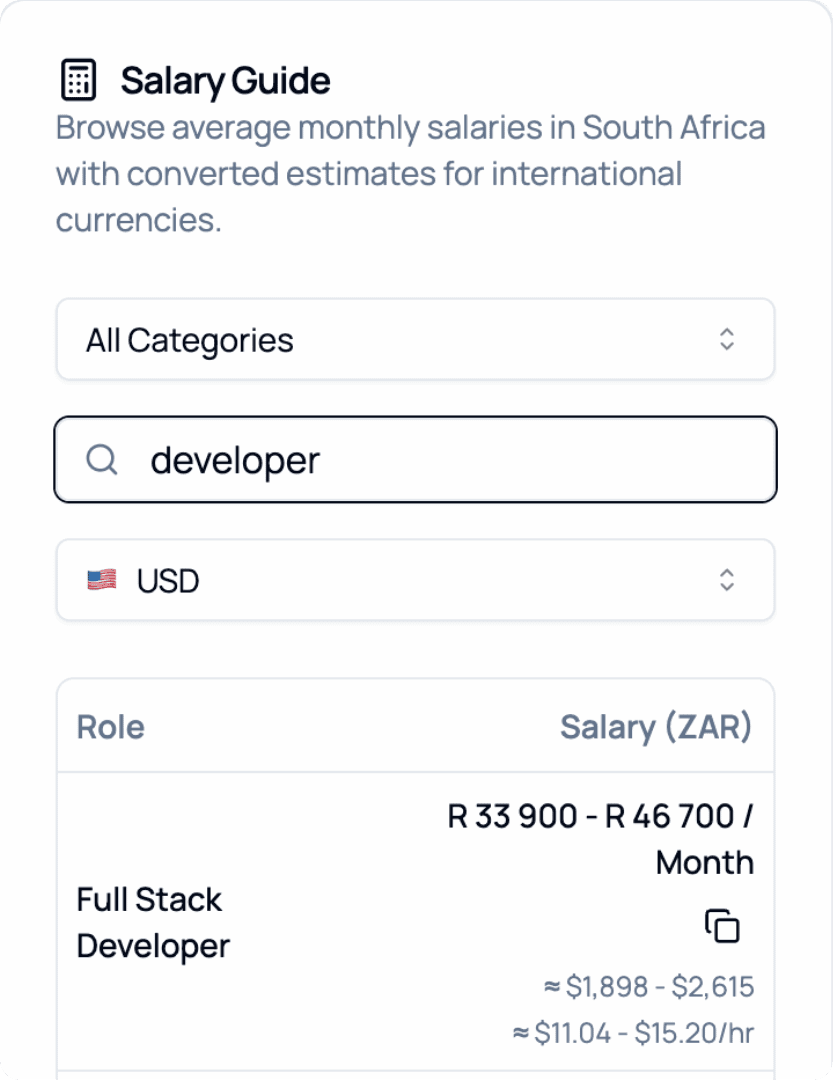
2026 Salary Guide: South Africa
Discover South African Salaries by Role. Compare costs and see how much you can save.