TL;DR
Hiring a local marketing manager costs over $100k fully loaded, while an outsourced South African team costs 60-70% less.
Traditional agencies often act as a black box, whereas dedicated remote staff offer transparency and direct real-time collaboration.
South Africa offers a "Goldilocks" time zone (GMT+2) and native English proficiency, ensuring high-quality creative output.
A "pod" structure (Strategist, Creator, Admin) is more effective and scalable than hiring a single generalist.
Success is measured by efficiency, growth (leads/traffic), and financial sustainability, not just hours worked.
Table of Contents
- Why Hiring a Local Marketing Team is No Longer Sustainable
- What is the Problem with Traditional Marketing Agencies
- Why South Africa is the Premier Destination for Marketing Talent
- How to Structure Your Outsourced Marketing Team
- How can you manage an outsourced marketing department without losing control?
- Why does cultural fit matter for an outsourced marketing department?
- The Transition Phase: How to Move from Local to Outsourced
- Measuring Success: KPIs for Your Outsourced Team
- Final Thoughts
Growth feels different these days. A few years ago, you could hire a generalist "Marketing Manager," and they could handle everything.
Today, that’s impossible. A modern marketing strategy needs distinct skills: SEO, copywriting, graphic design, email automation, and data analytics. Expecting one local hire to do all of this well is what experts call the "unicorn fallacy." You end up with someone who is burned out and mediocre at everything, or you pay a fortune for an agency that feels like a "black box" where you have zero control.
There is a third option. Instead of hiring one expensive generalist, you can build a full digital marketing virtual assistant team or a complete department based in South Africa.
This model gives you the best of both worlds: the control and culture of an in-house team with the cost efficiency of outsourcing. You get three specialists—like a strategist, a writer, and a designer—for the cost of one local hire.
Here is how you build a remote marketing department that actually works.
Why Hiring a Local Marketing Team is No Longer Sustainable
Hiring a local marketing manager costs far more than their base salary. Once you add payroll taxes, benefits, and recruitment fees, the total can exceed $100,000. An outsourced marketing department in South Africa cuts these costs by 60-70% while providing specialized experts who work in your time zone.
Small businesses often make the mistake of hiring a "generalist" marketing manager. They hope this one person can handle SEO, social media, email, and strategy.
This rarely works. Marketing has become too complex for one person to master every channel. You end up with someone who is stretched thin and delivers average results.
The Real Cost of Local Hires
When you hire locally in the US or UK, the salary is just the beginning. You have to account for:
- Payroll taxes and insurance: Often adding 15-20% to the base pay.
- Recruitment fees: Usually 20% of the first year’s salary.
- Benefits and equipment: Health insurance, laptops, and software seats.
A $70,000 hire actually costs the business closer to $100,000. For a small business, this is a massive risk. If the hire doesn't work out, you’ve lost months of momentum and thousands of dollars in "sunk" costs.
Why Outsourcing Marketing for Small Business is Different in South Africa
The biggest barrier to building a remote team used to be the "culture gap." If you hire from a region with a massive time difference or a language barrier, communication breaks down.
This is why many companies now choose to hire South African remote workers.
South Africa offers three distinct advantages:
- Cultural Alignment: South African professionals share a similar work ethic and business culture with Western markets.
- Native English: There is no "translation lag." The copy and communication are high-quality from day one.
- Time Zone Compatibility: South Africa is only 2 hours ahead of London and overlaps significantly with the US East Coast. Your outsourced marketing team isn't working while you sleep; they are working while you work.
By shifting to an outsourced model, you stop paying for "overhead" and start paying for "output." You can hire a specialist strategist and a content creator in South Africa for less than the cost of one junior-level employee in London or New York.
What is the Problem with Traditional Marketing Agencies
Traditional agencies often act as a "black box," where intermediate processes are hidden and communication is filtered through account managers. This creates a "fear of losing control" for business owners. An outsourced marketing department offers transparency by giving you direct access to specialists who integrate into your company culture.
For many small businesses, the alternative to a local hire is an outsourced marketing agency. On paper, this sounds great. You get a team of experts without the HR headaches.
But in practice, it often feels like a "black box". You send over a brief and a check, and then you wait. You don't see the work happening; you just see the final output. If you aren't happy with the results, it is hard to pinpoint where things went wrong because you were detached from the strategy.
Why the Agency Bottleneck Stalls Growth
In a standard agency model, you rarely speak to the people actually doing the work. Instead, you talk to an account manager.
This creates several problems:
- Information Lag: Your feedback is filtered and translated before it reaches the designer or writer.
- Lack of Priority: The agency is likely juggling 10 to 15 other clients at the same time. Your brand only gets a fraction of their mental bandwidth.
- Templated Strategy: To stay profitable, many agencies use "cookie-cutter" workflows. You might get a strategy that worked for another client but doesn't actually fit your specific goals.
Switching to a "Glass Box" Model
The outsourced marketing department model is different. Instead of hiring an agency to "do marketing for you," you hire dedicated remote staff who work exclusively for your business.
This is what we call a "Glass Box" methodology. There is no account manager standing in the way. If you want to check on a project, you message your digital marketing virtual assistant directly on Slack.
This setup provides radical visibility:
- Real-time Collaboration: Your remote team attends your Monday morning meetings and responds to strategy shifts as they happen.
- System Integration: They use your company's email domain and access your CRM. This ensures that all data and "institutional knowledge" stays within your business, not locked in an agency’s proprietary system.
- Dedicated Focus: Because they aren't managing other clients, their only goal is your growth.
By building an outsourced marketing team this way, you remove the "fear of losing control". You aren't just buying a service; you are extending your own workforce.
Why South Africa is the Premier Destination for Marketing Talent
South Africa is the top choice for an outsourced marketing department due to its high English proficiency, deep cultural alignment with Western markets, and a favorable time zone (GMT+2). This allows for real-time collaboration and high-quality creative output at a 60-70% lower cost than US or UK talent.
When most people think of outsourcing, they think of "transactional" tasks—data entry or basic tech support. But marketing is different. Marketing requires nuance, empathy, and a deep understanding of consumer psychology.
This is why South Africa has emerged as a global hub for creative and strategic work. It isn't just about lower costs; it’s about "cognitive proximity."
The "Native English" Advantage
Marketing is built on words. If your copy feels "off" or contains subtle grammatical errors, you lose trust with your audience instantly.
South Africa is one of the largest English-speaking nations in the world. Its education system and business environment are conducted entirely in English. When you hire south african remote workers, you aren't dealing with a "translation lag." They understand the slang, the humor, and the cultural references of US and UK audiences. This is vital when you want to outsource marketing strategy that actually resonates with your customers.
The "Golden Zone" Time Zone
One of the biggest failures in outsourcing is the 12-hour time difference. If your team is asleep while you are awake, feedback loops take days instead of minutes.
South Africa operates on GMT+2.
- For UK and European businesses: You are in the exact same time zone (or within one hour). Your outsourced marketing team is effectively in the "office" at the same time you are.
- For US East Coast businesses: There is a 6-7 hour overlap. Your South African team can handle tasks in their morning, and you can have "live" sync meetings during your morning and their afternoon.
According to data from DNA EOR, this overlap is the number one reason why Western firms are moving their creative departments to the region. It allows for a "follow-the-sun" model where work never stops, but communication never breaks.
The "Silicon Cape" Creative Hub
Cape Town, often called the "Silicon Cape," has become a magnet for world-class designers, copywriters, and growth hackers.
The city has a massive ecosystem of advertising agencies and tech startups. When you hire virtual assistant south africa talent through a marketplace like HireSava, you are tapping into a workforce that has been trained in these high-pressure, high-standard environments. You aren't getting "entry-level" assistants; you are getting professionals who understand how to build brands.
| Feature | South Africa | Other Common Regions | | :--- | :--- | :--- | | Primary Language | Native English | English as a Second Language | | Culture | Western-centric | High-context/Different | | Time Zone | GMT+2 (High Overlap) | GMT+8 (Zero Overlap) | | Cost Savings | 60-70% | 70-80% |
While other regions might be slightly cheaper on a per-hour basis, the "cost of management" is much higher elsewhere because of the communication barriers. South Africa offers the highest ROI because the talent requires less "hand-holding."
How to Structure Your Outsourced Marketing Team
A high-performing outsourced marketing department is typically built as a three-person "pod": a Strategist for high-level planning, a Creator for content and design, and a digital marketing virtual assistant for execution. This structure ensures specialized expertise across all channels while keeping costs 60-70% lower than a single local hire.
You don’t need a ten-person team to see results. In fact, for most small businesses, a massive team creates more management "bloat" than actual value.
The most effective way to outsource marketing for small business is to build a "Pod." This is a small, modular team of specialists who own specific parts of the marketing funnel.
Here is the ideal 3-person structure:
1. The Marketing Strategist (The Brains)
When you outsource marketing strategy, you are hiring someone to look at the big picture. This person doesn't spend their day posting on Instagram. Instead, they focus on:
- KPI Tracking: Which channels are actually making money?
- Campaign Planning: What is our focus for the next quarter?
- Funnel Optimization: Where are we losing leads?
In a local market, a strategist with 10 years of experience would cost $120k+. In South Africa, you can find world-class strategic talent for a fraction of that cost.
2. The Content Creator & Designer (The Voice)
Marketing is a visual and verbal medium. You need someone who can maintain your brand's "look and feel." By hiring a dedicated creative from South Africa, you ensure that your blogs, social posts, and ads aren't just generic—they are high-quality and culturally relevant.
Because South African creators are native English speakers, the "brand voice" stays consistent without you having to rewrite every single caption.
3. The Digital Marketing Virtual Assistant (The Engine)
This is the person who makes sure the work actually happens. While the strategist plans and the creator builds, the digital marketing virtual assistant executes. They handle the "repetitive but vital" tasks:
- Scheduling social media posts.
- Setting up email automation in HubSpot or Mailchimp.
- Basic SEO updates and link building.
- Uploading content to WordPress.
Why the "Pod" Beats the "Generalist"
When you hire one local person, they are forced to be the Brains, the Voice, and the Engine all at once. Usually, they end up being okay at one and failing at the other two.
With an outsourced marketing team, you divide these responsibilities. According to Unity Communications, specializing roles in an outsourced model is the fastest way to scale content production without losing quality.
This pod model allows you to scale up or down. If you need more content, you add another creator. If you need to enter a new market, you add a specialist. You aren't tied to the limitations of a single person's skill set.
How can you manage an outsourced marketing department without losing control?
You maintain control by integrating your outsourced marketing department into your own company systems. By using tools like Slack, Zoom, and Asana, your outsourced marketing team operates as a "virtual in-house" extension. South Africa’s time zone (GMT+2) ensures they are online when you are, allowing for real-time management.
The biggest fear business owners have is that "outsourced" means "out of sight, out of mind." If you can’t see what people are doing, you worry the work isn't getting done or the quality is slipping.
This is why the management style for an outsourced marketing department is different from a traditional agency. You aren't managing a vendor; you are managing a remote team.
Integrate into Your Internal Tech Stack
To maintain transparency, your remote team should live where your business lives. Don't let them work in a silo.
- Communication: Add them to your company Slack or Microsoft Teams. They should be just as reachable as a local hire.
- Project Management: Use tools like Monday.com or ClickUp. This allows you to see exactly which tasks are "In Progress" and who is responsible for them in real-time.
- Document Ownership: All assets—brand guides, logins, and strategy documents—should be stored in your company’s Google Drive or Dropbox, not on the staff's personal computers.
Establish a "Sprint" Rhythm
Because of the high time-zone overlap with South Africa, you can run your marketing like a software team. We recommend a "Weekly Sprint" model:
- Monday Planning: A 30-minute sync to decide the week's priorities.
- Mid-week Check-in: A quick Slack update on any "blockers" or hurdles.
- Friday Review: A look at what was accomplished and a preview of the next week.
This rhythm prevents "scope creep" and ensures that your outsource marketing strategy stays on track without requiring hours of micromanagement.
Avoid Common Communication Pitfalls
Managing remote talent requires clear documentation. Many business owners fail because they give vague instructions like "make this look better" or "write something for Facebook."
When you hire south african remote workers, take advantage of their high English proficiency by providing detailed briefs. WeGrowVA notes that one of the biggest challenges in hiring virtual assistants is a lack of clear standard operating procedures (SOPs). If you document your process once, your team can repeat it forever.
By treating your South African team as "internal staff who happen to be remote," you remove the "black box" and keep full visibility over your marketing spend.
Why does cultural fit matter for an outsourced marketing department?
Cultural fit is the "glue" that prevents miscommunication in an outsourced marketing department. South African talent shares a Western business mindset, high English proficiency, and similar work ethics to the US and UK. This "cognitive proximity" ensures your brand voice remains authentic and your team integrates seamlessly into your company culture.
When you hire south african remote workers, you aren't just looking for someone to check boxes. You are looking for a teammate. In marketing, cultural fit isn't a "nice-to-have"—it is a requirement.
If your team doesn't "get" your audience, your marketing will feel clinical and robotic. This is where many businesses fail when they outsource to regions with massive cultural divides.
The "Western" Work Ethic
South Africa’s professional landscape is deeply aligned with Western business standards. The work culture is direct, proactive, and results-oriented.
When you build an outsourced marketing team in South Africa, you’ll find that:
- Critical Thinking is Encouraged: Unlike "yes-man" cultures where staff wait for every instruction, South African professionals are trained to solve problems independently.
- Reliability: There is a high level of accountability. If a deadline is set for Friday, the expectation is that it’s done by Friday.
- Professionalism: The corporate structure in cities like Johannesburg and Cape Town mirrors that of London or New York.
Humor, Nuance, and Content
Marketing often relies on what isn't said—the subtext. A great social media post or email subject line uses humor, irony, or specific cultural references to grab attention.
Because South Africans grow up consuming the same media, movies, and internet culture as people in the US and UK, they "speak the same language" beyond just the dictionary definitions. This means your outsourced marketing department can write copy that actually converts because it feels like it was written by someone "in the room" with your customers.
The Benefits of Shared Values
Employmate notes that the "ease of doing business" with South Africans is significantly higher than in other popular outsourcing destinations. This is due to several shared traits:
- Direct Communication: If something isn't working, they will tell you. This saves weeks of wasted time on the wrong strategy.
- Adaptability: They are used to working with international clients and can pivot quickly when your business needs change.
- High Empathy: They understand the pain points of a Western consumer, which is essential for building effective marketing funnels.
By choosing South Africa, you aren't just saving money; you are protecting your brand’s reputation by ensuring the people representing it actually understand it.
The Transition Phase: How to Move from Local to Outsourced
Transitioning to an outsourced marketing department should be a phased process. Start by auditing your current marketing tasks and moving low-risk execution to a digital marketing virtual assistant. Once workflows are stable, you can transition higher-level outsource marketing strategy and creative roles to your South African team.
You don't need to fire your entire local team and hire a remote pod tomorrow. In fact, that is a recipe for disaster. Moving to an outsourced marketing team works best when it is done in stages.
This allows you to build trust and refine your communication systems before you hand over the keys to your entire brand.
Step 1: The Task Audit
Before you hire south african remote workers, you need to know what they are actually going to do. Sit down and list every marketing task performed in your business over the last month.
Categorize them into two buckets:
- Deep Work: Brand strategy, high-level partnerships, and product development. Keep this in-house for now.
- Execution Work: Social media posting, keyword research, email formatting, and basic graphic design.
This second bucket is where your digital marketing virtual assistant starts. These are the "bottleneck" tasks that prevent your local team from thinking strategically.
Step 2: Centralize Your Infrastructure
The biggest risk during a transition is losing access to your own data. Before onboarding a remote pod, ensure your "digital house" is in order:
- Password Management: Use a tool like 1Password or LastPass so you can grant and revoke access without sharing raw passwords.
- SOP Library: Create simple Loom videos or Google Docs for your common processes. According to research on In-house vs. Outsourced Marketing, having documented systems is the only way to ensure quality remains consistent when moving work offshore.
- Asset Management: Ensure all your brand assets (logos, fonts, templates) are in a shared drive that you own.
Step 3: The "Pilot" Hire
Start with one person. Usually, this is a specialist who can take over a specific, high-volume channel like SEO or Social Media.
By starting small, you can test your management rhythm. How does the 2-hour time difference feel? Is the English proficiency as high as expected? (With South African talent, it almost always is). Once this first hire is successful, it becomes much easier to justify building out the rest of the outsourced marketing department.
Step 4: Full Integration
Once the pilot is working, you can hire the remaining members of your "Pod"—the strategist and the creator. At this stage, your remote team should be attending your weekly meetings and contributing to your marketing calendar just like any other employee.
The goal is that eventually, a new person joining your company wouldn't even realize the marketing team is in Cape Town instead of the office next door.
Measuring Success: KPIs for Your Outsourced Team
Success in an outsourced marketing department is measured by output quality, lead generation, and cost-efficiency. Key performance indicators (KPIs) should focus on "leading indicators" like content volume and "lagging indicators" like Customer Acquisition Cost (CAC). Tracking these ensures your outsourced marketing team delivers a positive ROI compared to local alternatives.
When you transition to a remote model, you have to move away from "management by walking around." You can't see if your team is busy, so you must measure what they actually produce.
The Three Pillars of Marketing KPIs
To get a full picture of how your outsourced marketing team is performing, track these three categories:
- Efficiency Metrics: How much are they producing?
- Number of blog posts published per month.
- Number of social media updates and ad variants created.
- Speed of campaign turnaround (from brief to go-live).
- Growth Metrics: Is the needle moving?
- Organic traffic growth (SEO).
- Cost Per Lead (CPL) for paid campaigns.
- Email open and click-through rates.
- Financial Metrics: Is the model sustainable?
- Total Marketing Spend vs. Revenue: Your goal should be to lower your overhead while increasing your output.
- Retention: How long do your remote staff stay? (South African talent is known for high loyalty and lower turnover compared to other regions).
Using the "Goldilocks" Approach to Reporting
Don't drown in data. Ask your digital marketing virtual assistant to prepare a simple monthly "Health Report." This should highlight what went well, what failed, and what the plan is for next month.
According to MyOutDesk, the most successful remote teams are those that have a "single source of truth" for their data. Use a shared dashboard in Google Looker Studio or AgencyAnalytics so you can check your progress anytime without asking for a report.
Final Thoughts
The ultimate goal of building an outsourced marketing department isn't just to save money this month. It’s to build a scalable engine that grows with your business.
By hiring in South Africa, you gain access to a talent pool that is highly educated, culturally aligned, and operates in your time zone. You stop being a "manager of tasks" and start being a "leader of a department."
Building a team of digital marketing virtual assistants and specialists in South Africa gives you the freedom to focus on your product while experts handle the growth. It’s the most cost-effective way to compete with larger companies without losing the "scrappy" control that made your small business successful in the first place.
If you're ready to stop overpaying for local generalists and start building a high-performance pod, it’s time to hire south african remote workers who can scale your brand to the next level.
Explore related hiring options
Useful next pages based on this article's topic:
- Remote SEO Specialist role — organic growth execution and reporting
- On-Page SEO Optimization service — content relevance and ranking improvement
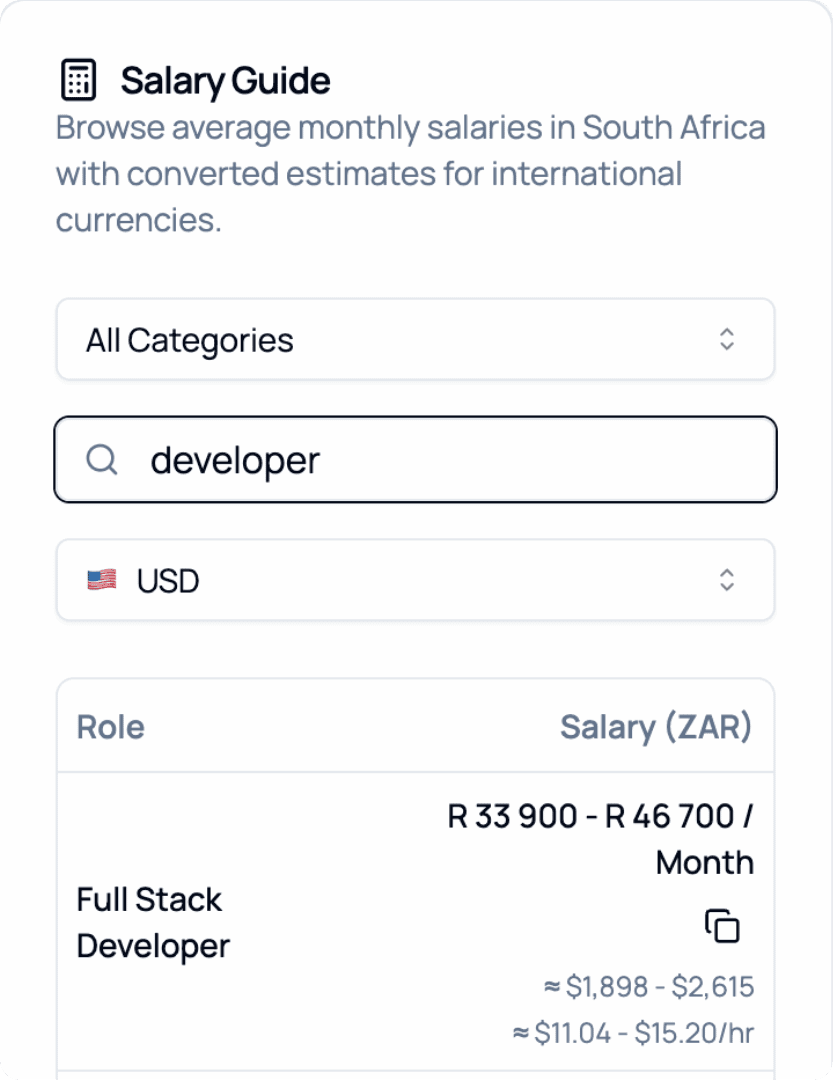
2026 Salary Guide: South Africa
Discover South African Salaries by Role. Compare costs and see how much you can save.