TL;DR
Legal document review services reduce litigation costs by 50-70% by converting fixed salaries to flexible expenses.
Managed review technology accelerates discovery speeds by 180% using AI and auto-coding tools.
Outsourcing to South Africa creates a 24-hour "follow the sun" workflow, doubling daily productivity.
Remote teams reduce associate burnout by handling repetitive high-volume document review tasks.
South African talent offers a unique advantage with a compatible legal system, native English, and high-quality standards.
Table of Contents
- Why the Old Legal Document Review Model Is Breaking
- #1: Financial Restructuring, Cutting Costs, Not Corners
- #2: Accelerating Speed to Evidence through Managed Technology
- #3: Elevating In-House Talent and Reducing Burnout
- #4: Mitigating Risk with Standardized Quality Control and Security
- #5: Strategic Geographic Arbitrage, The South African Advantage
- Conclusion
The legal industry is in a strange place right now. On the surface, things look great, profits per lawyer have jumped over 53% since 2019. But if you look closer, that growth is mostly coming from raising rates, not from working smarter.
Beneath that profit margin, there is a massive operational crisis brewing. The amount of digital evidence (ESI) involved in litigation is growing by about 40% every single year. The old way of handling this, throwing junior associates at a mountain of documents, just doesn't work anymore. It is too slow and way too expensive.
Discovery has turned into a bottleneck that eats up 60% to 80% of your total litigation budget. You are paying high salaries for routine data classification, and clients are starting to push back.
This is where partnering with a specialized legal document review service changes the math.
Instead of burning out your team on low-value tasks, you can tap into a scalable workforce that handles the volume for you. This isn't just about cutting costs; it's about fixing a broken process. When you look at options like South Africa, you find a massive advantage: highly qualified professionals who work while your local team sleeps, all at a fraction of the cost.
Whether you need a full managed team or a single virtual legal assistant to help organize your case files, shifting this workload is the only way to keep up with the data explosion.
Here is how a document review service actually creates value for your firm, beyond just "cheaper rates."
Why the Old Legal Document Review Model Is Breaking
To understand the savings, you have to look at the problem. It isn't just that there are "too many documents." The issue is a fundamental mismatch between data volume and human speed.
Digital evidence is growing by about 40% every year. Meanwhile, a human reviewer can still only read about 50 to 60 documents per hour. That speed limit is biological; you can’t force people to read faster without risking massive errors.
This creates a "volume-productivity paradox." In 2025, lawyers were busier than ever, yet they only achieved a 37% utilization rate for billable work. The rest of their time was swallowed by administrative tasks and data management.
When you rely on an internal team for this, you face "capacity waste." You pay full salaries even when the caseload is light. Then, when a massive request hits on a Friday afternoon, your team is overwhelmed, and you can't hire fast enough to catch up.
Shifting to a legal document review service fixes this by turning that fixed cost into a flexible utility. You stop paying for "availability" and start paying only for results.
#1: Financial Restructuring, Cutting Costs, Not Corners
Outsourcing document review cuts litigation costs by 50% to 70% by converting fixed salaries to flexible operating expenses. While internal associate review often exceeds $150 per hour, South African legal document review services typically range from $25 to $45 per hour, allowing firms to scale capacity on-demand without increasing overhead.
The most immediate impact of outsourcing is on your bottom line. This isn't just about finding cheaper rates; it is about moving from a rigid, expensive model (CAPEX) to a flexible, scalable one (OPEX).
What is the cost difference between in-house document review vs. outsourcing?
In-house review often exceeds $150 per hour when factoring in salaries, benefits, and overhead. Outsourcing to a South African legal document review service typically ranges from $25 to $45 per hour, offering a 50% to 70% reduction in total costs while converting fixed salaries into flexible, on-demand expenses.
The "Fully Loaded" Cost Fallacy
Firms often underestimate their internal costs. They look at an associate's salary, say, $225,000, and think that's the price tag. But the real cost to the firm, including healthcare, benefits, office space, and technology, is often over $300,000.
If that associate works 1,800 hours, your break-even cost is roughly $166/hour. Using that resource to click "Relevant" or "Not Relevant" on thousands of emails is financial suicide. Clients know this, which is why many now refuse to pay associate rates for routine review.
The South African Advantage
This is where the Global Legal Market Report highlights a massive opportunity. South Africa has emerged as a top destination for legal outsourcing because it offers Western standards at a fraction of the price.
By leveraging the exchange rate and lower cost of living, you can access high-quality talent for significantly less.
Here is the cost breakdown per hour:
- US In-House Associate: $150+ (High management burden)
- US Contract Attorney: $50 – $75 (Medium management burden)
- South African Remote Reviewer: $25 – $45 (Low management burden)
This arbitrage allows you to protect your margins. You can offer clients fixed-fee arrangements that are actually profitable, or bid on data-heavy cases that would be impossible to staff domestically. Most importantly, when the case ends, your cost drops to zero.
#2: Accelerating Speed to Evidence through Managed Technology
Managed document review services speed up discovery by using Technology Assisted Review (TAR) and Continuous Active Learning (CAL) to prioritize relevant files. By combining these tools with a "follow the sun" workflow, where South African teams review data overnight, firms can double their daily productivity and cut review times by over 50%.
The second major saving is time. In litigation, "speed to evidence" is often the difference between a quick settlement and a drawn-out trial.
Internal teams often review documents linearly (one by one), which caps speed at about 50 documents per hour. Document review companies break this ceiling by using advanced tech stacks that most firms don't manage in-house.
Breaking the Linear Limit with AI
Modern review isn't just about reading; it's about teaching the software to read.
- Continuous Active Learning (CAL): As human reviewers mark documents as "Relevant," the system learns from those choices and pushes similar documents to the front of the queue. In one case study, this reduced review volume by 54%, cutting out 730,000 irrelevant documents.
- Generative AI & Auto-Coding: New tools like Relativity aiR allow for "auto-coding" based on logic rules. This can boost review speeds from 50 documents/hour to 140 documents/hour, a 180% increase in velocity.
- Audio/Video Transcription: Instead of listening to hours of audio in real-time, tools like Everlaw auto-transcribe recordings into searchable text, saving millions in manual transcription costs.
The "Follow the Sun" Workflow
Technology works best when you combine it with the right time zone strategy. When you hire South African remote workers, you create a 24-hour production cycle.
South Africa is 6–7 hours ahead of US Eastern Standard Time. This means a South African team can start working while your US team sleeps. By the time your attorneys log on at 9:00 AM in New York, the remote team has already finished a full day's work, flagged "hot" documents, and generated privilege logs.
#3: Elevating In-House Talent and Reducing Burnout
Outsourcing routine document review reduces associate burnout by removing tedious, low-value tasks from their workload. This allows firms to retain top talent by refocusing them on substantive legal work, such as strategy and motion practice, which improves job satisfaction and cuts the high costs associated with associate turnover.
The third saving is protecting your human capital. The legal industry is facing a retention crisis, with 79% of legal professionals reporting burnout in 2024.
A major driver of this burnout is repetitive, administrative work. When you force highly educated associates to spend weeks clicking "Relevant" or "Not Relevant" on thousands of emails, you risk losing them.
The True Cost of Churn
Losing an associate is expensive. The cost to replace a lawyer is estimated at 1.5x to 2x their annual salary when you factor in recruitment fees and lost productivity.
If an associate leaves because they are stuck doing low-level work, you aren't just losing a body; you are losing institutional knowledge. Outsourcing the grunt work stops this bleeding.
"Top of License" Work
Partnering with a legal document review service lets you reposition your internal team. Instead of looking for the needle in the haystack, your associates can focus on analyzing the needles.
- Strategic Focus: Associates can spend their time drafting motions and preparing for witness exams based on the evidence found by the outsourced team.
- Client Alignment: Clients are refusing to pay high hourly rates for routine review. Outsourcing satisfies their demand for efficiency while freeing up your team to do the high-level analysis clients are willing to pay for.
Why South African Talent Fits Your Culture
When firms decide to hire talent from South Africa, they often find a better cultural fit than with other BPO destinations.
South African legal professionals are known for a strong work ethic that mirrors the intensity of Western law firms. The corporate culture in cities like Johannesburg is direct and deadline-driven, meaning these teams integrate seamlessly into US workflows without needing heavy management or "cultural translation".
#4: Mitigating Risk with Standardized Quality Control and Security
Managed review services lower risk by enforcing standardized "coding manuals" and rigorous QC loops (aiming for <5% overturn rates). Top providers utilize Virtual Desktop Infrastructure (VDI), which ensures client data never leaves the secure cloud environment, maintaining strict compliance with ISO 27001 and SOC 2 standards.
There is a common myth that outsourcing increases risk. The reality is usually the opposite. An ad-hoc internal team often lacks a unified protocol, leading to inconsistent tagging that can get a discovery process sanctioned.
A professional legal document review service survives on "defensibility." They don't just review; they create an audit trail that proves the review was sound.
The "Pixels Only" Security Model
Data security is the biggest hurdle for law firms. You cannot email zip files of evidence to a remote team.
That is why top providers use Virtual Desktop Infrastructure (VDI) solutions like Citrix.
- How it works: The remote reviewer logs into a secure server located in your jurisdiction (US or UK).
- No Data Transfer: They only see "pixels" of the document on their screen. They cannot download, print, copy-paste, or take screenshots. The data never actually leaves your secure environment.
Engineered Quality Control (QC)
Humans get tired. A structured QC process catches errors before they leave the building.
- The Coding Manual: Every project starts with a document defining exactly what "Relevant" means for this specific case.
- Statistical Sampling: Senior attorneys re-review a random 10–20% sample of the coded documents. If the error rate exceeds 5%, the team is retrained, and the batch is re-reviewed.
- Conflict Checks: Algorithms scan for logical errors, such as a document marked "Privileged" but also "Not Relevant."
#5: Strategic Geographic Arbitrage, The South African Advantage
South Africa offers a unique advantage because its legal system (a mix of Civil and Common Law) and education (LLB) align closely with US and UK standards. Unlike other outsourcing hubs, South African lawyers possess native English fluency and work in a time zone that allows for either real-time collaboration or overnight processing.
Not all outsourcing destinations are created equal. While India and the Philippines have led the BPO market for years, South Africa has emerged as the specialist hub for high-end legal work.
This is "geographic arbitrage", getting the same quality of work for a different price, simply because of location.
Why South African Talent Adapts Faster
The gap between a US JD and a South African LLB is smaller than you think. South Africa’s legal system incorporates elements of English Common Law, meaning concepts like tort (delict), contract law, and discovery rules are foundational to their training.
When you hire talent from South Africa, you aren't hiring generalist support staff; you are hiring qualified legal professionals who have completed a rigorous 4-year law degree. They understand the difference between "relevance" and "privilege" without needing basic legal education.
The "Goldilocks" Time Zone
South Africa operates on Standard Time (GMT+2).
- For UK/Europe: The time difference is negligible (1–2 hours), allowing for real-time collaboration.
- For the US: The 6–7 hour difference is perfect for the "follow the sun" model. You assign work at the end of your day, and it is completed by the time you wake up.
Conclusion
The era of solving discovery problems by throwing more bodies at them is over. The data volumes are too high, and the margins are too thin.
Shifting to a legal document review service isn't just a cost-saving tactic; it's a strategic move to modernize your firm. It allows you to bid on bigger cases, protect your associates from burnout, and ensure your clients aren't paying premium rates for routine work.
Whether you need a full managed team to handle a terabyte of data or a single virtual legal assistant to organize your intake, the talent is out there. You just need to look in the right place.
Explore related hiring options
Useful next pages based on this article's topic:
- Remote Paralegal role — case support, research, and document workflows
- Legal Document Preparation service — drafting and filing support for legal teams
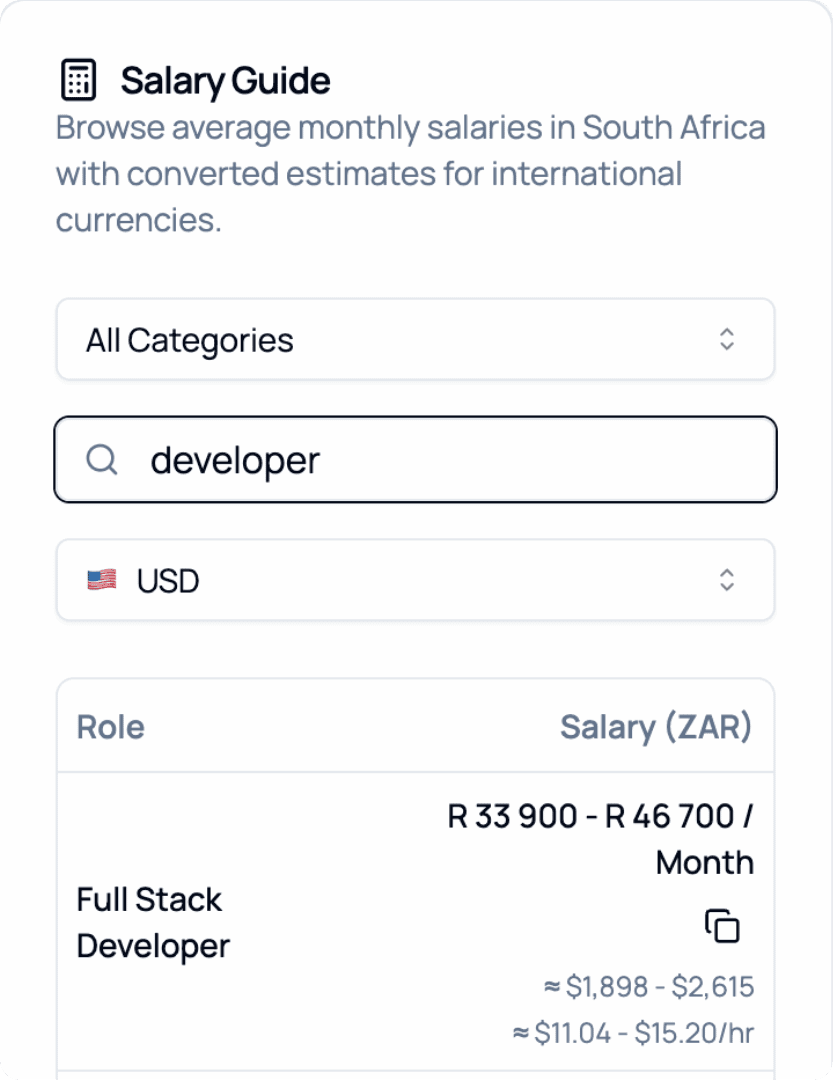
2026 Salary Guide: South Africa
Discover South African Salaries by Role. Compare costs and see how much you can save.