TL;DR
Distinguish between a "billable" Remote Paralegal (revenue generator) and a "non-billable" Legal Assistant (time saver).
Global law firms use South African talent to access Common Law-trained professionals at 70% lower costs.
Hiring the wrong role leads to "operational chaos"—learn the specific duties and educational requirements for each.
leverage the "Golden Hour" time zone advantage to turn your firm into a 24-hour production engine.
Table of Contents
- Remote Paralegal vs. Legal Assistant: What’s the Difference?
- Remote Paralegal vs. Legal Assistant: The "Billable" Divide
- Why South Africa as Your Paralegal or Legal Assistant?
- Cost Analysis: Salary & ROI
- How to Avoid UPL (Unauthorized Practice of Law)
- Best Tools for Managing Your Remote Team
- How to Recruit the Right Talent
- Final Thoughts
Law firms in the US are facing a dual crisis right now. You have attorneys burning out from unmanageable workloads, and operational costs are eating into profit margins. The traditional billable hour model is under pressure, and finding good domestic support staff is getting harder and more expensive.
Many firms are turning to remote staffing to fix this. But there is a massive confusion that keeps popping up: knowing the difference between a paralegal and a legal assistant.
If you treat these roles as the same thing, you will lose money.
Remote Paralegal vs. Legal Assistant: What’s the Difference?
A Paralegal performs substantive legal work (drafting, research, e-discovery) that you can bill to the client, effectively generating revenue. A Legal Assistant handles administrative tasks (scheduling, intake, filing) which are non-billable overhead but free up attorney time.
Mixing these up leads to "operational chaos". You don't want a billable paralegal wasting hours on scheduling, and you can't have an assistant drafting motions.
This guide breaks down exactly which role you need and why sourcing this talent from South Africa, with its English Common Law alignment, is the smartest move for scaling a law firm remotely. Whether you need a virtual legal assistant to handle the phones or a degreed professional to draft pleadings, getting the distinction right is step one.
Remote Paralegal vs. Legal Assistant: The "Billable" Divide
If you take nothing else from this post, take this: Paralegals make you money; Legal Assistants save you time.
Here is the breakdown of who handles what to stop "operational chaos":
A remote paralegal performs substantive legal work, like legal research, drafting pleadings, and e-discovery, that is billable to clients. A virtual legal assistant handles administrative tasks like scheduling, client intake, and billing, which are non-billable overhead expenses designed to free up attorney time.
Confusing these two roles is the fastest way to bloat your overhead. You do not want a billable paralegal spending four hours on hold with a court clerk (non-billable), and you definitely don’t want an admin assistant trying to draft a Motion for Summary Judgment.
What a Remote Paralegal Actually Does
According to the ABA, a paralegal performs "substantive legal work". This means if the paralegal didn't do it, an attorney would have to. Because of this, you bill their time to the client, effectively converting them from a cost center into a profit center.
When you hire talent from South Africa, you often get candidates with a full Bachelor of Laws (LLB) degree. They aren't just filling forms; they understand legal theory.
Their core duties include:
- Legal Research: Going beyond Google. They use tools like LexisNexis or Westlaw to analyze case law, identify relevant statutes, and prepare internal memos.
- Drafting Pleadings & Motions: Creating first drafts of complaints, answers, and discovery requests. You review and sign, but they do the heavy lifting of applying facts to law.
- E-Discovery Management: Reviewing thousands of documents for privilege and relevance on platforms like Relativity. This is critical in complex litigation and highly billable.
- Contract Review: Drafting "business as usual" contracts and NDAs. Because South African law is partly based on English Common Law, they grasp concepts like offer, acceptance, and breach instinctively.
What a Virtual Legal Assistant Handles
A virtual legal assistant (or legal secretary) is your administrative backbone. Their work is non-billable, meaning it's a cost to the firm. However, they pay for themselves by freeing up your attorneys to bill more hours.
Their core duties include:
- Calendar Management: Coordinating court dates and client meetings. They understand time zones and docketing rules to ensure no deadline is ever missed.
- Client Intake: Acting as the first point of contact. They screen potential clients to see if they fit your firm's criteria. South African talent is particularly strong here due to native English proficiency and neutral accents.
- File Organization: Keeping your Case Management System (CMS) clean. They name files, save emails, and ensure the "digital paper trail" is audit-ready.
- Billing Support: Preparing pre-bills, chasing accounts receivable, and managing expense reports to keep cash flow moving.
The Role Matrix: Who Does What?
To scale a law firm remotely, you need to enforce a rigid distinction between these roles. Mixing them leads to lost revenue.
| Feature | Remote Paralegal | Virtual Legal Assistant | | :--- | :--- | :--- | | Primary Focus | Substantive Legal Work | Administrative Support | | Financial Impact | Billable (Profit Center) | Non-Billable (Overhead) | | Typical Education | Specialized training or Law Degree (LLB in SA) | Admin experience or General Degree | | Key Tasks | Drafting, Research, Case Analysis | Scheduling, Filing, Intake, Transcription | | Autonomy | Works semi-independently | Supervised closely on tasks | | Value Driver | Generates Revenue | Increases Efficiency |
Why South Africa as Your Paralegal or Legal Assistant?
When you think of outsourcing, you might immediately think of India or the Philippines. Those regions are well-known BPO hubs, but for high-stakes legal work, South Africa offers a unique "trifecta" of advantages: legal compatibility, education, and time zone alignment.
It is not just about labor arbitrage; it is about finding a workforce that actually understands your business model.
The Legal System: A "Common Law" Cousin
You can't hire a remote paralegal from a country with a wildly different legal framework (like the Civil Law systems in Europe or South America) and expect them to understand US jurisprudence.
South Africa is different. It operates on a hybrid legal system that blends Roman-Dutch law with English Common Law.
- Adversarial Nature: Like the US, South Africa uses an adversarial system. Professionals understand plaintiff vs. defendant dynamics and the role of the judge as an arbiter.
- Precedent Matters: They grasp stare decisis (judicial precedent). A South African paralegal instinctively knows they need to cite case law to back up an argument because their system relies on it.
- Contract Logic: Principles like offer, acceptance, and breach are conceptually identical. They can review a US contract and spot issues immediately, needing only minor guidance on state-specific rules.
The LLB Advantage: Law School Grads as Paralegals
Here is the biggest value driver for US firms: Educational Arbitrage.
In the US, a paralegal might have a certificate or an associate degree. In South Africa, the standard entry for legal work is a Bachelor of Laws (LLB), a comprehensive four-year law degree.
Because the path to becoming an admitted attorney in South Africa is extremely competitive, there is a surplus of high-level talent. You are essentially hiring someone with the education of a junior lawyer, who has studied Torts (Delict), Contracts, and Evidence, to do your paralegal work.
Linguistic and Cultural Alignment
Language barriers create friction. South Africa removes that friction because English is the primary language of business, law, and government.
- Native Proficiency: South African professionals typically possess native-level fluency, which is vital for drafting nuanced legal documents.
- Neutral Accents: The accent is generally perceived as clear and professional by US clients, making them effective for client-facing roles like intake.
- Cultural Fit: The business culture mirrors Western norms, reducing the time it takes to integrate them into your team.
The "Golden Hour" Time Zone
Time zones can kill remote collaboration. If your team is asleep when you need them, projects stall.
South Africa (SAST) is 6 to 7 hours ahead of Eastern Standard Time (EST). This creates a perfect workflow:
- Follow-the-Sun: You assign work at the end of your day. Your South African team completes it while you sleep, delivering it by 8 AM EST the next morning.
- Real-Time Overlap: Many South African pros work slightly shifted hours (e.g., 11 AM – 8 PM SAST), giving you 4–5 hours of direct overlap for Zoom calls and urgent tasks.
Cost Analysis: Salary & ROI
A US-based paralegal costs nearly $100,000 annually when you include taxes and benefits. A remote South African paralegal costs between $24,000 and $36,000. This 70%+ cost reduction allows firms to bill remote staff at market rates, generating immediate profit margins that are impossible with domestic hires.
The economic argument for hiring from South Africa is simple: you get senior-level talent for the price of an entry-level domestic hire. But you need to look beyond just the salary cap. You need to look at the "Total Cost of Ownership" (TCO) and the potential return on investment.
Salary Comparison: US vs. South Africa (2025)
The following table contrasts the average annual costs. The "US Cost" includes an estimated burden of 20-30% for taxes and benefits (FICA, healthcare, 401k). The "SA Cost" reflects the rate you typically pay to hire talent from South Africa remotely.
| Role | US Annual Salary (Avg) | US Fully Burdened Cost | South Africa Remote Rate | Potential Savings | | :--- | :--- | :--- | :--- | :--- | | Senior Paralegal | $80,750 | ~$100,000 | $24,000 - $36,000 | 64% - 76% | | Entry Paralegal | $46,000 | ~$57,500 | $14,400 - $18,000 | 68% - 75% | | Legal Assistant | $55,000 | ~$68,000 | $12,000 - $15,000 | 78% - 82% |
The Paralegal Profit Center
When you hire a remote paralegal, you aren't just saving on overhead; you are building a revenue engine.
- The Math: If you hire a South African paralegal for $30,000/year (approx. $15/hour), you can bill that paralegal out at a conservative market rate of $100-$125/hour.
- The Output: If they bill 1,050 hours per year (70% utilization), they generate $105,000 in revenue.
- The ROI: After paying their salary, you net $75,000 in profit. The firm earns a 3.5x return on the cost of the talent.
How Legal Assistants Buy You Time
A remote legal assistant is non-billable, so their ROI comes from "opportunity cost."
Imagine a Senior Associate billing at $400/hour. If they spend just 5 hours a week on scheduling, intake, and filing, that costs the firm $2,000 per week in lost billable potential.
By hiring a remote assistant for $15,000/year to handle those tasks, the Associate can redeploy those 250 hours a year to billable work. That creates $100,000 in value. The assistant effectively pays for themselves nearly 7x over by liberating attorney time.
Hidden Costs to Watch
To keep your budget honest, you must account for the tools required to make this work.
- Employer of Record (EOR) Fees: If you hire directly, services like Deel or Remote.com charge ~$599/month to handle compliance.
- Tech Stack: You will need licenses for case management software (like Clio) and secure communication tools (Slack), costing roughly ~$150/month per user.
- Training Investment: Expect a 3-month ramp-up period where attorney supervision reduces billable efficiency. This "investment phase" is real but temporary.
How to Avoid UPL (Unauthorized Practice of Law)
Remote staff cannot practice law. They must work under the direct supervision of a licensed US attorney who retains full professional responsibility for their work product. According to ABA Model Rule 5.3, lawyers must make reasonable efforts to ensure non-lawyer conduct is compatible with professional obligations.
The biggest fear for any attorney hiring remotely is the risk of the Unauthorized Practice of Law (UPL). You need to be certain that delegating work to a virtual legal assistant or paralegal in South Africa won't jeopardize your law license.
The good news is that the rules are clear. As long as you follow the "Captain of the Ship" doctrine, you are safe.
The Duty of Supervision (ABA Model Rule 5.3)
You are the attorney; they are the support. That dynamic never changes, regardless of the distance.
Under ABA Model Rule 5.3, you are responsible for the actions of your non-lawyer assistants. This means you cannot simply "set and forget" a remote paralegal. You must review their drafts, approve their research, and sign off on every document that leaves your firm.
When you hire talent from south africa, you treat them exactly like a paralegal sitting in the cubicle next to you. You provide the instructions, they do the work, and you review it. As long as you maintain that supervisory relationship, you remain compliant.
The "Red Lines": What Remote Staff Cannot Do
To avoid UPL, you must establish clear boundaries. Your remote team needs to know exactly where their authority ends.
Strict Prohibitions:
- No Legal Advice: They cannot advise clients on their rights, potential outcomes, or legal strategy. If a client asks, "What should I do?", the assistant must defer to you.
- No Court Appearances: They cannot represent a client in depositions or court hearings.
- No Signing: They cannot sign pleadings or engage in fee-splitting arrangements.
- No "Esquire": They must clearly identify themselves as a "Paralegal" or "Legal Assistant" in all communications to avoid misleading the public.
Data Security & Client Privilege
Outsourcing does not mean you sacrifice confidentiality. In fact, remote security protocols are often stricter than physical office security.
- Secure Access: Use a VPN and restrict access to your Case Management System (CMS) based on roles. A remote paralegal should only see the files they are working on.
- Encryption: Ensure all communication happens through encrypted channels (like Slack or Teams) rather than personal email.
- NDAs: Every remote hire should sign a rigorous Non-Disclosure Agreement that is enforceable in their jurisdiction. South African employment law respects these contracts, offering you an extra layer of protection.
Best Tools for Managing Your Remote Team
The success of a remote South African team depends less on the talent itself and more on the technological infrastructure you build around them. If you treat them like an external vendor, they will fail. If you integrate them into your digital ecosystem, they will thrive.
You don't need expensive enterprise software. You just need the right stack to make the 8,000-mile distance disappear.
The Remote Tech Stack (Security & Speed)
To make this work, your tools must ensure security, collaboration, and workflow visibility.
- Case Management (CMS): Cloud-based platforms like Clio, MyCase, or PracticePanther are non-negotiable. They allow your remote virtual legal assistant to access files instantly without the lag of a traditional VPN. Crucially, these platforms have built-in time-tracking features that are essential for billing paralegal hours.
- Communication: Stop using email for internal chatter. Use Slack or Microsoft Teams for quick questions and "water cooler" updates. This creates a sense of belonging that email cannot match.
- VoIP Telephony: Systems like RingCentral or Dialpad allow South African staff to make and receive calls using a local US area code. This is vital for intake specialists; your clients will never know they are speaking to someone in Cape Town.
- Security: Never email passwords. Use tools like 1Password or LastPass to share access to portals without revealing the actual credentials to remote staff.
The "Follow-the-Sun" Workflow
The biggest advantage of South Africa's time zone (SAST) is the ability to create a 24-hour production cycle. Here is how to manage it:
- Asynchronous Handoffs: At the end of your US workday, leave detailed instructions for your team. Voice notes or Loom videos are highly effective here. Your team works on these tasks while you sleep, delivering the completed work by your morning.
- The Daily Stand-up: Schedule a 15-minute "huddle" at 8:00 AM or 9:00 AM EST. This is the afternoon in South Africa, making it the perfect time to review progress and set priorities for the next shift. This prevents isolation and keeps everyone aligned.
Documenting Your Brain (SOPs)
Because you cannot just "walk down the hall" to answer a quick question, your processes must be documented.
Create a "Firm Wiki" using tools like Notion or SharePoint. Detail exactly how to name files, how to format briefs, and how to handle a rude client on the phone. Standard Operating Procedures (SOPs) replace the need for constant micromanagement.
How to Recruit the Right Talent
Finding a resume is easy; finding a reliable remote professional who won't disappear during a power outage is harder. When hiring from South Africa, you generally have two viable paths: "Do It Yourself" via an Employer of Record, using a specialized Staffing Agency, or using talent marketplace like HireSava
The Vetting Checklist: What to Ask
If you decide to hire directly, you must screen for "South Africa-specific" risks. A standard interview isn't enough. You need to verify their infrastructure.
1. The "Load Shedding" Test
South Africa experiences rolling blackouts known as "load shedding." You cannot hire a remote worker who goes offline for 4 hours a day.
- Ask: "Do you have an inverter or UPS (Uninterruptible Power Supply) that keeps your WiFi and laptop running during Stage 4 load shedding?".
- Verify: Ask for a photo of their setup or a speed test result during a scheduled outage.
2. The Connectivity Test
Fiber internet is standard in major SA cities, but stability varies.
- Ask: "What is your upload/download speed?"
- Verify: Require a screenshot of a speed test (Speedtest.net) showing at least 20 Mbps up/down.
3. The "Legalese" Writing Sample
English proficiency is high, but legal nuance is specific.
- Task: Ask them to redact a sensitive document and send it to you, or give them a dummy fact pattern and ask them to draft a simple demand letter.
- Look for: The ability to structure an argument logically. Even if they cite South African case law, the structure (Issue, Rule, Analysis, Conclusion) should be perfect.
Final Thoughts
You don't need to choose between quality and cost. You just need to choose the right role for the right task.
If you treat a paralegal like a secretary, you lose revenue. If you ask a secretary to draft a contract, you lose your license. The distinction is simple:
- Hire a Remote Paralegal if you need someone to bill hours, draft motions, and handle substantive legal work.
- Hire a Legal Assistant if you need someone to save hours, clear your inbox, and manage your calendar.
Sourcing this talent from South Africa is the strategic lever that allows small firms to compete with the giants. You get the English Common Law background, the rigorous education, and the time zone overlap, all for a fraction of the domestic cost.
If you are ready to stop burning out and start scaling, it is time to build your remote team. Whether you need a virtual legal assistant to handle the admin or a qualified pro to handle the cases, the talent is ready.
Don't let operational chaos hold your firm back. Find your next legal pro with HireSava today.
Explore related hiring options
Useful next pages based on this article's topic:
- Remote Paralegal role — case support, research, and document workflows
- Legal Document Preparation service — drafting and filing support for legal teams
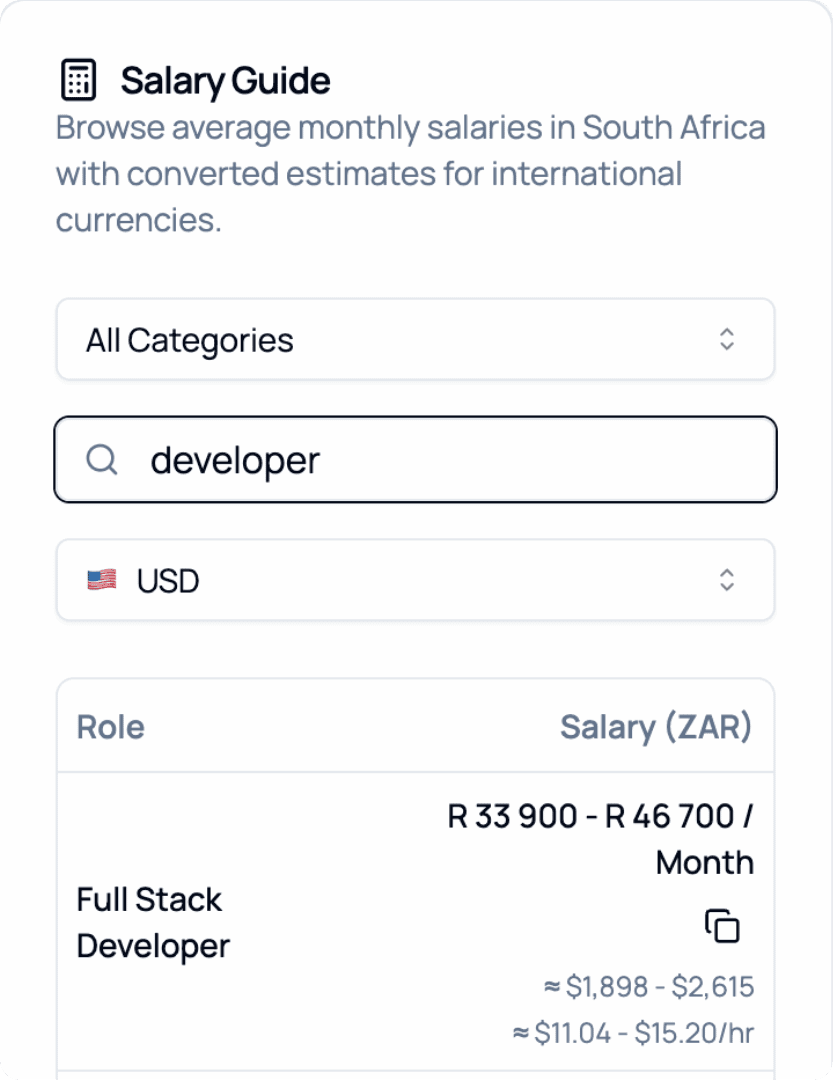
2026 Salary Guide: South Africa
Discover South African Salaries by Role. Compare costs and see how much you can save.