TL;DR
Engage each person as an independent contractor who invoices you, or as an employee of an employer of record (EOR) whose local company runs payroll. Deel and Remote both list EOR from $599 per employee per month, and contractor plans from $49 and $29 a month.
For a New York working day until March 13, 2027, Ghana (14:00 to 22:00) and Nigeria (15:00 to 23:00) need the smallest shift in hours. A London 09:00 to 17:00 day falls between 09:00 and 20:00 local time in all five countries compared.
On the employee route, employer contributions run from about 2% of pay in South Africa to 18.75% in Egypt. On 16 November 2026 the EU and Kenya announced the conclusion of data adequacy negotiations, but no African country has an EU adequacy decision yet.
Table of Contents
To hire remote workers from Africa, pick the country whose working day fits yours, then engage each person in one of two ways: as an independent contractor who invoices you, or as an employee of an employer of record (EOR), a provider whose local company runs payroll and carries the employer duties. A contractor costs little to set up. An EOR costs more, from $599 per employee per month at both Deel and Remote, but it lets you employ someone in a country where you have no company.
South Africa, Kenya, Nigeria, Ghana and Egypt differ on the points that change that decision: time zone, English proficiency, what an employer pays on top of salary, currency risk, and the data protection law the worker sits under. Every figure below was checked against its source on 19 November 2026.
Five countries side by side
| Country | Time zone | EF English Proficiency Index 2026 | Currency | Data protection law and regulator |
|---|---|---|---|---|
| South Africa | UTC+2 all year | 14th of 117, score 588 | Rand (ZAR) | Protection of Personal Information Act, 2013 (POPIA); Information Regulator |
| Kenya | UTC+3 all year | 20th of 117, score 582 | Shilling (KES) | Data Protection Act, 2019; Office of the Data Protection Commissioner |
| Nigeria | UTC+1 all year | 21st of 117, score 578 | Naira (NGN) | Nigeria Data Protection Act, 2023; Nigeria Data Protection Commission |
| Ghana | UTC+0 all year | 35th of 117, score 535 | Cedi (GHS) | Data Protection Act, 2012 (Act 843); Data Protection Commission |
| Egypt | UTC+2, and UTC+3 from the last Friday of April to the last Thursday of October | 83rd of 117, score 452 | Pound (EGP) | Personal Data Protection Law No. 151 of 2020; Personal Data Protection Centre |
The English ranks come from the EF English Proficiency Index, 2026 edition, which scores 117 countries and regions from the results of 2.3 million adults who took EF's English tests. The people tested chose to take the test, so treat the ranking as a broad signal, not a prediction for any one candidate. South Africa, Kenya and Nigeria sit within seven places of each other. Egypt's score is more than 100 points below all three, so for a role that writes to your customers all day, test written and spoken English with care there.
Line up the working day
Egypt is the only one of the five that changes its clocks. The clocks that move are more likely to be yours: New York switches to daylight time on March 14, 2027, London on March 28, 2027, and Sydney leaves daylight time on April 4, 2027.
| Your 09:00 to 17:00 in | South Africa | Kenya | Nigeria | Ghana | Egypt |
|---|---|---|---|---|---|
| New York, until March 13, 2027 | 16:00 to 00:00 | 17:00 to 01:00 | 15:00 to 23:00 | 14:00 to 22:00 | 16:00 to 00:00 |
| Los Angeles, until March 13, 2027 | 19:00 to 03:00 | 20:00 to 04:00 | 18:00 to 02:00 | 17:00 to 01:00 | 19:00 to 03:00 |
| London, until March 27, 2027 | 11:00 to 19:00 | 12:00 to 20:00 | 10:00 to 18:00 | 09:00 to 17:00 | 11:00 to 19:00 |
| Sydney, until April 3, 2027 | 00:00 to 08:00 | 01:00 to 09:00 | 23:00 to 07:00 | 22:00 to 06:00 | 00:00 to 08:00 |
After each change, the New York and London rows move one hour earlier and the Sydney row one hour later. Egypt's own switch to UTC+3 on April 30, 2027 moves its column one hour later.
What that means in practice:
- UK and European teams can work with any of the five. The London day sits between 09:00 and 20:00 local time in every country on the list.
- For the US East Coast, Ghana and Nigeria need the smallest shift. Until the US clock change, a worker in South Africa or Egypt on a 12:00 to 20:00 day shares four hours with New York, from 09:00 to 13:00 there.
- For the US West Coast, full overlap means evening and night work in all five countries. Ghana's 17:00 to 01:00 is the least disruptive.
- Australian employers get almost no overlap, because the Sydney business day falls in the African night. An early start narrows the gap: Kenya's 08:00 is 16:00 in Sydney, and a South African worker who starts at 06:00 overlaps Sydney from 15:00.
For South Africa, the time zone overlap calculator works out shared hours from your own city.
Contractor, employer of record or your own company
Independent contractor
A contractor runs their own business, invoices you and pays their own tax at home. You do not register as an employer in their country. You can pay by bank transfer yourself or through a contractor platform: Deel lists its contractor plan from $49 per contractor per month and Remote lists contractor management from $29.
The title on the contract does not settle whether someone is a contractor. The International Labour Organization's Employment Relationship Recommendation, 2006 (No. 198) lists indicators of an employment relationship that member states may define in law. Among them: work "carried out according to the instructions and under the control of another party", work that "involves the integration of the worker in the organization of the enterprise", work "performed solely or mainly for the benefit of another person", work "carried out within specific working hours", "the provision of tools, materials and machinery by the party requesting the work", "periodic payment of remuneration" that is "the worker's sole or principal source of income", and "absence of financial risk for the worker".
South Africa has written its own version into law. Section 200A of the Labour Relations Act presumes, until the contrary is proved and whatever the contract says, that a person who earns no more than the threshold (R269,600.90 a year from 1 May 2026) is an employee if any one of seven listed factors is present. The list runs from "the manner in which the person works is subject to the control or direction of another person" to "the person only works for or renders services to one person". In any country, a "contractor" who works fixed hours for you alone, on your laptop, for a flat monthly fee matches most of the ILO list. Before you rely on the contractor route for that kind of role, get local advice or use an EOR.
Employer of record
An EOR's company in the worker's country employs the worker, runs payroll, pays the contributions in the next section and issues the employment contract, while you direct the day to day work. Deel lists EOR from $599 per employee per month, and Remote from $599 per employee per month on annual contracts. Ask whether the EOR employs staff in that country through its own company or through a partner, and which partner.
The fee matters most for a single hire. For someone paid $1,500 a month, a $599 fee adds about 40% before any statutory contribution. That is the price of having a local employer carry the leave, termination and payroll rules for you.
Your own company in the country
A local company makes sense for a team, not for one or two hires, because you take on registration, payroll and accounting in that country. In South Africa, a foreign company that signs even one local employment contract must register as an external company within 20 business days. The guide to hiring employees in South Africa as a foreign company covers that route and its costs.
What an employee costs on top of salary
On the EOR route or through your own company, the employer pays social contributions on top of salary. The EOR passes these through in its quote.
| Country | Employer pays | Pay counted and caps | Deducted from the employee |
|---|---|---|---|
| South Africa | UIF 1% of pay; Skills Development Levy 1% of payroll once annual payroll passes R500,000; a Compensation Fund assessment set by risk class | UIF counts pay up to R17,712 a month, so at most R177.12 | UIF 1%, at most R177.12; income tax under PAYE |
| Kenya | NSSF 6% of pensionable pay; Affordable Housing Levy 1.5% of gross pay; NITA levy of KES 50 per employee a month | NSSF counts pay up to KES 108,000 a month, so at most KES 6,480 | NSSF 6%; Social Health Insurance Fund 2.75%; Affordable Housing Levy 1.5%; PAYE |
| Nigeria | Pension at least 10% of monthly emoluments; Employees' Compensation 1% of payroll | Pension counts monthly emoluments, at least basic salary plus housing and transport allowances | Pension at least 8%; PAYE |
| Ghana | SSNIT 13% of basic salary | Up to the maximum insurable earnings that SSNIT announces | SSNIT 5.5% of basic salary; PAYE |
| Egypt | Social insurance 18.75% of the insurable wage | Insurable wage between EGP 2,700 and EGP 16,700 a month in 2026, so at most EGP 3,131.25 | Social insurance 11%; income tax |
Below the caps, the employer's share is about 2% of pay in South Africa before the Compensation Fund assessment, 7.5% plus KES 50 in Kenya, at least 11% in Nigeria, 13% of basic salary in Ghana and 18.75% in Egypt. The caps change the picture for well-paid staff: per employee, a South African employer never pays more than R177.12 a month in UIF, a Kenyan employer never more than KES 6,480 in NSSF, and an Egyptian employer never more than EGP 3,131.25 in social insurance. A Nigerian EOR quote may also pass on the Industrial Training Fund levy of 1% of annual payroll, which applies once the employer passes the Fund's size test.
These are the statutory costs only. Paid leave, notice, termination pay and any year-end bonus practice come on top and differ by country, so ask the EOR for a full-year cost per person before you compare countries.
Paying in five currencies
Agree the pay currency in writing before the first invoice or payslip. Paying in your own currency, such as US dollars, pounds or euros, keeps your cost fixed and protects the worker if the local currency falls. Paying in local currency moves that risk onto the worker, so pair it with a written pay review date.
The risk is real in at least two of the five. On 14 June 2023 the Central Bank of Nigeria moved the naira to a "willing buyer, willing seller" market and consolidated its exchange windows into one. On 6 March 2024 the Central Bank of Egypt said it would allow the exchange rate to be "determined by market forces", as Daily News Egypt reported, and the pound went from EGP 30.96 to about EGP 49.6 per US dollar that day, according to Enterprise. A salary fixed in Egyptian pounds was worth more than a third fewer dollars by the end of that day.
For contractors, pay from your bank or a payout service that supports the country and currency, and check the exchange rate and fee shown before you send. For South Africa, how to pay a South African contractor covers the payment options and paperwork.
Personal data: local law and transfers from the EU and UK
Each of the five countries has a data protection law and a regulator, listed in the first table. For employers in the EU and UK, the larger question is whether giving a worker there access to personal data counts as an international transfer.
The European Data Protection Board's Guidelines 05/2021 set three conditions for a transfer: a controller or processor subject to the GDPR "discloses by transmission or otherwise makes personal data" available "to another controller, joint controller or processor", and that other party is in a third country. A contractor who works on your customer records on your behalf fits the GDPR's definition of a processor in Article 4(8), which covers natural persons, so access from Lagos or Nairobi meets all three conditions and needs a safeguard under Chapter V of the GDPR. The Board's Example 8 is the contrast: an employee who opens company data from abroad on a business trip is part of the company, not another controller or processor, so that access is not a transfer, although the GDPR still applies to it.
None of the five countries has an EU adequacy decision. Kenya is closest. On 16 November 2026, a joint press statement by EU Commissioner Michael McGrath and Kenya's Data Commissioner welcomed "the successful conclusion of the adequacy negotiations" and said the Commission and Kenya's Office of the Data Protection Commissioner "will soon launch the process for the adoption of their respective adequacy decisions". Until a decision is adopted, transfers to a Kenyan contractor need a Chapter V safeguard such as the EU standard contractual clauses, as they do for the other four countries.
For UK employers, the ICO's guidance follows the same pattern: where no UK adequacy regulations cover the country, use a safeguard such as the International Data Transfer Agreement or the UK Addendum, and complete a transfer risk assessment.
Whatever the paperwork, give each remote worker access to only the systems the role needs. The data security planner builds a least privilege access plan for a remote assistant, from day one access to a revocation checklist.
Checking a candidate before the offer
Whichever channel you use, whether a job board, a marketplace or a recruiter, ask three questions before you start: who screens the candidates, who employs them once hired, and what you pay on top of salary and for how long.
Then test the work. A short paid task in the format of the real job, plus a live call at the hours the person will work, tells you more than any country ranking.
For roles that handle money, health records or customer accounts, ask the finalist for a police certificate. Each country's police issues one, usually after taking fingerprints, according to the police certificate guidance published by Immigration, Refugees and Citizenship Canada:
| Country | Document | Issued by |
|---|---|---|
| South Africa | Police Clearance Certificate | South African Police Service, Criminal Record and Crime Scene Management |
| Kenya | Police Clearance Certificate, widely called a certificate of good conduct | Directorate of Criminal Investigations |
| Nigeria | Police Character Certificate | Nigeria Police Force, Central Criminal Registry |
| Ghana | Police Clearance Certificate | Ghana Police Service, Criminal Investigations Department |
| Egypt | Criminal record certificate | The local police station, or an Egyptian embassy or consulate for applicants abroad |
Ask at the offer stage, with the candidate's written consent, and only when the role justifies it. Criminal record information gets extra protection under section 26 of POPIA and Article 10 of the GDPR. For South African hires, the background check planner builds a check by check plan with the legal footing under POPIA, turnaround times and consent wording.
Where South Africa fits
Of the five, South Africa has the highest English score and the smallest statutory add-on before the Compensation Fund assessment. Its working day covers London's in full on an 11:00 to 19:00 schedule and New York's morning on a 12:00 to 20:00 schedule. Its limit is the US West Coast, where full overlap means night work, as it does from every country on the list.
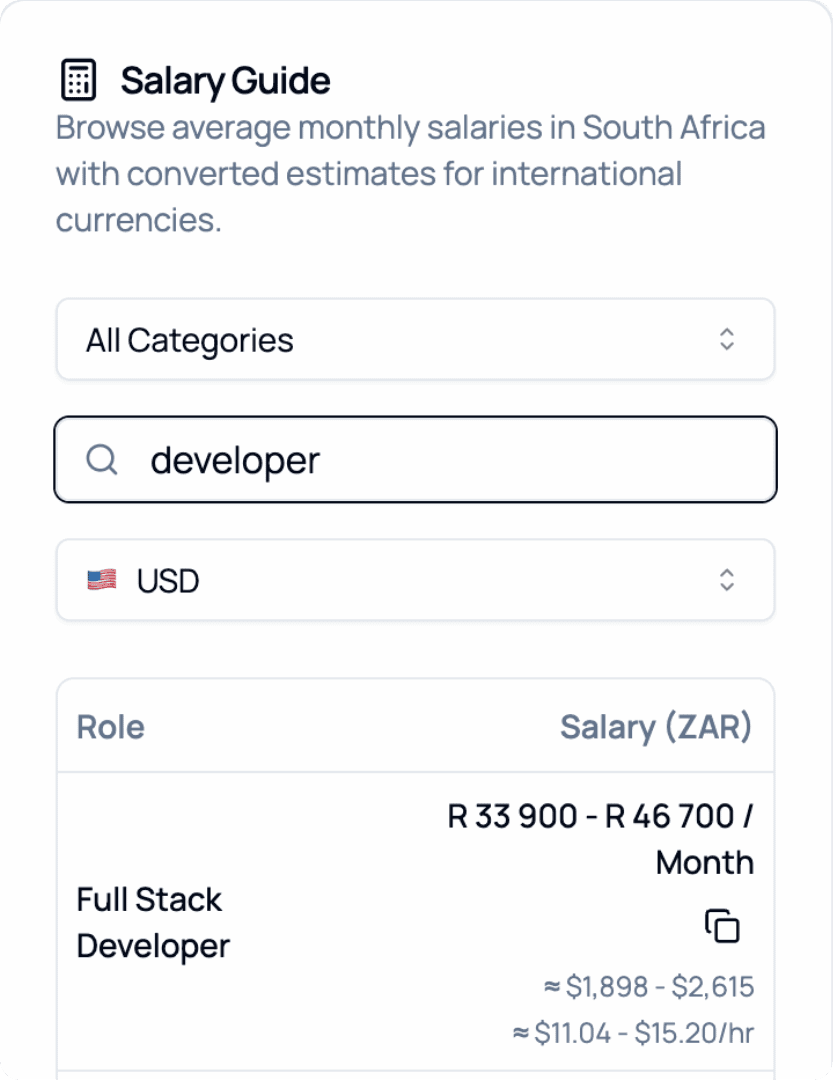
HireSava is a marketplace for hiring South African professionals directly: you post the role, interview and hire with no agency in the middle, and you choose the contractor or EOR route yourself. Employers remain responsible for payroll, HR, and compliance for the people they hire. The South African salary guide benchmarks pay by role and seniority, and the contractor vs employee checker runs a planned role through the section 200A factors and the SARS tests. If Egypt is also on your list, the Egypt vs South Africa comparison compares costs for virtual assistant roles.
When the country, route and role are settled, create an employer account and post the job. The pricing page lists the employer plans.
Sources and notes
This is general information for employers, not legal or tax advice. Rates and thresholds change, often every year, so confirm the route with a local labour lawyer, a tax adviser or the EOR before you sign. Sources were checked on 19 November 2026:
- EF English Proficiency Index, 2026 edition: ranks and scores for all five countries, from 2.3 million adults in 117 countries and regions who took EF's tests. The sample is not random.
- IANA Time Zone Database: standard offsets for Johannesburg, Nairobi, Lagos, Accra and Cairo.
- Zawya: Egypt's daylight saving rule under Law No. 24 of 2023. Secondary source, used because the law is published in Arabic in the official gazette.
- Clock changes: 15 U.S.C. 260a for US daylight saving time, GOV.UK for the UK date of March 28, 2027, and the NSW Government for April 4, 2027 in Sydney.
- Deel and Remote pricing pages: EOR and contractor management list prices.
- ILO Employment Relationship Recommendation, 2006 (No. 198), paragraph 13: indicators of an employment relationship.
- Labour Relations Act, section 200A (Acts Online) and RSM South Africa: the presumption and the R269,600.90 threshold from 1 May 2026. RSM is a secondary source, used because the gazette is published as a scanned image.
- SARS: UIF rate and the R17,712 monthly ceiling, and SDL rate and the R500,000 threshold.
- PwC Worldwide Tax Summaries: Kenya (reviewed 17 July 2026), Nigeria (reviewed 29 May 2026), Ghana (reviewed 27 October 2026) and Egypt (reviewed 17 August 2026). Secondary source, used because it states the current rates for all four countries in one format.
- KPMG Kenya: the NSSF limits of KES 9,000 and KES 108,000 from February 2026 under the NSSF Act, 2013. Secondary source.
- SSNIT: Ghana's 18.5% total contribution on basic salary under the National Pensions Act, 2008 (Act 766).
- PenCom: the pension contribution base of basic salary, housing and transport allowances under the Pension Reform Act, 2014.
- Mondaq: the Industrial Training Fund levy. Secondary source, a law firm article.
- Exchange rates: the Central Bank of Nigeria's page on foreign exchange structure; Daily News Egypt and Enterprise for the Central Bank of Egypt decision of 6 March 2024 and the rates that day. The Egypt sources are secondary.
- European Data Protection Board, Guidelines 05/2021, version 2.0 of 24 February 2023: the three transfer criteria and Example 8 on an employee who opens company data on a business trip abroad.
- European Commission: the list of adequacy decisions and the joint press statement on Kenya of 16 November 2026.
- ICO: the guide to international transfers.
- Regulators: the Information Regulator, Kenya's Office of the Data Protection Commissioner, the Nigeria Data Protection Commission and Ghana's Data Protection Commission. For Egypt, CMS on the executive regulations issued in 2025. CMS is a secondary source.
- Companies Act 71 of 2008, section 23: external company registration in South Africa, covered in the South Africa employer guide linked above.
- Immigration, Refugees and Citizenship Canada: police certificate pages for South Africa, Kenya, Nigeria, Ghana and Egypt. Kenya's certificate of good conduct name comes from Nation Africa, a secondary source.
The working hours in the second table are calculated from the standard offsets and the clock change dates above.
Frequently Asked Questions
Explore related hiring options
Useful next pages based on this article's topic:
- Virtual Assistant role overview — hiring and onboarding guidance
2026 Salary Guide: South Africa
Discover South African Salaries by Role. Compare costs and see how much you can save.