TL;DR
Learn when to hire ecommerce virtual assistant support based on margin pressure, order volume, and response-time bottlenecks.
Compare role design, pricing models, and KPI targets before buying ecommerce virtual assistant services.
Use a practical 30-day hiring and onboarding framework built for US ecommerce operators.
Table of Contents
- Introduction
- What does a virtual assistant for ecommerce store operations actually do each day?
- When should a US brand hire ecommerce virtual assistant support instead of adding local headcount?
- How much do ecommerce virtual assistant services cost in 2026, and what should US stores pay for?
- How do you hire and onboard ecommerce virtual assistants in the first 30 days without wasting time?
- Which KPIs prove your ecommerce va is profitable for a US store?
- Final Thoughts
Introduction
If your US store is growing, your bottleneck usually is not demand. It is execution. Orders come in, returns pile up, listings drift out of date, customer messages wait too long, and your best hours disappear into repetitive tasks. Most founders respond by working longer, then hitting a ceiling anyway.
That is where many operators decide to hire ecommerce virtual assistant support. Not as a generic admin fix, but as a margin decision. The right person can stabilize daily operations, protect customer experience, and free your core team to focus on pricing, merchandising, and growth channels.
The challenge is not whether to outsource. The challenge is buying the right scope, at the right cost, with measurable outcomes. Too many brands buy broad "help" and get vague results. This guide is built to avoid that mistake.
You will get a practical framework for selecting ecommerce virtual assistant services, defining role boundaries, onboarding quickly, and measuring ROI with hard numbers. You will also see how to evaluate a virtual assistant for ecommerce store operations when you run Shopify, Amazon, Walmart Marketplace, or a multi-channel stack.
If you are exploring options right now, start with HireSava's ecommerce talent page to benchmark available roles and capabilities.
What does a virtual assistant for ecommerce store operations actually do each day?
Short answer: a strong virtual assistant for ecommerce store operations owns recurring workflows that protect revenue every day, including order support, listing quality, inventory updates, returns handling, and routine reporting.
Most US ecommerce teams lose money in tiny operational gaps. A delayed stock update causes oversells. A weak product title lowers conversion. A slow response increases refund pressure. A forgotten promo code ticket creates churn. These are not strategy failures. They are process failures.
A good ecommerce va closes those gaps through structured execution. Day to day, that often includes:
- Product catalog maintenance: titles, bullets, images, variant mapping, and collection/category logic.
- Inventory and availability checks across channels, with escalation when reorder points are triggered.
- Customer support triage for shipping updates, exchanges, refunds, and product questions.
- Returns and RMA workflow handling, including status follow-ups and policy consistency.
- Promo and merchandising support: scheduling banners, checking discount logic, and QA before campaign launches.
- Performance snapshots for the operator: response time, unresolved tickets, top refund reasons, and daily exceptions.
In practice, this means your leadership team stops doing task switching every 15 minutes. Your internal team can focus on high-leverage work while ecommerce virtual assistants handle structured execution.
For US sellers with increasing order complexity, this split is usually the difference between stable growth and chaos. The US Census tracks continued ecommerce activity and category shifts in its ecommerce retail data releases. As order volume rises, operational variance rises with it unless someone is accountable for the daily controls.
What this role should not own
A store management virtual assistant is not a replacement for your head of growth, your merchandising lead, or your media buyer. The role should not start with full ownership of paid acquisition strategy, pricing architecture, or major platform migrations.
Instead, assign bounded functions with clear SOPs. Example:
- Own first-response support within business hours.
- Own catalog QA every Monday, Wednesday, and Friday.
- Own return-tag aging report and escalation process.
- Own weekly top-20 SKU content refresh queue.
When scope is bounded, execution quality climbs fast.
Where this creates immediate financial impact
The first 60-90 days typically affect these lines:
- Reduced refund leakage from faster response and cleaner policy handling.
- Better conversion support from improved listing consistency.
- Lower founder time spent on low-complexity operations.
- Fewer costly errors in campaign setup and stock visibility.
If your goal is to scale without adding full local overhead, this is why brands prioritize virtual assistant ecommerce operations before expanding domestic headcount.
For related playbooks, see HireSava's guide to hiring remote talent without recruiting fees and virtual assistant onboarding checklist.
When should a US brand hire ecommerce virtual assistant support instead of adding local headcount?
Short answer: hire when repetitive operations are slowing growth and you can document outcomes with SOPs and KPIs; add local headcount when the role requires constant cross-functional decision-making or on-site dependencies.
Many founders ask this too late. They wait until service levels fall, reviews dip, and team burnout is obvious. A cleaner decision model uses trigger points.
You should strongly consider hire ecommerce virtual assistant support when at least three of these are true:
- Ticket backlog regularly exceeds 24 hours.
- Listing updates lag campaign plans.
- Founders still handle routine support daily.
- Operations errors are driving avoidable refunds.
- You cannot ship reporting consistently each week.
- Order volume has increased but operating rhythm has not matured.
The role works best when your processes are good enough to document. You do not need perfect SOPs, but you need repeatable workflows. If everything is ambiguous, any hire will struggle.
A practical decision matrix
Use this simple test before buying ecommerce virtual assistant services:
- Is the task repeatable at least 3 times per week?
- Can the task be measured by time, accuracy, or completion rate?
- Can your team provide a decision rule for common edge cases?
If the answer is yes to all three, that function is ready for delegation to an ecommerce va.
If the answer is no, either keep it in-house temporarily or define the process first.
Common US use cases where VAs outperform delayed hiring
- Brands between $30K and $300K monthly revenue that need stable execution before adding management layers.
- Founder-led stores with heavy channel switching across Shopify, Amazon, and email platforms.
- Teams with expensive local talent doing low-leverage admin work.
- Seasonal businesses that need flexible capacity without fixed full-time overhead.
For many operators, the right model is hybrid: keep strategic leadership in-house, delegate operational throughput to ecommerce virtual assistants.
Why geography and language fit still matter
For customer-facing tasks in US ecommerce, communication quality is non-negotiable. Tone, clarity, and speed shape retention and reviews. That is one reason many brands evaluate South African remote talent for US teams, where English fluency and business communication standards are strong.
If you are still comparing models, HireSava's small business VA hiring guide can help you decide role design before you commit budget.
How much do ecommerce virtual assistant services cost in 2026, and what should US stores pay for?
Short answer: pricing varies by scope and seniority, but the best buying decision is outcome-based; pay for measurable throughput, accuracy, and customer response quality, not just low hourly rates.
Cost is where many teams underbuy and then blame remote hiring. They purchase the cheapest package, skip onboarding, and expect high-judgment execution from day one. That is not a pricing problem. It is a role-design problem.
When evaluating ecommerce virtual assistant services, break cost into three layers:
- Core execution hours: catalog, support, order ops, and returns workflows.
- Management overhead: who reviews quality and resolves exceptions.
- Ramp period: training time until stable independent output.
A strong store management virtual assistant should create savings through fewer errors and faster cycle times, not only through wage arbitrage.
Pricing models you will see
- Hourly support with tracked task logs.
- Part-time monthly retainer for fixed workflow ownership.
- Full-time embedded VA with cross-functional execution blocks.
- Hybrid package with extra coverage during sales events.
The right model depends on order volatility. If your weekly volume swings heavily, flexible blocks can be better than rigid retainers.
What US operators should ask before signing
- What exact workflows are in scope and out of scope?
- What response-time SLA is realistic for support channels?
- How is QA handled for listings and policy-sensitive replies?
- What happens when the VA hits an edge case?
- What weekly reporting is included?
If answers are vague, risk is high.
Build your budget around outcomes, not promises
Use expected impact ranges for planning:
- Support: faster first-response and reduced backlog.
- Catalog: cleaner listing quality and fewer merchandising mistakes.
- Returns: faster closure cycle and fewer policy errors.
- Founder time: reclaimed hours for pricing, sourcing, and growth.
You can estimate this with HireSava's virtual assistant cost calculator guide. Pair cost with value targets from day one.
External benchmarks to keep your expectations realistic
Two benchmarks matter for ecommerce operations planning:
- Cart abandonment remains a major leakage area. Baymard regularly tracks trends in its cart abandonment research, which reinforces how much execution detail matters in checkout and support.
- Customer expectations for fast, reliable fulfillment remain high. Shopify Enterprise highlights fulfillment and service realities in its ecommerce fulfillment resources.
Your VA will not fix your entire funnel, but a well-scoped virtual assistant ecommerce role can reduce avoidable operational leakage that depresses conversion and retention.
How do you hire and onboard ecommerce virtual assistants in the first 30 days without wasting time?
Short answer: define success metrics before recruiting, run a task-based hiring process, then onboard with SOPs, QA checkpoints, and escalation rules in week one.
Most hiring failures happen before the hire starts. Teams write generic job descriptions, evaluate personality over execution, and skip process documentation. You can avoid this with a structured 30-day plan.
Days 1-3: define role scorecard and tools
Before interviews, create a one-page scorecard:
- Primary workflows the role owns.
- SLA targets (for example, first response under X hours).
- Quality standards for product content and policy compliance.
- Reporting cadence and owner.
List required tools explicitly: Shopify, Amazon Seller Central, Gorgias or Zendesk, Notion or Google Docs, and communication tools.
Days 4-10: run task-based hiring
Do not rely on resumes alone. Give candidates short, realistic exercises:
- Rewrite a low-performing product description.
- Triage a mock support inbox by priority.
- Resolve a sample return request with policy rules.
- Build a simple daily exception report.
This exposes quality, judgment, and communication speed.
When candidates pass, move quickly. Delays lose top talent.
Days 11-20: operational onboarding
A high-performing ecommerce va should receive:
- SOP library with screenshots and decision trees.
- Policy cheat sheet for refunds, exchanges, and shipping claims.
- Brand voice examples for customer responses.
- Escalation map: what to solve independently vs. escalate immediately.
Use short daily check-ins during week one, then shift to twice-weekly reviews.
Days 21-30: stabilize and optimize
By this stage, the VA should own recurring workflows with minimal supervision. Your job is to improve the system:
- Remove unclear steps causing repeated questions.
- Add templates for common tickets.
- Create QA tags for top recurring errors.
- Tighten KPI dashboard so performance is visible.
If you need a baseline process, HireSava's virtual assistant onboarding checklist is a strong operational template.
Interview prompts that reveal true capability
Use direct scenario questions:
- "A top SKU goes out of stock during a paid campaign. What do you do first?"
- "A customer requests a refund outside policy after two prior exceptions. How would you reply?"
- "The product page conversion drops this week. Which checks do you run first?"
Candidates who can prioritize, communicate clearly, and escalate correctly are usually the best long-term ecommerce virtual assistants.
Practical hiring channels and quality controls
When you source candidates, prioritize platforms and partners that specialize in ecommerce support instead of generic admin pools. Role-context fit matters more than raw availability.
If you are deciding where to source, start with HireSava's ecommerce roles and profiles and compare with broader market options from the US Bureau of Labor Statistics occupational data to calibrate expectations around task complexity and skill development.
Which KPIs prove your ecommerce va is profitable for a US store?
Short answer: track metrics that connect daily execution to revenue protection and margin stability, including response speed, backlog reduction, listing quality, return-cycle efficiency, and owner time recovered.
Without KPI discipline, every staffing decision feels subjective. With KPI discipline, you can prove whether your store management virtual assistant is paying for itself.
Use a balanced KPI stack across service quality, operational throughput, and business impact.
Service quality KPIs
- First response time (FRT): median and 90th percentile.
- Resolution time by ticket category.
- Customer satisfaction trend (if your stack captures CSAT).
- Reopen rate for resolved tickets.
These metrics show whether support quality is actually improving.
Operational throughput KPIs
- Listing update turnaround time.
- Catalog error rate (broken variants, wrong imagery, missing attributes).
- Return processing cycle time.
- Daily exceptions closed vs. opened.
These metrics show whether your virtual assistant for ecommerce store workflows are stable and predictable.
Business impact KPIs
- Refund rate trend by reason.
- Repeat-purchase indicator or retention proxy.
- Promo execution accuracy before campaign launch.
- Founder/operator hours reclaimed per week.
Not every store has perfect attribution, but directional improvement across these metrics is enough to validate ROI.
A simple monthly scorecard format
Use one page with:
- KPI target.
- Actual result.
- Gap analysis.
- Action for next month.
- Owner and due date.
Keep it boring and consistent. Most teams fail because they overcomplicate reporting.
KPI review cadence that works
- Weekly: execution metrics and exceptions.
- Monthly: trend analysis and role scope adjustment.
- Quarterly: cost-to-value review and capacity planning.
This cadence makes it easy to decide whether to expand responsibilities, add additional ecommerce virtual assistant services, or redesign workflows.
Why this matters more in 2026
US ecommerce competition is compressing margins. Operational mistakes that looked small in 2023 now compound fast. Better process ownership is not optional.
McKinsey continues to emphasize operational and customer-experience performance as differentiators in digital commerce in its consumer and retail insights. Your VA program should be built with that reality in mind: reliable execution, measurable improvement, and fast iteration.
If you are planning headcount decisions this quarter, compare your current baseline first, then decide whether to expand a single ecommerce va into broader virtual assistant ecommerce coverage.
Final Thoughts
Choosing to hire ecommerce virtual assistant support is not about cutting corners. It is about putting the right work in the right seat.
For US operators, the highest-return approach is practical:
- Delegate repeatable operations with clear SOPs.
- Buy ecommerce virtual assistant services with measurable outcomes.
- Onboard with real workflows, not generic orientation.
- Track KPI performance monthly and adjust scope decisively.
When done correctly, a virtual assistant for ecommerce store operations can protect margins, improve customer experience, and give your core team the time to drive growth.
If you are ready to move, start by defining your top three operational bottlenecks, then review role options on HireSava's Ecommerce industry page. For broader staffing strategy, compare your plan with HireSava's best countries for remote talent guide and refine cost targets using the VA cost calculator framework.
Explore related hiring options
Useful next pages based on this article's topic:
- Remote Ecommerce Specialist role — store operations and channel performance
- Inventory Management & Forecasting service — stock planning and margin protection
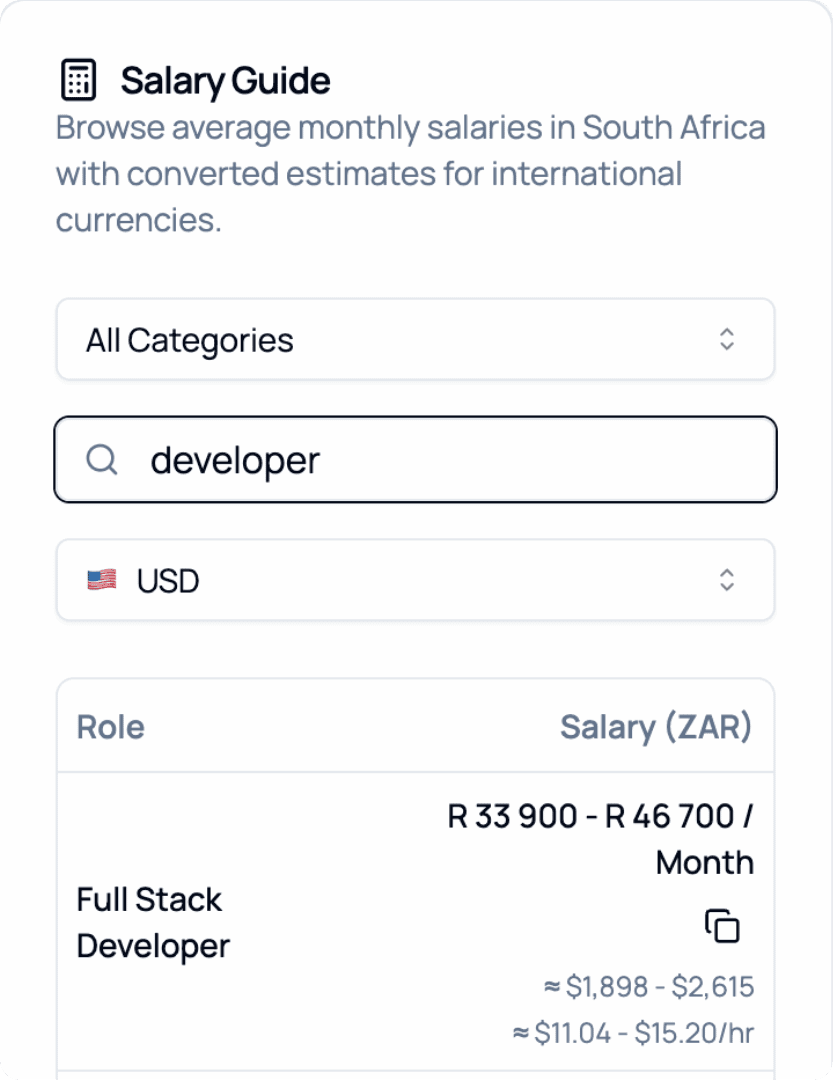
2026 Salary Guide: South Africa
Discover South African Salaries by Role. Compare costs and see how much you can save.