TL;DR
Shift the focus from "administrative task" to "profit recovery" by using South African VAs as financial gatekeepers.
Recover 2-5% of top-line revenue annually lost to carrier errors and commission "leakage".
Leverage South African financial literacy for sophisticated "Revenue Integrity Management" beyond simple data entry.
Free up domestic staff from manual commission tracking to focus on high-value client relationships.
Table of Contents
The insurance industry is entering the 2026-2027 operational cycle at a critical juncture. While a "hard market" has driven premiums and potential revenue upward, the operational machinery required to service this growth is grinding to a halt. For the average independent agency owner, the "Great Resignation" has morphed into the "Great Burnout," where highly skilled producers and account managers are drowning in a mire of administrative "nightmares".
We’ve analyzed the data so you don’t have to. A deep dive into primary industry sentiment across specialized insurance communities reveals a workforce in crisis, defined by friction, legacy debt, and manual labor. You likely feel this every day, the constant "cacophony" of commission reconciliation and the "hidden factory" of non-revenue work that consumes up to 80 hours of your staff’s time every month.
We've all been there, staring at a scattered Excel sheet, wondering why a high-value account manager is acting as a data entry clerk. The traditional solutions, like domestic hiring or commodity Business Process Outsourcing (BPO) in the Philippines or India, are no longer enough. Domestic hiring is cost-prohibitive, while traditional BPOs often lack the ownership mindset required for judgment-heavy insurance workflows.
This guide provides an exhaustive roadmap for decoupling these tasks from your domestic team and migrating them to specialized South African Virtual Assistants. By the time you finish this article, you will understand how to transform your agency from a state of defensive administration to offensive growth.
Why is insurance commission reconciliation so difficult for modern agencies?
Insurance commission reconciliation is difficult because of a lack of standardization across carriers, leading to a "cacophony" of formats like PDFs, CSVs, and paper checks. Agencies often manage 20 to 50 carriers, each with different reporting methods, forcing highly paid staff to manually normalize data into Agency Management Systems (AMS).
Carrier Format Fragmentation: The CSV, PDF, and Portal Headache
The core of the administrative struggle is format anarchy. In 2025, sophisticated commission structures are still tracked in "scattered Excel sheets" because data does not flow; it must be pushed.
- Carrier A might send a clean CSV file ready for import.
- Carrier B sends a locked PDF that requires manual typing.
- Carrier C forces your team to log into a proprietary portal just to download a report.
- Carrier D still sends a paper check with a scanned statement attached.
This "data deluge" creates a manual workaround process that defies traditional automation.
Identifying the 2-5% Variance in Direct Bill Statements
While agency billing is relatively straightforward, Direct Bill commissions are a "tracking nightmare". Because agencies have no control over the data flow, they must wait for the carrier to remit payment.
Because the process is so "laborious, error-prone, and unpleasant," many agencies default to a "good enough" approach, simply depositing the check and assuming the carrier is correct. However, industry estimates suggest agencies lose 2% to 5% of their top-line revenue due to carrier errors, missed payments, and incorrect commission tiers. On a $5M revenue agency, that is $100,000 to $250,000 in pure profit lost annually.
South Africa: The Strategic Pivot for Insurance Industry in 2026
The convergence of the domestic talent crisis and the failure of traditional "commodity" outsourcing has elevated South Africa as the premier strategic hub for insurance operations. This is not merely a shift in geography; it is a shift in asset class. We’ve analyzed the shift so you don’t have to: South African talent is increasingly viewed as "arbitrage talent", highly skilled professionals available at a lower cost due to currency differences, not a lack of capability.
Why is South Africa better than the Philippines for insurance VAs?
South Africa is superior for insurance VAs because it offers a native English-speaking workforce with deep Western cultural alignment and specialized financial/legal literacy. Unlike traditional "Doer" models in the Philippines, South African VAs operate as "Owners," capable of managing complex, judgment-heavy insurance workflows like commission reconciliation and compliance with minimal supervision.
1. Structural Surplus of Financial and Legal Talent
South Africa produces a structural surplus of graduates in fields directly relevant to your agency’s survival: commerce, accounting, and law.
- Financial Literacy: The country has a robust banking sector, but high local unemployment means degree-holding accountants and bookkeepers are available for remote work. This literacy is the "missing link" for tasks like complex commission reconciliation.
- Legal Precision: An abundance of paralegals and law graduates provides a workforce capable of navigating the regulatory landscape of US insurance (e.g., surplus lines affidavits) with a level of reading comprehension rare in other markets.
2. The Cultural and Linguistic Bridge
In an industry built on trust and precise terminology, nuances matter. South Africa is a native English-speaking nation (ranked #12 globally in proficiency) with a business culture modeled on UK/US systems.
- The "Neutral" Advantage: The South African accent is widely perceived as "neutral" and professional by US clients.
- Professional Peer Orientation: Unlike the "Service" orientation of traditional BPOs, South African VAs act as "Professional Peers". They understand concepts like "fiduciary duty" and "professional liability" natively, which dramatically reduces your onboarding time.
3. Time Zone Arbitrage: The "Overnight" Productivity Engine
Operating at GMT+2, South Africa is 6-7 hours ahead of the US East Coast. This creates a follow the sun capability that feels like miraculous efficiency for your domestic team.
- Your VA works their normal day while the US is sleeping.
- Tasks like quote preparation, data entry, and email triage are completed before your domestic staff logs in at 8 AM.
Bottleneck #1: Commission Reconciliation
Commission reconciliation is the "third rail" of agency operations, dangerous to touch, but fatal to ignore. In 2026, it represents the single largest source of revenue leakage and administrative despair.
How much revenue do insurance agencies lose to commission errors?
Independent insurance agencies lose an estimated 2% to 5% of their top-line revenue annually due to carrier errors, missed payments, and incorrect commission tiers. For an agency with $5M in revenue, this translates to $100,000 to $250,000 in pure profit lost because the reconciliation process is too laborious to perform manually.
The "Cacophony" of Revenue Data
The core of the struggle is a lack of standardization. The average agency works with 20 to 50 carriers, each with a different reporting method:
- Direct Bill vs. Agency Bill: Direct Bill is a "tracking nightmare" because the agency has no control over the data flow.
- Format Anarchy: You are likely receiving a "cacophony" of CSVs, locked PDFs, and paper checks that force your most expensive staff to act as data entry clerks.
The South African Solution: From "Data Entry" to "Variance Analysis"
This bottleneck is uniquely suited for the South African talent pool. By deploying a VA with an accounting background, your agency transitions to Revenue Integrity Management.
| Metric | Manual Local Process | South African VA Process |
|---|---|---|
| Cost | High ($30-$50/hr domestic staff) | Low ($10-$18/hr specialized VA) |
| Accuracy | "Spot Check" (Low) | Line-by-Line Reconciliation (High) |
| Recovery | Passive (Accept Carrier Errors) | Active (Dispute & Recover) |
| Time Impact | 40-80 Hours/Month Drain | Zero Domestic Hours Used |
The "Owner" Workflow:
- Normalization: The VA aggregates disparate formats into a single "Master Reconciliation File"
- Line-by-Line Matching: They compare carrier statements against your AMS (e.g., Applied Epic, HawkSoft) expected commission
- Active Dispute Resolution: If a carrier paid 12% instead of 15%, the VA, using native English fluency, drafts the dispute to the carrier’s accounting department to recover the variance
Bottleneck #2: Surplus Lines & Licensing
If commission reconciliation is a "nightmare" for your bottom line, managing Surplus Lines affidavits and multi-state licensing is a threat to your very existence. As you expand your agency across state lines to chase harder-to-place risks, the administrative weight doesn't just grow; it compounds.
What makes Surplus Lines filing such a major administrative bottleneck?
Surplus Lines filing is a bottleneck due to fragmented state-specific regulations, mandatory affidavit submissions, and strict tax reporting deadlines. Missing a single filing can lead to license revocation or heavy fines, forcing agency owners to dedicate high-level staff to tedious, repetitive paperwork that requires 100% legal accuracy and zero margin for error.
Navigating the State-Specific Minefield
Every state has its own "flavor" of bureaucracy. From Florida’s FSLSO to the specific stamping office requirements in California, your team is likely drowning in a constant cycle of NIPR compliance and state-specific affidavit filings.
We’ve all been there, your top producer lands a massive multi-state account, and instead of celebrating, your account manager spends the next three days manually entering data into state portals. This is the "Hidden Factory" of insurance; it’s work that must be done but generates zero commission.
The South African Paralegal Advantage
This is where the South African VA provides a distinct competitive edge. Because South Africa has a surplus of law graduates and paralegals, you aren't just hiring a "virtual assistant"; you are hiring a Regulatory Specialist.
- Credentialing & Renewals: A South African VA can manage your agency's entire licensing lifecycle via NIPR, ensuring no producer's license ever lapses.
- Affidavit Accuracy: They possess the linguistic and legal "chemically pure" talent to read complex state statutes and ensure that surplus lines tax filings are submitted correctly the first time.
- Audit Readiness: By maintaining a "Master Compliance Calendar," they move your agency from reactive panic to proactive stability.
Bottleneck #3: COI Tracking & Renewals
Issuing a Certificate of Insurance (COI) seems like a simple task, until it isn't. In high-stakes industries like trucking, construction, or healthcare, a single typo on a COI can trigger a catastrophic Errors & Omissions (E&O) claim.
How can Certificate of Insurance (COI) tracking become a liability for your agency?
COI tracking becomes a liability when manual entry leads to expiration dates being missed or incorrect coverage limits being recorded. This creates massive Professional Liability (E&O) exposure, as agencies may unintentionally confirm coverage for a client whose policy has lapsed, resulting in uncovered claims and potential lawsuits that can bankrupt an independent agency.
The Friction of Manual Data Entry
The "Great Burnout" in agencies is often fueled by the relentless "cacophony" of COI requests.
- The Problem: Your domestic staff is too expensive to spend 20 hours a week typing data from one screen to another.
- The Risk: Fatigue leads to errors. A missed "Waiver of Subrogation" or an incorrectly noted "Additional Insured" is a ticking time bomb.
- The Cost: Industry data suggests that operational friction in manual data entry is the leading cause of internal E&O incidents.
High-Velocity COI Management
By integrating HireSava specialized insurance VAs into your workflow, you create a dedicated "Liability Shield." Because South African VAs work in a time zone 6-7 hours ahead of the US, they can process all COI requests received overnight before your clients even start their workday.
The "Standard of Care" Workflow:
- Incoming Request Triage: The VA monitors the service inbox 24/7.
- Verification: They verify coverage limits against the AMS (Applied Epic, Vertafore, etc.) to ensure the policy is active and compliant with FMCSA or state-specific standards.
- Issuance: The COI is drafted and queued for a final "spot check" or issued automatically based on your agency’s SOPs.
- Renewal Tracking: The VA proactively reaches out to clients 60 days before expiration to gather updated information, preventing the "last-minute fire drill."
Conclusion
We’ve analyzed the data so you don’t have to. The choice is no longer between hiring locally or "offshoring" to a low-quality BPO. The strategic move for 2026 is Specialized Talent Arbitrage.
By decoupling these three core bottlenecks, Commission Reconciliation, Regulatory Filings, and COI Management, you free your domestic team to do what they do best: build relationships and close deals. You transition your staff from "Account Clerks" back to "Account Managers."
Don't let your agency be held back by the manual work that a highly-educated, culturally-aligned South African insurance virtual assistant can do for a fraction of the cost. By the time you finish implementing these steps, you won’t just have a more profitable agency, you’ll have your time back.
Explore related hiring options
Useful next pages based on this article's topic:
- Remote Policy Admin Specialist role — policy workflows, endorsements, and renewals
- Claims Processing service — faster claims handling and reduced admin drag
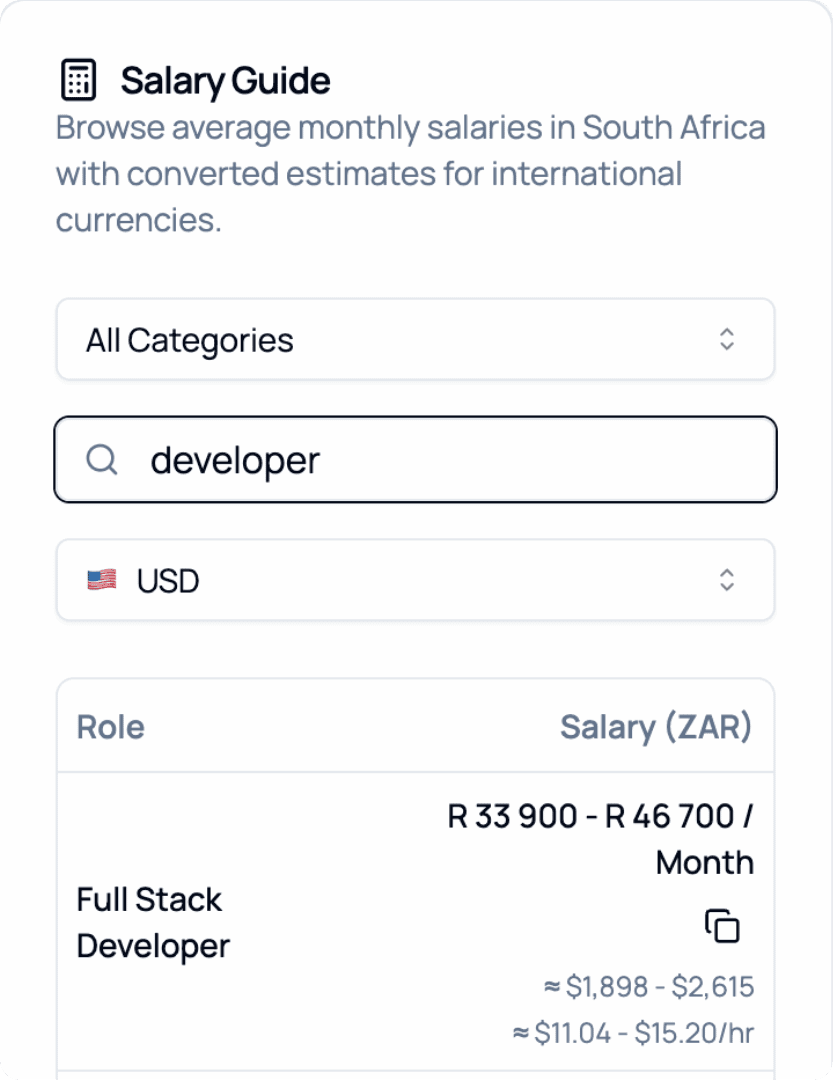
2026 Salary Guide: South Africa
Discover South African Salaries by Role. Compare costs and see how much you can save.