TL;DR
Speed up commercial quotes by automating loss run retrieval with an insurance VA.
Overcome incumbent agent "stall tactics" with proactive, polite persistence.
Leverage South African talent for neutral-accent carrier communication.
Table of Contents
New business is the lifeblood of any independent agency, but the path to a quote is often blocked by a data bottleneck. To win a commercial account, you need loss runs—verified claims history from the last three to five years. The problem? Incumbent agents and carriers often use stall tactics to keep that data out of your hands, slowing your sales velocity to a crawl.
Many agencies now use an insurance virtual assistant to manage this friction. By using a specialized insurance loss run retrieval service, you transform your agency from a defensive posture into an offensive growth machine. Instead of your high-value producers spending hours on hold with carrier service centers, a dedicated remote professional handles the "polite persistence" required to get the data you need to quote business before your competitors do.
This approach leverages South African talent to bridge the gap between a signed Letter of Authority (LOA) and a quote-ready submission packet. South African remote workers provide a strategic advantage because they combine high financial literacy with a neutral accent that commands professional respect from US-based carriers.
Why do loss run requests take so long to fulfill?
Loss run requests are often delayed because incumbent agents and carriers intentionally use "stall tactics"—such as ignoring faxes or claiming authorization forms are invalid—to prevent policyholders from shopping their coverage. These administrative hurdles are designed to create friction and protect the incumbent's book of business.
Navigating Incumbent Agent "Stall Tactics"
The insurance market is built on retention, and incumbent agents know that without loss runs, a new agent cannot provide an accurate quote. Common tactics include:
- Claiming they never received the request.
- Demanding "wet signatures" when digital ones are legally sufficient.
- Sending password-protected files without the password.
- Simply ignoring the request until the renewal date is too close for the client to switch.
A South African VA acts as a "Polite Persistence" engine, calling carriers daily to confirm receipt and verify that the request is moving through the system.
Understanding Carrier-Specific Submission Requirements
Every carrier has a different protocol for releasing claims data. Some require requests to be uploaded via a proprietary portal, while others still rely on faxed Letters of Authority (LOA). When you hire talent from South Africa, you get a process-oriented professional who documents these carrier-specific quirks. They maintain a database of exactly how "Carrier A" vs. "Carrier B" prefers to receive documents, ensuring the request is done right the first time and avoiding the "Doer Trap" of waiting for instructions.
How can an insurance VA speed up the quoting process for new business?
An insurance VA speeds up quoting by taking over the labor-intensive tasks of requesting loss runs, managing carrier follow-ups, and organizing raw data. This allows producers to focus on closing deals while the VA ensures a complete, quote-ready submission packet is prepared in record time.
Managing the Letter of Authority (LOA) Workflow
An LOA is just a piece of paper until someone tracks it. A VA manages the entire lifecycle of the document—from ensuring the client signs it correctly to confirming the carrier actually received it. This is a critical part of speeding up insurance quoting.
When you hire south african remote workers, you benefit from a workforce that understands the urgency of the sales cycle. They don't just send an email and hope for the best; they call the carrier to confirm the LOA is in the right hands. This proactive Letter of Authority (LOA) management ensures that files don't sit in a general inbox for weeks.
Instant Data Extraction: From Raw PDF to Quote-Ready Format
Getting the loss runs is only half the battle. Carriers often send back messy, multi-page PDFs that are difficult to parse. A specialized insurance loss run retrieval service includes the heavy lifting of data entry.
Your VA will take those raw PDFs and distill them into a clean insurance loss recap summary. Instead of a producer squinting at a blurry scan from 2021, they get a structured spreadsheet. This organized data helps the underwriter make a faster decision, which is exactly how you win on speed. According to industry discussions on how to build a P&C book, administrative efficiency is often the difference between a top producer and one who is struggling to stay afloat.
What should be included in a professional insurance loss recap summary?
A professional insurance loss recap summary should be a clean, structured distillation of 3-5 years of claims history, including total incurred losses, open reserves, and a breakdown of claim frequency versus severity. It transforms messy carrier PDFs into a quote-ready format that underwriters can analyze instantly to determine risk.
Visualizing Trends for Underwriter Approval
Underwriters are currently operating in a "hard market" where they are increasingly selective about the risks they accept. A South African VA doesn't just deliver a data dump; they provide a "Loss Recap" that highlights trends. By identifying whether claims are decreasing over time or spiked due to a single "shock loss," the VA helps the producer tell a better story to the carrier. This level of Letter of Authority (LOA) management and data preparation can significantly reduce the back-and-forth that typically stalls a submission.
Categorizing Large Losses vs. Frequency Issues
An insurance loss recap summary must distinguish between a single catastrophic event and a "frequency" problem where dozens of small claims suggest poor management.
- Large Losses: High-dollar amounts from a single incident (e.g., a major fire).
- Frequency: Numerous small claims that often signal underlying operational risks.
- Open Reserves: Estimated future costs for claims that haven't been finalized yet.
How do you handle incumbent agents who stall on loss run requests?
Handling stalling incumbent agents requires a "Polite Persistence" model—a scheduled cadence of phone calls and emails to confirm the carrier received the LOA and is processing it. By using professional, articulate South African talent, you ensure that these requests are treated as a priority rather than ignored as administrative background noise.
The "Polite Persistence" Model of Follow-Ups
When you hire remote workers from South Africa, you are hiring "Owners" who manage the outcome (getting the data) rather than just the task (sending the email). Their approach is structured:
- Day 1: Send the LOA via email, fax, and carrier portal.
- Day 3: A "neutral" accent phone call to verify receipt and identify the specific clerk handling the file.
- Day 5: Follow-up call to confirm the release date, escalating to a supervisor if the request is being intentionally delayed.
Escalation Paths for Non-Compliant Data Requests
If a carrier or agent continues to stall, your VA knows how to escalate effectively. This might include drafting a formal letter citing state-specific regulations or coordinating with the client to have them call the carrier directly while the VA stays on the line. This assertive insurance loss run retrieval service prevents your new business pipeline from drying up because of a competitor’s "gatekeeping".
The SA Advantage: Why a Neutral Accent Matters
In the insurance world, phone requests are often the only way to break a deadlock. South African talent offers a professional, neutral accent that is highly regarded by US carrier personnel. Unlike traditional BPO hubs where heavy accents might lead to misunderstandings or "hang-ups," South African VAs command professional respect. This ensures your data requests are treated with the professionalism and priority needed to keep your sales moving.
As your agency looks to scale, remember that winning on speed is often about removing the administrative friction that holds your producers back. By using an insurance virtual assistant to manage your loss run retrieval, you ensure that your agency is always the first to the table with a quote.
Final Thoughts
Winning new business in a hard market comes down to who gets the quote to the client first. If your producers are stuck waiting on loss runs, you’re losing revenue to more agile competitors. Bringing on an insurance virtual assistant to handle the friction of data retrieval transforms your sales process from reactive to proactive. By leveraging the professional, neutral communication style of South African talent, your agency can bypass stall tactics and keep your submission pipeline moving. It isn't just about saving time; it's about building a scalable engine that outpaces the competition. As noted in industry guides on getting appointed with carriers, having a streamlined operational workflow is the foundation for long-term growth.
Explore related hiring options
Useful next pages based on this article's topic:
- Remote Policy Admin Specialist role — policy workflows, endorsements, and renewals
- Claims Processing service — faster claims handling and reduced admin drag
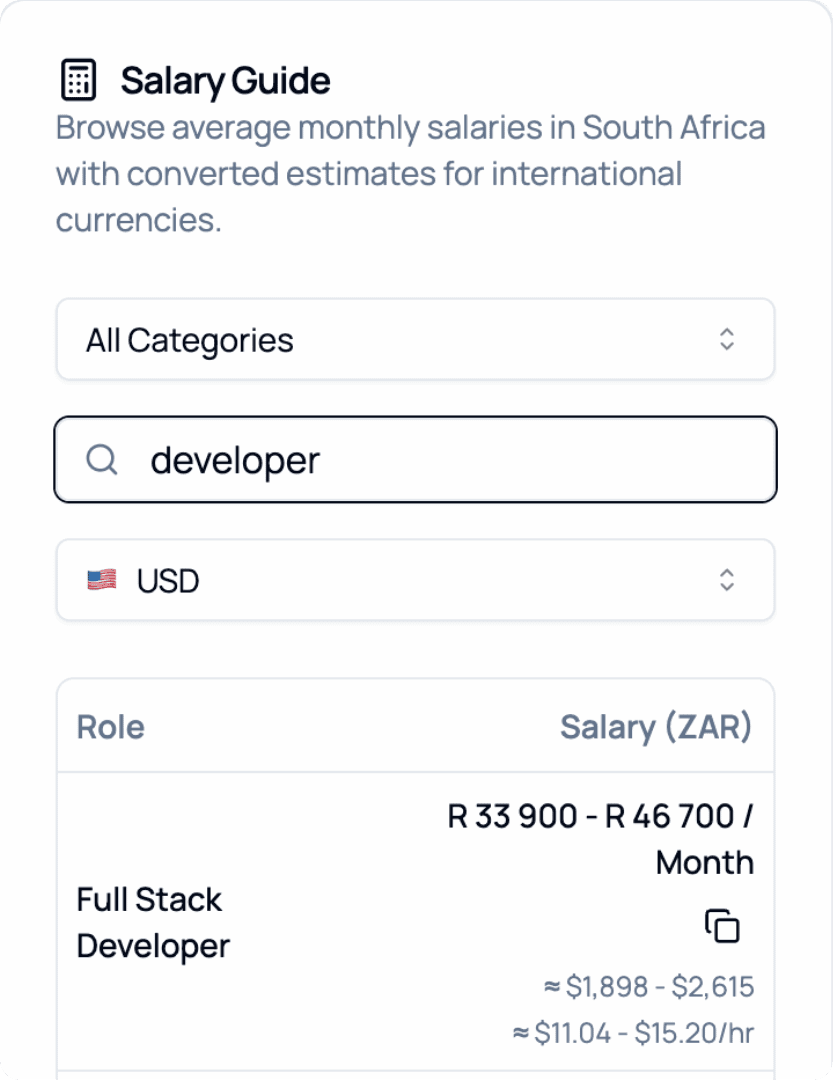
2026 Salary Guide: South Africa
Discover South African Salaries by Role. Compare costs and see how much you can save.